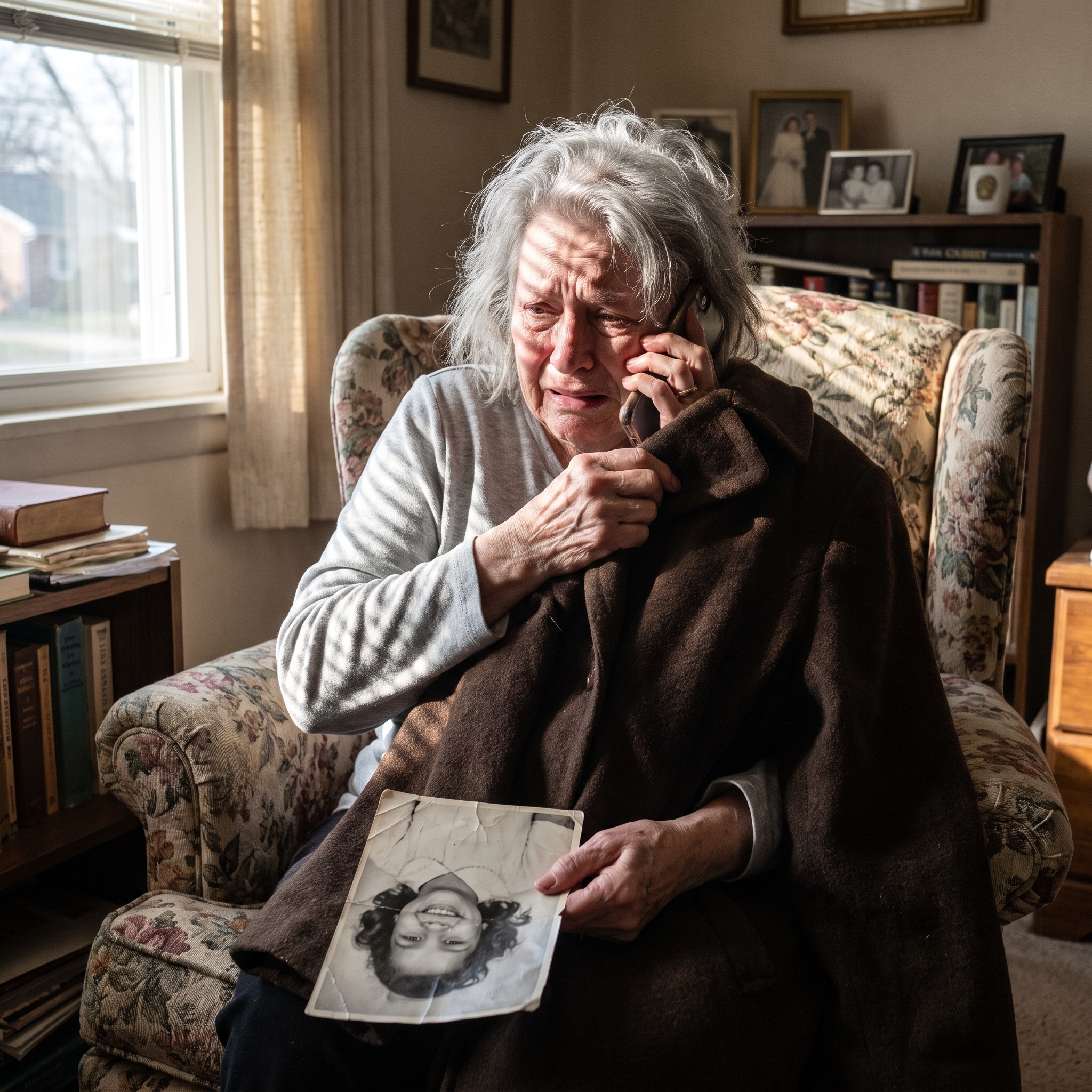
I still talk to his clothes. Does that sound crazy? Maybe. But six months after my Harold passed away, I would stand in our closet and press my face into that old brown wool coat. It still smelled like him—Old Spice, a trace of pipe tobacco, and something warm I can’t name. The sleeves were worn at the elbows, the lining frayed, but it was the most precious thing I owned. For half a year, I couldn’t part with a single thread.
People told me I needed to move on. My daughter Sarah gently suggested I donate some things. ‘Dad would want his things to be useful, Mom,’ she said. And I knew she was right. So one rainy Tuesday, I gathered all his shirts, his trousers, his sweaters, and that coat. I folded them carefully, kissed the collar, and placed them in a donation bag. It felt like I was burying him all over again.
Three weeks passed. I tried to keep busy—volunteering at the library, tending my roses. Then my phone rang. A number I didn’t recognize. I almost let it go to voicemail, but something made me answer.
A man’s voice, gentle and hesitant. ‘Ma’am, is this Evelyn Morrison?’
‘Yes, this is she.’
‘My name is Frank Thompson. I’m so sorry to call out of nowhere. I got your number from the donation center here in Dayton. I… I purchased a bag of men’s clothing, and I need to tell you about a coat.’
My knees buckled. I sank into the kitchen chair. ‘A coat? What kind of coat?’
‘A brown wool coat. Very well-worn. Looked like it had been loved a long time.’
That was Harold’s coat. ‘Yes,’ I whispered. ‘That was my husband’s.’
Frank paused. When he spoke again, his voice was thicker. ‘Ma’am, I found something in the pocket. Something I think you need to see. I don’t want to describe it over the phone. Could we meet? I promise I’m not some oddball. I just feel this is too important.’
My mind raced. What could Harold have left in a coat pocket? A receipt? An old note? A forgotten piece of paper? But why would this stranger be so shaken? I agreed to meet him the next morning at a coffee shop on Main Street.
I didn’t sleep that night. I kept thinking about that damn coat. The one he wore to every family dinner, every church service, every walk we took around the park.
He had it on the day we met, at a fall festival, when he was a shy young man with kind eyes. I remembered the feel of the wool when I rested my head on his shoulder during a cold football game. Twenty-five years of memories stitched into that fabric.
At the coffee shop, Frank was already waiting. He was maybe sixty, with a kind face and a receding hairline. He stood when I approached. ‘Mrs. Morrison? I’m Frank.’ He held a paper bag. ‘I brought the coat. I couldn’t keep it, not after finding what was inside.’
I sat down, my hands trembling. Frank placed the bag on the table and gently pulled out the brown wool coat. Seeing it again felt like a punch to the chest. He then reached into his jacket and produced a small white envelope. ‘This was inside the pocket,’ he said. ‘I didn’t mean to snoop. I was just checking for loose change and I felt something stiff behind the lining. I reached in and found this.’
He slid the envelope across the table. My name was not on it. Just blank. My fingers were numb as I opened it. Inside was a single photograph, old and faded, with a crease down the middle. A little girl, maybe five or six years old, with dark curly hair and Harold’s unmistakable eyes—that deep, thoughtful gaze I had loved for forty years.
I couldn’t make sense of it. ‘Who…’ I started, but my voice cracked. I turned the photo over. In Harold’s neat handwriting, a message: ‘To my precious Lily, I’m sorry I couldn’t be the father you deserved. You are always in my heart. – Dad.’
The world tilted. I remember hearing my own sob, a raw sound that seemed to come from somewhere else. Frank reached across the table, his face full of pity. ‘I’m so sorry,’ he said. ‘I didn’t know what else to do. I thought you should have it.’
I couldn’t speak. I just held that photo, staring at the child who had my husband’s eyes, and his secret fatherly love scrawled on the back. How long had he carried this? All those years, walking beside me, kissing me goodnight, while a daughter I never knew existed lived somewhere beyond us.
After what felt like hours, I managed to thank Frank. I insisted he keep the coat—no, I needed him to keep it. I couldn’t bear to have it near me anymore. He reluctantly accepted and walked me to my car, his hand gently on my elbow. ‘If you ever need anything,’ he said, ‘please call.’ I nodded, though I knew I wouldn’t.
The drive home is a blur. I pulled into the driveway and sat in the car, clutching that envelope. Rage bubbled up—how dare he keep this from me? Betrayal, grief, confusion swirled until I felt sick. But underneath it all, a deep, aching curiosity. Who was Lily? Where was she? Had Harold been seeing her, supporting her, all along?
I went straight to his study. For forty years, that room was his sanctuary, and I had rarely disturbed it. Now I tore through it like a detective. I opened drawers, flipped through files, emptied the closet. In the back of his filing cabinet, under a stack of old tax returns, I found a small, dusty shoebox tied with a brown ribbon.
My hands shook as I lifted the lid. Inside were letters—at least two dozen—all addressed to ‘Lily Harrison’ at an address in Chicago. None had stamps; they were never sent. Each envelope was sealed. I opened the most recent one, dated just two months before Harold passed away.
It began, ‘My dearest Lily, I think about you every morning when the sun rises. I know you’re all grown up now, but in my heart you’re still that little girl in the yellow dress, chasing butterflies at the park.’ It went on to describe how he wished he could have been at her school plays, her birthdays, her graduation. It mentioned money he had been depositing into a trust fund ‘since the day you were born.’ There was no mention of me, no explanation. Just a river of love and regret.
I found the bank book at the bottom of the shoebox. Deposits, every month, sometimes just $100, sometimes more, spanning back twenty-eight years. The address matched the envelopes. I stared at the name: Lily M. Harrison. My husband’s middle name was Matthew. He had given her part of his name.
The next week was a haze of sleepless nights. I talked to my daughter Sarah, but I couldn’t bring myself to tell her the full truth—only that I’d found something troubling in her father’s things. She worried but didn’t press. I needed to decide what to do. Could I just let this go? Pretend I never saw the photo? No. That little girl, now a woman, was part of Harold. And if he loved her enough to carry her picture for decades, then somehow, I had to know her.
On a bright Thursday morning, I filled the gas tank and pointed the car toward Chicago. The address led to a modest apartment building in a quiet neighborhood. I stood outside the door for ten minutes, trying to collect myself. What would I say? ‘Hello, I’m your father’s wife?’ It sounded absurd. But the ache in my chest pushed me forward. I knocked.
The door opened to reveal a young woman, late twenties, with those same dark, thoughtful eyes and curly hair pulled back in a loose ponytail. She looked at me, confused. ‘Can I help you?’
‘Are you Lily? Lily Harrison?’ My voice came out a whisper.
‘Yes, that’s me. Who are you?’
I swallowed hard. ‘My name is Evelyn Morrison. I… I was married to Harold Morrison. I believe he was your father.’
Her face went pale. She grabbed the doorframe for support. ‘You’re his wife?’ She sounded terrified. I realized she must have known about me, and must have been afraid of this moment all her life.
‘Please,’ I said quickly, ‘I’m not here to cause trouble. I only found out about you a few days ago. I found a photograph—your photograph—in his coat. And letters. I just… I had to see you. To understand.’
Tears welled in her eyes. She hesitated, then stepped back. ‘Come in.’
Her apartment was small but cozy, filled with books and plants. She motioned to a sofa and I sat down heavily. She remained standing, arms wrapped around herself. ‘I never meant to hurt anyone,’ she began. ‘My mother—she was with your husband before you met. A brief relationship. When she found out she was pregnant, he had already met you. She didn’t want to ruin his new life, so she never told him right away. But when I was born, she sent a letter. He came to see me once. I was two. He held me for an hour, then he got back in his car and left. He told my mom he couldn’t stay, but he would always take care of me.’
She wiped her eyes. ‘And he did. Every month, there was money. When I was older, the letters started. He never sent them; my mom said he was too afraid. But when I turned eighteen, he finally reached out. He started writing to me directly—beautiful, long letters. I have them all. He told me about you, about your daughter Sarah. He told me he was so proud of his family. And he always ended by saying he was sorry he couldn’t tell you. He said he wanted to, but he didn’t know how. He thought it would destroy you.’
I was sobbing by then. All the bitterness melted away. He wasn’t a betrayer—he was a man caught between two lives, trying desperately not to hurt anyone. He carried that secret for twenty-five years, the weight of it in his coat pocket every day.
Lily knelt before me. ‘He sent me this last year.’ She handed me a framed photo from her shelf—Harold, sitting at her college graduation, beaming. I hadn’t even known he went to Chicago that weekend. He told me it was a business trip. I studied his face in the picture, seeing a joy I hadn’t witnessed in years.
‘He was so proud of you,’ she said softly. ‘He talked about you all the time. He said you were the love of his life. He wanted to tell you about me, the last time we talked. He said he was going to sit you down and explain everything. But he was scared. He wanted to find the right words. I guess… he ran out of time.’
We cried together, two women bound by a man we both loved. I stayed for hours, learning about Lily’s life—her job as a teacher, her love of painting, her gentle laugh that was so much like Harold’s. She showed me the stack of letters he had written over the years, each one a window into a part of him I never saw. And yet, in every line, I saw the same devotion, the same tenderness he gave me.
Before I left, Lily hugged me tightly. ‘Thank you for coming,’ she said. ‘I always wanted to meet you. He said you were the strongest person he knew.’
I drove home under a sky of orange and pink, the photograph of little Lily now tucked into my purse. Not as a secret, but as a treasure. When I walked through my front door, the house felt different. Emptier in some ways, fuller in others. I went to the hall closet, where I had once kept his coat, and I paused. I knew I would call Frank tomorrow and ask if I could buy the coat back. It didn’t feel tainted anymore. It felt like a bridge to a part of Harold’s soul I was just beginning to understand.
A few weeks later, I invited Lily and her mother to our home for Thanksgiving. Sarah was shocked at first, but she opened her heart quickly. That day, as Lily sat across the table, laughing about something Harold used to say, I felt him there. Not as a ghost, but as the architect of a family that was finally whole.
I still visit his grave, and sometimes I bring a small bouquet of lavender, his favorite. I talk to him about Lily, about Sarah, about the grandchildren. I tell him I forgive his silence. I tell him I love him more now than ever. And in my quiet moments, I place my hand over my heart and remember the day I opened that envelope. It broke me, yes. But it also rebuilt me, into someone who understands that love is rarely simple, and that the most profound stories are the ones we carry in secret.
Thank you for reading. If this story touched your heart, please like and follow our page. Share it with someone who might need to hear that even the deepest secrets can lead to unexpected healing. We all carry hidden pockets—what would you find in yours?