My eight-year-old son was nearly b:eat:en to d:ea:th in his grandfather’s driveway while three grown men laughed and pinned him down. By the time I got to the hospital, the doctors were murmuring words like brain swelling and concussion — Part 3

Toby looked at me. “Will you get tired of me?”
“What if I cry too much?”
“What if I get scared?”
“What if I am different now?”
That one landed deep. I reached for his hand beneath the table. “Then I will learn the new you.”
He crawled into my arms and cried until he fell asleep there, under the dining table, while Lena guarded the hallway and Leighton quietly swept up the broken glass. That night, I realized something. The dangerous men had been wrong about strength. Strength was not revenge. Strength was not fear. Strength was staying gentle when you had every reason not to be.
Vivian Maddox requested a private meeting three weeks before trial. My attorney said no. Leighton said absolutely not. Lena said, “I will go if I can bring a brick.” I went anyway. Not alone. The meeting took place inside a federal building in Nashville, in a conference room with two cameras, one prosecutor behind mirrored glass, and Leighton close enough to stop a disaster before it took three steps.
Vivian entered like a queen visiting a prison. Cream suit. Pearls. Silver hair pinned perfectly. No visible fear. She sat across from me and smiled. “Ethan,” she said. “You look tired.”
“You look finished.”
Her smile thinned. “Dramatic as ever.”
I said nothing. She placed a folder on the table. “I can make all of this disappear.”
“No, you cannot.”
“I can reduce the damage.”
“To yourself.”
“To the boy.”
That was the first time my control slipped. “Do not call him that.”
Her eyes sharpened. “There it is. The temper. The flaw your mother always worried about.”
“My mother worried about people like you.”
“My sister was sentimental.”
“My mother was kind.”
Vivian leaned forward. “Your mother was weak. She had an empire in her hands and wasted it on strangers. Clinics. Scholarships. Shelters.” Her lip curled. “Do you know what power is for?”
“Yes,” I said. “Revealing people.”
She laughed softly. Then she opened the folder. Inside were photographs. Me, years ago. Places I had been. Men I had met. Operations nobody should have known about. “Walk away from the trust proceedings,” Vivian said, “and I keep these buried.”
I looked at the photos. There I was, younger and colder, standing in a country whose name had never appeared on any official travel record. Vivian tapped one image. “You built quite a legend before becoming Daddy of the Year.”
Behind the mirrored glass, someone shifted. Good. Let them hear. Vivian continued, “The world loves a protective father. But a mercenary? A liar? A man trained to make people disappear?” She smiled. “They will take Toby from you before lunch.”
I gathered the photographs slowly. Then I surprised her. I slid them back. “Release them.”
For the first time, Vivian blinked. “You do not mean that.”
“I do.”
“You will lose everything.”
“No,” I said. “I already told Toby the truth.”
Her expression flickered. That was the trap. Not the cameras. Not the prosecutor. Not Leighton. The trap was honesty. For ten years, I had believed my past was Vivian’s strongest weapon. But secrets only have power when they remain secrets. Toby knew enough. Not details. Not nightmares. But truth. That I had once worked in dangerous places. That I had done things I regretted. That I left because I wanted to become someone who could love him properly.
He had listened quietly. Then he asked, “Did you stop being bad before I was born?”
I said, “I started trying.”
He thought about that. Then he said, “Trying counts.”
Vivian had nothing to do with a child who understood mercy better than adults understood strategy. I stood from the conference table. “You came here to scare me with my past,” I said. “But my son is not afraid of the truth.”
Vivian’s face hardened. “You self-righteous little…”
The door opened. Federal agents stepped in. Vivian turned sharply. “What is this?”
The prosecutor entered behind them. “Vivian Maddox, you are under arrest for conspiracy, obstruction, attempted financial exploitation of a minor, witness intimidation, and related charges.”
Her eyes flew to me. “You recorded this.”
“No,” I said. “You confessed on camera in a federal building.”
“I confessed nothing!”
Vivian’s composure cracked at last. Not with tears. With hatred. “You think this ends with me?” she spat as they cuffed her. “The money will poison him anyway. It poisons everyone.”
I stepped close enough for only her to hear. “There is no money.”
Her eyes widened. I smiled. “My mother’s clause activated the day you filed for guardianship. Toby’s personal needs are protected. His care, education, medical support—all secured. But the fortune? Gone.”
“Gone where?”
“To the people your family spent generations stepping over.”
Her face emptied. Hospitals. Schools. Shelters. Trauma centers. Legal aid funds. Rural clinics. The Maddox empire had not been inherited. It had been released. Vivian screamed as they took her away. I did not watch. I walked outside into the afternoon sun, where Lena waited with two coffees and a paper bag.
“What is that?” I asked.
“Donuts.”
“Why?”
She shrugged. “Your terrifying family collapsed. Felt like a donut situation.”
For the first time in weeks, I laughed. Six months later, I returned to Matthew’s house. Not for revenge. Not for closure. For a bicycle. Toby’s blue bike was still in the garage, along with his helmet, two baseball cards, and a pair of sneakers Isabelle had bought him before everything broke.
The house looked smaller than I remembered. Matthew was awaiting trial. Jasper and Kyle had taken plea deals. Vivian was fighting charges from a place with locked doors and no pearls. Isabelle had accepted a sentence that included cooperation, probation conditions, and no contact with Toby until his therapist approved it.
The divorce was quiet. Painful, but quiet. She signed away custody without a fight. In the final hearing, Isabelle looked at me across the courtroom and said, “I loved him badly.”
It was the truest thing she had ever said. I answered, “Then love him better by leaving him safe.”
She nodded. And she did.
Now I stood in the Rodriguez garage beside Leighton, staring at Toby’s bike.
“Need help?” he asked.
“With a child’s bicycle?”
“I have seen you assemble furniture, Ethan.”
“Low blow.”
He smirked. We loaded the bike into my truck. As I closed the tailgate, Mrs. Jones stepped out of her house next door. She had a watering can in one hand. “You tell that boy I still have his other shoe,” she called.
I smiled. “You kept it?”
“Evidence first. Keepsake second.”
Then her face softened. “How is he?”
I looked toward the truck. The blue bike gleamed in the afternoon light. “He laughs again.”
Mrs. Jones put a hand to her heart. “That is all I wanted to hear.”
When I got home, Toby was in the backyard with Lena, trying to teach our new rescue dog to sit. The dog, a ridiculous golden mutt named Waffles, had no interest in sitting. Waffles preferred stealing socks and barking at butterflies. Toby saw the bike and froze. For a second, I worried I had made a mistake. Then he walked toward it slowly.
“That is mine.”
“Yeah,” I said. “I thought maybe you would want it back.”
He touched the handlebars. His fingers tightened. “I fell off it once.”
“I remember.”
“You laughed.”
“I did not laugh.”
“You did. Then you checked if I was bleeding.”
“That sounds like responsible laughing.”
He smiled. Then he looked at me with a seriousness no child should have to carry. “Can we change it?”
“The bike?”
He nodded. “New color.”
“What color?”
He thought about it. “Yellow.”
“Why yellow?”
“Because it looks like morning.”
So we painted it yellow. Badly. Paint got on the driveway, the dog, my jeans, Lena’s left shoe, and somehow Leighton’s car, though he was parked twenty feet away. Leighton stared at the yellow speck on his black hood like it was a personal betrayal. Toby laughed so hard he had to sit down.
That laugh changed the air. It did not erase the hospital. It did not erase the driveway. It did not erase Isabelle’s choices or Matthew’s cruelty or Vivian’s greed. But it proved something darkness hates. It proved darkness is not permanent. That evening, as the sun lowered behind the trees, Toby asked if we could ride to the end of the street.
“Just to the mailbox,” he said. “Maybe farther.”
I walked beside him while he pedaled slowly, wobbling at first, then steadier. Waffles ran circles around us. Lena filmed from the porch. Leighton pretended not to care and watched like a guard dog in human form. At the mailbox, Toby stopped. He looked down the road, then back at me.
“Dad?”
“Yeah?”
“When Grandpa said you were not coming…”
His voice thinned. I crouched beside the bike. “I am listening.”
“I believed him for a little bit.”
The words hit softly, but deep. “I know.”
His eyes filled. “I did not want to.”
I placed my hand over his on the handlebar. “Buddy, when someone hurts you and scares you, your brain tries to make sense of it. That does not mean you stopped trusting me.”
He wiped his nose with his sleeve. “What does it mean?”
“It means you were alone and scared.”
He looked down. Then he whispered, “I do not feel alone now.”
I could not speak for a moment. So I hugged him carefully beside the mailbox, under a sky turning gold. And that was when the black sedan pulled up. Leighton moved before I did. Lena came off the porch. My body went cold. The rear door opened. A woman stepped out. Older. Small. Wearing a navy dress and white gloves. She looked nothing like a threat.
Leighton whispered, “Impossible.”
The woman looked at me with eyes I had seen only in photographs. My mother’s eyes. She said, “Ethan.”
The world stopped. I stared at her. “No.”
Her face trembled. “I am sorry.”
Toby looked between us. “Dad?”
I could barely breathe. “My mother is dead.”
The woman nodded, tears shining. “That was the safest thing for everyone to believe.”
Leighton’s face had gone pale. “You told me she died,” I said to him.
He looked shattered. “I thought she had.”
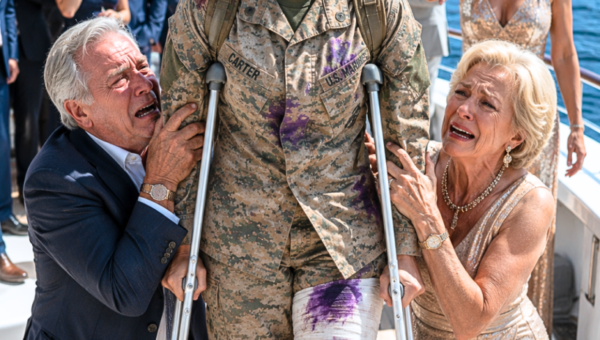
The woman stepped closer, slowly, as if approaching a wounded animal. “My name is Eleanor Carter,” she said. “And I have spent twelve years making sure Vivian never found the final trust documents.”
I shook my head. “This is not possible.”
“I know.”
“You left me.”
“No,” she whispered. “I hid from Vivian’s reach. And from the people your father owed. I thought I was protecting you.”
The old anger rose fast, hot and boyish. “You missed my life.”
“I know.”
“You missed him.”
She looked at Toby. Her face broke open. “I know.”
Toby whispered, “Is she my grandma?”
I did not answer. I could not. Then Eleanor reached into her handbag and pulled out a small envelope. “I did not come for forgiveness,” she said. “I came because the final clause required me alive to sign it.”
“What final clause?”
Her eyes moved to Toby. “The trust was never money, Ethan. Not really.”
She handed me the envelope. Inside was a deed. Not to mansions. Not to companies. Not to accounts. Land. Hundreds of acres outside Nashville, transferred into a protected foundation under Toby’s name—not for sale, not for profit, not accessible by guardians, relatives, or creditors.
Designated use: The Toby Sinclair Center for Children and Families. A trauma recovery campus. Therapy. Emergency housing. Legal advocacy. Medical care. Art rooms. Gardens. Safe playgrounds. A place for children who had been hurt by the people who should have protected them.
Eleanor’s voice shook. “Your son did not inherit a fortune. He inherited what the fortune was supposed to become.”
Toby looked at the paper, then at me. “What is a center?”
I swallowed hard. “It is a place that helps kids.”
“Kids like me?”
I nodded. His bruises had faded by then, but I still saw them. We all did. Toby thought for a long moment. Then he looked at Eleanor. “Does it have bikes?”
She blinked through tears. “It can.”
“Yellow bikes?”
She laughed and cried at the same time. “Yes. Yellow bikes.”
Toby nodded seriously. “Then okay.”
And somehow, with those two small words, the impossible became real. A year later, the Toby Sinclair Center opened on a bright April morning. There were no velvet ropes. No champagne. No politicians cutting ribbons for photographs. Just children running across new grass, counselors carrying boxes of art supplies, therapy dogs wearing blue bandanas, and a row of yellow bicycles shining near the path like captured sunlight.
Isabelle sent a letter. Toby chose not to open it yet. I put it in a drawer for someday. Eleanor came every Sunday. Forgiveness did not arrive all at once. It came awkwardly, in cups of coffee, in old stories, in long silences, in Toby teaching his grandmother how to play video games while accusing her of historical cheating.
Leighton became the center’s security director and complained constantly about glitter. Lena ran the medical wing and married nobody, obeyed nobody, and let Toby call her Aunt Lena after pretending not to cry about it. As for me, I stopped trying to be nobody. I became exactly who I was. A father. A survivor. A man with a past. A man building something better from the wreckage.
On opening day, Toby rode his yellow bike down the long path toward the oak trees. Waffles chased him. Other children followed, laughing, fearless for one perfect moment. Toby stopped at the top of the hill and waved.
“Dad! Come on!”
I looked at the center behind me. At the place born from greed, pain, secrets, and one little boy who had refused to stop calling for me. Then I ran after him. Because that was the promise. Not revenge. Not power. Not blood. When my son called, I came. And this time, I brought morning with me.
THE END.