My daughter lay in a hospital bed, covered in finger-shaped bruises. “They locked me in the guest house and beat me,,̶

I was still wearing my Class A uniform when I left Fort Liberty that evening.
My dark dress jacket was perfectly pressed, the fabric stiff and unyielding. The ribbons and medals on my chest caught the harsh, fragmented light of the streetlamps as I drove through the wealthy, manicured suburbs of Charlotte, North Carolina, toward Mercy General Hospital. I gripped the leather steering wheel so tightly my knuckles ached.
The gold nameplate pinned meticulously above my left breast pocket read: COLONEL SARAH MILLER.
I walked through the sliding glass doors of the emergency room like a storm making landfall. The air inside smelled of harsh antiseptic, stale coffee, and underlying panic, but I tuned it all out. I had navigated war zones; a civilian hospital waiting room was not going to slow me down.
A triage nurse stepped into my path, holding a clipboard like a shield. “Ma’am, you can’t go back there, family only—”
“My daughter,” I said, my voice a low, terrifying calm that I usually reserved for insubordinate officers. “Where is Chloe Sterling?”
She looked up, taking in the brass on my shoulders and the absolute, unblinking focus in my eyes. Something in my face made her step aside immediately, pointing a trembling finger toward the restricted corridor.
I found Chloe in a small, sterile observation room at the far end of the hallway.
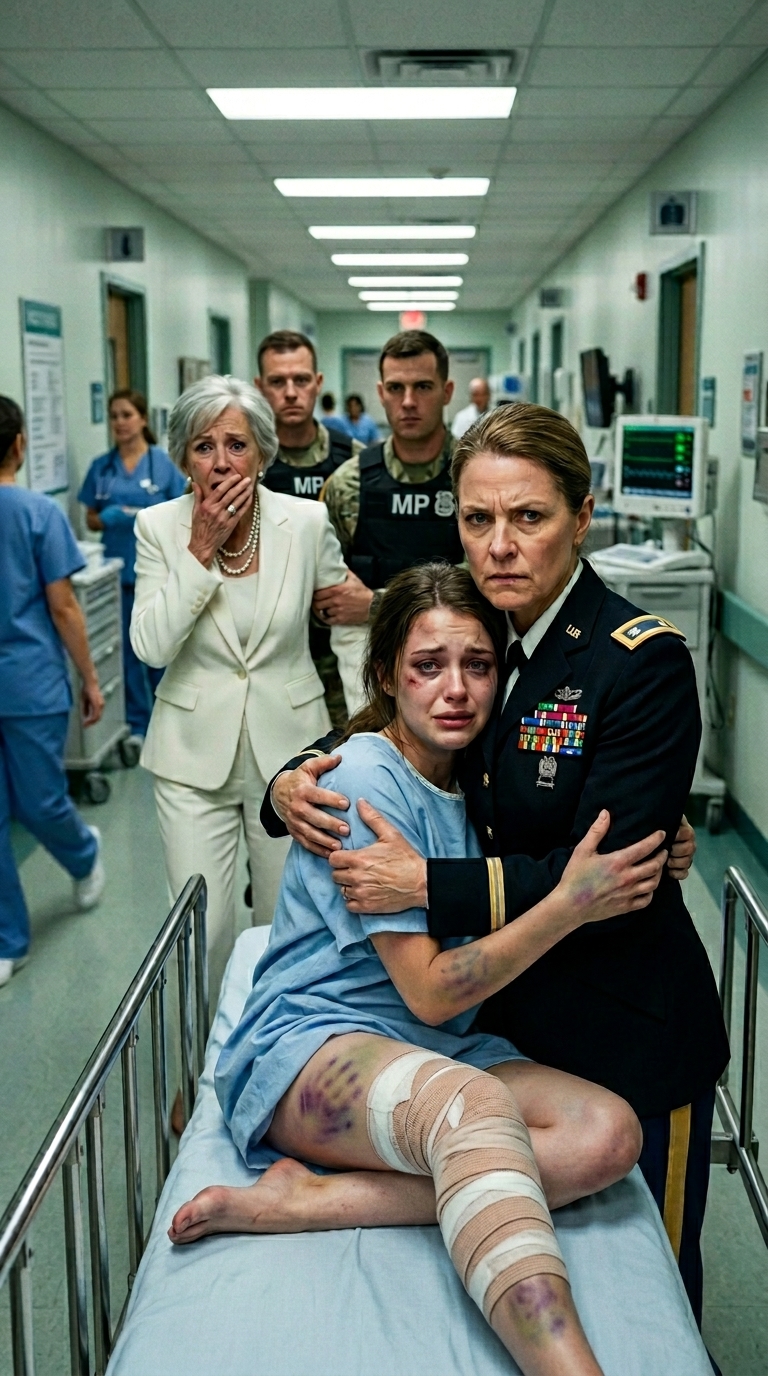
She was curled tightly beneath a thin, scratchy hospital blanket, trying to make herself as small as possible. The sight of her stopped the breath in my lungs. One of her beautiful hazel eyes was swollen completely shut, the skin around it a mottled, ugly purple. Her bottom lip was split, dried blood flaking against her pale skin. Dark, distinct finger-shaped bruises wrapped around her slender forearms. Her white, tailored designer dress—a garment chosen by her husband’s family to project an image of flawless wealth—was torn at the shoulder and stained with dirt.
This was my daughter. The same vibrant girl who used to call me every evening when I was deployed in the Middle East, just to describe the color of the sunset back home. The same little girl who used to draw pictures of eagles and tape them to our kitchen refrigerator. Now, she could barely lift her head.
“Mom…” she whispered, her voice cracking, sounding like a frightened child lost in the dark.
I crossed the cold linoleum floor in three strides and wrapped my arms around her. Her entire body shook against mine. I kissed the top of her head, smelling dried sweat and fear.
Then, I heard a sharp, irritated sigh behind me.
“If she doesn’t sign it, Doctor, I will sign it as her legal proxy. She is clearly a danger to herself.”
I turned slowly, keeping one arm wrapped securely around my daughter.
Standing in the corner of the room, cornering a young, nervous-looking emergency room physician, were her husband, Richard Sterling; his mother, Beatrice Sterling; and Richard’s older brother, Carter. They wore bespoke suits and heavy, arrogant luxury watches. They radiated the kind of generational wealth that believed it could buy gravity itself.
Beatrice wore flawless diamond earrings and the kind of practiced, glacial smile that could freeze a room. She held a silver pen, pressing it against a stack of legal documents on the doctor’s clipboard.
“Colonel Miller,” Beatrice said smoothly, not bothering to lower her voice. “Your daughter had a severe emotional episode tonight. She tripped on the terrace stairs in her hysteria. Nobody touched her. But she is clearly unwell. We are transferring her to Oakridge Institute for her own safety.”