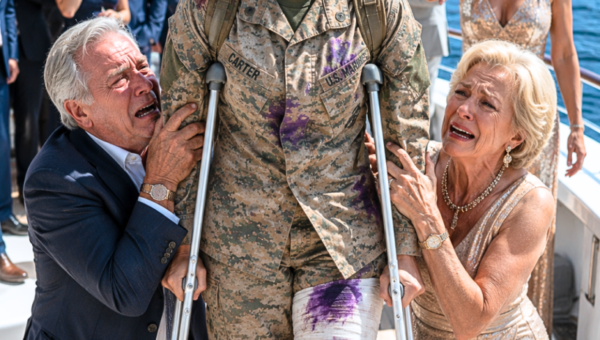
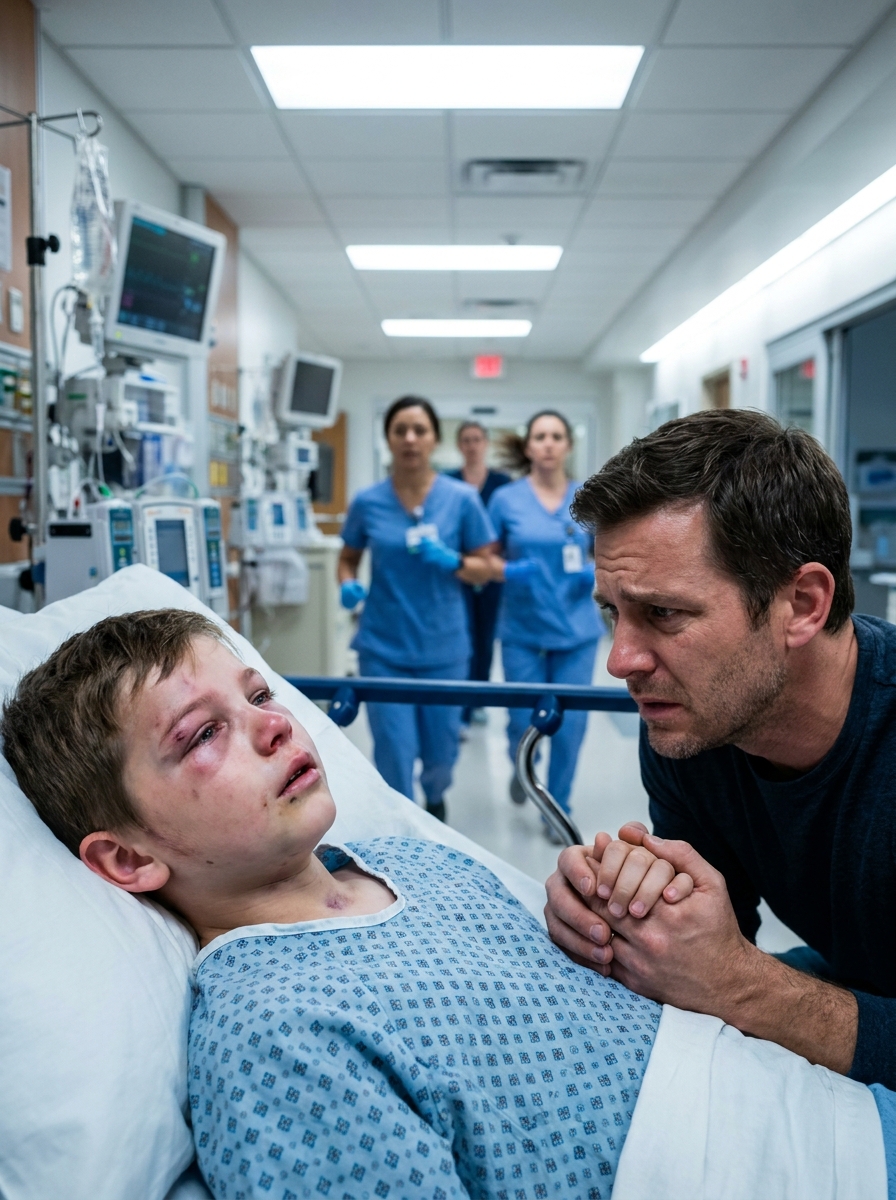
My eight-year-old son was nearly b:eat:en to d:ea:th in his grandfather’s driveway while three grown men laughed and pinned him down. By the time I got to the hospital, the doctors were murmuring words like brain swelling and concussion — Part 2

I froze. Then I kissed his hair. “No, buddy,” I said. “I was dangerous. Now I am your father.”
I buckled him in gently. “The difference is who I choose to protect.”
The house was low, stone built, and silent, with no mailbox, no visible cameras, and windows that reflected the moon like black water. Toby woke as I carried him inside.
“Safe house,” Leighton said.
Toby frowned. “That sounds less cool.”
“It has pancakes,” I said.
His eyes opened a little wider. “Chocolate chip?”
Leighton looked offended. “This is a secure facility, not a diner.”
From the kitchen, a woman’s voice called, “There are chocolate chips in the pantry.”
Toby whispered, “I like her.”
The woman stepped into the light. It was Lena Ortiz, a former military medic, former field surgeon, and the former person I trusted with my life when trusting anyone was stupid. She looked at Toby, and the hardness in her face softened instantly.
“Well,” she said. “You must be the famous Toby.”
Toby blinked. “I am famous?”
“To your dad? Extremely.”
That got the first real smile from him since the attack. Lena examined him in the guest room while I stood by the door, useless and burning. She was gentle. More gentle than I remembered she could be. She checked his pupils, his pulse, the swelling near his temple, the bruises along his arms where adult fingers had gripped too hard.
Her jaw tightened only once when she saw the marks on his wrists. Toby saw it too.
“Are you mad?” he asked her.
Lena paused. Then she sat beside him. “I am mad that someone hurt you,” she said. “But I am not mad at you.”
His eyes filled. That was the sentence he had needed all night. Not because he believed he deserved what happened, but because children are strange little miracles. They will blame themselves for storms, divorces, empty chairs, slammed doors, and grown men’s cruelty if nobody tells them not to.
He fell asleep twenty minutes later, one hand wrapped around a stuffed dinosaur Lena somehow produced from a supply closet. In the kitchen, Leighton poured coffee none of us wanted.
“Vivian filed the petition,” he said.
I looked up. “Already?”
“At 2:13 a.m. Emergency guardianship. She claims Isabelle is compromised, Matthew is falsely accused, and you have a violent undisclosed past that makes you unfit.”
Lena snorted. “Technically, parts of that are true.”
I shot her a look. She shrugged. “Not the unfit part.”
Leighton slid a tablet across the table. “It gets worse.”
On the screen was a news headline: Nashville father with secret past removes injured child from hospital during abuse investigation. Under it was an old photograph of me from twelve years ago, cropped from a charity gala. My real name was printed beneath it: Ethan Maddox. The comment section was already a sewer of accusations: kidnapping, trust fund psycho, dangerous father.
I stared at the screen. “She is controlling the narrative.”
Leighton nodded. “And she is good at it.”
I walked to the window. Outside, dawn had begun staining the sky gray. “Then we stop playing defense.”
Leighton went still. “What does that mean?”
“It means Matthew and Isabelle opened the door. Vivian walked through it. But none of them know what is buried under the foundation.”
Lena folded her arms. “You are talking about the Maddox archive.”
Leighton said sharply, “No.”
I turned around. “Yes.”
The Maddox archive was not a folder. It was a vault of sins. For three generations, my mother’s family had built wealth through shipping, defense contracts, political favors, and deals that looked clean only because enough important people had washed their hands afterward. My mother hated it. That was why she created the trust. Not to preserve power, but to dismantle it slowly.
Education funds, medical grants, land conservation, abuse shelters; quiet money sent where old Maddox money had once caused damage. When she died, Vivian tried to seize control. I stopped her. Then I disappeared into ordinary life because ordinary life felt like heaven. Isabelle knew I had family money. She never knew the size, she never knew the history, and she never knew my mother left one final instruction: If the Maddox family ever came for my child, burn the whole empire clean.
Leighton’s face hardened. “If you open the archive, powerful people will fall.”
“Good.”
“They will not fall alone.”
“I know.”
Silence filled the kitchen. Lena looked between us. “What does that mean?”
I did not answer right away. Because the truth was not simple. I had done terrible things for good reasons, and good things for reasons I still could not forgive. Finally, I said, “It means my son may learn the worst parts of me.”
From the hallway came a small voice. “I already know the best part.”
I turned. Toby stood there in oversized pajamas Lena had found, his bruised face pale but alert. His eyes were on me. “You came,” he said.
And just like that, every fear I had carried for ten years lost its power. I crossed the room and knelt in front of him. “I will always come.”
Toby leaned into me carefully. Behind him, Lena wiped at her eyes and pretended she had not. Leighton looked away. The decision was made. By breakfast, the archive was opened. By noon, the first documents were sent to three federal prosecutors, two investigative journalists, and one judge my mother had trusted more than anyone alive. By sunset, Vivian Maddox stopped smiling on television.
Isabelle called me from a holding room at the courthouse. I almost did not answer, but Toby was asleep beside me, curled under a quilt in the safe house bedroom, and I knew one day he might ask whether I had given his mother a chance to speak. So I answered. For ten seconds, all I heard was breathing.
Then Isabelle whispered, “Is he alive?”
The question was so ugly I closed my eyes. “Yes.”
She sobbed once. “Can I talk to him?”
“No.”
“Ethan…”
“No.”
Her breathing shook. “My lawyer says Vivian is trying to take him.”
“She is.”
“I did not know it would become this.”
That sentence again. A smaller version of the same knife. “What did you think would happen, Isabelle?”
“I thought…” she stopped. “I thought my father would scare you.”
“By hurting Toby?”
“No. By making you look unstable. He said you were hiding money. That you were humiliating us. That you thought my family was beneath you.”
“He told you what you wanted to hear.”
Her silence admitted it. Then she said something I did not expect. “I recorded them.”
My eyes opened. “What?”
“My father. Jasper. Kyle. The lawyer. Some meetings. Some calls.”
I stood and walked into the hallway. “Why?”
“At first? To protect myself,” her voice cracked. “Then because I got scared.”
“Scared of who?”
“My father.”
There it was. The truth beneath all the polish. Matthew Rodriguez had not ruled his family with love. He ruled them with debt, fear, shame, and the oldest weapon of all: blood. Isabelle had grown up under that roof. She had learned to smile while obeying, learned to perform grief, loyalty, and innocence, and learned that survival meant standing beside the cruelest person in the room and pretending he was right.
It did not excuse her. Nothing could. But it explained the shape of the wound.
“What is on the recordings?” I asked.
She cried quietly. “One of them is from the driveway.”
My blood turned cold. “You recorded it?”
“No. The porch camera did. Dad thought he deleted it. I copied it first.”
I gripped the phone so hard my hand hurt. “And you did not give it to the police?”
“I was afraid.”
“Toby was bleeding.”
“I know.”
“Toby thought I abandoned him.”
“I know!”
Her cry echoed through the line, raw and ruined. Then she whispered, “I am not asking you to forgive me. I am asking you to save him from Vivian. I will give you everything.”
“Why now?”
“Because my father told the lawyer that once Vivian got guardianship, Toby would be sent away. Boarding school first. Then treatment programs. Places where nobody listens to children.”
My stomach twisted. Isabelle continued, barely audible. “And he said, ‘The boy will not be a problem forever.’”
The hallway blurred. For a moment, I was back behind the hospital glass watching Toby’s fingers twitch against a blanket. “Send the files,” I said.
“I already did.”
My phone buzzed. A folder arrived. Videos. Audio clips. Photographs. Bank records. Messages. And one file labeled: Toby Driveway Full. I did not open it. Not yet. I could not watch my son scream. But I sent it to Leighton.
Then Isabelle said, “Ethan?”
“What?”
“Tell Toby…” her voice collapsed. “Tell him I am sorry.”
I stared at the closed bedroom door. “No,” I said.
She went silent.
“You will tell him yourself one day,” I continued. “When a therapist says he is ready. When he wants it. Not before. Not because you need relief.”
A long pause. Then she whispered, “That is fair.”
For the first time in years, Isabelle sounded like a person instead of a performance. The next morning, the recordings hit court. Matthew’s attorneys asked for a delay, but the judge denied it. Vivian’s lawyers argued I was unstable. Then Leighton played thirty-four seconds of audio from Matthew’s study.
Matthew’s voice filled the courtroom: “The boy is the key. Break the father through the son, and the money opens.”
A woman gasped. Isabelle lowered her head. Jasper stared at the table. Kyle looked like he might vomit. Then came Vivian’s voice, smooth as poisoned honey: “Do whatever must be done, Matthew. But do not leave marks that matter.”
The courtroom went silent. Even the judge looked stunned. My attorney stood. “Your Honor, there is more.”
There was always more. Bank transfers from Vivian to Matthew. Messages from Vivian’s office to the fired lawyer. Draft documents naming Vivian as financial guardian over Toby’s inheritance. And finally, a sealed letter from my mother, written years before her death, notarized and stored in the archive.
The judge read it privately. His face changed before he finished the first page. Then he looked at me.
“Mr. Sinclair, did your mother anticipate this exact scenario?”
I stood. “Yes, Your Honor.”
“And what was her instruction?”
I swallowed. “That if any member of the Maddox family attempted to exploit, isolate, institutionalize, or financially control my child, the full trust was to transfer immediately into a protected charitable structure, with Toby retaining personal care benefits but no liquid fortune for any guardian to access.”
Vivian stood so fast her chair fell backward. “No!”
That single word told the entire courtroom the truth. She had never wanted Toby. She had wanted the door he opened. And my mother, brilliant even from the grave, had locked it.
Toby never entered the courtroom. That was my one condition. He had already suffered enough under adult eyes. But he still testified through drawings. Lena had given him crayons during recovery. A therapist named Dr. Hall sat with him every afternoon, asking no leading questions, pushing no details, simply letting him draw what his memory needed to release.
The first picture was of a driveway. Three tall stick figures. One small figure on the ground. A red crayon line near the head. At the top, in shaky letters, Toby had written: I CALLED DAD.
The second picture showed a sidewalk. A child with one shoe. A house behind him with black windows. At the corner stood a woman. Not Isabelle. Mrs. Jones. Our elderly neighbor. The woman who had found him.
When Mrs. Jones testified, she wore a lavender cardigan and orthopedic shoes. She looked tiny beneath the courtroom lights, but her voice was iron.
“I heard a child crying,” she said. “Not fussing. Not whining. Crying like the world had ended.”
The prosecutor asked, “What did you see?”
“I saw Toby limping down the sidewalk. Blood on his face. One shoe gone. He kept saying, ‘I need my dad.’”
Isabelle sobbed silently. Matthew stared straight ahead. Mrs. Jones turned toward him. Then she said, “And I saw Mr. Rodriguez on the porch watching him.”
The courtroom held its breath. “Did he attempt to help?”
“No.”
“Did he call an ambulance?”
“No.”
“What did he do?”
Mrs. Jones’s mouth trembled, but her voice did not. “He laughed.”
That was the moment the public stopped debating. Not because of my name. Not because of the money. Not because of Vivian. Because an old woman in a lavender cardigan had said the truth plainly enough for anyone to understand.
The case moved fast after that. Matthew was denied bail. Jasper and Kyle turned on him within forty-eight hours. Cowards usually do. They claimed Matthew ordered everything. Claimed they only held Toby down. Claimed they thought it was discipline. The prosecutor’s face during that statement could have curdled milk.
Vivian’s world cracked slower. People like her rarely fall in one dramatic collapse. They lose rooms first. Then allies. Then invitations. Then lawyers. Then bank access. The Maddox archive did what my mother built it to do. It burned clean. Contracts were investigated. Foundations audited. Shell companies exposed. Old victims contacted. Quiet settlements made public. The family name that had once opened doors now made people step back.
And through it all, Toby healed. Slowly. Not in a montage. Not in a miracle. Healing was ugly sometimes. He had nightmares. He flinched when grown men laughed too loudly. He panicked the first time he dropped a glass and it shattered on the kitchen floor.
I found him under the dining table, shaking. “I am sorry,” he kept saying. “I am sorry. I did not mean to.”
I crawled under the table beside him. The floor was cold against my palms. “Look at me, buddy.”
He shook his head. So I lay down on my back beside him, staring at the underside of the table. After a moment, he sniffed. “What are you doing?”
“Hiding from the glass.”
“That is dumb.”
“Maybe. But I am with you.”
He was quiet. Then he whispered, “Are you mad?”
“No.”
“But I broke it.”
“Then we clean it up.”
“What if I break something worse?”
I turned my head toward him. “Then we fix what we can. And we love each other through the rest.”
His chin trembled. “Grandpa said love stops when people get tired of you.”
I closed my eyes. There are sentences that should never be spoken to children. When I opened them again, I said, “Grandpa was wrong.”