
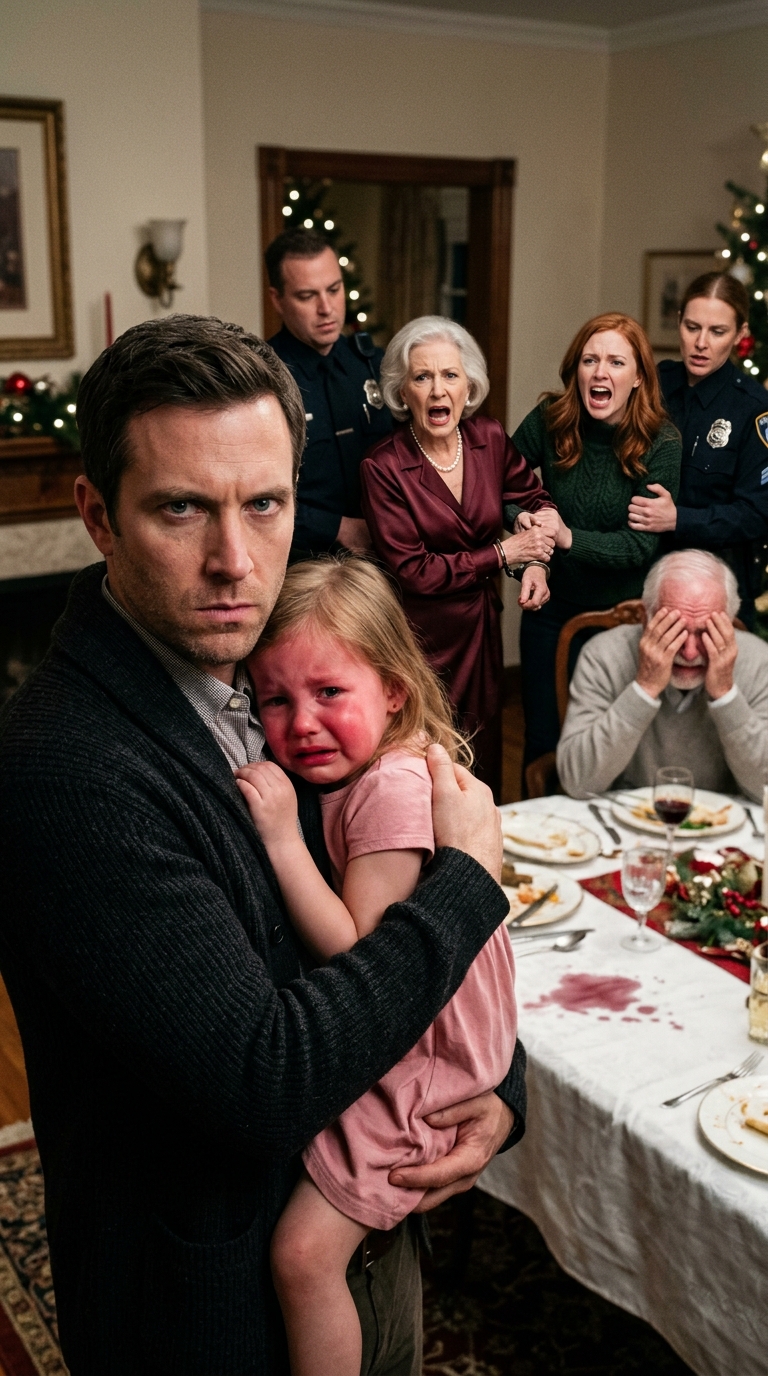
At my mother-in-law’s Christmas Gala, she struck my 5-year-old daughter across the face for spilling juice in front of sta — Part 3

But Patricia had miscalculated one crucial variable: Claire’s awakening.
The day after Robert’s confession, Claire walked into the police precinct and formally, legally retracted the kidnapping affidavit. She provided a sworn, recorded statement detailing the events of the Christmas Gala, including the assault on Lily and the subsequent coercion by her mother.
The criminal charges against me evaporated instantly, but the family war had only just begun.
By the fifth day in Vermont, Lily began to laugh again. She built clumsy snowmen with Melissa’s old Golden Retriever, Benny, and drank hot chocolate by the fire. The bruise on her cheek was fading into a dull yellow, but the invisible scars were harder to track.
Every evening at 7:00 PM, Claire called.
For the first four days, Lily refused to speak to her. She would hide her face against my chest the moment the phone rang. I never forced her. I simply told Claire that Lily wasn’t ready, and I listened to my wife weep on the other end of the line.
On the fifth night, sitting on the braided rug by the fireplace, Lily finally nodded when the phone rang.
I put it on speaker.
“Hi, baby,” Claire’s voice wavered, thick with unshed tears.
Lily pulled her knees to her chest. “Hi.”
“I am so sorry, Lily,” Claire said, her voice cracking with raw, unfiltered honesty. “Grandma was evil to hit you. And I was wrong, so incredibly wrong, to say you deserved it. You were not bad. You were perfect. I was scared of Grandma, and I failed to protect you. It is my fault, and I am so deeply ashamed.”
Tears welled in Lily’s eyes. She looked at the phone, processing words she had desperately needed to hear.
“Are you still mad at me?” Lily whispered.
“No, sweetheart. Never. I love you more than life. I am only mad at myself.”
“Can Grandma come to my birthday?” Lily asked, a slight tremble in her voice.
“No,” Claire said, with a sudden, fierce strength that surprised me. “Grandma is never allowed near you again. Not until you are a grown woman and you decide you want to see her. She is not welcome in our home.”
When we finally returned home in late January, the atmosphere was fundamentally altered. Healing was not a cinematic montage of instant forgiveness. It was grueling, exhausting work.
Claire enrolled in intensive trauma therapy twice a week. She gave me full administrative control over Lily’s school pickup list, permanently removing Patricia’s name. She personally changed the deadbolts on our front doors.
Patricia, however, refused to accept defeat. The loss of control drove her into a frantic, obsessive spiral.
She sent threatening emails via her corporate lawyers. She mailed lavish, manipulative gifts to the house, which Claire promptly threw into the incinerator un-opened. Patricia spread vicious rumors at the country club, claiming I was a cult-like manipulator holding her daughter hostage.
We ignored all of it. We documented every text, every letter, every unhinged voicemail, building an impenetrable fortress of legal evidence.
By February, I foolishly thought the worst of the storm had passed. We were settling into a new normal—a quieter, safer dynamic.
Then came a freezing Saturday morning.
I was at the kitchen counter, pouring a cup of coffee, watching Lily color at the dining table. Claire was upstairs getting dressed.
Suddenly, the jarring, aggressive wail of police sirens shattered the quiet suburban morning. Red and blue lights bounced off the snow-covered front lawn, painting the living room walls in frantic flashes.
I rushed to the window.
Two police cruisers had blocked our driveway. Four officers stepped out, their hands resting cautiously near their utility belts.
And standing behind them, wrapped in an extravagant mink coat, dabbing her dry eyes with a lace handkerchief, was Patricia Whitmore.
She hadn’t come to yell. She had come for the kill.
My blood ran cold as I watched her point a trembling, manicured finger directly at my front door, shouting to the officers. I didn’t need to hear the words to know what she was doing. She was executing her final, desperate play.
She had called in a hostage situation.
Heavy, aggressive fists pounded on our thick mahogany front door.
“Police! Open the door immediately!” a stern voice boomed through the freezing morning air.
Lily dropped her crayons, her eyes wide with sheer terror. She scrambled off her chair and ran to hide behind my legs, her small hands gripping my jeans like a lifeline.
Claire flew down the stairs, her face pale, a heavy cardigan pulled haphazardly over her shoulders. She took one look out the window at the flashing lights and her mother’s theatrical, weeping performance on the sidewalk, and her expression transformed.
The fear that had governed Claire’s entire existence vanished, replaced by a cold, terrifyingly calm resolve.
“Stay here with Lily,” Claire commanded, her voice steady and hard.
“Claire, no. Let me handle them,” I urged, stepping forward. “She’s trying to frame me for domestic abuse or unlawful imprisonment. If I go out there—”
“This is my monster, Daniel,” Claire interrupted, placing a firm hand on my chest. “I let her into this house. I am going to be the one to drag her out of it.”
She didn’t wait for my response. Claire unlocked the deadbolt and pulled the heavy door open, stepping out onto the frost-covered porch.
I stood in the doorway, shielding Lily, watching as the two lead officers immediately tensed.
“Ma’am, step away from the door,” the taller officer ordered, his hand resting on his radio. “We received a distressed call from your mother stating your husband is holding you and your daughter against your will, and that he has a history of violent outbursts.”
Patricia pushed past the officers, acting the part of the hysterical savior. “Claire! Oh, my poor darling! Thank God! Officers, arrest that man! Get my granddaughter out of there!”
Claire did not cower. She did not look at the ground. She stood tall, staring at the woman who had broken her arm and her spirit.
“Officers,” Claire said, her voice carrying loudly over the hum of the cruiser engines. “My name is Claire Vance. I am standing here of my own free will. My husband is entirely innocent. The woman behind you is Patricia Whitmore, and she is a pathological liar attempting to weaponize this department to harass my family.”
Patricia gasped, clutching her mink collar. “She’s brainwashed! He’s threatening her! Look at her, she’s terrified!”
Claire reached into the deep pocket of her cardigan. The officers tensed, but she slowly withdrew a thick, manila envelope.
“I am not terrified of my husband,” Claire said, walking slowly down the porch steps and handing the envelope to the lead officer. “I am terrified of her. Inside that envelope, you will find three timestamped photographs of my six-year-old daughter’s face, severely bruised after my mother struck her during a Christmas party. You will also find a sworn, signed affidavit from Dr. Aris, detailing how my mother pushed me down a flight of stairs when I was eight years old, breaking my arm, and how my father bribed him to cover it up.”
Patricia’s theatrical weeping stopped instantly. The color entirely drained from her face, leaving her looking like a wax figure. The socialite mask cracked, revealing the panicked, hollow shell underneath.
“That is slander!” Patricia screeched, taking a step backward. “It’s a lie! She fabricated those documents!”
The lead officer opened the envelope. He pulled out the glossy, 8×10 photograph of Lily’s swollen, bruised cheek that I had taken in that cheap motel room. His expression hardened into absolute disgust. He looked up at Patricia.
“Ma’am,” the officer said, his voice dropping an octave, “filing a false police report is a felony. Wasting emergency resources to harass a family is a crime. Given the photographic evidence of child abuse I am holding in my hand, I strongly suggest you back away from this property before I place you in handcuffs.”
“You don’t know who I am!” Patricia shrieked, pointing a manicured claw at the officer. “I will have your badge! I will call the Mayor!”
“Call whoever you want from the station, lady,” the second officer snapped, stepping between Patricia and my wife. “Right now, you are trespassing.”
Claire looked at her mother, delivering the final, fatal blow.
“I filed for an emergency restraining order yesterday, Mother,” Claire said, her voice devoid of any emotion. “The judge signed it this morning. You are legally required to remain five hundred feet away from me, my husband, and my daughter. If you ever come near my home again, if you ever look at my child again, I will not hesitate to see you rot in a prison cell. You have absolutely no power here anymore. You are nothing to us.”
Patricia opened her mouth, but no words came out. The sheer, undeniable reality of her total defeat finally crushed her. She looked at the officers, looked at Claire’s unyielding face, and then looked past them to me, standing in the doorway with Lily safely behind me.
She turned on her heel, her expensive heels slipping on the icy pavement, and marched briskly back to her luxury sedan. She sped away, the tires squealing, leaving nothing behind but the toxic exhaust fumes in the freezing air.
The police officers took Claire’s formal statement, apologized for the intrusion, and drove away, returning our street to its quiet, suburban peace.
Claire walked back up the stairs, stepped inside, and locked the deadbolt. She leaned against the door, closed her eyes, and let out a long, shuddering breath. The war was officially over.
Four months later, the bitter winter had finally melted into a warm, forgiving spring.
We were sitting around our own dining table—a modest, scuffed oak table, not a twenty-foot mahogany antique. The sliding glass doors were open, letting in the smell of fresh-cut grass and the distant sound of neighborhood kids playing.
Lily was chattering excitedly about a drawing she had made at school, gesturing wildly with her hands.
As she reached across the table for a dinner roll, her elbow clipped her tall plastic cup.
The cup tipped over. A tidal wave of sticky, bright orange juice flooded across the placemats, dripping rapidly onto the hardwood floor.
The room went completely, terrifyingly still.
Not because anyone was angry. But because the three of us, bonded by a shared, traumatic history, instantly remembered the echoes of that Christmas night.
Lily’s face turned paper-white. Her hands flew into the air, hovering near her chest. I saw the raw, primal fear flash through her bright blue eyes, bracing for an impact that used to be inevitable.
Claire stood up slowly.
For a fraction of a second, the air was thick with tension.
Then, Claire grabbed a roll of paper towels from the counter, knelt on the floor beside Lily’s chair, and let out an exaggerated, comical sigh.
“Oops,” Claire said softly, looking up with a warm, gentle smile. “Sticky table.”
Lily stared at her, her small chest heaving, waiting for the trap to spring.
“Will you help me clean it up, sweetie?” Claire asked, tearing off a sheet of paper towel and handing it to her daughter.
Lily blinked. The fear slowly dissolved from her eyes, replaced by a profound, radiant relief. She took the paper towel and nodded enthusiastically.
Together, mother and daughter wiped the orange juice from the floor, laughing when their hands bumped together. When they finished, Claire stood up and kissed the top of Lily’s head.
“I love you infinitely more than any table, Lily,” Claire whispered into her hair.
Lily leaned back into her mother’s embrace, safe, secure, and deeply loved.
I sat back in my chair, looking out at the fading sunlight in the yard, and finally released a breath I felt like I had been holding since December. We were not the exact same family we had been before the gala. That old family had been built on polite tension, hidden fears, and words swallowed to keep a toxic peace.
This new family was louder, messier, and required work. Therapy appointments dotted the calendar, boundaries were written in stone, and difficult conversations didn’t end just because someone started crying.
But in this house, when things spilled, nobody was struck. The cycle of generational pain had hit a solid brick wall, and it would go no further.
In this house, love did not hurt.
If you want more stories like this, or if you’d like to share your thoughts about what you would have done in my situation, I’d love to hear from you. Your perspective helps these stories reach more people, so don’t be shy about commenting or sharing.