
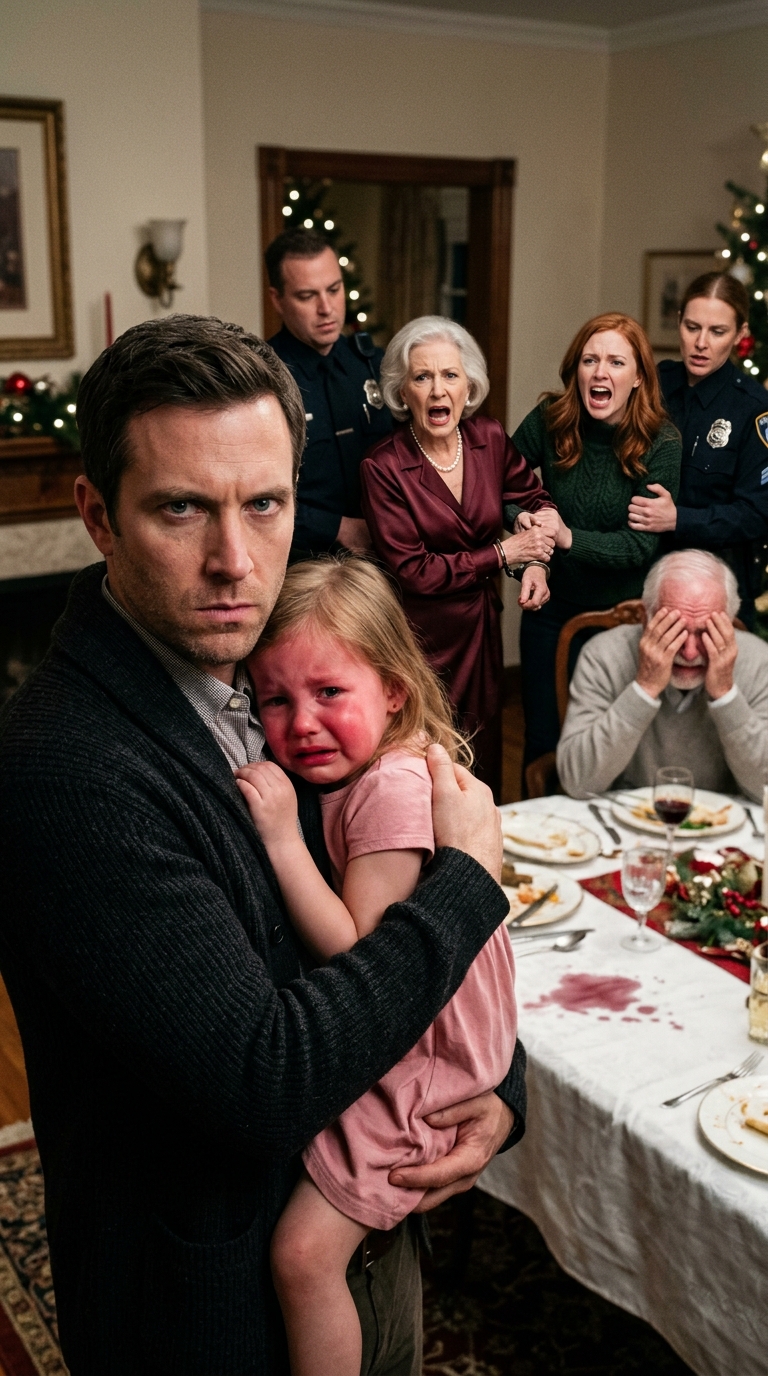
At my mother-in-law’s Christmas Gala, she struck my 5-year-old daughter across the face for spilling juice in front of sta

The scent of roasted pine, expensive imported truffles, and vintage champagne hung heavy in the vaulted dining hall of the Whitmore Estate. It was the pinnacle of the winter social season—Patricia Whitmore’s annual Christmas Gala. This wasn’t merely a family dinner; it was a carefully curated exhibition of power. Seated around the massive, twenty-foot mahogany table were state senators, corporate magnates, and the city’s elite.
And tucked among them, wearing a red velvet dress and a bow that kept slipping sideways, was my six-year-old daughter, Lily.
I have replayed the moment a thousand times in my head. It happened with the agonizing slowness of a car crash.
Lily shifted in her oversized, velvet-upholstered chair, reaching her small hand across the pristine expanse of the white damask tablecloth toward a silver basket of dinner rolls. Her elbow clipped the base of her crystal goblet.
The glass tipped. The dark, crimson cranberry juice surged over the rim, cascading across the snowy white fabric like a miniature, violent crime scene. It soaked into the napkins, pooled around the silver cutlery, and dripped onto the imported Persian rug below.
Lily went completely, terrifyingly still. Her hands flew into the air, hovering near her chest. Her large blue eyes widened in pure panic, and her lower lip instantly began to quiver.
“I’m sorry,” she whispered, her voice barely carrying over the low hum of classical music playing from the string quartet in the corner. “Grandma, I’m sorry. I didn’t mean—”
The slap echoed like a gunshot through the cavernous dining room.
Patricia Whitmore had shot to her feet with such sudden, vicious speed that her heavy chair tipped backward, crashing onto the hardwood floor. Without a word, she leaned across the corner of the table. Her palm struck Lily’s cheek with enough force to violently snap my daughter’s small head to the side.
For three agonizing seconds, nobody breathed. The string quartet faltered into a screeching halt. The clinking of silver against china ceased. Two dozen of the most powerful people in the state sat paralyzed, staring at a six-year-old girl whose cheek was rapidly blooming into a harsh, angry red handprint.
At first, Lily didn’t even cry. She was paralyzed by the shock of the assault, her small, trembling fingers slowly lifting to hover over her burning skin.
Then, a jagged, breathless sob tore from her throat.
Something primitive and blindingly cold snapped inside my chest. It felt as if a fault line had cracked wide open through my ribs.
“What the hell is wrong with you?!” I roared. I shoved back from the table with such force that my own chair splintered against the wainscoting behind me. I didn’t care about the senators. I didn’t care about the wealth in the room. I cared only about the terrified child weeping at the table.
My wife, Claire, stood up instantly.
For a fraction of a second, I thought she was going to rush to our daughter. But Claire did not step toward Lily. She stepped toward her mother.
Her face was deathly pale, her eyes darting frantically toward the horrified political donors sitting across from her. The pressure of the Whitmore legacy, the desperate, pathological need to maintain the illusion of control in front of high society, overtook her entirely.
“She deserved it!” Claire screamed, her voice cracking, completely devoid of maternal instinct. “Look what she did to the antique linens! She ruined the dinner! She deserved it, Daniel!”
The temperature in the room plummeted. The silence that followed was suffocating.
My brother-in-law, Marcus, a hulking former college linebacker, lowered his eyes to his prime rib. His wife, Anna, gripped her wine glass until her knuckles turned white. Claire’s father, Robert, the patriarch of the family, simply cleared his throat, stared at his plate, and remained utterly, cowardly silent.
Not a single soul in that room of powerful, influential people stood up for a six-year-old child.
Lily looked at me through a blur of tears. She was sobbing uncontrollably now, her chest heaving, deeply confused in the heartbreaking way only a child can be confused by the adults tasked with protecting her.
“Daddy,” she choked out, her voice fractured. “Am I bad?”
That question shattered the last remnants of the man I used to be.
I bypassed the table, scooped my daughter into my arms, and pressed her small, shaking body tightly against my chest. The heat radiating from the swelling welt on her cheek burned through the fabric of my suit.
“You are making a scene, Daniel,” Patricia hissed, straightening her diamond necklace, her eyes cold and unrepentant. “The child lacks discipline. I am simply teaching her what her parents clearly will not.”
I didn’t waste my breath on her. I looked directly at Claire. She looked back at me, her chin raised in false defiance, but her hands were trembling. I was looking at a stranger wearing my wife’s face.