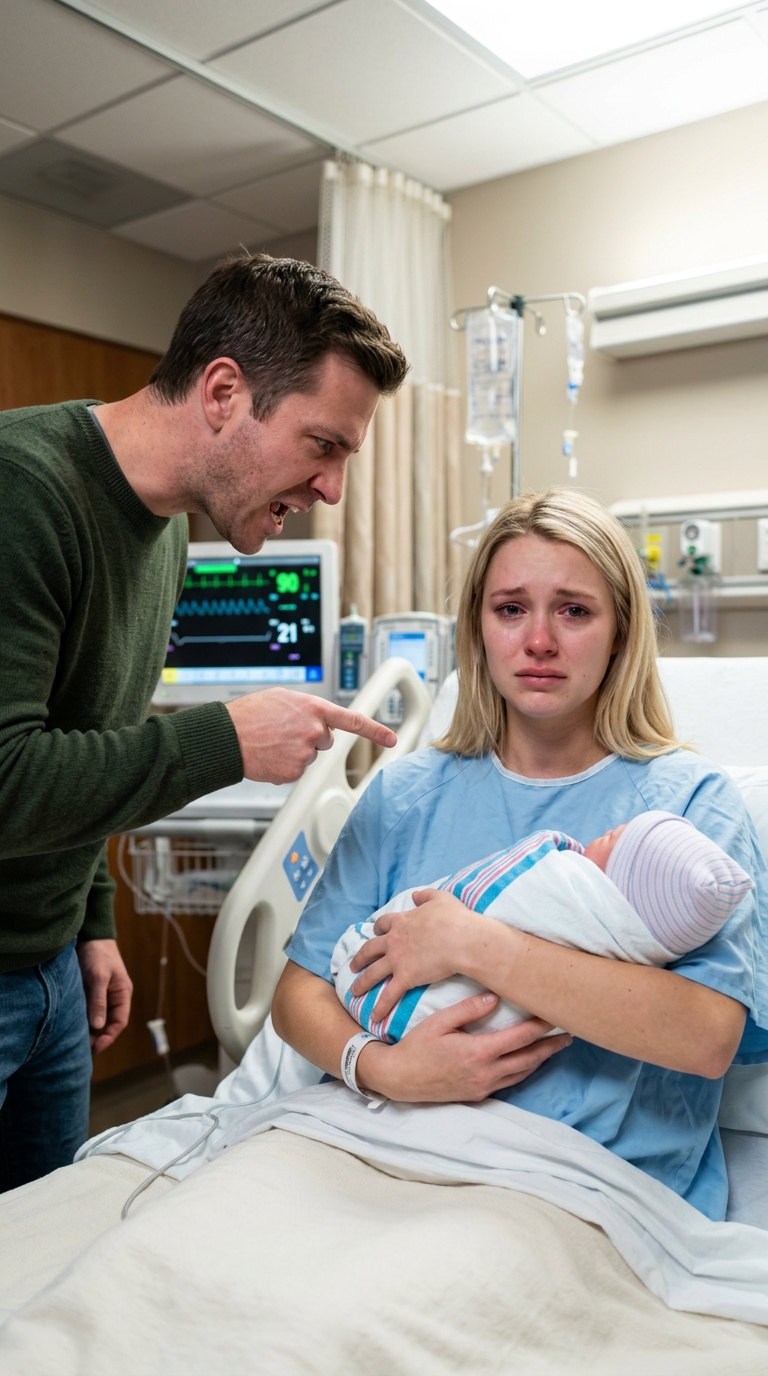
Five days after I gave birth, my husband glared at our wailing newborn in our bedroom. “You had the baby, you raise it. I&

Five days. One hundred and twenty hours since they had sliced my abdomen open, pulled a screaming, seven-pound human being from my body, and sewn me back together with dissolving thread and clinical indifference. Five days of bleeding, of breasts engorged and leaking, of a hormonal crash so violent it felt as though the very atmosphere in the room was crushing my lungs.
I stood in the center of our master bedroom, swaying slightly on feet that were still swollen to the size of water balloons. In my arms, my son, Leo, was a rigid, red-faced knot of pure distress. He had been crying for three hours. A high, reedy wail that scraped against the inside of my skull like broken glass. My arms, trembling from the sheer lactic acid buildup of holding him uninterrupted, felt like they were detaching from their sockets.
On the King-sized bed, mere feet away, lay my husband, Julian.
He was propped up against a mountain of down pillows, wearing the silk pajama pants I had bought him for our second anniversary. His eyes were glued to the flat-screen television mounted on the opposite wall, a post-game sports analysis playing at an obnoxious volume.
He hadn’t looked at me. He hadn’t looked at Leo. For the entirety of the three hours I had paced the hardwood floor, leaving small, damp footprints of sweat, Julian had existed in an impenetrable bubble of self-imposed ignorance.
“Julian,” I whispered. My voice was a dry, broken rasp. It sounded like it belonged to a ghost haunting her own life. “Please. I need… I need help.”
He didn’t blink. His thumb rested casually on the television remote, pressing the volume button up two notches. The booming voice of a sports anchor drowned out my plea, a deliberate sonic barrier erected between his comfort and my agony.
I swallowed the bile rising in my throat and took a halting step toward the bed. Every movement felt like a hot knife twisting in my lower abdomen. “Julian. I’m shaking. I think I have a fever. Please, just hold him for twenty minutes so I can pump and lie down.”
Finally, he shifted. He didn’t look at the screaming infant. He looked at me, his gaze dropping to the dark, spreading milk stains on my gray cotton t-shirt, and then up to my pale, exhausted face. His handsome features—the sharp jawline and clear blue eyes that had once charmed the absolute fool out of me—twisted into a mask of profound annoyance.
“You had the baby, Victoria,” he said, his voice flat, devoid of a single ounce of empathy. “You raise it.”
It. He called our son it.
He turned his attention back to the television, the dismissal absolute.
From the corner of the room, a soft, mocking chime of metal against glass broke the tension. His mother, Beatrice, sat in the upholstered accent chair by the window. She had arrived the day after we brought Leo home. I had wept tears of relief when she pulled into the driveway, believing, in my postpartum naivety, that reinforcements had arrived. I thought she would cook, hold the baby, perhaps let me sleep.
Instead, she had treated my home like a boutique hotel. She sat there now, immaculately dressed in a cashmere cardigan and tailored slacks, eating green grapes from a crystal bowl she had dug out of my wedding china cabinet. Her wrists were stacked with heavy gold bracelets that clinked like tiny, malevolent bells with every grape she plucked.
“In my day,” Beatrice announced, her tone dripping with casual condescension, “women didn’t complain every five minutes. We understood our duties. We didn’t need our husbands to hold our hands while we did what nature designed us to do.”
I turned my head slowly, the muscles in my neck screaming in protest. I stared at her perfectly manicured nails, at the smug, self-satisfied curve of her lips.
“In your day, Beatrice,” I said, my voice eerily calm despite the violent trembling in my legs, “did men abandon their children in the same room? Did they pretend their flesh and blood was nothing more than background noise?”
The air in the room instantly hardened.
Julian snapped. He threw the remote onto the mattress and swung his legs over the side of the bed. The apathy vanished, replaced by the cold, commanding anger he used to terrorize his subcontractors.
“Watch your damn mouth, Victoria,” he snarled. “You do not speak to my mother that way in my house.”
My house. The phrasing echoed in my mind, a sharp, metallic ping of irony.
Leo, sensing the sudden spike in hostility, arched his tiny back and cried harder, his face turning a deep, dangerous purple. I instinctively pulled him tighter against my chest, bouncing him gently, absorbing the shockwaves of his cries as fresh pain tore through my healing incision.
Beatrice popped another grape into her mouth and smiled—a thin, reptilian stretching of her lips. “Oh, let her throw her little tantrum, Julian. He’s tired of your drama, Victoria. You trapped him with that baby because you knew his business was taking off, and now you want him to do the work too. It’s pathetic.”
I looked at the woman who had raised the monster sitting on the bed. Then, I looked at the monster himself.
For the past two years, Julian had chipped away at my sanity. He had called my career as a forensic accountant “glorified bookkeeping.” He had dismissed my concerns, gaslit my intuitions, and slowly isolated me from my friends. I had convinced myself it was just stress. I had convinced myself that having a child would anchor him, would soften the harsh, ambitious edges of his ego.
I was wrong. He wasn’t stressed. He was inherently, fundamentally broken. And he had broken me right along with him.
But standing there, bleeding through my postpartum pads, vibrating with an exhaustion so deep it felt cellular, something profound happened.
Something inside my chest, right behind my sternum, went utterly and completely silent.
It wasn’t a snap. It wasn’t a break. It was the sound of a heavy steel vault closing and locking tight. The desperate, weeping, pleading wife who wanted her husband to love her vanished. The terrified new mother who felt completely out of her depth disappeared.
Julian stood up, grabbing his keys and his leather wallet from the mahogany dresser. He didn’t even glance in my direction.
“I’m going out,” he announced to the room at large. “I’ve got a site visit, and then I’m getting a drink with the partners. Don’t call me unless the house is literally burning to the ground.”
I watched his broad back as he walked toward the door. “You’re leaving? Right now?”
He paused in the doorway and let out a short, cruel laugh. “You wanted to be a mother so badly, Victoria. You practically begged for this. So, be one. I’ll be back when it’s quiet.”
Beatrice lifted her chin, the gold bracelets chiming in agreement. “And stop acting like this is his problem, dear. It’s unflattering.”
They both looked at me, a united front of aristocratic cruelty. For a fleeting, agonizing second, I saw in their eyes exactly what they expected. They expected me to break down. They expected me to fall to my knees, to weep, to beg him not to go, to apologize for being hysterical. They thrived on my subjugation.
Instead, I turned away from them.
I walked to the walk-in closet, my spine rigid despite the searing pain in my stomach. I reached up and pulled down Leo’s dark grey diaper bag. I moved with a slow, deliberate precision. I packed the sample tins of formula the hospital had given us. I packed three swaddle blankets, a handful of onesies, the breast pump, and the copy of Leo’s birth certificate. I gathered my own medical discharge papers and a single change of clothes.
Julian lingered in the doorway, a frown finally creasing his forehead. He wasn’t used to silence. He was used to my frantic apologies. “Where exactly do you think you’re going in your condition?”
I didn’t stop packing. “To my mother’s house.”
Beatrice let out a sharp, dismissive snort. “Oh, let her go, Julian. It’s a bluff. She’ll be crawling back by morning when she realizes how hard it is to do this alone. Let her mother deal with her hysterics.”
I zipped the main compartment of the bag. Then, I reached beneath the stack of my winter sweaters on the bottom shelf. My fingers brushed against smooth, cool plastic.
I pulled out a thin, unassuming black folder.
I didn’t look at them as I slid the folder into the hidden side pocket of the diaper bag, pressing it flat against the nylon lining.
I lifted Leo into his portable car seat, securing the straps over his tiny, heaving chest. I picked up the carrier by the handle, the sheer weight of it pulling at my torn abdominal muscles, and turned to face my husband.