After my son hi:t me for refusing to pay his gambling debts, I didn’t shed a tear. The next afternoon, I roasted a prime rib, polished his late father’s polished his late father’s crystal glasses, and set the dining room to perfection.

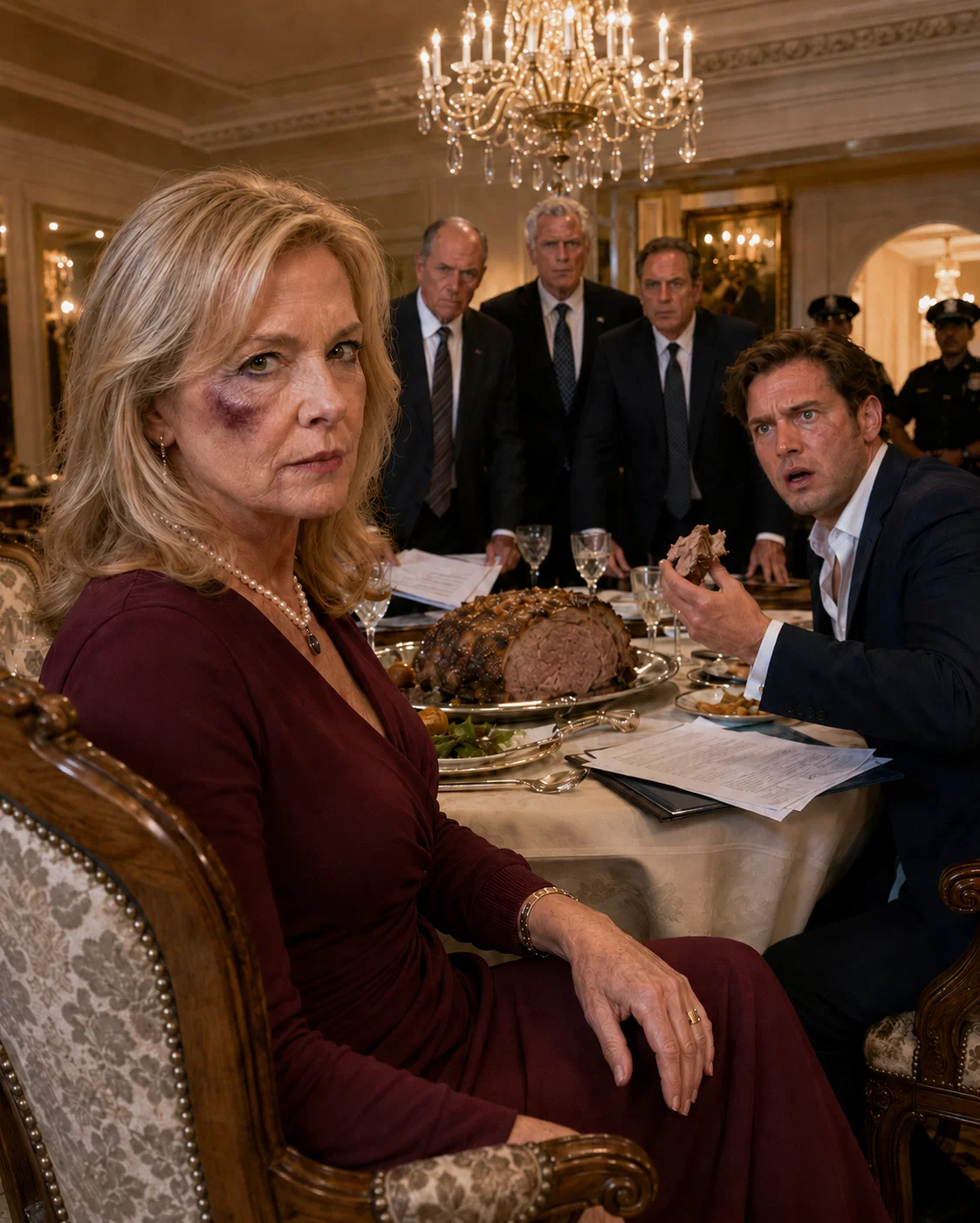
After my son sh0ved me down the stairs because I refused to cover his gambling debts, I did not cry. The next afternoon, I roasted a prime rib, polished his late father’s crystal glasses, and arranged the dining room flawlessly. He swaggered in, tore off a piece of meat with his bare hands, and laughed, “Good girl. Now go get my checkbook.” Then he froze when the three men in suits turned around from the head of the table. They were not my friends; they were estate lawyers, and they had just finished notarizing his complete disinheritance.
My son pushed me down the stairs because I refused to pay the men threatening to break his hands. I did not cry when my shoulder struck the marble, or when he stepped over me and said, “You should’ve stayed useful, Mom.”
For thirty-one years, I had confused shared blood with loyalty.
His name was Caleb, and once, he had been the little boy who slept with a toy fire truck tucked beneath his pillow. Now he stood at the top of the staircase in my late husband’s home, wearing a designer watch purchased with my money, smelling like whiskey and panic.
“You owe them,” he snapped.
“No,” I said, gripping the banister while pain burned through my ribs. “You owe them.”
His face twisted. “Dad would’ve helped me.”
That almost made me laugh.
His father, Henry Whitmore, had built Whitmore Logistics from two trucks and a warehouse with a leaking roof. Henry had loved Caleb fiercely, but he had never trusted him. Before he died, he left me control of the estate, the company shares, the house, and one sentence in his private letter:
Protect what we built, even from our own son.
Caleb did not know I still had that letter.
He only knew I had rescued him three times before. Once for reckless investments. Once for a totaled sports car. Once for a casino debt disguised behind the word “business.”
This time was different.
This time, two men had come to my door and shown me photos of Caleb signing loan papers beside a known bookmaker. This time, my son had used my name as collateral.
“I’m not paying,” I said.
His smile vanished.
Then his hand struck my shoulder.
The fall was quick, bright, and soundless. When I landed, the chandelier above me looked like a shattered crown. Caleb came down the stairs slowly, crouched beside me, and whispered, “Tomorrow, you’ll call the bank. Or next time, I won’t miss.”
Then he left me lying there.
But he made one mistake.
He forgot about the security camera Henry had installed in the staircase alcove after my hip surgery.
At midnight, with ice pressed against my bruised ribs, I called Dr. Levin, an old family physician. Then I called Henry’s estate attorney.
“Mrs. Whitmore,” Mr. Graves said, his voice suddenly sharp, “are you safe?”
I looked toward the empty staircase.
“Safe enough,” I said. “Come tomorrow. Bring witnesses. Bring a notary. And bring the documents Henry and I discussed five years ago.”
There was a pause.
Then he said, “It’s time?”