“You are a psychotic, vindictive maniac, Harrison. My father is contacting his attorneys as we speak. You have humiliated us beyond repair. If you do not bring my daughter back to this house by midnight and get on your knees to apologize to my parents, I will absolutely destroy you in court. You will never see her again. I swear to God.”
I deleted the message. The sheer audacity of her threat fueled a cold, burning resolve within me.
When I finally pulled into my own driveway, the house was entirely dark.
Meredith’s car was gone. The silence inside was oppressive, feeling less like a home and more like an abandoned crime scene.
On the granite kitchen island, illuminated by a single pendant light, lay a folded piece of heavy cardstock. I opened it. Meredith’s elegant, cursive handwriting slashed across the page.
You are destroying this family over nothing. My father has never laid a hand on Chloe in malice. You have always been too soft, too permissive. If you don’t drop these insane allegations by morning, I am filing for immediate divorce and full custody. This is your only chance to save our marriage.
I stared at the note, realizing with absolute clarity that the woman I married had never truly existed. She was just a meticulously crafted extension of Richard’s will.
Suddenly, the silence of the kitchen was shattered by my phone ringing. It wasn’t Meredith. It was an unknown number.
I answered, putting it on speaker and hitting record. “Hello.”
“Mr. Vance.” The voice was a low, gravelly rasp, dripping with aristocratic contempt. Richard.
“You shouldn’t be calling me, Richard,” I said evenly.
“Listen to me very carefully, you insignificant little man,” Richard snarled, the mask of civility completely gone. “I do not know what twisted lies you are coaching my granddaughter to spew, but I will not have my reputation sullied by a peasant like you. The police actually came to my door tonight. The sheer humiliation of it. You will march into that precinct tomorrow, retract every single word, and admit you made it up in a fit of hysteria.”
“I’m not retracting anything. You left your handprints on my daughter.”
A dark, cruel chuckle echoed through the phone. “Who do you think the courts are going to believe, Harrison? A wealthy, respected pillar of the community and his devoted daughter, or a frantic, low-earning husband trying to steal a child?
I have judges on speed dial. I have politicians at my dinner table. I will bury you so deep financially and legally that you will beg me to let you see her. You have twenty-four hours to fix this, or I will unleash hell on you.”
The line went dead.
I stood in the empty kitchen, the recorded threat echoing in my mind. Richard thought he had the upper hand. He thought his money and his intimidation tactics would crush me.
But he had made one critical miscalculation. He had threatened a man who literally had nothing left to lose.
At 8:00 AM on Monday, I was sitting in the sleek, minimalist conference room of Jessica Sterling, Attorney at Law. She was a striking woman in her fifties, radiating an aura of absolute, terrifying competence. She listened to the recording of Richard’s phone call, reviewed the photos, and read Meredith’s note.
When I finished my recounting, she didn’t offer platitudes or sympathy. She simply closed her leather folio with a sharp snap.
“Okay, Harrison. Here is the reality. Richard Campbell is a very powerful, very arrogant man. Men like him do not expect to be challenged. They expect you to fold. We are not going to fold. We are going to strike first, and we are going to strike with overwhelming force.”
“What’s the play?” I asked, leaning forward.
“We are bifurcating this war,” Jessica explained, her eyes gleaming with tactical intensity. “The criminal investigation against Richard is in the hands of the District Attorney. We let Detective Hayes build that case. Our battlefield is the family court. Right now, I am filing an ex parte emergency petition for a temporary Protective Order against both Richard and Meredith, citing severe physical abuse and failure to protect.”
“Against Meredith too?”
“Absolutely,” Jessica stated firmly. “Her note explicitly demands you return an abused child to her abuser. That is documented negligence. We are petitioning for immediate, sole physical and legal custody for you. She will be blindsided. By the time her father’s expensive lawyers mobilize, the order will already be in place by a judge. We cut off their access to Chloe completely.”
The next ninety days were a grueling, psychological meat grinder.
The emergency order was granted by a sympathetic judge within forty-eight hours. Meredith was forcibly removed from the home by sheriff’s deputies while she screamed obscenities at me from the front lawn. I was granted sole temporary custody. Meredith, utterly shattered by the realization that her father’s money couldn’t stop a judge’s gavel, was reduced to strictly supervised, two-hour visitations at a sterile county facility.
Richard’s legal team launched a massive counter-offensive. They filed motions claiming I was experiencing a psychotic break, that I had coached Chloe to fabricate the abuse, and that the bruises were from a documented vitamin deficiency. They hired ‘expert’ medical witnesses to cast doubt on the photos.
The stress was agonizing. I lost fifteen pounds. Chloe struggled with terrible nightmares, waking up screaming that Richard was in her closet. We both started intense trauma therapy.
Meredith, seemingly doubling down on her delusion, filed a brutal counter-suit for full custody, alleging parental alienation. Her strategy was clear: drag this out, bleed me dry financially, and break my spirit until I surrendered.
But in late August, the tide turned violently in our favor, thanks to a deeply buried piece of evidence Jessica unearthed.
Jessica had subpoenaed all of Chloe’s educational and medical records. Buried in the files of Chloe’s elementary school counselor, Ms. Albright, were three pages of handwritten, contemporaneous notes dating back to early March.
I sat in Jessica’s office as she slid the highlighted copies across the table to me.
March 12th: Chloe reported feeling terrified to visit her grandparents. Stated, “Grandpa hits me when I’m bad.”
March 15th: Called mother (Meredith Vance) to discuss Chloe’s statements. Mrs. Vance was highly dismissive. Stated, “My father is old school. Chloe is highly manipulative and prone to dramatic exaggeration. Please do not indulge her fantasies.”
“Meredith shut down a mandated reporter months before you ever found out,” Jessica said, her voice laced with lethal satisfaction. “This destroys their entire narrative. It proves Meredith had prior knowledge, actively suppressed it, and intentionally left Chloe in a dangerous environment.”
Armed with the counselor’s notes and the damning audio recording of Richard’s threat to me, the District Attorney finally felt they had an airtight case.
On September 14th, a grand jury indicted Richard Campbell on two felony counts of child abuse.
The walls were closing in on the Campbell empire. But desperate people do desperate things.
Two days before the preliminary hearing, I received an urgent, frantic call from Sarah while I was at work.
“Harrison, you need to get to Chloe’s school. Right now.” Sarah’s voice was breathless with panic. “Meredith just showed up there with a private security detail. She’s bypassed the front office. She’s trying to pull Chloe out of her classroom.”
I don’t remember the drive to the elementary school. I only remember the blinding red haze of pure, instinctual panic. I threw my car into a fire lane, leaving the engine running, and sprinted through the front doors.
The main office was in chaos. The principal was on the phone, looking frantic. Down the primary hallway, I saw them.
Meredith, flanked by two massive men in dark suits, was yanking forcefully on the heavy wooden door of Chloe’s third-grade classroom. It was locked from the inside.
“Open this door!” Meredith was screaming, her hair disheveled, her eyes wild with a manic, desperate energy. “I am her mother! I have a right to take my child!”
“Get away from her!” I roared, the sound tearing from my throat with the force of a physical blow.
Meredith spun around. She looked completely unhinged. The pristine, country-club facade had entirely melted away, revealing the terrified, broken woman underneath. “Harrison! Tell them to open the door! Dad’s lawyers said the temporary order is flawed! I’m taking her to safety!”
“You are taking her to her abuser!” I yelled, advancing on her. The two security men stepped forward, placing their hands on my chest to stop me.
“Back off, buddy,” one of them grunted.
“I have a court-mandated order of protection granting me sole custody,” I said to the security guards, my voice dropping to a terrifyingly calm register. “If you do not remove your hands from me, you are aiding in an attempted kidnapping, and I will ensure you both go to federal prison. Now, step aside.”
They hesitated, glancing at Meredith, who was now sobbing hysterically against the classroom door. In that moment of hesitation, two local police cruisers pulled up to the front of the school, sirens wailing. The principal had hit the panic button.
Meredith was detained on the spot for violating the restraining order. As the police escorted her away in handcuffs, she didn’t look at me. She just stared at the floor, muttering her father’s name over and over again.
That reckless, desperate stunt was the final nail in their coffin. It demonstrated to the family court judge that Meredith was a severe flight risk and an active danger to Chloe’s psychological well-being. My temporary sole custody was made permanent. Meredith’s visitation rights were suspended entirely, pending a psychological evaluation.
Two weeks later, the preliminary criminal hearing for Richard Campbell began.
The courtroom smelled faintly of lemon polish and nervous sweat. I sat in the front row, holding Sarah’s hand. Richard sat at the defense table, looking significantly older, his arrogant posture sagging under the weight of impending ruin. Meredith sat a few rows behind him, looking hollowed out, a ghost of the woman she used to be.
The defining moment of the trial came when Chloe had to testify.
Because of her age, she was allowed to testify from behind a physical screen, shielding her from having to look directly at the man who had tormented her. Her voice, piped through the courtroom speakers, was tiny, trembling, but impossibly brave.
She recounted the Saturday afternoons. The dining room table. The heavy, suffocating silence of her grandmother. And the crushing, terrifying grip of Richard’s hands.
“He told me I was bad,” Chloe’s voice echoed in the silent courtroom. “He said if I ever told Dad, he would use his money to take me away forever, and I would never see my daddy again. He said it was my fault.”
I watched Richard’s face. The smugness was completely gone, replaced by the stark, terrifying realization that his money and power could not silence the truth speaking from behind that screen.
The defense’s cross-examination was half-hearted. They knew they had lost. The photographic evidence, the counselor’s notes, the audio recording of his threats, and finally, Chloe’s harrowing testimony created an insurmountable mountain of guilt.
Before the trial could even proceed to a jury, Richard’s high-priced legal team approached the prosecution. The old man, terrified of dying in a state penitentiary, folded.
Richard Campbell pled guilty to two counts of felony child abuse.
In a plea deal designed to spare Chloe the trauma of a full trial, he received a five-year suspended sentence, massive fines, and strict, court-ordered probationary terms that forbade him from ever contacting Chloe or myself again. If he violated the terms by so much as a millimeter, he would instantly serve the five years behind bars.
The empire had fallen. The coup was complete.
The judge, a stern man with white hair, looked down at Richard from the bench. “Mr. Campbell,” the judge said, his voice echoing with absolute disdain. “You used your position, your size, and your wealth to terrorize a defenseless child. You are a disgrace. Court is adjourned.”
As we walked out of the courtroom, Meredith stood in the hallway. She looked at me, tears streaming down her face. She opened her mouth to speak, perhaps to apologize, perhaps to beg.
I didn’t stop. I didn’t slow down. I simply walked past her, holding my daughter’s hand, and walked out into the bright, blinding sunlight of a new life.
It has been two years since that humid May afternoon when a text message fractured my universe.
Chloe is ten years old now. She is taller, more resilient, and incredibly loud. The nightmares have mostly faded, though she still instinctively flinches if someone raises their voice unexpectedly or moves too quickly. The healing process is not a straight line; it is a complex, winding road, but we walk it together every single day.
Meredith and I finalized our divorce eighteen months ago. Through intense, court-mandated therapy, she finally broke through decades of her own repressed trauma. She realized that her entire childhood had been governed by her father’s dictatorial fear, and she had simply projected that sick dynamic onto our daughter. She is currently allowed supervised, therapeutic visits with Chloe once a month. It is incredibly strained, and I don’t know if they will ever have a real mother-daughter relationship, but that is a bridge we will cross when Chloe is ready.
Richard remains a pariah, isolated in his mansion, stripped of his social standing and terrified of his probation officer. His power was an illusion, entirely dependent on our silence.
Last Sunday, Chloe and I were sitting on the porch of our new, smaller house, eating ice cream and watching the fireflies begin to blink in the twilight.
“Dad?” she asked, swinging her legs over the edge of her chair.
“Yeah, kiddo?”
She was quiet for a long moment, tracing the edge of her bowl with her spoon. “Why did you believe me right away? Mom didn’t. She thought I was making it up. Why did you know I was telling the truth?”
I set my bowl down. I reached over and pulled her into a tight hug, the memory of her bruised skin still a phantom scar on my own heart.
“Because you are my daughter,” I told her, the absolute truth of it ringing in the quiet evening air. “And when your child looks you in the eye and tells you they are hurting, you do not question them. You do not protect the adults. You listen. Always. No matter what the cost.”
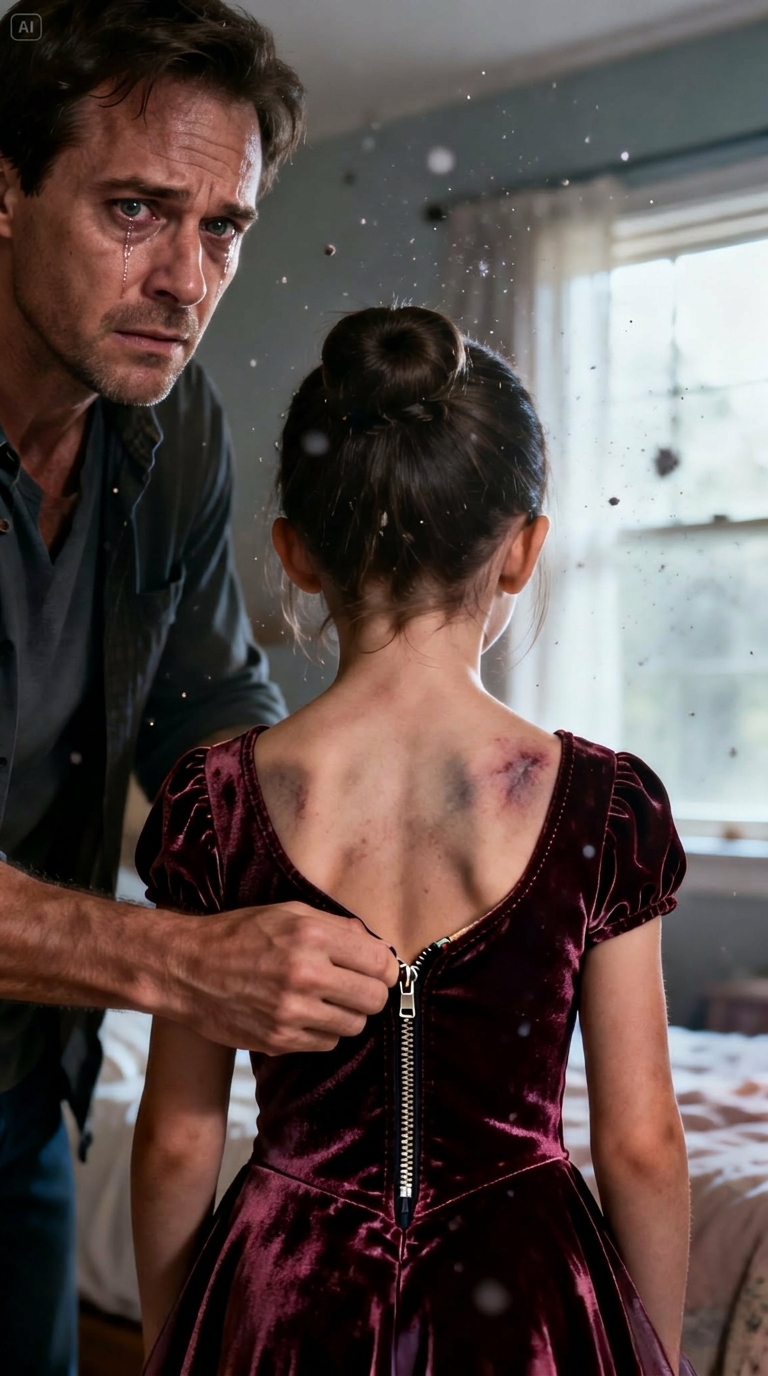
You don’t get a medal for doing the bare minimum of protecting your child. You don’t get a parade for doing what is right. But sometimes, in the quiet, peaceful moments of our new life, I think about the alternate timeline. The terrible, suffocating reality where I told her to put on her green velvet dress, smiled for the cameras, and prioritized keeping the peace over her safety.
The thought of that reality is unbearable. I am not a hero. I didn’t perform a miracle. I just did what a father is supposed to do.
I listened.
If you want more stories like this, or if you’d like to share your thoughts about what you would have done in my situation, I’d love to hear from you. Your perspective helps these stories reach more people, so don’t be shy about commenting or sharing.
✅ End of story — Part 3 of 3
← Read from Part 1