The Bride Took One Look at the Elderly Teacher Standing Quietly by the Wedding Welcome Table, Mocked Her Clothes, Called Her a Nobody, and Slapped Her in Front of Hundreds of Guests—But What She Didn’t Know Was That the “Poor Old Woman” Had Helped Build the Groom’s Entire Future, Funded His First Business When No One Else Believed in Him, and Was About to Trigger a Truth So Devastating It Would End the Wedding Before She Ever Reached the Altar
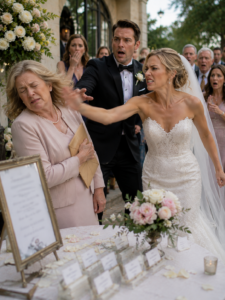
The slap echoed louder than the wedding music.
Not because it was the hardest slap anyone had ever given. It was not. I had taught public school for forty-one years in a brick building where pipes groaned in winter, ceiling tiles stained after every rainstorm, and children sometimes carried anger into the classroom the way other children carried lunchboxes. I had heard the crack of a hand against skin before. I had broken up fights in hallways. I had stood between boys twice my size when they were too hurt to know what else to do with their hands. I had held crying children after they threw chairs, slammed doors, or said the ugliest thing they knew how to say because no one had ever taught them what pain was supposed to become.
No, the slap was not loud because of force.
It was loud because of where it landed.
It landed in a grand entrance hall beneath crystal chandeliers, beside a welcome table covered in white roses, gold place cards, and little glass bowls full of sugared almonds. It landed while a string quartet played something soft and expensive near the staircase. It landed in front of two families dressed in silk, satin, tailored suits, polished shoes, diamond studs, pearl bracelets, and smiles practiced for photographs. It landed on the cheek of a retired teacher standing quietly with a gift bag in her hand.
I was that teacher.
And for one humiliating second, every eye in that grand entrance hall turned toward me as if I were the problem.
My name is Eleanor Brooks. I was sixty-eight years old that afternoon, though I had been a teacher so long that age had stopped feeling like a number and started feeling like a collection of bells. Morning bells. Lunch bells. Fire drill bells. Bells that sent children into classrooms, into hallways, into summers, into futures, into lives where some remembered me and some did not. For forty-one years, I taught public school in a low-income district most politicians remembered only during speeches. I taught reading, history, writing, basic civics, and sometimes survival, though the district never put that on my lesson plans.
I taught children who came to school hungry and children who came to school angry because hunger often puts on anger’s coat to keep warm. I taught children whose parents worked nights, children who lived in cars, children who had never owned a new pair of shoes, children who were brilliant but had been told too many times that brilliance belonged to other ZIP codes. I bought notebooks, pencils, granola bars, winter gloves, science fair poster boards, and once a pair of black dress shoes for a boy who had a scholarship interview and only sneakers with holes in both soles.
I was not rich. I never had been. Teachers do not become rich in money unless they marry well, inherit well, or leave teaching before it drains them of both youth and savings. I lived in a small white house with green shutters, a narrow porch, and rose bushes I could never get to behave. I drove a twelve-year-old sedan with a dent near the back bumper. I clipped coupons out of habit long after I technically did not need to. I owned one good winter coat, three church dresses, and a navy dress I had worn to more graduations, funerals, scholarship dinners, retirement lunches, and weddings than I could count.
That was the dress I wore to Daniel Mercer’s wedding.
It was clean and pressed. It fit me well enough. It was not fashionable, but it was dignified, and dignity matters to women who have spent a lifetime proving that modest means do not equal small worth. I wore low heels because my knees had started complaining after sixty-five. I wore my pearl earrings, the ones my younger sister Ruth gave me before she passed. They were not expensive pearls, but they had been hers, and that made them priceless to me. In my hand was a small cream-colored gift bag. Inside was a framed photograph and a handwritten letter. The photograph showed Daniel at seventeen, standing in front of our old school building with his graduation gown unzipped, his hair too long, his smile half proud and half terrified. I was beside him, holding a folded program. His mother had died the winter before, and his father had disappeared long before that. That day, Daniel had no parents in the auditorium, but he had me.
That is the part Vanessa did not know when she saw me at the welcome table.
She saw my navy dress, my low heels, my old handbag, and the careful gift bag in my hand.
She saw a poor old woman.
She did not see the beginning of the man she was about to marry.
The venue was the Westbridge Country Club, one of those places that tried very hard to make money look effortless. Everything gleamed. The marble floor reflected the chandeliers overhead. Tall arrangements of white roses stood in silver vases along the entryway, the flowers so perfect they looked almost artificial. A champagne tower shimmered near the staircase, each glass catching light as if the whole structure had been built for a magazine cover. Waiters in black jackets moved silently through the hall. A wedding planner wearing a headset and an expression of permanent crisis kept whispering into a tablet while nodding at people who looked important.
Vanessa stood near the welcome table like a queen receiving tribute.
She was stunning. I will not pretend otherwise. Some people are beautiful in a way that makes a room organize itself around them before anyone has decided whether they are kind. Vanessa had that kind of beauty. Pale skin, high cheekbones, smooth blond hair pinned low at the nape of her neck, and a silk gown so simple it had to be expensive. Tiny buttons ran down the back. Diamonds flashed at her ears and wrist. Her makeup was flawless. Her smile was perfect. But the first time I met her, months before the wedding, I had noticed that her eyes did not warm when she smiled. They measured.
That day, her smile vanished the moment she saw me.
I had arrived early because I hate making entrances. Retired teachers learn to move quietly. We spend our lives making room for others. We stand to the side while children walk across stages. We clap for every name, even the ones that were difficult all year. We move through crowds without expecting anyone to stop the room for us.
A teenage usher checked my invitation and smiled politely.
“You’re good, ma’am.”
I thanked him and took three steps toward the entrance hall.
That was when Vanessa turned.
Her eyes moved over me once, quickly and completely. Dress. Shoes. Handbag. Gift bag. Face. Age. Value.
“Excuse me,” she said, lifting two fingers as if stopping a delivery person at the wrong door. “Family entrance is on the other side.”
I stopped. “I’m here for Daniel.”
She laughed.
Not a confused laugh.
Not a polite one.
A cruel laugh dressed in silk.
“Of course you are.”
A few bridesmaids behind her snickered. They were young, pretty, and nervous in the way bridesmaids get around a bride who has made fear feel like loyalty. One of them looked down at her bouquet. Another glanced toward the wedding planner, then away.
Vanessa stepped closer.
“I’m sure you know him somehow,” she said. “But this area is for family and close guests. The general entrance is around the side.”
“I have an invitation,” I said.
She looked at the card in my hand as if it were counterfeit.
“I’m sure you do.”
Her voice had changed. It was softer now, which made it worse. Cruel people know softness can sharpen humiliation. If they yell, they look ugly. If they smile, they can make you look unreasonable for bleeding.
I said gently, “I’m not here to cause trouble.”
Wrong thing to say.
Predators hear softness as permission.
Vanessa leaned in. I could smell her perfume, something white and floral and expensive.
“Then leave quietly.”
The words slid under my skin.
I should have stepped back. I should have asked for Daniel. I should have handed the usher my invitation again and insisted someone call the groom. But old training is strong. Teachers are trained to de-escalate. Women of my generation are trained to absorb. Poor women are trained not to make wealthy people uncomfortable. So I stood there, holding my gift bag, feeling heat rise into my face.
“I’m here for Daniel,” I repeated.
Vanessa looked over her shoulder at the bridesmaids as if inviting applause.
“People like this always say that.”
Then she said the sentence I will never forget.
“This wedding cost more than your whole life probably did. Don’t stand in my photos.”
The welcome area went still.
People heard it.
They absolutely heard it.
That is the thing about public cruelty. Once an ugly sentence is spoken in a room full of witnesses, it does not disappear. It settles on everyone. It asks each person silently: What kind of human being are you going to be now?
I felt my face burn. Not because I was ashamed of who I was. I was not. I had spent too many decades standing in front of chalkboards, watching children learn to read, watching young people survive impossible circumstances, watching former students return in uniforms, scrubs, suits, work boots, and sometimes grief. I was not ashamed of being a retired teacher. I was not ashamed of my modest life. I was not ashamed of my old handbag or my navy dress or the fact that my gift did not come from the registry.
My face burned because I knew exactly what Vanessa had done.
She had tried to purchase dignity by spending someone else’s worth.
I said quietly, “You don’t know me.”
Vanessa smiled.
“I know enough.”
Then she slapped me.
Hard enough to knock my glasses sideways.
Hard enough that the gift bag slipped from my hand and struck the marble floor with a soft, heartbreaking little sound.
Hard enough that two cousins near the champagne tower gasped out loud.
My glasses fell, skittering across the marble.
Someone whispered, “Oh my God.”
Someone else lifted a phone.
And Vanessa, still wearing that perfect bridal smile, said, “Somebody remove her before she embarrasses us.”
For one second, I was not sixty-eight. I was twenty-four again, standing in front of my first classroom while a boy with bruises on his arms called me a stupid old lady because I asked him to sit down. I was thirty-six, telling a principal that no, I would not stop advocating for the girl whose mother could not read the forms. I was fifty-two, sitting beside Daniel Mercer in a guidance office while a counselor suggested vocational training because “college might be unrealistic.” I was every version of myself who had ever been underestimated by people who mistook kindness for weakness.
I bent down slowly and picked up my glasses.
That was the moment everyone expected me to cry.
Or yell.
Or beg.
I did none of those things.
I straightened, fixed my frames, and looked at Vanessa the way I used to look at first-graders right before they admitted they had broken the classroom globe.
Calm.
Quiet.
Certain.
Because while Vanessa thought she was humiliating a nobody, I had already recognized the deeper problem.
She did not know Daniel at all.
If she had, she would have known there were exactly three people on earth he would never allow to be disrespected: his late mother, his younger sister Ava, and me.
Daniel Mercer walked into my classroom at seventeen years old.
He was thin, exhausted, and angry at the world in the particular way grief makes teenagers angry when nobody has given them permission to be broken. His father had disappeared years earlier, leaving behind unpaid bills, a truck loan, and the kind of absence that teaches children not to expect rescue. His mother, Lila, was the person who held their little family together until illness took her apart. She died the previous winter after a long, expensive struggle that left Daniel and Ava with more memories than resources.