My mother moved through the crowd like a docent in a museum of Meredith’s life.
“Meredith picked the wood herself. Isn’t she talented?” she’d say, running a hand along the mantel. “This layout was entirely her idea. You know, she’s always had such an eye for design.”
I stood by the drink table with a plastic cup of sparkling water and practised the art of existing without drawing attention.
“So,” my mother said eventually, appearing at my elbow, “still renting that little place?”
“Yes, Mom.”
“Well, at least you’re saving, right?” Her voice dripped sympathy. “You are saving?”
My promotion check was sitting in my savings account. My investment portfolio was quietly compounding. But I said only, “I’m managing.”
Meredith floated over, wineglass in hand. “You know,” she said, “if you’d listened to me about real estate a few years ago, you’d have equity by now.”
“I’m fine, Meredith,” I said, keeping my tone neutral.
“I’m just saying.” She raised her hands, martyr-style. “You don’t have to be defensive.”
My mother patted her arm. “Your sister bought this kitchen herself,” she said. “That’s what a plan looks like, Harper.”
Later, in the hallway, Todd—Meredith’s husband—stopped me. He was holding two beers, his tie already loose.
“Your mom talks a lot,” he said, handing me one. “Don’t believe everything.”
He gave a half-shrug and walked away. It was the kindest thing anyone in that house said to me all night.
By then, my mother had settled into a particular rhythm: she’d call every few weeks with unsolicited advice and veiled criticism.
When I turned thirty-one, the calls took on a new edge.
“You’re thirty-one,” she texted one day. “No house, no husband. I’m worried, sweetheart.”
I was deep in a server migration, my brain juggling IP ranges and downtime windows. I let the text sit.
Twenty minutes later, a voicemail appeared from an unfamiliar number. When I played it back, a man’s cheerful voice filled my tiny apartment.
“Hey, Harper, this is Greg—Greg Whitaker. Your mom gave me your number. She says we’d really hit it off. I’m in commercial insurance. Got a place over in Beaverton. Anyway, give me a ring when you get the chance.”
I deleted the message and texted my mother.
I didn’t ask you to set me up.
He owns his house outright, she replied. He’s a catch.
Good for him, I wrote back.
You’re going to end up alone, she sent.
I stared at the message for a long time, feeling… not hurt exactly. Tired. So tired of being cast as a problem to be solved.
I locked my phone, turned back to the server migration, and finished the deployment with zero downtime.
That night, with my laptop balanced on my knees and a cooling mug of tea on the coffee table, I opened Zillow.
Not for Greg. For me.
I didn’t expect to find anything right away. The numbers wouldn’t make sense—not in a way that aligned with the strict columns of my spreadsheet.
But something had shifted. My mother’s words, meant as a warning, had landed differently this time.
No house. No husband.
She meant it as a verdict. I decided to treat it as a blank page.
Six months later, everything accelerated.
Diane called me into her office, closed the door, and said, “You’re getting a new title. Senior manager. Bigger team, bigger portfolio. And the raise that goes with it.”
Salary: $145,000 plus bonus.
The index fund I’d been feeding for two years had quietly doubled.
My spreadsheet—the one I’d built at two in the morning that night after Uncle Frank’s call—finally had numbers that looked like something tangible.
On Saturdays, I started driving through neighborhoods with a coffee in my cup holder and my phone on silent. No real estate agents, no flyers. Just me and the quiet act of looking.
I wasn’t searching for granite or shiplap or a perfect kitchen island I could photograph for Instagram. I was looking for a feeling.
I found it one pale, cold morning in the West Hills.
The house sat halfway up a hill, tucked among Douglas fir forest and maples, with a wraparound deck that looked out over a valley. The photos on the listing showed floor-to-ceiling windows in the living room, hardwood floors, a stone fireplace. The kitchen had an island big enough to seat six without anyone getting stuck at the kids’ table.
Four bedrooms. Three bathrooms. A little worn at the edges, in a way I liked.
The price made my stomach lurch: $950,000.
I ran the numbers—then ran them again. Called the financial advisor I’d started seeing once a year when my accounts had first crossed six figures.
“You can afford it,” he said, after walking through my savings, investments, and projected bonus. “Comfortably. You’re conservative by nature, Harper. That’s not a bad thing. Just don’t let it stop you from enjoying what you’ve built.”
Enjoy. That word felt foreign.
I called the listing agent, made an offer, negotiated counteroffers by email from my kitchen table while the faucet dripped in the background. Signed documents in my browser at midnight between incidents.
Three weeks later, I sat at a long laminate table in a bland office with fluorescent lights and signed my name forty-seven times.
The title agent slid a small envelope across the table. Inside was a single key on a plain metal ring.
“Congratulations,” she said. “You’re a homeowner.”
I walked out into the weak winter sunlight, sat in my car, and held the key in my palm. It was warm from the agent’s hand. My fingers closed around it like it might evaporate if I opened them too soon.
I didn’t call my mother. I didn’t text Meredith. I didn’t post anything.
I drove straight to the house.
The first time I unlocked that front door, the sound was surprisingly quiet. A soft clack, a subtle give. The door swung inward and the smell of empty space and dust greeted me like a blank page.
The living room was even bigger than it had looked in the photos. The wall of glass framed the valley beyond—a sweep of green and gray, Douglas firs swaying, distant rooftops like someone had scattered small stones across the floor of the world.
My footsteps echoed on the oak floors. The place was almost painfully empty: no furniture, no art, just sunlight striping the walls and my breath fogging a little in the cold air.
I stood there a long time, just listening.
I had the key. I had the deed. What I didn’t have was any desire to hand this to my family as another stage they could perform on.
I moved in small. No big moving truck, no “new house!” photos. Just my Civic packed with whatever mattered—clothes, laptop, a box of books, the cast iron skillet that had survived four apartments, the dented French press that made coffee that always tasted faintly of burnt hope.
For two weeks, my bed was a mattress on the floor and my couch was a stack of boxes with a blanket draped over it. I ate standing at the kitchen counter with paper plates because I hadn’t found the right table yet.
On Saturdays, I drove to thrift stores and estate sales. I bought a solid maple table with old knife scars and water rings. Six mismatched chairs that somehow belonged together. A couch so deep you could disappear into it with a book and not resurface for hours.
One weekend, I painted the wall behind the fireplace warm white, the kind of color you only notice when it’s wrong. My arms ached by evening, paint flecks on my wrists and in my hair. I stood back, roller in hand, and felt something settle in my chest.
This, I thought, is mine.
Diane was the first person I invited over.
She stepped into the entryway, looked up at the vaulted ceiling, then walked slowly into the living room. Her eyes tracked the glass wall, the view, the light.
“This is stunning, Harper,” she said finally. “Does your family know?”
“Not yet.”
She studied my face. “You’re not punishing them by hiding this,” she said gently. “You’re protecting yourself.”
“Maybe.” I poured us wine into the only two real glasses I owned. “Or maybe I just don’t want to hand them another thing to ruin.”
She didn’t argue with that.
Later that night, after she’d left, I unpacked the last box I’d been ignoring. It was just office stuff, mostly—folders, an old planner, a mug a coworker had given me with a joke about firewalls printed on the side.
On top was the folder from the title company. I put the deed into the top drawer of my new desk.
Then I took out the manila envelope that had arrived from Uncle Frank a week earlier and set it next to the deed.
There was a second document in that drawer now, but I wasn’t ready to open it. Not yet.
In March, Meredith’s daughter, Lily, turned four. Birthday party at Meredith’s house, naturally. Balloons in pastel shades, a rented canopy in the backyard, a Pinterest-perfect cake iced to look like a unicorn.
I brought a stuffed elephant and a card with a twenty inside. Lily hugged my leg, shrieked “Auntie Harp!” and ran off. That part was easy. Kids haven’t learned to rank people by their real estate yet.
My mother, on the other hand, had apparently been practicing new material.
“This is Harper,” she told her new book club friends, one manicured hand resting on my shoulder. “She’s still finding her path.”
I laughed lightly. “I’m a senior manager in cyber security, Mom.”
She gave that airy little laugh that meant she hadn’t heard a word. “Those tech titles, they change every week, don’t they?” she said to the women. “Anyway, she has such a good attitude about it.”
Meredith drifted past holding a plate of cupcakes. “At least she’s got that,” she said.
I smiled and retreated to the edge of the yard, where Uncle Frank sat in a lawn chair with a paper plate balanced on his knee.
“The bank statement I sent you,” he said quietly as I sat down. “Your mother’s signature is right there. Date, amount, account number. You read it?”
“Not yet,” I admitted. “Soon.”
“Take your time,” he said. “It’s not going anywhere.”
Across the yard, my mother’s voice carried over the noise of kids and relatives.
“Frank,” she called, just loud enough for other people to hear. “Don’t fill her head with your nonsense. You always dramatize everything.”
He took a sip of lemonade and didn’t answer.
That night, back in my house on the hill, I made tea and sat at the scarred maple table. The house was quiet except for the creak of old wood and the occasional sigh of wind against the glass.
I opened the drawer and took out the envelope.
The bank statement was printed on bland paper, the kind that looks harmless until you actually read it.
Pacific Northwest Federal Credit Union. Custodial account opening date: September 3, 2004. Beneficiary: Harper Elaine Holloway. Custodian: Gloria A. Holloway.
Monthly deposits in neat little rows. Fifty dollars. One hundred. Two hundred. As the years went on, the amounts grew. I imagined my grandmother sitting at her kitchen table, writing checks with hands that smelled like lavender.
By March of my senior year, the balance read $42,380.
Then a single withdrawal: March 14, 2013. Amount: $42,380. Authorized by: Gloria A. Holloway. Transferred to joint checking account ending in 7741.
My mother’s signature sat at the bottom of the page. The same neat cursive that had signed permission slips and birthday cards—“Love, Mom” looping confidently.
Two weeks later, my sister closed on her house.
I folded the statement, placed it back into the envelope, and set it gently beside the deed.
Then I called Uncle Frank.
“I read it,” I said. “And I’m not going to yell. I’m not going to beg. I’m just going to be ready when the moment comes.”
“That’s my girl,” he said. His voice sounded like it did when I was six and he’d taught me how to ride a bike in one afternoon because I refused to give up.
“Easter’s eight weeks away,” he added. “Meredith is hosting twenty-five people.”
“I know.”
“I might need you there,” I said.
“I’ll be there,” he replied, without hesitation.
Easter in Oregon arrived with that particular brand of weather that can’t decide whether it wants to be merciful or mean. Morning was cold and gray. By noon, the sky had cracked open into patches of blue.
Meredith’s house was overflowing by the time I pulled up. Cars lined the cul-de-sac. Through the front windows, I could see bodies moving, platters passing, my mother’s silhouette at the center of it all, directing traffic like a conductor.
I sat in my car for thirty seconds, watching my own reflection in the rearview mirror. My hair pulled back, navy blouse, jeans. No statement jewelry. No sharp edges. I didn’t want armor. I wanted clarity.
Inside, the house looked like a spring catalog. Tulips in every vase. Linen napkins folded just so. Ceramic rabbits arranged in a centerpiece on the table. My mother’s touch was on everything—her love language expressed in place settings and performance.
“Harper, you look thin,” she said within three minutes of my arrival, pinching my arm lightly. “Are you eating?”
“Happy Easter, Mom,” I replied.
“Doesn’t she look thin?” she said to Patrice, who gave a neutral little nod.
I poured myself sparkling water and leaned against the kitchen island, watching the choreography. My mother gave tours of Meredith’s life:
“Meredith just had the living room repainted,” she told a cousin. “Farrow & Ball. She picked the shade herself.”
“Those floors are original oak. Meredith had them refinished. They add so much value.”
“The deck extension was Meredith’s idea. She has such vision.”
Todd drifted past me and murmured, “Brace yourself. She’s been rehearsing a toast since Thursday.”
I believed him.
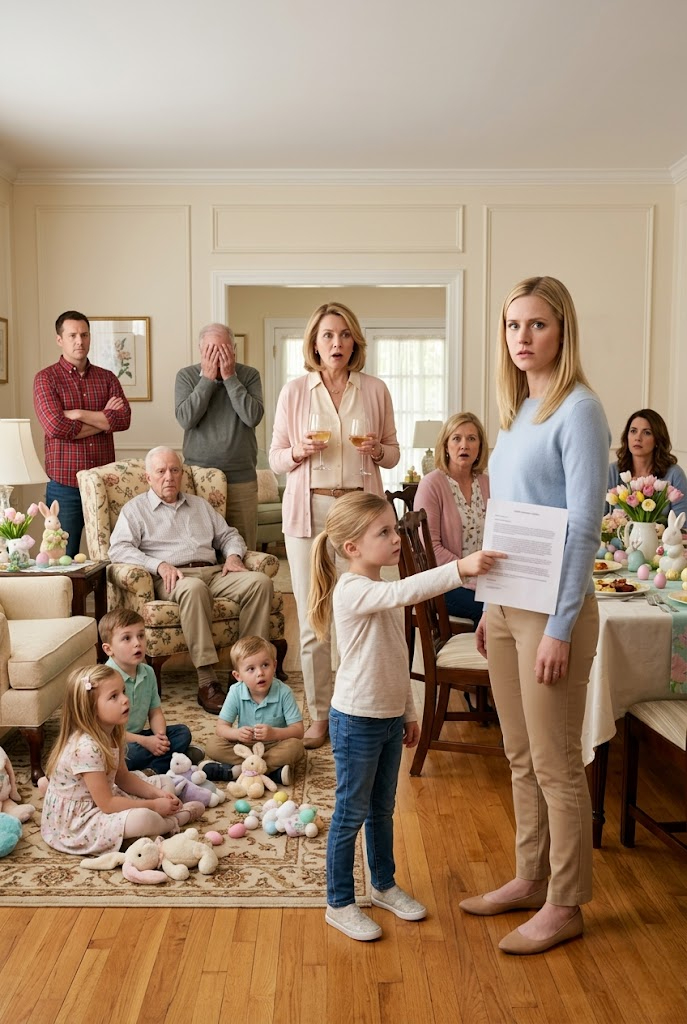
After dinner, everyone migrated to the living room. Kids sprawled on the rug, adults claimed chairs around the perimeter. My mother stood in the center, wine glass raised, cheeks flushed.
“I just want to say a few words,” she began.
She thanked Meredith for hosting, of course, weaving her gratitude into a small speech about hard work and good decisions. “This house, this life you’ve built… this is what discipline looks like,” she said.
The room applauded. Meredith glowed.
Then my mother turned to me.
“And Harper,” she said, voice softening into that register that sounded compassionate but always ended with bruises. “Honey, we’re all rooting for you. One day you’ll get there.”
There it was. The gentle humiliation. The performative concern.
A few people laughed—short, uncomfortable sounds. Cousin Laura looked at her shoes. Uncle Dennis coughed.
Meredith leaned toward me from the adjoining chair. “There’s no shame in renting,” she whispered, loud enough for at least five people to hear. “We all start somewhere.”
Patrice reached over, patted my arm. “Your mom told me you’re looking for something cheaper,” she said. “No shame in downsizing. I know a wonderful landlord in Milwaukie—”
“I’m not looking for a cheaper place, Patrice,” I said.
“Oh, honey, there’s no shame in asking for help.”
“I didn’t ask.”
My mother’s chin lifted. “Your pride will be your downfall, Harper.”
I set my glass down very carefully.
I didn’t answer. Not yet.
Because I had realized something in the weeks leading up to that day: my mother’s power over my life came down to two things—money and narrative. She’d taken one from me thirteen years ago. The other she’d been controlling ever since.
The money was gone. But the story? That, I could take back.
About ten minutes after the toast, as conversations broke up into smaller clumps and people started drifting toward dessert, I stood, slipped on my jacket, and headed toward the front hallway.
In the living room behind me, my mother said in a stage-whisper, “Harper always leaves early. It’s just her way.”
I paused in the doorway, turned back, and spoke just loud enough to carry over the background noise.
“Actually, Meredith,” I said. “I wanted to ask if you’d like to come over for tea next Saturday. I moved into a new place.”
The room shifted. Not dramatically. Just a subtle drop in pressure, the way the air changes before a storm.
My mother blinked. “A new place? What new place?”
“I just moved,” I said. “Nothing big. Saturday at two? I’ll text you the address.”
Meredith looked genuinely confused, for once. “You moved and you didn’t—when did you—?”
“It happened fast,” I said lightly. “I’ll send you the details.”
“Sure,” she said slowly. “I’ll come.”
“Bring Todd if you want,” I added. “Thanks for hosting. Dinner was lovely.”
I stepped outside before anyone could throw more questions at me.
As the door closed, I heard my mother’s voice trailing after me. “She’s probably renting another apartment,” she said. “You know how she is.”
But I also caught Uncle Frank’s low chuckle from his corner chair. When I glanced back through the window as I crossed the lawn, he was watching me go.
He was smiling.
Saturday came in with clear skies and bright light, the kind that makes everything look more honest.
I spent the morning cleaning, not because the house needed it, but because I needed something to do with my hands. I vacuumed floors that didn’t have crumbs. I wiped down countertops that already shone. I arranged two ceramic mugs on the kitchen island like it mattered.
Then I baked scones—lemon and blueberry, from a cookbook I’d found at Goodwill during my first month in the studio apartment. The recipe was dog-eared and spattered with old batter. The scones came out golden and slightly uneven, which is to say perfect.
By one-thirty, the house smelled like sugar and citrus. Sunlight poured through the living room glass and painted the floor in honey-colored rectangles. Beyond the deck, the valley stretched out under a spread of clouds.
I changed into a cream sweater and jeans. Light makeup. No lipstick so bright it looked like I was trying to prove anything.
This wasn’t a performance. The house would do the talking.
At 1:45, my phone buzzed.
OMW, Meredith wrote. What’s the address again?
I sent it. A beat later:
West Hills? That’s a nice area. Are you housesitting? Lol
I put the phone down without answering and poured hot water into the teapot, set it on the maple table next to the plate of scones. Two chairs, two napkins, nothing fancy.
At 2:03, I heard tires on gravel.
I walked to the front door and opened it just as Meredith was stepping out of her SUV.
She stood in the driveway for a full ten seconds, keys dangling from her fingers, neck craned back to take in the house—the slope of the roof, the wide front steps, the big windows catching light.
Her face was an odd mix of disbelief and something almost like vertigo, like she’d suddenly lost her bearings on a map she thought she’d memorized.
“Hey,” I said, leaning against the doorframe. “Come in. Tea’s ready.”
She walked up the path slowly, her heels clicking on the stone. In the entryway, she stopped dead.
Her gaze worked its way up the vaulted ceiling, over the iron railing of the staircase, across the living room to the wall of glass and the valley beyond.
“This…” she said slowly. “This is your place?”
“Yes.”
“You bought this?”
“I did.”
She walked into the kitchen like someone in a dream, touching the granite island with her fingertips, opening a cabinet and closing it again, like she needed to confirm that dishes were really inside.