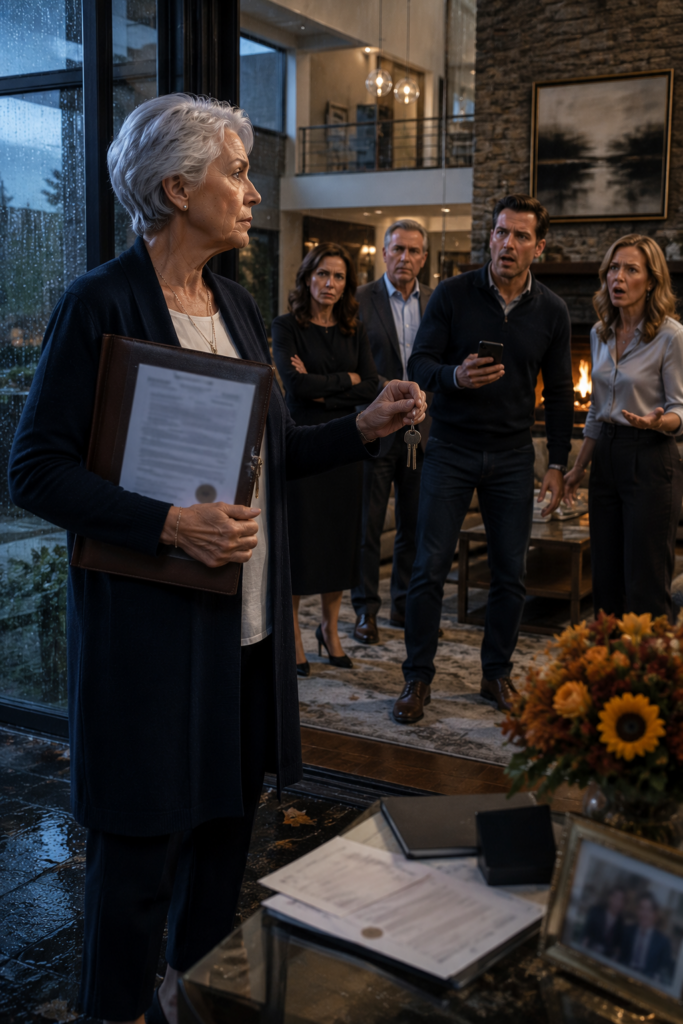
“I’m your son.”
The words hung between us.
I looked at him—thinner than a month ago, exhausted, frayed.
“You were my son when you excluded me from Thanksgiving,” I said, each word measured and cold. “You were my son when you let Richard manipulate your wife against me. You were my son when you spent eight years treating me like a bank. Now you are someone who owes me money. Pay what you owe.”
I closed the door.
He stayed in the driveway for a while.
Then he left.
Friday morning arrived. Deadline day.
I sat at my desk, phone on speaker with Linda Martinez, waiting to see if the money transfer would hit my account by four.
“They might not make it,” Linda said. “Are you ready for court?”
“I’m ready for whatever happens.”
At 3:32, my phone buzzed with a bank notification.
Transfer received: $25,000.
Not the full amount.
But enough to show they had bled themselves dry trying.
An email arrived minutes later.
Mom,
We sent everything we could. We sold Sarah’s car, sold furniture, emptied savings, and borrowed what we could.
We are still $3,000 short. Please give us thirty days for the rest. I know we don’t deserve flexibility. I know I don’t deserve anything from you. But we will pay it.
Danny
I called Linda.
“They sent twenty-five,” I said. “Three short. Danny’s email asks for thirty days.”
“Your options are accepting it as full settlement, demanding immediate payment of the balance, or creating a formal loan for the shortfall.”
“Option three.”
“Terms?”
“Twelve months. Eight percent interest. Automatic payment. Legal agreement.”
Linda paused.
“That’s harsh, Margaret.”
“The interest is fair for risky debt to borrowers with proven poor judgment.”
“I’ll draft it.”
The loan agreement arrived in my inbox Sunday morning. I read every word, signed it digitally, and sent it to Danny without explanation.
No nice email.
No softening words.
Just the contract.
Cold and binding.
What I learned later was how they scraped together the twenty-five thousand.
Sarah’s mother arrived with a bank check for seven thousand dollars and the kind of disappointment that does not need raised volume.
“That is what we can spare without damaging retirement,” she told her daughter. “You will pay it back within two years. Five percent interest. Monthly payments. Understood?”
Sarah barely whispered, “Mom—”
“I do not want to hear it. Your father and I raised you better than this. Treating family like piggy banks. Listening to Richard’s poison. I am ashamed, Sarah. Truly ashamed.”
They borrowed four thousand dollars from friends, a couple from Sarah’s work. The husband insisted on a written agreement.
“Nothing personal,” he told Danny. “Just protecting myself.”
Danny signed and watched another friendship die in the space between trust and paperwork.
The Honda brought twelve thousand dollars at a used car lot, far below what it was worth. Furniture brought another two. Every savings account emptied. Every safety net gone.
They had bled themselves dry and still come up short.
Monday morning at ten, the digital signing notification arrived on Danny’s phone. He opened the document at his kitchen table, hand shaking slightly as he scrolled through legal language that made his failure official.
Eight percent annual interest.
Monthly payments of $375.
Twelve months.
Every word a reminder that he was not a son getting help.
He was a borrower repaying a debt.
He signed.
Tuesday morning, I received the signed agreement. I opened it, looked at the signature, and saved it to my legal papers folder.
Danny Gray was now legally required to pay me $375 monthly for twelve months.
Not as son to mother.
As debtor to creditor.
The change was complete.
The first payment arrived on a Tuesday morning in early December.
Payment received: $375.
I marked the calendar box green.
Paid.
Book balanced.
The victory felt empty, like winning an argument with someone who had stopped listening.
Five weeks had passed since Danny signed the loan agreement. Five weeks of monthly payments arriving exactly on time. Each one automatic, cold, businesslike. The money mattered less than what it meant. A son paying his mother back like a bank. Duty replacing relationship.
Carol kept me informed without my asking. Small things she noticed. Casual mentions.
“Saw your son and daughter-in-law at Walmart yesterday,” she said during a call. “They looked rough. Buying generic everything. Sarah was comparing tomato soup prices. Danny’s lost weight. Stress weight, not healthy weight. The fancy lifestyle is gone.”
“That is what happens when you live beyond your means and lose your money backup,” I said. “They’re learning.”
“You planning to reach out? Holidays are coming.”
“When people learn lessons the hard way, stopping the lesson does not help. They need to sit with it.”
I meant it.
Still do.
But something about that first loan notification sat differently in my chest.
The consequences had spread beyond Danny and Sarah. Word had gotten around. Small community things. Someone knowing someone. Danny’s younger coworker had apparently asked him about “family trouble” with that careful tone people use when they know more than they are saying. Danny’s reputation had shifted. No longer the successful young manager with the generous mother. Now he was the man who had mishandled his own mother. The warning story.
Then the certified letter arrived from Richard Morrison.
Two pages. Angry capital letters. Wild accusations.
He accused me of financial abuse. Claimed I used wealth to force submission. Threatened to report me to adult protective services, the state attorney, and “every agency that protects families from predatory elders,” which was almost creative enough to admire.
I called Linda and read selected lines.
“Adult protective services,” I said. “For a sixty-year-old woman protecting herself from freeloading relatives. That is imaginative.”
Linda’s laugh carried professional scorn.
“I’ll write a cease-and-desist that will make him think twice. His bankruptcy and documented manipulation destroy any credibility he thinks he has.”
“Mention possible defamation claims.”
“I planned to.”
I filed Richard’s letter in a folder labeled Morrison Harassment and forgot about it.
He was noise.
Not the story.
Then, one Thursday evening, my email chimed.
Danny.
Subject: No excuses.
I sat at my desk for a full minute before opening it.
Mom,
I have written and deleted this email more times than I can count.
I am not asking you to reduce the debt, undo the contract, invite us back into your good graces, or pretend anything is okay. I am writing because I owe you the truth without excuses.
I used you for years.
I let Sarah and Richard convince me that your help was control because that made it easier to take the help without feeling guilty. I accepted money, gifts, wedding support, car money, furniture, and then the house, and I told myself it was what mothers did. I never asked what it cost you. I never asked what you gave up. I never protected your place in my life.
When I sent that Thanksgiving text, I knew it was wrong. I knew Dad would have been ashamed of me. I still sent it because I did not want to fight with Sarah or Richard. I chose cowardice and called it peace.
You deserve better than the son I have been.
I do not know if I can ever repair what I broke, but I am going to try by doing the only thing I can do now: pay what I owe, stop making excuses, and learn how to be someone you do not have to protect yourself from.
I am sorry, Mom.
Danny
I read it three times.
Then I closed the computer and walked away.
Friday, I opened a reply box and typed five different versions.
Forgiveness.
Coldness.
Careful acceptance.
Conditional reconciliation.
Complete rejection.
I saved all five and sent none.
Let quiet do its work.
Two weeks passed.
Then I drove to the park overlook north of Scottsdale because my house could no longer hold my thinking. The desert stretched toward mountains that did not care about family drama, legal agreements, or whether a mother could forgive a son who finally learned the name of what he had done. I sat on my car hood for two hours with Danny’s email open on my phone.
The question was not whether he deserved forgiveness.
Forgiveness, I had learned, is not a trophy you hand someone for saying the correct words.
The question was whether I wanted to let the door remain locked forever.
A bird circled overhead, patient and precise.
I closed my phone and drove home.
Another week passed before Danny came.
His Civic pulled into my driveway at 1:58 on a Tuesday afternoon. He did not get out. He sat there, head down, hands folded, no phone in sight. I watched from the upstairs window for eighteen minutes.
Then I went downstairs.
I left the kitchen door open. Conversation, yes. Privacy, no.
When I opened the front door, Danny stood quickly.
“Thank you for not turning me away,” he said. “I know I don’t deserve—”
“Living room.”
We walked without speaking. I sat across from him, not beside him, and waited.
“I don’t know where to start,” he said. “I practiced this a hundred times, but now I’m just going to say it. I used you. I treated you like a bank instead of a person. I let Sarah and Richard poison my thinking because their version let me keep taking without admitting what I was doing. I let you be hurt, excluded, disrespected, and I didn’t defend you because it was easier not to.”
I stayed quiet.
Silence can be a confession’s best witness.
“The house should have been a moment of thankfulness,” he continued. “Instead, I let Richard decide whether you belonged at Thanksgiving. I chose a manipulative man I barely knew over the woman who raised me. When you took the house back, I was furious because I thought I deserved your money without your respect.”
His voice cracked.
“I was wrong about everything.”
“What changed?” I asked. “The consequences or the understanding?”
Tears came then.
Real ones.
“The consequences first,” he admitted. “The money. The house. The shame. Selling the car. Borrowing from people who looked at me like they finally knew who I was. But somewhere in that mess, I realized you weren’t punishing me. You were showing me the truth I had been avoiding—that I’d become someone Dad would be ashamed of.”
I leaned forward slightly.
“You are my son, Danny. I never stopped loving you. Even when I took back the house, demanded repayment, refused your calls. That was love, not cruelty. Letting you continue using me would have been cruelty to both of us.”
He covered his mouth.
“Can you forgive me?”
The question hung between us like smoke.
“Eventually, maybe,” I said. “But forgiveness does not mean things go back to how they were. Trust is not rebuilt with sorry. It is rebuilt with steady actions over time. You want a relationship with me? Earn it. Show me, month after month, that you have changed. No big gestures. No dramatic promises. Just steady, respectful behavior.”
Danny nodded, wiping his eyes.
“I understand. Sarah wants to apologize too. She has been going to counseling with me. We are working on the entitlement, the manipulation, the damage Richard did, the damage we allowed. She knows she played a huge role.”
“She can apologize when she is ready to tell the truth without using her father as a shield.”
He nodded.
“She knows.”
I extended my hand.
A handshake.
Not a hug.
“Coffee next week,” I said. “Public place. One hour. We’ll see how it goes.”
Danny took my hand with gratitude flooding his face.
“Thank you, Mom,” he whispered. “For not giving up on me completely.”
Small steps.
Careful progress.
Months later, I accepted an invitation to dinner at their apartment.
Not the house they had expected. Not the house I had taken back. A modest apartment complex with tired landscaping, old cars in the lot, and stair rails that needed paint. Danny’s Civic sat in spot 143. No covered parking. No Honda for Sarah anymore.
I climbed the outside stairs carrying nothing.
No wine.
No flowers.
No gift.
This was not celebration.
It was a careful truce.
Sarah opened the door before I knocked, clearly watching through the peephole.
“Margaret,” she said. Real warmth. Visible nervousness. “Thank you for coming. I know this isn’t easy. Please, come in.”
The apartment told the story of consequences. IKEA furniture where expensive pieces used to stand. Blank walls where art had hung. A folding dining table set for three with mismatched plates that spoke to budget shopping and humility learned through need.
“It’s not fancy, Mom,” Danny said, setting down a serving dish. “We’re adjusting to different circumstances, but the company is what matters, right?”
“Fancy never mattered to me,” I said. “Respect did.”
Dinner was simple. Roasted chicken. Vegetables. Sarah’s hands shook slightly while serving—not from fear, I think, but from the weight of knowing this meal might be a second chance or final failure.
Halfway through, Sarah set down her fork.
“Margaret, I need to say something I should have said months ago. I am sorry. Not just for Thanksgiving, though that was inexcusable, but for years of taking advantage of your kindness. I let my father poison my thinking. I convinced myself you were controlling when really you were a mother who loved her son. I treated your gifts as duties, your help as entitlement, and your presence as inconvenient. I was wrong, and I am ashamed of the person I became.”
I watched her eyes, her body language, testing for rehearsed acting versus real emotion.
“What changed, Sarah?” I asked. “The consequences or your understanding?”
“Both.”
No hesitation.
“I won’t pretend losing everything was some spiritual awakening. It was terrifying and humiliating. But somewhere in that fear, I had to look at who I had become. Counseling helped. Danny helped. Seeing my father’s manipulation from outside his control helped. I realized I traded your respect for his approval, and his approval was worthless.”
Danny reached for Sarah’s hand.
“Mom, you taught me something these past months I should have learned as a kid. Strength isn’t just providing for people. Sometimes it’s refusing to. You showed dignity by walking away from people who didn’t value you. I want to be that kind of strong.”
I set down my fork and gave them my complete attention.
“I appreciate the words,” I said. “But I need you to understand something clearly. This is your last opportunity. I am sixty. I do not have twenty years to see if you have changed. I have maybe, if I am lucky, fifteen good years left. I will not spend them being used, manipulated, or disrespected. I love you both—yes, Sarah, even you, because you are my son’s wife and you are working on yourself. But love does not mean accepting abuse. If this happens again, if either of you falls back into old patterns, I am done. No drama. No arguments. Just boundaries that do not bend.”
They stayed silent for twenty-five seconds.
Digesting the weight of the words rather than immediately responding with promises.
That silence convinced me more than any reassurance could have.
“We understand,” Sarah finally said. “You shouldn’t have to say that. But we earned the warning.”
“Not in words,” I said. “In actions.”
Danny nodded. “We’ll show you.”
The conversation shifted to lighter topics. Danny asked what I had been doing with my time now that I was not managing their chaos.
“Actually,” I said, “I bought property.”
Both of them looked up.
“A small cottage near Flagstaff,” I continued. “Nothing fancy. Just a place to get away. I’m learning to spend time with people who value me, which turns out to be a shorter list than I thought. Quality over quantity.”
Sarah’s interest seemed real.
“That sounds perfect for you. Private. Peaceful.” She hesitated. “Would you ever invite us there?”
“Maybe someday,” I said. “If we get there. It’s a place for people I trust. Trust is still being rebuilt. But it is possible. That is more than I could have said two months ago.”
At the door, Danny extended his hand.
“Same time next month? Sarah makes a good meatloaf.”
I shook his hand.
Not hugging yet.
“Next month. We’ll see how it goes.”
“Thank you for giving us the chance,” Sarah said. “We won’t waste it.”
“See that you don’t.”
I drove home through quiet Phoenix streets, windows down, January air cool against my face. The revenge had served its purpose, though I no longer liked that word for it. It was not about destroying them. It was about teaching consequences, restoring dignity, and setting boundaries that protected the person I had forgotten to protect.
Me.
Linda had helped me update my will the week before. Danny remained my heir, but with trust protections and conditions. No more blank access. No more assumptions. No repeat of being used under the name of love.
The cottage purchase had finalized.
My personal safe place.
Invitation only.
My rules.
My peace.
Regular but measured contact would continue. Monthly dinners, occasional coffee, rebuilding without pressure or money strings. Richard remained forever excluded. Sarah had cut off contact with him, and he had become irrelevant to our lives in the way manipulators often do once their audience stops applauding.
I did not feel victory as much as peace.
Not because they had suffered.
Because I had remembered my own worth.
Sometimes love means walking away.
Sometimes dignity means deciding who is allowed to walk back.
And sometimes a mother has to stop being the place everyone takes from so her family can finally learn what it means to give.
THE END.
✅ End of story — Part 3 of 3
← Read from Part 1