The email arrived at 2:13 on a Tuesday afternoon, between a budget meeting I did not want to attend and a contractor call I had been avoiding for three days because I already knew he was going to ask for more money.
Subject: RE: 1247 Coastal Highway — Sale Pending.
I almost deleted it.
That is the honest beginning. Not because I was careless with real estate correspondence, and not because the address meant nothing to me. It meant everything to me.
Too much, maybe. But I was tired, and the subject line looked like one more automated update from one more zoning office or environmental consultant or architectural review board member who had discovered another form they should have asked for six months earlier.
The coastal project had trained me to expect obstacles disguised as paperwork.
I was sitting alone in my office downtown, the door half closed, the November light outside already fading into that flat gray that makes every window look like a screen. My coffee had gone cold. A stack of permit revisions sat to my left. On my monitor, a spreadsheet tracked contractor estimates, preconstruction deposits, drainage modifications, environmental mitigation credits, and a dozen other categories that had consumed my life for years. My phone buzzed with a family group chat I had muted at lunch because my younger sister, Clare, had announced another “financial emergency” and my mother was performing panic in fourteen separate messages.
I clicked the email because avoidance had never saved me from anything.
Dear Miss Chin,
We are representing the purchaser of the above-referenced property. Please contact our office regarding commercial zoning transfer procedures. Closing scheduled for November 18th.
Sincerely,
Jennifer Walsh
Thompson & Associates
For a few seconds, I did not move.
Not because I did not understand the words. I understood every word individually. Purchaser. Property. Commercial zoning transfer. Closing. November 18th. Six days away. The problem was that the words did not belong together.
1247 Coastal Highway was not for sale.
I owned 1247 Coastal Highway.
I had owned it since 2016, when my grandmother left it to me with a handwritten note folded inside her will that said, Sarah knows what this place can become. Let her build something that lasts.
It was a narrow beach lot in San Aurelia, a California coastal town that had spent twenty years trying to decide whether it wanted to remain quaint or become expensive.
When my grandmother bought it in the eighties, it held a weather-beaten bait shop, a cracked parking pad, and a view of the Pacific that made even practical people sentimental. By the time she died, the bait shop had been boarded for years, the parking pad had split with weeds, and the lot had become the kind of property families argue about because everyone believes unused land is wasted unless it is being converted into cash for them personally.
To my family, 1247 Coastal Highway was “Grandma’s old beach lot.”
To me, it was eight years of work.
Eight years of surveys, hearings, consultants, soil tests, stormwater plans, architectural revisions, community meetings, and savings drained slowly into fees with names so dull they sounded harmless until you added them together. Eight years of being told I was playing developer, pretending to know real estate, chasing something too big for me. Eight years of driving two hours each way to sit in municipal buildings under fluorescent lights while planning commissioners debated sightlines, parking, neighborhood character, and whether a mixed-use building might destroy the soul of a block currently occupied by an abandoned bait shop and a chain-link fence.
I had secured commercial zoning. Mixed-use approval. Ground-floor restaurant and retail. Residential units above. Five stories if the roofline remained within the coastal view corridor requirements. The permits alone had cost me $127,000, not counting the years of unpaid time, the opportunity cost, the dinners missed, the weekends surrendered, and the self-doubt I had fought like mold creeping behind a wall.
The lot was worth at least $2.1 million before construction.
With the project completed, it would be worth four times that.
And someone had just informed me that it was being sold in six days.
I read the email again.
Then again.
The family chat buzzed on my phone.
Mom: Clare is really scared, Sarah. You know she wouldn’t ask if she had another option.
Dad: We should all talk calmly tonight.
Aunt Rachel: Family means showing up before it’s too late.
I turned the phone face down.
Then I called Thompson & Associates.
The receptionist transferred me after I gave the address. A woman answered, her voice brisk and polished. “Jennifer Walsh.”
“This is Sarah Chin,” I said. “I received your email about 1247 Coastal Highway. There’s been a mistake. That property isn’t for sale.”
A pause. Keyboard clicking. “Miss Chin, thank you for returning my message. We’re representing the purchaser. Closing is scheduled for November 18th. We were told you were the appropriate contact for commercial zoning transfer details.”
“I’m the appropriate contact because I’m the owner.”
Another pause.
“I’m sorry,” Jennifer said carefully. “Our records show the sale contract was signed by Margaret Chin on October 24th.”
Margaret Chin.
My mother.
I stood up so quickly my chair rolled back and struck the wall behind me.
“My mother doesn’t own that property.”
“Miss Chin—”
“She has never owned that property. My grandmother left it to me in 2016. Sole ownership. Recorded deed. I pay the taxes. I paid for the zoning applications. I paid for every permit associated with that lot.”
Jennifer’s voice changed. Not dramatically, but enough. “Hold, please.”
The hold music was piano, soft and expensive. My office seemed suddenly too bright, the edges too sharp. I gripped the phone in one hand and the edge of my desk in the other, staring at the project board on my wall. Renderings of the building. Ocean-facing balconies. Ground-floor glass storefronts. A public walkway with drought-resistant landscaping. A note from my architect, Luis, stuck with a magnet beside the elevation drawings: We are close. Don’t blink now.
A man came on the line.
“Miss Chin? This is Richard Thompson. I’m the senior partner. Can you explain the discrepancy?”
There are moments when fear and anger arrive together, and the body does not know which one to serve first. Mine chose precision.
“My grandmother, Eleanor Chin, left me the lot at 1247 Coastal Highway in 2016. The deed is in my name. My mother has no legal authority to sell it. She has no ownership interest. No power of attorney. No estate control. Nothing.”
“Your mother claimed power of attorney for the estate.”
“The estate closed eight years ago.”
“She represented that the property remained in a family trust under her administration.”
“She lied.”
A silence opened on the line.
“Do you have proof of ownership?” Thompson asked.
“Yes. Deed, title insurance, property tax records, permit applications, commercial zoning approval, environmental impact study, architectural renderings, building permit documentation, Coastal Commission correspondence, planning board minutes. I can bring all of it today.”
“Commercial zoning approval?” he repeated, suddenly sharper.
“Yes.”
“What type?”
“Mixed-use development. Restaurant and retail on the ground floor. Residential above. Five stories within approved coastal limits.”
More silence.
I heard paper shifting.
“Miss Chin,” he said slowly, “what do you believe this property is worth?”
“With the zoning and permits secured? Minimum $2.1 million. Higher if sold to the right developer. But it isn’t being sold.”
His voice became very quiet. “Our client was contracted to purchase it for four hundred thousand dollars.”
For a second, everything inside me went still.
Four hundred thousand dollars.
That was not a sale price. That was a robbery with stationery.
“My mother accepted that?”
“Yes.”
“What was the proposed use?”
“A single-family coastal residence. The purchaser believed the lot had residential potential and that commercial zoning transfer might be a formality if they later changed plans.”
I laughed once. It came out dry and wrong. “A single-family home? On a lot with approved mixed-use permits that took three years to secure?”
“I need to see your documentation,” Thompson said. “All of it. Today, if possible.”
“I can be there by three.”
“Bring everything.”
“I will.”
When I hung up, my hands were shaking.
Not from surprise. That would come later. The first feeling was not surprise.
The first feeling was recognition.
My mother had been asking about the beach lot for years.
Not asking, exactly. Asking can be answered. My mother applied pressure in layers, like varnish. A casual question at Thanksgiving. A pointed comment during Clare’s debt crises. A sigh after hearing I had paid another consultant. She would say things like, “Your grandmother wouldn’t want you stressing yourself over that old piece of land,” or “Clare could really use a reset, and you’re sitting on something valuable,” or “You’ve always been so independent, Sarah. Some of us need family more.”
The words changed. The message did not.
Give up what is yours because your sister wants rescue.
Clare was thirty-one, three years younger than me, and had been in financial emergency since she discovered credit cards at nineteen. She was beautiful in a soft, practiced way, with wide eyes, glossy black hair, and the remarkable ability to make consequences look like accidents that had happened to her while she was standing nearby being adorable. She had lost jobs because bosses were toxic. She had broken leases because landlords were predatory. She had maxed out cards because life was expensive. She had borrowed from our parents, my aunt, two ex-boyfriends, one friend’s mother, and, on three separate occasions, me.
Every time, the story was different. The structure was the same.
Clare was overwhelmed.
Clare had been misled.
Clare just needed one clean start.
And I, apparently, had been born with a mop.
I opened the lower drawer of my filing cabinet and pulled out the property folder. It was too thick now for one binder, so I kept the essentials in a reinforced accordion file: deed, title insurance, tax records, zoning approvals, environmental clearance, architectural review board letters, permits, invoices, correspondence. The rest lived in boxes at home and scanned backups in three places because I trusted bureaucracy more than family and had been called cold for both.
Before leaving, I checked the family chat once.
Mom: Sarah, please call me. This silent treatment is childish.
Clare: I’m literally drowning and you don’t even care.
Dad: We don’t need drama. Let’s talk like adults.
Aunt Rachel: Your grandmother valued family above money.
I typed nothing.
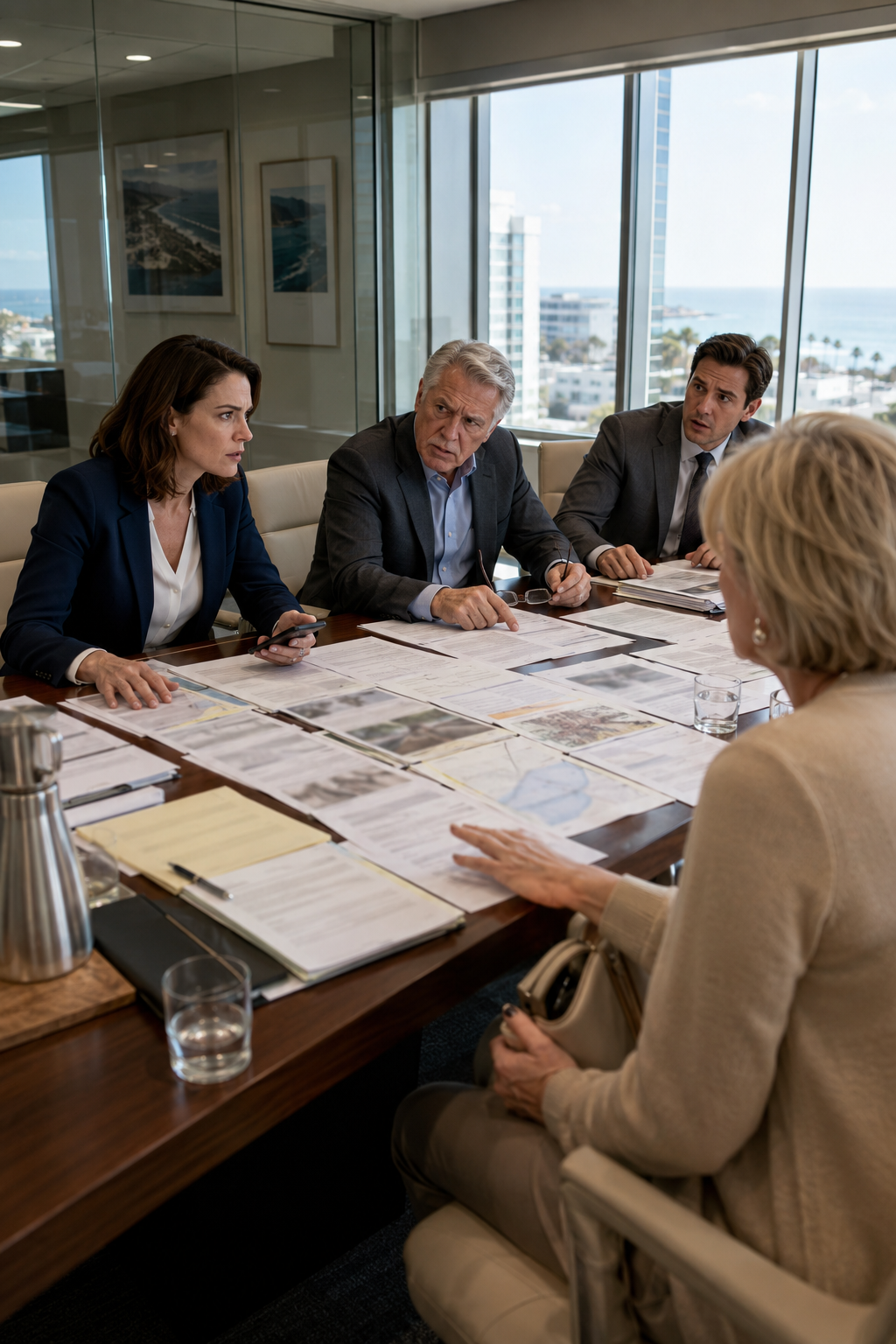
At 3 p.m., I walked into Thompson & Associates with a folder three inches thick and the calm of someone who knew that if she allowed herself to feel everything at once, she would either scream or collapse.
Their office occupied the eighth floor of a glass building near the marina, the kind of place with muted carpets, abstract art, and a receptionist who spoke as if every appointment were confidential even before it began. Jennifer Walsh met me in the lobby. She was younger than I had expected, maybe early thirties, with auburn hair in a low ponytail and a face that suggested she had already replayed our phone call several times.
“Miss Chin,” she said. “Thank you for coming so quickly.”
“I didn’t have much choice.”
“No,” she said quietly. “I suppose not.”
Richard Thompson was waiting in a conference room overlooking the harbor. He stood when I entered, tall, silver-haired, expensive suit, no wasted movement. He had the weary intelligence of a man who had spent thirty years watching people lie badly and ten watching them lie well.
I placed the folder on the table.
He opened it.
For the next twenty minutes, he read in silence.
Jennifer sat beside him taking notes. I sat across from them, hands folded, watching his expression shift from professional skepticism to concern to something harder. Anger, maybe. Not on my behalf exactly. Lawyers are careful with anger. But fraud offends certain professionals the way bad foundations offend engineers.
He spread the documents across the table.
Recorded deed. Transfer from Eleanor Chin estate to Sarah L. Chin, 2016. County property tax receipts in my name, eight years running. Title insurance policy. Zoning application. Coastal Commission approval. Environmental report. Architectural elevations. Planning board meeting minutes. Building permit pre-approval. Invoices showing payments from my business account. Emails from city planners. Letters from community stakeholders.
Finally, Thompson leaned back.
“This is fraud,” he said.
Hearing it spoken aloud did something strange to me. It did not shock me. It steadied me.
“My mother forged sale documents for property she doesn’t own.”
“Yes.”
“And sold it for an eighty percent discount.”
“Yes.”
“To fund my sister’s life.”
“I can’t speak to motive yet,” he said. “But based on what you’ve brought, your mother had no legal authority.”
Jennifer looked up from her notes. “Has she done anything like this before?”
I almost said no.
Then I thought about Thanksgiving 2022.
I had hosted that year because my parents said they were tired and Clare said her apartment kitchen was “emotionally hostile,” which turned out to mean she had let dishes pile up for three weeks and did not want anyone to see. My mother disappeared upstairs during dinner, claiming the downstairs bathroom smelled like cleaning chemicals. She was gone too long. I remembered noticing, then dismissing the thought because suspecting your mother of rifling through your home office felt paranoid even for a family like mine.
I thought about every time she asked how the permits were stored. Every time she said, “You keep copies, right?” Every time she implied the lot was family property because my grandmother had loved all of us, even though the will had been painfully clear.
“I don’t know,” I said. “But she’s been pressuring me to sell for years. I never gave her access to the paperwork.”
“Family members often obtain documents informally,” Thompson said.
“That’s a polite way to say steal.”
“It is.”
Jennifer’s pen paused. “How is your relationship with your mother?”
I smiled without humor. “Strained.”
“And with your sister?”
“Worse.”
Thompson waited.
“My sister Clare is the golden child,” I said. “I’m the responsible one. The one who left town, built a career, remembered deadlines, paid her bills, answered calls. That sounds good until your family decides responsibility means you’re a utility. You don’t need support. You provide it.”
Jennifer’s face softened, but she stayed professional.
“The property was my grandmother’s,” I continued. “She left it to me because she knew I’d do something with it. Not flip it. Not let it rot. Build something. Mixed-use, community-focused, local businesses on the ground floor, housing above. I’ve spent eight years making that real.”
“Your family knew the scope?” Thompson asked.
“No. Not after 2019. I stopped sharing details because everything got minimized. New job? Must be nice. Promotion? Don’t brag. Property development? Stop playing real estate mogul. They’d have called this greedy or gentrification or destroying Grandma’s legacy because that would justify taking it from me.”
Thompson’s jaw tightened.
He stood and picked up the phone. “I need to call our client.”
While he stepped into the hallway, Jennifer remained with me.
“Miss Chin,” she said, “I’m very sorry.”
I looked at the documents spread across the table. “Your client is the one who put down money.”
“A forty-thousand-dollar deposit, yes. They have been planning this purchase for months. Architects, preliminary designs. They believed they were buying a residential lot.”
“I don’t blame them.”
“They will be upset.”
“They should be.”
A strange silence followed.
Then Jennifer said, “You seem very calm.”
I looked at my grandmother’s name on the deed.
“I’m not calm,” I said. “I’m organized.”
That night, after I got home, I created a spreadsheet.
I called it the ghost ledger.
At first, it was practical. I needed a record of every conversation about the property, every text from my mother, every family gathering where the lot had been mentioned, every attempt to pressure me into selling. My attorney would need documentation. I understood documentation. Documentation had saved my project more than once. When city staff misplaced a drainage revision, I had the date-stamped copy. When a consultant claimed he never received updated soil data, I had the email. When a neighbor accused me of ignoring community input, I had meeting notes showing six design changes made in response to public concerns.
Paper remembered what people tried to revise.
But the ghost ledger became something else.
I made columns: Date. Event. What Happened. Cost. Evidence. Emotional Damage.
Then I began filling it in.
March 2016. Grandmother’s will reading. Mom said, “At least Clare would spend money on something that matters.” Cost: validation from the woman who believed in me contaminated before grief had even cooled.
August 2017. First property tax payment. Dad said, “You sure this isn’t too much for you?” Cost: confidence erosion.
May 2018. Missed anniversary dinner with Daniel because Mom called about Clare’s emergency credit card situation. Cost: memory with partner; never recoverable.
October 2019. Coastal zoning pre-application approved. Shared in family chat. Dad responded, “Hope you know what you’re doing.” Cost: three-year achievement diminished in four words.
Christmas 2020. Clare asked why I couldn’t “just sell that empty lot” if I really cared about family. Mom cried when I said no. Cost: painted as selfish for preserving inheritance left specifically to me.
Thanksgiving 2022. Hosted dinner. Mom disappeared upstairs for seventeen minutes. Cost: unknown then. Catastrophic now.
April 2023. Emergency trip to co-sign Clare’s lease because “you’re good with paperwork.” Missed architect meeting. Cost: professional credibility; rescheduling fees; emotional labor.
Every weekly call from Mom regarding Clare’s debts, crises, conflicts, bruised feelings, ruined chances. Estimated time: one hour per week for eight years. Cost: 416 hours as unpaid emotional accountant.
Promotion celebration, 2021. Mentioned in family chat. Received three messages about Clare’s rent trouble within ten minutes. Cost: joy converted into obligation.
Grandmother’s birthday, every year after death. I brought flowers to her grave. Mom asked whether I had “thought about what Eleanor would want” regarding the lot. Cost: grandmother’s memory weaponized.
The spreadsheet grew for hours.
At midnight, I sat at my kitchen island with the laptop open and realized I had not cried. My apartment was silent except for the hum of the refrigerator and the occasional passing car outside. Daniel, my partner, texted from a conference in Denver: How are you holding up? Call anytime, even if late.
I stared at his message. Daniel had known for years that my family hurt me, but he had learned not to push. He did not say things like, “Just cut them off,” though he probably wanted to. He came from a family that fought honestly and apologized loudly, so mine baffled him. He once said being around the Chins felt like attending a dinner party where every dish had a concealed blade.
I typed: I’m making a spreadsheet about emotional theft.
He replied: Of course you are. I love you. Send it when you’re ready. Or don’t. I’m here.
That undid me more than the fraud.
Not the theft. Not the forged documents. Not the $2 million my mother had tried to strip from me. A text that asked for nothing.
I closed the laptop and finally cried.
The next morning, I hired Linda Morrison.
Linda was a real estate fraud attorney recommended by Thompson, though he was clear I should choose independent counsel. Her office was smaller than his, less glossy, and significantly more intimidating because every surface looked like it had been arranged by someone who did not care whether clients felt comfortable as long as opposing counsel felt afraid.