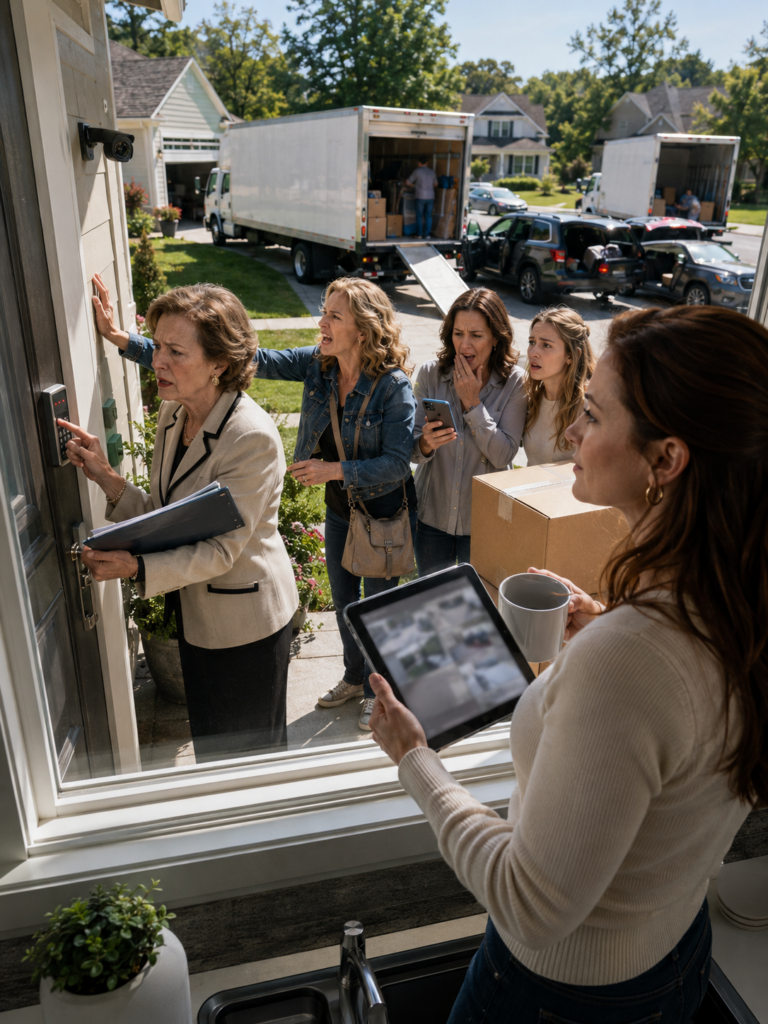
“Why do you have that?” I asked.
She smiled. “Just making notes.”
“For what?”
“Furniture placement.”
“Whose furniture?”
She gave me a look, the kind adults give children who interrupt obvious things. “Audrey, don’t start. I’m only helping.”
That evening, after guests left, Madison came downstairs glowing.
“The east room is perfect,” she said.
I froze. “For what?”
“My room.”
I stared at her.
She laughed. “I mean, when I stay. Mom said it makes sense because the light is good and my anxiety is better in bright spaces.”
The room with the best morning light.
My office.
“No,” I said.
Madison blinked. “What?”
“That room is my office.”
“But there are other rooms.”
“Yes. Guest rooms.”
“So why can’t I have that one?”
“Because it’s mine.”
Her eyes filled with tears so quickly I almost admired the efficiency. “You know how hard this year has been for me.”
Across the room, Mother appeared like she had been summoned by the scent of boundaries. “Audrey, it’s just a room.”
“Then she can use a different one when she visits.”
Mother’s eyes sharpened. “We’re not talking about visiting. Madison needs stability.”
“So do I.”
The sentence landed strangely. My mother looked almost confused, as if I had spoken in another language.
“You have stability,” she said. “That’s why you’re able to help.”
There it was. The family constitution in one sentence.
If Audrey has something, it exists so Audrey can help.
I told them again nobody was moving in. Mother did not argue in front of guests, but the look she gave me promised later consequences.
Three days after the housewarming, I came home from work to find a moving van in my driveway.
For a moment, I sat in my car with both hands on the steering wheel and wondered if exhaustion had finally caused hallucinations.
Then I saw Brianna carrying a box through my front door.
My front door.
Chloe stood on the porch with two lamps. Madison was inside, laughing. Mother supervised from the walkway with her clipboard.
I got out slowly.
“What is happening?”
Mother turned, bright and efficient. “You’re home early.”
“I asked what is happening.”
Brianna set the box down just inside the foyer. “We’re bringing over a few things.”
“Why?”
“Because Mom said we could start moving in before the weekend.”
The air left my lungs.
Chloe appeared behind her. “Not officially officially. Just some stuff. My apartment is full of inventory, and Madison’s roommate situation is toxic, and Brianna’s lease—”
“No.”
Mother stepped closer. “Audrey, lower your voice.”
“No.”
Brianna rolled her eyes. “Here we go.”
I walked into my own house and saw boxes in the foyer, garment bags hanging over the stair rail, Chloe’s candle crates stacked beside my dining room, Madison’s pink suitcase by the stairs. Someone had placed a framed photo on the desk in my office. Not my photo. Madison’s. She had put a white throw blanket over my office chair.
A sound rose in me.
Not a scream. Something older.
I turned to my mother. “Who gave you the code?”
She looked briefly uncomfortable, then recovered. “You did.”
“I gave it to you for emergencies.”
“This is an emergency.”
“Madison wanting a better bedroom is not an emergency.”
Madison flinched. “Wow.”
Mother’s face hardened. “Your sisters need help.”
“They always need help.”
Brianna snapped, “Must be nice to be perfect.”
“I’m not perfect. I’m tired.”
Chloe folded her arms. “We’re not strangers, Audrey. We’re your family.”
“You still need permission.”
Mother looked at me for a long second, then used the voice she had used when I was fourteen and questioning bills at the kitchen table.
“You have more than enough.”
Something inside me became very still.
That was the sentence.
The one behind all of it.
You have more than enough.
Enough money. Enough rooms. Enough patience. Enough emotional endurance. Enough life to be divided into portions and passed around because other people had less. Nobody asked what enough had cost me. Nobody asked whether I wanted to keep what I had built. The existence of my stability was treated as proof that I could survive losing pieces of it.
I did not fight that night.
That surprises people when I tell the story. They expect the moment of awakening to arrive with shouting, thrown boxes, police at the door. But real change often begins quietly because the person changing has finally stopped wasting energy on performance.
I said, “Leave the boxes for now.”
Mother smiled, victorious. “Good. We’ll sort everything Saturday.”
Brianna muttered, “Finally.”
Chloe carried in another lamp.
Madison went upstairs to “settle.”
I stood in the foyer and watched them move through my home like water through a cracked foundation.
Then I walked into the kitchen, opened my laptop, and made a plan.
Dr. Morris once told me that boundaries without enforcement are only suggestions. My family had been treating my life as a suggestion for years. If I wanted this to end, I needed more than anger. I needed structure.
First, I called a locksmith.
“Can you come tonight?”
He could, for an emergency rate that made me wince and then smile. Best money I ever spent.
Second, I called the non-emergency police line and explained that family members had moved belongings into my home without permission, had access to a door code that would be revoked, and were not authorized residents. The officer I spoke with sounded tired but kind.
“Do they receive mail there?” he asked.
“No.”
“Any lease agreement?”
“No.”
“Any payment toward mortgage or utilities?”
“No.”
“Do they have keys?”
“One old garage key, but I’m changing locks tonight.”
“Good. Document everything. If they attempt entry after you tell them they don’t have permission, call us.”
Third, I called a moving company and asked whether they had availability the next morning.
“Small move?” the dispatcher asked.
“Emotionally large. Physically medium.”
He laughed. “We can do nine.”
Fourth, I rented a storage unit in Madison’s name as the primary contact but paid six months in advance from my card. Then I rented two more units, one for Brianna, one for Chloe. I labeled everything. I photographed every item before boxing. I kept receipts. I had the movers sign inventory sheets. I was careful. Not because my sisters deserved tenderness after trespassing through my life, but because I knew them. If a glass chipped, it would become proof I was cruel. If a sweater went missing, it would become theft. If a box was dented, it would become trauma.
So I documented.
Everything.
The locksmith arrived at 8:40 p.m. My family had left by then, after making plans to return Saturday morning with “the rest.” Madison hugged me before leaving and said, “I know this is sudden, but it’ll be good for all of us.”
I almost admired the confidence.
The locksmith’s name was Rob. He had a gray beard, heavy boots, and the emotional instincts of a man who had seen more domestic chaos than daytime television.
“Family?” he asked while replacing the front deadbolt.
“Yes.”
He nodded. “Always worse.”
By midnight, every exterior lock was changed. Every code reset. The garage keypad disabled. The smart locks reconnected only to my phone. The old garage key Brianna loved so much became a souvenir from a door that no longer existed.
The movers came Friday morning.
I took the day off work.
They were efficient, polite, and blessedly uninterested in family drama. Madison’s belongings came out of my office first: two suitcases, six boxes of clothes, three framed prints, a lamp, a throw blanket, a basket of skincare products, and the framed photo she had placed on my desk. I wrapped it carefully and labeled the box DECOR. Then I stood in the empty office for a moment, looking at the morning light on the floor, and felt something in my chest unclench.
Brianna’s things filled half the guest room: clothing, shoes, a television still in the box, kitchen items she apparently thought belonged in my pantry, and a stack of unpaid-looking envelopes. Chloe’s candle inventory took three men and a dolly. The whole house smelled like competing fragrances for hours afterward—vanilla smoke, lavender storm, cashmere moon, citrus grief. I had to open every window.
By late afternoon, all three storage units were filled, locked, photographed, and paid. I texted each sister a simple message: Your belongings have been moved to a storage unit. Six months paid. Address and access information attached. You do not have permission to enter my home without invitation.
Then I blocked nobody.
That mattered.
I wanted the evidence.
The responses began within two minutes.
Brianna: What the hell is wrong with you?
Chloe: Audrey this energy is honestly violent.
Madison: Are you serious???? My stuff???
Mother called seventeen times.
I did not answer.
Instead, I made dinner, poured a glass of wine, sat in my living room, and listened to the quiet return like a tide.
Saturday morning arrived right on schedule.
So did my family.
And now, watching them stand locked outside the house they had already divided among themselves, I understood something Dr. Morris had tried to teach me for two years.
Boundaries do not feel peaceful to the people who benefited from you having none.
Brianna pointed toward the house through the camera. “We already moved in.”
“No.”
“Yes, we did.”
“No, you unpacked without permission.”
“Same thing.”
“Not legally.”
Mother’s face tightened. “What did you do with their belongings?”
“Storage unit.”
“Where?”
I texted the addresses.
A moment later, all four phones chimed.
“I paid six months in advance,” I said.
Madison stared at her phone. “You seriously moved everything?”
“Every sock.”
She looked like she might cry.
Not because she had lost anything.
Because she had lost certainty.
The certainty that I would always surrender.
Then Mother tried a different tactic.
The guilt.
Her favorite weapon.
“After everything I’ve done for you.”
I laughed.
Actually laughed.
The sound surprised all of us because I almost never laughed around them. Not like that. Not freely. My family’s version of me was too busy anticipating needs to find anything funny.
“What exactly have you done for me?” I asked.
Her mouth opened.
Closed.
Opened again.
Nothing came out.
I continued.
“I paid my own college tuition.”
Silence.
“I bought my first car.”
Silence.
“I paid off my student loans.”
Silence.
“I worked seventy-hour weeks.”
Silence.
“I bought this house.”
More silence.
Then I asked the question nobody wanted.
“What exactly are you claiming credit for?”
Mother looked stunned, as though facts were somehow unfair.
Chloe stepped forward. “You’re making a huge mistake.”
“No.” I glanced around my beautiful living room. My furniture. My kitchen. My office upstairs waiting in morning light. My home. “The mistake was letting all of you believe this would work.”
That was when Brianna snapped.
She stormed toward the garage. “I still have my key.”
I watched her confidently insert the old key.
Turn it.
Nothing.
She tried again.
Nothing.
Then again.
Nothing.
The locksmith had been worth every penny.
Brianna kicked the door.
The camera recorded everything.
“Careful,” I said through the speaker. “That’s vandalism.”
She froze.
Mother looked at the camera. “You would call the police on your family?”
“I already spoke with them yesterday.”
The silence became absolute.
“What?”
“They know nobody besides me has permission to enter this property.”
The realization hit them all at once.
This was not an argument.
This was not a negotiation.
This was not one of our usual family battles where everyone pressured me until I surrendered.
This was finished.
Legally.
Completely.
Madison started crying.
Real tears this time.
“Where are we supposed to go?”
I almost felt sorry for her.
Almost.
Then I remembered the framed photo she had placed in my office. The room I had dreamed about for years. The assumption. The entitlement. The certainty.
And the sympathy disappeared.
“The same place you lived before trying to steal mine.”
Mother looked furious. “You selfish little—”
“Stop.”
My voice cut through hers.
For the first time in my life, she actually stopped talking.
“Do not ever call me selfish again.”
Nobody moved.
“Do you know what selfish looks like?”
I pointed the camera slightly toward them.
“Four adults deciding one woman owes them a house.”
Their faces changed.
Not because they agreed.
Because they had finally heard it out loud.
The truth sounds ugly when entitlement is translated into plain language.
Mother straightened her shoulders. “This family will remember this.”
I nodded. “So will I.”
Then I disconnected the speaker.
The screen went silent.
Outside, they stood frozen in the driveway. Inside, I sat peacefully in my kitchen. For nearly twenty minutes they argued among themselves. Blaming each other. Complaining. Demanding solutions. Brianna paced, waving both arms. Chloe cried into her phone, probably recording voice messages to people who would hear only her version. Madison sat on the porch step for three minutes before Mother pulled her up sharply. Mother kept looking at the camera, perhaps expecting me to come back online, apologize, open the door, restore the old order.
No one suggested apologizing.
That told me everything.
Eventually, the vehicles started.
One by one, the SUVs backed out.
The driveway emptied.
The cameras showed nothing except sunlight and quiet.
I sat there for a long moment.
Listening.
No demands.
No guilt.
No expectations.
Just silence.
Real silence.
The kind that belongs to people who finally own their own lives.
Then I carried my coffee upstairs, past the guest rooms, past the empty bedrooms, to the smallest room in the house. The room with the best morning light. My office. The room Madison had claimed. The room my mother had assigned away. The room everyone believed they were entitled to.
I opened the door.
Walked inside.
Set my laptop on the desk.
And finally spent my first morning in the house I had built for myself.
Alone.
Exactly as planned.
Of course, my family did not disappear simply because the SUVs left.
Entitlement is not a doorbell. It does not stop ringing because you ignore it once.
By noon, the calls had become texts, then group messages, then individual essays. Brianna accused me of emotional abuse. Chloe said my “scarcity mindset” was blocking blessings. Madison sent a photo of herself crying in a Starbucks bathroom with the caption I hope your office is worth my anxiety. Mother wrote only one sentence: I hope you are proud of yourself.
I replied to none of it.
At 2:15 p.m., Aunt Lydia called.
I almost answered because Aunt Lydia had always occupied a strange place in the family structure. She was my mother’s older sister, a retired school secretary with a cigarette voice despite never smoking and an ability to know everyone’s business before it became public. She had watched me grow up packing lunches and paying bills. Sometimes I thought she saw more than she said.
I let the call go to voicemail.
Then I listened.
“Audrey,” she said, voice low. “Your mother called me. I’m not calling to scold you. I’m calling because I want to know if you’re all right. Call me when you can.”
I stared at the phone for a long moment.
Then I called her back.
She answered immediately. “There you are.”
“If you’re calling to tell me family shares, I’m hanging up.”
Aunt Lydia snorted. “Please. I’ve been telling your mother for twenty years that she uses that word like a crowbar.”
I sat down slowly in my office chair. “Really?”
“Yes, really. I also told her she was out of her mind if she thought moving three grown women into your house without your permission was going to end well.”
“She told you?”
“She told everyone. She made it sound like you offered.”
My throat tightened. “I didn’t.”
“I know.”
The simplicity of that nearly broke me.
Aunt Lydia continued. “Brianna is posting.”
“Of course she is.”
“She says you threw them into the street.”
“They never lived here.”
“I know that too.”
A pause.
Then she said, “Do you want advice or just backup?”
I closed my eyes.
For years, family advice had meant instructions for how I should make myself smaller so everyone else could stay comfortable. But Aunt Lydia’s question had options inside it.
“Backup,” I said.
“Good. Here it is. Do not open that door. Do not explain yourself to people committed to misunderstanding you. And if your mother sends church people, call me before you commit a felony.”
I laughed.
The sound startled me again.
“Thank you,” I said.
“You should have done this years ago.”
“I know.”
“No,” she said. “Listen to me. You should have been allowed to do this years ago. That is not the same thing.”
I turned toward the window. Sunlight covered the desk, warm beneath my hand.
“I don’t know what happens now,” I admitted.
“Now they panic,” Aunt Lydia said. “Then they punish. Then, if the Lord is merciful and therapy exists, maybe one or two of them learn.”
“And if they don’t?”
“Then you still have a house.”
That became my first real comfort.
Not revenge. Not victory.
A house.
Mine.
By evening, Brianna’s posts had reached mutual family friends. She did not mention storage units paid for six months. She did not mention moving in without permission. She did not mention the changed locks because that would require admitting she had expected her key to work. Instead, she wrote about “being abandoned by someone who forgot where she came from.” Chloe shared a pastel quote about how money reveals character. Madison posted nothing, which was almost worse because Madison’s silence was usually theatrical preparation.
Mother did not post. She never did. She preferred private influence. By Sunday morning, three women from her church had texted me.
Praying for healing in your family.
Your mother is heartbroken.
Sometimes success is meant to bless others.
I answered only the last one.
Blessings require consent.
She did not reply.
Monday morning, I went to work.
That may sound ordinary, but after a family rupture, ordinary tasks feel like moving through water. I sat in meetings, reviewed data migration timelines, answered client questions, and tried not to check my phone every four minutes. By lunch, I had seventeen missed calls. None from Mother. That was strategic. She was making others do the work.
At two, building security called my desk.
“Ms. Whitaker? There’s a Madison Whitaker in the lobby asking to see you.”
I closed my eyes.
Of course.
“Did she have an appointment?”
“No.”
“I’m not available.”
A pause.
“She’s crying.”
I looked through the glass wall of my office at colleagues moving between conference rooms, carrying laptops and coffee, living in a world where families did not arrive weaponized in workplace lobbies.
“Please tell her I’m not available,” I repeated. “And if she refuses to leave, follow building policy.”
Ten minutes later, Madison texted.
You embarrassed me in front of security.
I typed back: You came to my workplace without permission.
She replied: I needed my sister.
I stared at that sentence long enough for anger to drain into something colder.
No, I wrote. You needed access.
Then I blocked her for the rest of the workday.
When I told Dr. Morris that evening, she nodded.
“That was a good distinction.”
“It didn’t feel good.”
“Boundaries often feel cruel when you were trained to experience other people’s discomfort as danger.”
“She was crying.”
“Did she ask how you felt?”
I opened my mouth.
Closed it.
No.
Madison had cried because crying had always worked. She had not asked why I moved her things. She had not asked what it felt like to come home and find my office claimed. She had not asked whether I was hurt, overwhelmed, betrayed, furious. She had needed my sister, she said, but what she meant was she needed the version of me who fixed things without requiring accountability.
Dr. Morris leaned back. “Your family will likely test different doors. Guilt, anger, public pressure, helplessness, nostalgia. Your job is not to stop them from trying. Your job is to keep the doors locked.”
“And if they never stop?”
“Then you will get better locks.”
That week, the tests came exactly as predicted.
Brianna chose anger. She sent a long email with bullet points, which was almost funny because Brianna had never organized anything in her life unless rage was involved. She accused me of financial arrogance, emotional cruelty, betraying family values, humiliating Madison, disrespecting our mother, and acting like I was “too good for the people who raised me.” She ended with, You will regret choosing a house over your sisters.
I replied: I chose consent over entitlement.
Chloe chose spirituality. She mailed me one of her candles, labeled Forgiveness Bloom, with a handwritten note explaining that she was “holding space for my healing from scarcity and control.” I opened the package, sneezed for five minutes, and donated the candle to a thrift store.
Madison chose helplessness. She sent photos of the storage unit, claiming boxes were “too heavy” and she did not know how to move them. I sent her the phone number of the moving company I used.
Mother chose silence.
For nine days, she did not call, text, or send intermediaries. That was not peace. That was weather gathering offshore.
On the tenth day, she arrived alone.
I saw her on the camera at 7:40 p.m., standing on my porch in a navy coat, no clipboard, no sisters, no SUVs. She looked smaller than she had on Saturday. Older. Or perhaps I was finally seeing her without the shadow she cast.
She rang the doorbell.
I opened the speaker. “What do you need?”
Her face tightened at being addressed through a camera, but she controlled it. “I would like to speak to my daughter.”
“You are.”
“In person.”
“No.”
“Audrey.”
“Why are you here?”
She looked toward the street, then back at the camera. “I’m your mother.”
“That’s not an answer.”
Her lips pressed together. “I came to understand why you are doing this.”
For a moment, hope flickered.
Then I remembered Aunt Lydia’s warning. Do not explain yourself to people committed to misunderstanding you.
“Doing what?” I asked.
“Tearing the family apart.”
There it was.
I almost smiled.
“I didn’t assign bedrooms in someone else’s home.”
She exhaled sharply. “I was trying to help everyone.”
“You were helping them take from me.”
“That is a cruel interpretation.”
“It is an accurate one.”
Mother’s eyes flashed. “You have always been hard.”
I laughed once, quietly. “No. I became hard where all of you kept leaning.”
That one moved through her. I saw it land. For a second, her face loosened. The mother beneath the manager, beneath the martyr, beneath the woman who had survived abandonment by turning one daughter into a support beam, looked almost visible.