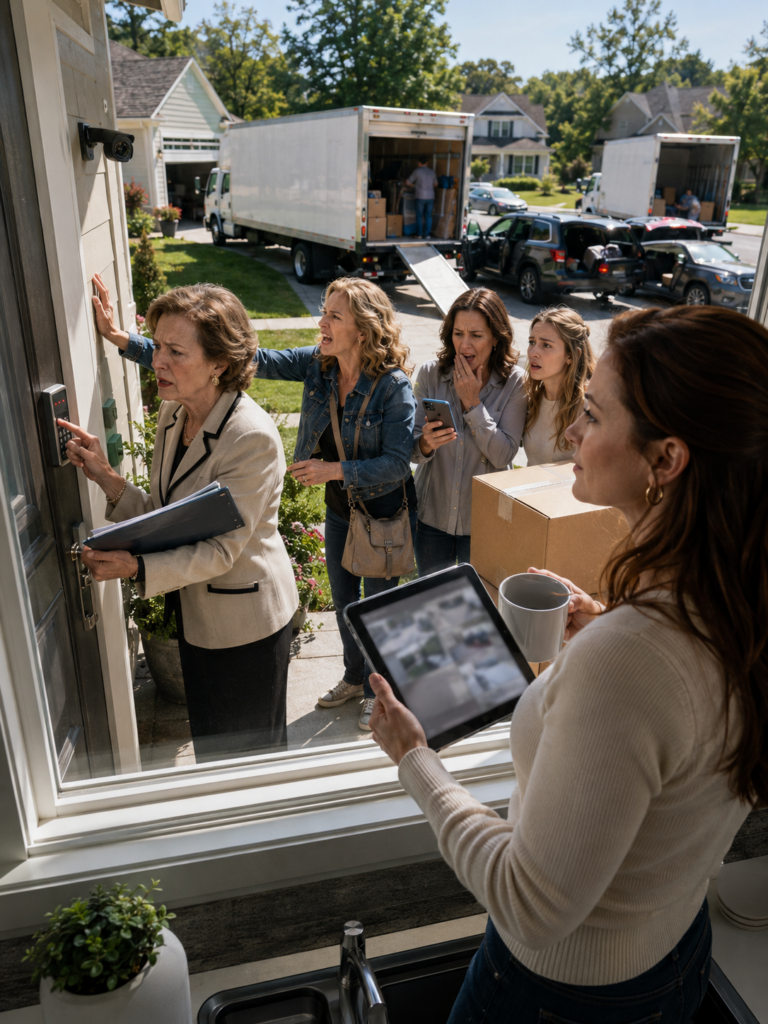
Then she retreated.
“Madison is devastated.”
“Madison is an adult.”
“She’s sensitive.”
“So am I.”
Mother stared up at the camera as though it had insulted her.
“You?” she said.
The word was soft, but it cut more deeply than if she had shouted.
You.
As if sensitivity was something reserved for daughters who cried prettily, not the one who got quiet and paid invoices.
“Yes,” I said. “Me.”
Mother looked away.
I waited.
She folded her hands in front of her coat. “I did the best I could.”
I had heard that sentence all my life. It was my mother’s shield.
Her best, apparently, was a sacred substance that could not be questioned no matter who it burned.
“I believe you,” I said.
Her face lifted, hopeful.
Then I added, “And your best hurt me.”
The hope vanished.
“How dare you.”
“I’m done pretending those things cancel out.”
She stepped back. “I don’t know who you are anymore.”
“I do.”
For the first time, that was enough.
Mother left without saying goodbye.
I watched her car disappear down the street and felt grief rise so suddenly I had to sit on the floor.
That was the part nobody tells you about boundaries.
Even when they are right, even when they save you, even when they return your life to your own hands, they still grieve the child in you who wanted saying the truth to make your mother understand.
For a month, the family campaign continued in waves.
Brianna tried to get relatives involved. Uncle Ray called and began with, “You know your mother is under a lot of stress.” I replied, “Then please help her.” He stumbled through three more sentences before realizing I was not accepting the assignment.
Cousin Elise sent me a private message saying she wished she had my courage because her brother had been living in her basement rent-free for eleven months. Aunt Lydia became my unofficial intelligence network, reporting which relatives were “being ridiculous” and which had begun privately admitting Mother went too far.
Chloe attempted a public reconciliation post, tagging me in a photo from childhood with a caption about sisterhood surviving misunderstandings. I untagged myself. She texted, That was humiliating. I replied, So was finding your candle inventory in my dining room.
Madison escalated last.
She showed up at the storage unit and discovered, apparently for the first time, that six months prepaid did not mean someone would carry everything back into her life for free. She called me sobbing from the parking lot.
“I can’t do this alone.”
“You can hire movers.”
“I don’t have money.”
“You had money for a suitcase, framed prints, and that throw blanket.”
“That’s not fair.”
“What isn’t fair is moving into my office because you decided your anxiety outranked my ownership.”
She went quiet.
Then she said, “Mom said you wanted us there.”
There it was.
A crack.
I sat down at my kitchen island. “Did I ever say that to you?”
“No, but Mom—”
“Did I ever say it?”
Silence.
“No.”
“Did you ask me?”
“No.”
“Why not?”
Her breathing changed.
I waited.
“Because I thought you’d say yes.”
“No,” I said softly. “You thought you didn’t need to ask.”
She began crying again, but this time the sound was different. Less performance. More confusion.
“I don’t know how to live by myself,” she whispered.
The old Audrey rose instantly. The fixer. The rescuer. The sister-mother. The one who would have opened the door, made tea, researched apartments, paid deposits, solved the panic before Madison had to feel it fully.
I gripped the counter.
“I believe you,” I said.
“Then help me.”
“I am helping you.”
“How?”
“By not letting you hide in my life instead of building your own.”
She said I was cruel and hung up.
I cried afterward.
Then I did not call back.
Two months passed.
The house became mine in layers.
Not all at once. At first, I moved through it cautiously, as if expecting to find a sister’s box behind every door. Then slowly, room by room, I reclaimed what had almost been taken. The dining room became a dining room, not Chloe’s inventory warehouse. The guest rooms stayed guest rooms, with clean sheets and empty closets that did not apologize for being empty. The office became sacred.
I painted the office a soft green called Morning Sage. I installed shelves. I placed my desk facing the window. I hung one framed print above it: a simple line drawing of a woman sitting alone at a table with light pouring over her shoulders. I bought a reading chair no one else had chosen, a brass lamp, and a small rug with blue threads woven through cream. On the first morning after it was finished, I sat there with coffee and cried because the room was so quiet.
Nobody needed it.
Nobody had claimed it.
Nobody’s crisis lived in the corners.
It was mine.
Dr. Morris called that “corrective experience.” I called it Tuesday with sunlight.
Work improved. Without constant family emergencies, my evenings stretched open. I started cooking again, not because someone needed feeding, but because I liked the sound of onions hitting hot oil. I joined a Saturday hiking group and discovered I hated steep trails but loved the women who complained up them with me. I invited two friends over for dinner and did not apologize for the house being “too much.” One of them, Priya from work, stood in my kitchen and said, “Audrey, this place feels like you.”
I nearly cried into the salad.
Then came Mother’s birthday.
Every year, I organized it. Restaurant reservation, cake, group gift, flowers, reminder texts, payment coordination that never resulted in full reimbursement. This year, I did nothing.
Three days before, Brianna texted the family group: So what’s the plan for Mom’s birthday?
I watched the message sit there.
Chloe responded with a heart emoji.
Madison wrote, I can do Saturday but not expensive.
Brianna: Audrey?
I typed: I don’t know. What are you planning?
Silence.
For two hours.
Then Brianna: You always handle it.
Me: Not this year.
Chloe: Seriously?
Me: Seriously.
Madison: Mom will be hurt.
Me: Then plan something.
Watching them try to organize a birthday dinner was like watching raccoons attempt city planning. Brianna wanted a restaurant but refused to make a reservation until everyone confirmed. Chloe suggested a “sound bath picnic” Mother would have hated. Madison said she could make cupcakes if someone bought ingredients. They argued for two days. Finally, Aunt Lydia stepped in and reserved a modest Italian restaurant, then sent me a private message: They are helpless, but less helpless than they pretend.
I attended the dinner.
That surprised everyone.
Mother looked startled when I arrived with flowers—not the expensive arrangement I usually ordered, just a simple bouquet from a local shop. Brianna narrowed her eyes, perhaps trying to determine whether the flowers were passive-aggressive. Chloe hugged me too long. Madison barely looked at me.
Dinner was awkward, but not catastrophic. I did not pay for everyone. When the bill came, I placed my card down for my meal and Mother’s, then passed the check folder along. Brianna stared at it like it contained a snake.
“We’re splitting?” she asked.
“Yes.”
“But you invited—”
“No,” Aunt Lydia said sharply from across the table. “I invited.”
Brianna closed her mouth.
Mother said little. She accepted the flowers, thanked me quietly, and did not mention the house until we were outside.
I had almost reached my car when she said, “Your office must be lovely now.”
I turned.
She stood under the parking lot light, bouquet held against her coat.
“It is.”
“Madison told me you painted it green.”
“She saw a photo Chloe showed her.”
Mother nodded.
For a moment, neither of us spoke.
Then she said, “I should not have assigned it.”
The world seemed to pause.
It was not an apology. Not fully. My mother did not yet know how to step into guilt without arranging furniture there. But it was the first sentence she had spoken that did not defend, accuse, or rewrite.
“No,” I said. “You shouldn’t have.”
Her mouth trembled slightly.
“I thought…” She stopped.
I waited.
“I thought if I made it sound decided, you wouldn’t have to be asked.”
“That was the problem.”
“I know.”
Two words.
Small.
Late.
But real.
I did not hug her. I did not invite her over. I did not reward the first crack with full access. But I nodded.
“Good night, Mom.”
“Good night, Audrey.”
The next morning, I told Dr. Morris I felt guilty for not feeling more moved.
She smiled. “You are allowed to require more than one sentence after decades of pattern.”
“Is that in a manual?”
“It should be.”
The months that followed were quieter.
Not perfect.
Never perfect.
Brianna still made comments about “people with big houses and small hearts.” Chloe still sent me articles about communal living and healing family wounds. Madison eventually found a studio apartment with help from Mother and, I suspect, Aunt Lydia. She did not apologize for trying to move into my home, but she did text me a photo of her own tiny desk by a window with the caption I guess I understand the office thing now.
I stared at that message for a long time.
Then I replied: Good. Everyone needs a room that belongs to them.
She sent back a heart.
I did not mistake it for resolution.
But I accepted it as a beginning.
Mother asked to visit three months later.
Not announced. Not assumed. Asked.
May I come see the house sometime? Just me.
I read the message twice, then three times.
Then I wrote: Yes. Saturday at 2. For coffee.
She arrived at 1:58 with no clipboard.
I watched on camera as she stood on the porch and smoothed her coat. For once, she rang the bell and waited.
I opened the door myself.
Her eyes moved past me into the foyer, then returned to my face. “Thank you for having me.”
“You’re welcome.”
It was strangely formal, which was perhaps what we needed. Formality has boundaries built in.
I gave her a tour. The living room. The kitchen. The dining room. The guest rooms. She said nice things, careful things. She did not open closets. She did not suggest furniture. She did not mention my sisters.
At the office door, I paused.
“This room matters to me,” I said.
“I know.”
“No. I need you to understand before you walk in. This room is not spare space. It is not backup space. It is not available.”
Mother swallowed. “I understand.”
I opened the door.
Morning Sage walls. Desk facing the window. Brass lamp. Blue-threaded rug. Bookshelves. Reading chair. Light pouring across the floor.
Mother stepped inside and stopped.
“Oh,” she said softly.
Something in her voice changed.
Maybe she finally saw it. Not square footage. Not unused capacity. Not a room Madison could have enjoyed. But me. My longing. My rest. My chosen silence.
“It’s beautiful,” she said.
“Thank you.”
She walked to the window but did not touch anything.
“I don’t think I ever imagined you needing quiet,” she said.
The sentence landed in me with both pain and relief.
“I did,” I said.
“I know that now.”
I wanted to ask why she had not known before. I wanted to hand her a list: the packed lunches, the bills, the prom dress, the panic attack, the years I spent being praised for not needing what I needed. But for once, I did not want to spend my peace teaching someone the shape of my wounds.
So I said, “Coffee?”
We sat in the kitchen. She asked about work. I answered. She told me Madison had signed a six-month lease. Chloe had taken a part-time job at a gift shop, which was apparently helping her understand wholesale pricing in ways her candle business never did. Brianna was angry at everyone but had started working overtime because nobody offered to cover her car payment.
“Good,” I said.
Mother looked surprised.
“It’s good for them,” I said.
She nodded slowly. “I think maybe I was afraid if they struggled, it meant I failed.”
I looked at her across the island.
“And if I struggled?”
Her eyes filled.
There it was.
The question under my whole childhood.
Mother’s hands wrapped around her mug. “I told myself you didn’t.”
I looked away.
She began to cry quietly, but this time the tears were not a weapon. They did not ask me to cross the kitchen and comfort her. They simply existed.
“I am sorry,” she said.
I closed my eyes.
There are apologies that demand immediate forgiveness. This one did not. It sat on the island between us, imperfect and late, but not empty.
“Thank you,” I said.
That was all I could give.
It was enough for that day.
A year after the driveway standoff, I hosted Thanksgiving.
Not because anyone expected it.
Because I wanted to.
The invitation was simple: dinner at 4 p.m., no overnight guests, no uninvited extras, everyone contributes a dish, and anyone who insults my boundaries leaves before dessert.
Aunt Lydia replied first: I’ll bring pie and bail money in case Brianna tests the rules.
Mother replied: I’ll bring rolls.
Chloe replied with three heart emojis and then, after a minute, added: I can bring salad.
Madison asked if she could bring sweet potatoes.
Brianna waited two days, then wrote: Fine. I’ll bring wine.
It was not the Thanksgiving of movies. Nobody gathered around the table confessing generational wounds while golden light healed us. Brianna complained about the traffic. Chloe’s salad had edible flowers and too much dressing. Madison burned the marshmallow topping on the sweet potatoes and cried in the bathroom for seven minutes before coming back out and laughing at herself. Mother overbaked the rolls but did not apologize six times. Aunt Lydia drank wine and muttered commentary only I could hear.
But everyone knocked.
Everyone waited to be invited in.
No one went upstairs without asking.
That mattered more than perfect warmth.
Halfway through dinner, Brianna looked around the dining room and said, “Must be nice.”
The table went still.
Old Audrey would have smiled, deflected, made the moment comfortable.
New Audrey set down her fork.
“It is,” I said.
Brianna blinked.
“It’s very nice,” I continued. “I worked hard for it.”
Aunt Lydia coughed into her napkin, probably hiding a smile.
Brianna looked down at her plate. “I didn’t mean—”
“Yes, you did.”
Her cheeks flushed.
The old current rose in the room, everyone waiting to see whether I would smooth things over. I did not.
Brianna took a breath. “Okay. I did. I’m sorry.”
I nearly dropped my fork.
She looked uncomfortable, irritated, human. “I’m still mad,” she added.
“That’s allowed.”
“And jealous.”
“That’s also allowed.”
“But I shouldn’t make it your problem.”
The room became very quiet.
Mother looked at Brianna with something like wonder.
I nodded slowly. “Thank you.”
Brianna shrugged, embarrassed. “Whatever.”
It was not cinematic. It was better.
After dinner, Madison asked if she could see the office.
I hesitated.
She noticed. “It’s okay if no.”
That was new too.
“You can see it,” I said. “Just don’t sit at my desk.”
She nodded solemnly. “Fair.”
She stood in the doorway for a long time, looking at the green walls, the shelves, the lamp, the window.
“I get why you were mad,” she said.
“Do you?”
“Yeah.” She leaned against the doorframe. “I think I wanted it because it looked like what I wanted my life to feel like.”
That was the most honest thing Madison had ever said to me.
“And I thought if I moved into it, I’d feel that way.”
I stood beside her. “Did it work?”
“No,” she said. “I just felt like a thief with better lighting.”
I laughed.
So did she.
That was how healing came, when it came.
Not as one grand reconciliation, but in small moments where someone said a true thing and did not ask me to pay for it.
My house did not become a family hotel. It became my home. Sometimes people visited. Sometimes they did not. Sometimes Mother came for coffee. Sometimes Madison sat on the porch and told me about learning to manage her bills. Sometimes Chloe brought candles that no longer smelled like emotional manipulation and asked for honest feedback on pricing. Sometimes Brianna came over and complained about work while pretending not to admire my kitchen. No one stayed without invitation.
I stopped being the emergency fund.
That change was harder for everyone, including me. The first time Brianna asked for money after the house incident, she did it with less aggression than usual but the same expectation underneath.
“My tires are bald,” she said. “I need eight hundred by Friday.”
“Can’t do it.”
“You can.”
“I won’t.”
She stared at me. “So what am I supposed to do?”
“Make a plan.”
“You sound like a bank.”
“Banks require credit checks.”
She hung up.
Then, somehow, she figured it out. She picked up extra shifts, negotiated a payment plan, bought two tires first and two later. Nobody died. The world did not collapse. A month later, she mentioned casually that she had started an emergency savings account.
“Only two hundred bucks,” she said.
“That’s great.”
“It’s pathetic.”
“It’s two hundred dollars you didn’t have before.”
She looked at me strangely, then nodded.
Chloe asked for a business loan.
I said no.
She cried, journaled, accused me of blocking her abundance, then took a bookkeeping class at the community college. Six months later, her candle business still was not profitable, but for the first time she could tell me exactly how unprofitable it was. That was progress.
Madison asked me to help her make a budget.
I said yes, with rules.
“I’ll help you understand it,” I told her. “I won’t fund it.”
She agreed. Mostly. We spent two hours at my kitchen island going through rent, utilities, groceries, insurance, subscriptions, and every little leak in her bank account. She cried once when she realized how much she spent on delivery food.
“I’m terrible at this,” she said.
“You’re new at this.”
“No, I’m terrible.”
“Madison, helplessness was rewarded in our family. Competence takes practice.”
She stared at me.
Then she whispered, “Do you think I can learn?”
“Yes.”
That yes felt better than any check I had ever written her.
Two years after the driveway standoff, I held a small party for my thirty-sixth birthday.
Small by choice. Friends. Aunt Lydia. Mother. My sisters. A few colleagues. No drama, though Brianna and Chloe argued for nine minutes about whether one of the appetizers was technically bruschetta. I wore a green dress that matched my office walls and did not spend the evening refilling everyone’s drinks. People helped. People cleaned. People asked where things belonged instead of deciding.
At the end of the night, Mother found me on the back porch.
The yard was dark except for string lights along the fence. The air smelled like cut grass and leftover rain. Inside, laughter moved through the kitchen.
“You look happy,” she said.
“I am.”
She nodded. “I didn’t always know how to let you be.”
I looked at her.
She continued carefully. “When your father left, I was so afraid. Brianna was angry, Chloe was crying, Madison was a baby. You were… steady. I leaned on that. Then I kept leaning because it worked.”
I wrapped my hands around my glass.
“It worked for you,” I said.
She flinched. “Yes.”
The old Mother would have defended. This one swallowed.
“I am sorry,” she said. “Not just for the house. For making you the place everyone fell.”
A breeze moved through the porch lights.
I thought about nine-year-old me watering down pancake batter. Fourteen-year-old me with bills. Twenty-two-year-old me sending money I needed. Thirty-two-year-old me in the airport bathroom, unable to breathe because Chloe’s humiliation had been handed to me like an invoice. Thirty-four-year-old me watching SUVs in the driveway.
“Thank you,” I said.
This time, something in me softened.
Not completely.
Enough.
Mother looked toward the kitchen window, where Madison was laughing with Priya from my hiking group. “They’re better now,” she said.
“They’re becoming responsible for themselves.”
She smiled sadly. “That sounds less pretty.”
“It is prettier.”
“Maybe.”
We stood together in a silence that no longer felt like punishment.
A month later, I finally opened the last box from my move.
It had been sitting in the back of a closet since the day I arrived, labeled MISC PERSONAL in my own handwriting. Inside were old notebooks, college photos, a few birthday cards from my father back when he still remembered my age, and a stack of envelopes containing thank-you notes from my sisters over the years.
I sat on the office floor and read them.
Brianna, after the first divorce money: You saved me. I don’t know what I’d do without you.
Chloe, after the dance program deposit: You’re the only one who believes in me.
Madison, after the laptop: You’re basically my second mom.
At the time, those notes had felt like love.
Now they felt more complicated.
Not false.
Not enough.
I put them in a new folder labeled OLD PATTERNS and slid it onto a shelf. Not hidden. Not displayed. Just kept. Evidence of a life I had survived, and of people who had loved me poorly because nobody taught them love without taking.
Then I opened my laptop and worked in the room with the best morning light.
Years from now, maybe my family will tell the story differently. Maybe Brianna will say I locked them out over a misunderstanding. Maybe Chloe will describe it as “a painful but necessary rupture in our collective healing.” Maybe Madison will admit she tried to steal my office because she did not know how to build her own. Maybe Mother will tell the truth. Maybe she will say, “I treated Audrey like a resource because I was afraid, and I almost lost her.”
I cannot control the story they tell.
I can only control the door.
The door has a new lock.
The code belongs to me.
And every morning, when I carry coffee upstairs to my office, past guest rooms that remain guest rooms, past empty spaces that no longer beg to be filled by other people’s crises, I remember the sound of those SUVs leaving my driveway. I remember the silence afterward. I remember how strange it felt to sit inside my own home and hear nothing calling me to surrender.
Peace did not arrive because my family finally understood.
Peace arrived because I stopped making understanding a requirement for freedom.
That is what I wish I had known sooner.
Some people will call you selfish for refusing to be consumed.
Let them.
Some people will say you changed when what they mean is they lost access.
Let them.
Some people will stand outside the life you built, pounding on the door, holding old keys, furious that the locks no longer honor their expectations.
Let them stand there.
You do not have to open the door just because someone once taught you love meant handing over the house.
I know that now.
I learned it on a Saturday morning, with coffee in my hand, sunlight in my kitchen, and four people outside my front door discovering that family is not a password.
THE END.
✅ End of story — Part 3 of 3
← Read from Part 1