Once, I heard him say, “No, Ashley, you can’t talk to her like that right now.”
Right now.
As if there might be a better time.
On Wednesday evening, he knocked on the study door.
“Can we talk?”
I was reviewing bank statements.
I did not look up immediately.
“Come in.”
He stepped inside and closed the door halfway behind him.
He looked tired. Greg had always aged well, silver at the temples, clean jawline, the kind of man people described as distinguished. That night he looked older in a less flattering way.
“I’ve been thinking,” he said.
I waited.
“I handled Sunday badly.”
I leaned back.
“Badly?”
He looked pained. “Diane.”
“Say it clearly.”
He exhaled. “I should not have said what I said.”
“No. You should not have believed it.”
That stopped him.
His eyes flicked toward the window, then back to me.
“I don’t believe you’re the help.”
“You allowed Ashley to say it.”
“I was trying not to escalate.”
“You escalated by making it clear she had more standing in this house than I did.”
His jaw worked.
“She’s my daughter.”
“Yes.”
“She’s all I have from that part of my life.”
“I know.”
“I feel guilty all the time,” he said suddenly, and there it was, the thing beneath everything. “Her mother died, and I was working constantly, and Ashley had to grow up too fast, and every time I try to set a boundary, I hear her mother’s voice in my head telling me not to be too hard on her.”
I felt sympathy then.
Not enough to excuse him.
But enough to ache.
“Greg,” I said softly, “your guilt has been writing checks from my account.”
He closed his eyes.
“I didn’t think of it that way.”
“No. That is the problem.”
He sat in the chair across from the desk.
“I told Ashley we should all meet. Public place. Brunch maybe. She needs to understand.”
I studied him.
“What exactly do you think she needs to understand?”
“That she was disrespectful.”
“And?”
“That the money was not automatic.”
“And?”
He looked at me, uncertain.
“That you deserve an apology.”
Those words should have helped.
They did not.
Because he had made the problem smaller again. A disrespectful comment. Money. An apology.
He still did not understand that the issue was architecture, not furniture.
“Set the brunch,” I said.
Hope flashed across his face.
I let it sit there.
“But I am not coming to negotiate support. I am coming to explain why it ended.”
The hope dimmed.
He nodded anyway.
Saturday came cold and bright.
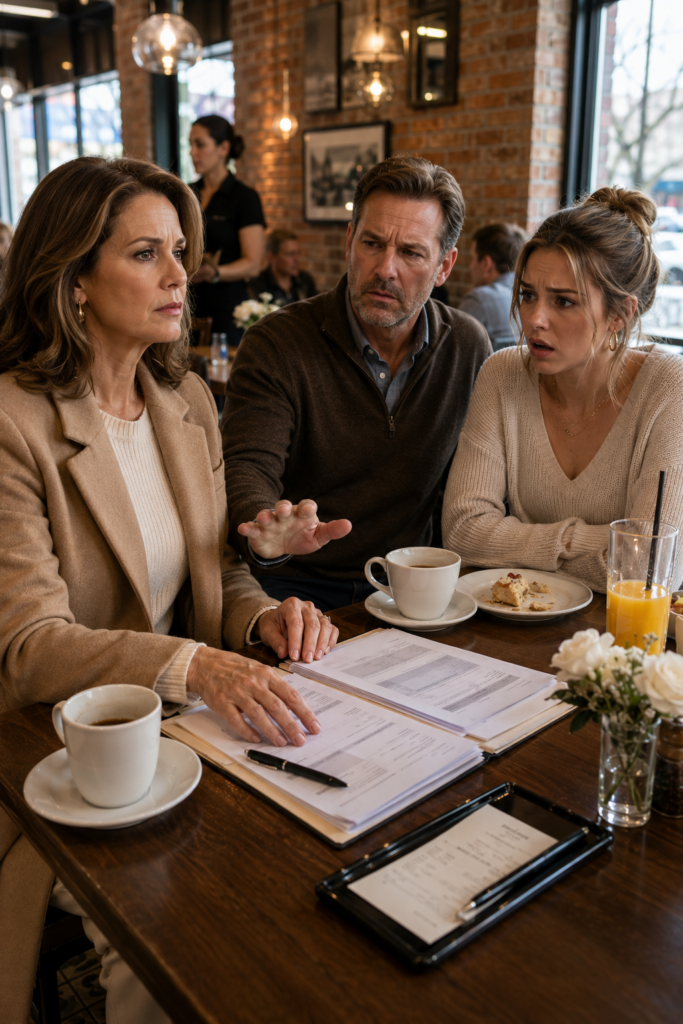
Greg chose a restaurant in Carmel with exposed brick walls, pendant lights, and enough noise to make private conversations feel less private. He wanted neutral ground. Public. Civil. A place where he believed things could be contained.
I arrived fifteen minutes early, because I like knowing the shape of a room before people enter it.
I wore dark jeans, a cream sweater, and the camel coat I had bought for myself after my first divorce because it made me feel expensive in a way that had nothing to do with anyone else’s opinion.
I ordered black coffee and sat near the window with my folder in my bag and my hands resting flat on the table.
I was not nervous.
I was aware.
Aware of my posture. My breathing. The weight of paper beside my chair. The fact that some conversations become doors, and once you walk through them, you cannot pretend you are still in the old room.
Greg walked in first.
Ashley followed.
She looked polished as always. Hair smooth, makeup precise, boots expensive enough to make me wonder which account had paid for them. But there was something beneath the polish now. Uncertainty. Irritation mixed with fear. The expression of someone encountering consequences and mistaking them for cruelty.
She did not smile.
Greg did.
“Hey,” he said. “You got here early.”
“I like to be on time.”
Ashley slid into the seat beside him.
For a few seconds, nobody spoke.
A server came by with menus. Greg ordered coffee. Ashley ordered orange juice without looking at the server. I noticed that too. A small thing, but small things are where character leaks out.
When we were alone again, Greg leaned forward.
“Diane,” he said carefully, “we don’t need to make this bigger than it is.”
I looked at him.
He seemed to realize immediately that he had chosen the wrong opening.
Ashley crossed her arms.
“Can we just talk about why you decided to ruin my life overnight?”
I turned to her.
“You think your life was mine to ruin?”
She opened her mouth.
Closed it.
I took the folder from my bag and placed it on the table.
“These are your expenses,” I said. “Car lease. Insurance. Tuition gaps. Rent support. Phone. Sorority charges. Transfers. Extras.”
I slid the first page toward her.
“Dates. Amounts. Payment sources.”
Ashley leaned forward reluctantly.
At first, her expression remained guarded, almost bored. Then her eyes moved down the page. Four hundred twelve. One eighty. Two thousand. Seven hundred. Three hundred. One twenty-six. Five hundred.
Line after line.
Month after month.
Her face changed.
Not softened yet. But altered.
“That’s not…” she began.
“It is,” I said.
She looked at Greg.
“Dad?”
Greg stared at his coffee.
“You told me she offered,” Ashley said. “You told me Diane liked doing this stuff.”
I slid the second page forward.
Greg’s face tightened.
“That page,” I said, “shows transfers from our joint account that your father made without discussing them with me. Labeled emergency, books, miscellaneous.”
Ashley looked between us.
“You told me you handled it,” she said to him.
“I did handle it,” Greg replied.
“No,” I said. “You moved money and trusted me to keep the household stable around it. That is not the same thing.”
Ashley looked down again.
I reached into the folder and took out the email printout.
“This is what your father told you about me.”
Greg’s head came up.
“Diane.”
“No. She should read it.”
I placed it in front of Ashley.
She read the line.
Don’t worry about Diane. She likes taking care of this stuff. Makes her feel needed. Just focus on school.
The restaurant noise seemed to fade around us.
Ashley’s cheeks reddened.
She did not look at me.
She looked at her father.
“You said that?”
Greg said nothing.
And in that silence, in the small gap where denial should have been if denial were available, something shifted in Ashley’s face.
Not repentance.
Not yet.
But the first fracture in a story she had believed because it benefited her.
I sat back.
“I did not pay because I needed to feel important,” I said. “I paid because I thought I was part of this family.”
No one spoke.
The server returned, sensed something in the air, and asked with too much brightness whether we were ready to order.
“Not yet,” Greg said.
I touched my coffee cup.
“Separate check for mine, please.”
The server nodded quickly and left.
Greg leaned in, lowering his voice.
“You’re embarrassing me.”
I held his gaze.
“You humiliated me in front of my family. I am telling the truth in front of strangers who do not know your name.”
Ashley flinched.
Maybe because I said family.
Maybe because she remembered what she had said at the table.
“I shouldn’t have called you that,” she muttered.
It was not an apology. It was an observation.
“No,” I said. “You shouldn’t have.”
She looked down at the papers again.
“I didn’t know it was that much.”
“I know.”
“Dad made it sound like…”
“I know.”
For the first time since I had known her, Ashley looked twenty. Not polished, not superior, not untouchable. Just twenty. Young enough to have accepted a story that made her comfortable, old enough to be responsible for the harm she caused while living inside it.
Greg rubbed both hands over his face.
“Can we please just reset?” he asked.
The word almost made me laugh.
Reset.
As if a marriage were a router.
“No,” I said.
He lowered his hands.
“What does that mean?”
“It means I’m done.”
“With the payments?”
“With the arrangement.”
Ashley looked up sharply.
Greg went still.
I did not explain further. Not there. Not to both of them. Not in a restaurant where coffee machines hissed and people at nearby tables laughed over eggs and toast.
The server returned with my check. I paid cash, left a tip larger than necessary, and stood.
Greg rose halfway.
“Diane.”
I looked at Ashley.
“You are not a child,” I said. “You are old enough to know that people who help you deserve basic respect, even when they are not your mother.”
Her eyes filled, though she blinked quickly.
Then I looked at Greg.
“And you are old enough to know that guilt is not love. It is not parenting. And it is not a reason to make your wife smaller.”
I buttoned my coat.
No dramatic exit.
No final shot.
Just a small nod, the kind one gives when a meeting is over.
Then I walked out into the cold November air and stood on the sidewalk breathing like someone who had been underwater longer than she realized.
The days after that were quiet in the way battlefields are quiet after everyone has stopped firing but before anyone has counted the cost.
I called my bank and separated what needed separating. I opened a new checking account in my name only, moved my direct deposit, and updated every bill that was truly mine. I scheduled a consultation with a family attorney in Indianapolis, a woman with kind eyes and a voice that made no false promises.
I gathered records.
Not because I wanted a fight.
Because I was done being unprepared for my own life.
Greg came home late most nights. Sometimes he tried to speak. Sometimes he did not. We moved around each other in the house with the careful politeness of hotel guests sharing an elevator.
Ashley sent one text the Tuesday before Thanksgiving.
I’m sorry for what I said.
I stared at it for a long time.
Then I typed back: Thank you for saying that.
Nothing more.
Forgiveness, I had learned, is not a vending machine where someone inserts apology and receives immediate access.
Thanksgiving came and went.
I did not host.
That alone felt revolutionary.
Patricia invited me to her house, and I brought a bakery pie instead of making one from scratch. When I arrived, she opened the door, looked at the pie box, and said, “Who are you and what have you done with my sister?”
“I’m evolving.”
“Into a woman who buys pie?”
“Apparently.”
She hugged me hard.
Ethan was there already, helping Ron with folding chairs. During dinner, he kept glancing at me, not with pity, but with a kind of quiet pride that made my throat ache.
Later, while Patricia and Ron argued in the kitchen about whether the turkey was dry, Ethan leaned toward me.
“You okay?”
I considered giving the automatic answer.
Then I told the truth.
“Not entirely.”
He nodded.
“But I will be.”
He studied me for a moment.
“You look different.”
“Older?”
“No.” He smiled slightly. “More like yourself.”
That nearly undid me.
By early December, I had made my decision.
I filed.
Not rushed. Not dramatic. Not in anger.
Just the next necessary thing.
Greg did not fight it the way I expected. Maybe he understood that what had ended at the dinner table could not be rebuilt with flowers or chores or late apologies. Maybe he was tired. Maybe he did not want the financial records becoming part of a larger argument. Maybe some part of him finally saw that he had mistaken my patience for permanence.
The divorce was clean because I insisted on clean.
What was mine stayed mine. What was his stayed his. We divided the joint account, settled the mortgage issue, and arranged for him to buy out the portion of the house I had paid into. No courtroom drama. No shouting in parking lots. Just signatures, disclosures, and the particular silence that follows the legal end of something emotionally finished weeks before.
I moved back into the townhouse I had bought after my first divorce.
It was smaller than Greg’s house. Less impressive from the outside. No formal dining room. No guest room Ashley could claim without asking. The kitchen had one east-facing window over the sink, and every morning light came through it in a warm column that landed on the countertop for about an hour before drifting across the floor.
The first night back, I sat on the couch with a blanket over my lap and a cup of tea in my hands.
The quiet felt strange.
No television from another room. No footsteps overhead. No phone buzzing with someone else’s emergency. No tension in the walls, waiting to be managed.
Just the hum of the refrigerator.
The creak of settling wood.
The wind pressing gently against the windows.
At first, it felt empty.
Then it felt like mine.
Christmas was small.
A tree with white lights. A wreath Patricia forced me to hang because, according to her, “independence does not mean seasonal neglect.” Ethan came over Christmas Eve with takeout from a Thai restaurant because neither of us wanted ham. We ate from cartons at the coffee table and watched a movie we barely paid attention to.
He gave me a bird feeder.
“You always liked cardinals,” he said.
I had forgotten that about myself.
That is one of the strangest things about leaving a life where you have been overused. Preferences return like shy animals. You remember what you like when no one else’s needs are standing in front of it.
I hung the feeder from the eave outside the kitchen window.
For weeks, nothing came.
Then, one morning in late January, a cardinal landed there.
Red and vivid against the gray Indiana morning, turning its head in quick, precise movements, entirely absorbed in the ordinary business of being alive.
I stood at the sink holding my coffee and watched it for a long time.
I thought about Greg sometimes.
Not with longing exactly.
More with a kind of distant sadness.
He had not been a monster. Monsters are easier. Greg had been weak in specific ways that caused real damage. He loved his daughter, but his love had no boundaries. He enjoyed my steadiness, but he did not respect the labor that created it. He wanted peace, but only if someone else absorbed the cost.
A few months after the divorce was final, Ashley asked to meet me.
I almost said no.
Then curiosity, and maybe a little unfinished tenderness, made me agree.
We met at a coffee shop near downtown Carmel. She arrived on time. That was new. She wore jeans and a sweater, less polished than usual, and looked nervous in a way I did not take pleasure in.
“I won’t take long,” she said.
“All right.”
She wrapped both hands around her cup.
“I was awful to you.”
I waited.
“My dad told me things in a way that made it easy not to think about what you were doing. But I also didn’t want to think about it. That’s on me.”
It was the first real adult sentence I had heard from her.
I said nothing because I did not want to rescue her from the discomfort of saying it.
She swallowed.
“I was angry that he remarried. I was angry that my mom wasn’t there. And you were convenient.”
There it was.
The truth, small and ugly and human.
“I understand some of that,” I said. “But grief does not give you the right to humiliate people.”
“I know.”
Her eyes filled.
“I’m sorry I called you the help.”
I looked at her then and saw not the smirking girl at my dinner table, not the sharp-tongued college student who treated inconvenience like an injustice, but a young woman standing at the beginning of what might become self-knowledge if she had the courage to keep going.
“Thank you,” I said.
She nodded, wiping quickly beneath one eye.
“I’m paying my own insurance now,” she added, almost awkwardly. “And I got a campus job.”
Despite myself, I smiled a little.
“Good.”
“It sucks.”
“It often does.”
She laughed once, watery but real.
We did not become family after that. Life is not that neat. But we became something less hostile. Something with room for basic decency. She sends me a Christmas card now. Sometimes a text on my birthday. I answer. That is enough.
As for Greg, we speak only when necessary. There are no children between us, no shared obligations now that the house is settled. Once, I saw him at a grocery store. He was standing near the bakery section, holding a package of rolls and looking tired. We nodded. Nothing more.
I did not feel triumphant.
That surprised me too.
For a long time, I thought victory would feel like watching someone regret losing me.
It did not.
Victory felt like not needing him to regret it.
On a morning in March, I woke early, as I often do now, and made coffee. Two scoops, a little too strong. The kitchen window glowed with that pale Midwest dawn, not quite blue, not quite gray. The cardinal returned to the feeder, bright as a dropped ribbon against the last dirty snow.
I stood there in my robe, warm mug in my hands, and realized I had not thought about the dinner table the moment I woke.
That was healing.
Not dramatic. Not cinematic. No swelling music. Just an absence where pain had been.
The house around me was quiet. My bills were mine. My time was mine. The furniture was where I wanted it. The Thanksgiving towel with the faded pumpkins was folded in a drawer, and sometimes I used it without flinching.
People think dignity is loud because losing it often happens in public.
But getting it back is usually quiet.
A login changed.
A payment removed.
A document printed.
A door closed softly.
A woman sitting in her own kitchen, drinking coffee she made for herself, realizing no one can tell her she does not belong in a life she built with her own hands.
I finished my coffee and rinsed the mug.
The cardinal flicked its wings and vanished into the cold bright air.
For a moment, I watched the empty feeder swinging gently.
Then I put on my coat, stepped outside, and walked into a day that belonged to no one but me.
✅ End of story — Part 3 of 3
← Read from Part 1