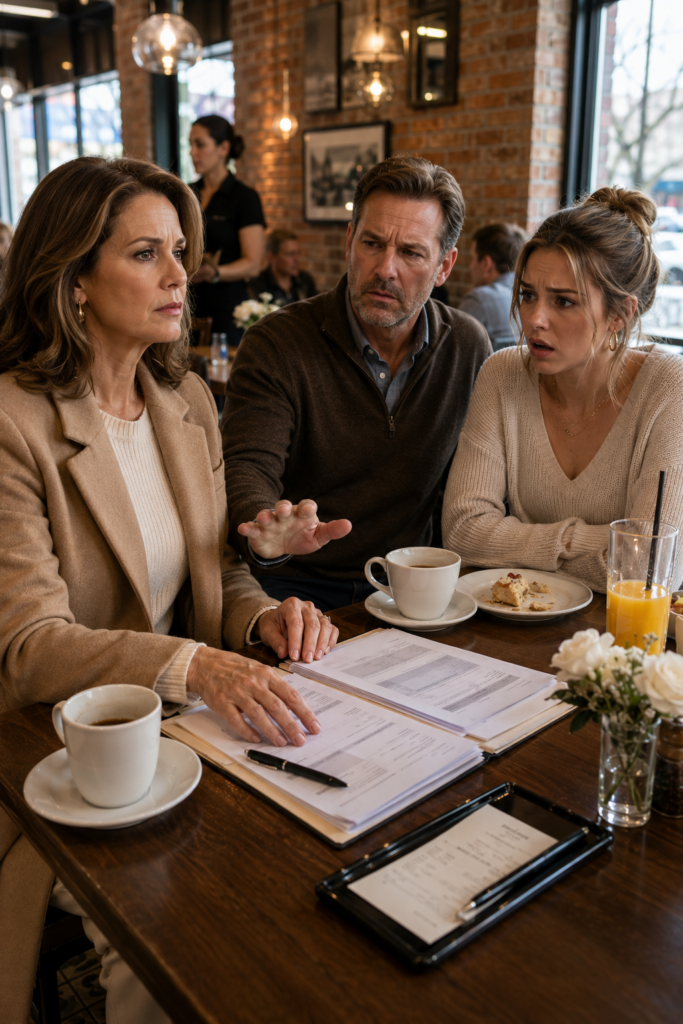
I was still holding a damp dish towel when my husband looked across the dinner table and told me I had no right to correct the young woman who had just called me the help in my own house.
“She’s not your daughter,” Greg said, his voice flat and final. “Don’t try to parent her.”
For a few seconds, nobody moved.
The refrigerator hummed in the kitchen behind me. The wall clock above the pantry door ticked as if it had no idea that an entire marriage had just cracked open beneath its hands.
From the living room, the muted voice of a football commentator kept rising and falling, talking about a Colts third down like the world had not changed at all.
My sister Patricia sat very still, her fork halfway between her plate and her mouth. Her husband Ron looked down at his napkin, suddenly fascinated by the little blue embroidered edge. My son Ethan, who had driven in from Fishers after a long shift, stared at Greg with a calmness that worried me more than anger would have.
And Ashley, my twenty-year-old stepdaughter, leaned back in her chair with the faintest little smile pulling at one corner of her mouth.
Not triumphant exactly.
Satisfied.
As if something had finally been clarified for the entire room.
I remember the damp towel in my hand most clearly. I had picked it up without thinking after bringing the last casserole dish from the oven, folded it once, and kept it looped over my fingers the way women do when they are working through dinner even while sitting down to eat it.
The towel had a faded pumpkin pattern on it, one of those cheerful seasonal things sold in sets of two at Target near the checkout lanes. I had bought it the week before because Thanksgiving was coming, because I still believed in small touches, because I had spent most of my adult life making homes feel warm for people who rarely noticed the effort until it disappeared.
That towel was damp from wiping counters.
The table was set because I had set it.
The food was hot because I had cooked it.
The house was clean because I had cleaned it.
The young woman smirking at me across the table had a car in the driveway because I had quietly helped pay for it. She had tuition covered, insurance active, a phone that worked, and rent gaps smoothed over before she ever had to feel the panic of being short because I had helped hold the loose edges of her life together for nearly a year.
And my husband had just told me, in front of my family, that I did not have the standing to ask her not to insult me.
I looked at him.
Really looked.
Not the way a wife looks at a husband during an argument, searching for the softened edge, the apology forming behind the eyes, the sign that he has overstepped and knows it. I looked at him the way you look at a wall you have walked past every day and suddenly realize it was never a doorway.
He believed what he had said.
That was the part that made the room go cold.
Not that he was angry. Not that he had spoken too sharply. Not that he had been caught between his wife and daughter and chosen poorly in the moment. Those things might have been repaired with humility, with a conversation, with a real apology spoken before sleep.
But Greg’s face held no surprise at himself.
No regret.
Only irritation that I had challenged the arrangement out loud.
I set the towel beside my plate. Carefully. Neatly. Because something in me knew that if I moved too quickly, if I let my hands shake, if I gave the room the emotional reaction it had earned, they would use that reaction to make the moment about my tone instead of their treatment.
So I nodded once.
“Okay,” I said.
That was all.
Ashley rolled her eyes and reached for her phone again. Greg sat back as if order had been restored. Patricia opened her mouth, closed it, then reached for her water glass with a hand that was not steady. Ron mumbled something about the game. Ethan kept looking at me, and I could feel him waiting for permission to speak, to stand up, to do something.
I gave him a small shake of my head.
Not because I was protecting Greg.
Because the moment was mine.
My name is Diane Mercer. I was fifty-two years old that November, living in Carmel, Indiana, in a two-story brick house on a quiet street lined with trimmed lawns, bare maple trees, and neighbors who waved when they brought their trash cans in on Monday mornings. It was the kind of neighborhood where people decorated early for fall, where mums sat on porches in big clay pots, where everyone seemed to own at least one wreath for every season.
From the outside, my life looked settled.
That was important to me.
Settled had been the thing I wanted after my first marriage ended. Not glamorous. Not dramatic. Not perfect. Just settled. A home that did not throb with tension. A partner who came in through the garage and called out for me because he was glad to be home. A dinner table where people passed dishes and laughed and maybe argued about football, but never made anyone feel like a guest in the place she helped build.
My first marriage had lasted twenty years and ended the way old wallpaper peels in a bathroom: slowly, then all at once.
There had been no affair that I knew of. No thrown plates. No spectacular betrayal that gave me a clean story to tell people when they asked what happened. Instead, there had been a long erosion of being taken for granted. Birthdays remembered late. Conversations postponed until they became unnecessary. Decisions made around me, then presented to me like weather. Apologies that sounded like exhaustion. Years of being useful, dependable, reasonable, low-maintenance, and increasingly invisible.
By the time I left, I had already been lonely for so long that the divorce felt less like a rupture than an official acknowledgment of what had already died.
Afterward, I promised myself I would never again mistake quiet for peace.
I meant it when I said it.
Then I met Greg.
He was charming in a way that did not announce itself too loudly. A widower, though not recently. A regional operations director for a medical equipment company, steady, responsible, neat in the way men become when they have spent years being admired for not falling apart. He had a dry sense of humor, a nice house, a grown daughter in college, and a habit of making me feel chosen in the beginning.
We met at a fundraiser for the Indianapolis Symphony. I was there because Patricia had bought two tickets and her husband had refused to wear a jacket that evening. Greg was standing near the silent auction table, pretending to know something about a framed abstract painting that looked, to me, like someone had spilled cranberry sauce on a white tablecloth.
“I think it’s supposed to evoke movement,” he said when he saw me looking.
“I think it evokes a cleanup fee,” I replied.
He laughed hard enough that people turned.
That laugh mattered.
At fifty-one, after a lonely first marriage and several awkward dinners with men who talked about retirement portfolios before appetizers arrived, a man laughing like that felt like a door opening.
Greg was easy to talk to. He asked questions and listened to the answers. He remembered that I liked my coffee with a little cream but no sugar. He sent flowers once, not red roses, but tulips, because I had mentioned in passing that I liked them better. When I told him I was cautious about remarriage, he said, “Good. You should be. Let me earn trust, not assume it.”
I carried that sentence around like proof.
Maybe that was why I ignored the little things at first.
Ashley was away at Indiana State for most of our courtship. I met her three months in, when she came home for a weekend. She was nineteen then, blonde, polished, sharp-featured, with the effortless confidence of someone who had never wondered whether a room had space for her. She hugged her father, glanced at me, and said, “So you’re Diane.”
Not rude enough to object to.
Not warm enough to welcome.
I told myself she needed time.
Greg told me the same.
“She’s protective,” he said later. “It’s been just the two of us for a long time.”
I understood that. I genuinely did. I had a son of my own. Ethan was twenty-six, practical, kind, a mechanic who could fix almost anything and had inherited from me the unfortunate habit of noticing emotional undercurrents before other people admitted there was water in the room. He had been polite to Greg from the beginning, but careful. I respected that. Children, even grown ones, are allowed to take their time when a parent’s life changes.
So I gave Ashley grace.
When she arrived twenty minutes late to the small dinner where Greg proposed and spent half the meal scrolling on her phone, I gave her grace.
When she called me “Diane” with a tone that made my name sound like a service category, I gave her grace.
When she left coffee cups in the living room, took leftovers I had packed for Greg’s lunch, borrowed my good scarf without asking, and once told a cousin that my decorating style was “very middle-aged Pinterest,” I gave her grace.
Greg always had an explanation.
“She’s adjusting.”
“College stress.”
“She doesn’t mean anything by it.”
“You have to remember, she lost her mother young.”
That last one was hard to argue with. Ashley’s mother had died when Ashley was twelve. Cancer. Fast, ugly, unfair. A loss like that changes the architecture of a child’s life. I knew enough not to compete with a ghost, and I never tried. I did not ask Ashley to call me Mom. I did not insert myself into memories that were not mine. I did not move photographs or rearrange traditions. I tried to be present without pushing.
But there is a difference between giving a grieving young person room and giving a spoiled adult permission to treat you like furniture.
I learned that difference too late.
The financial support began innocently, the way dangerous arrangements often do.
Ashley’s tuition payment was due before Greg’s bonus cleared. He mentioned it one night while we were cleaning up after dinner, rubbing the back of his neck the way he did when he was stressed.
“It’s just timing,” he said. “I’ll move some things around.”
I had savings. I had a good position managing administrative operations for a regional healthcare nonprofit. I had spent years after my first divorce rebuilding my finances with the care of a woman who knew exactly how expensive vulnerability could be.
“I can cover the gap for now,” I offered.
He looked at me with gratitude so immediate and tender that it warmed me.
“Are you sure?”
“Of course. We’re married. We help each other.”
He kissed my forehead.
“You’re amazing,” he said.
That was the first payment.
The second was car insurance after Ashley had a minor accident near campus and the premium jumped. Greg was frustrated, Ashley was frantic, and I had become, almost without noticing, the person who knew which account could absorb a hit without disturbing the rest of the month.
Then came the lease on the Toyota RAV4. Greg insisted it was safer than her old car. Ashley needed reliable transportation. She had classes, sorority events, internships to apply for. I agreed, because safety sounded reasonable.
Then a phone plan. Textbooks. Rent shortfalls. Parking permits. Sorority dues that Greg called “networking expenses,” though I had to bite my tongue not to ask what kind of networking required so many themed sweatshirts.
Every individual choice made sense in isolation.
That is how women like me get trapped. Not by one enormous demand, but by a hundred reasonable requests that accumulate into a life where everyone else’s emergency becomes your responsibility and your exhaustion becomes proof of devotion.
I was not blind.
I knew Ashley did not appreciate it the way I hoped she might. She did not thank me directly unless Greg prompted her. Sometimes she complained about things I paid for. The car did not have the package she wanted. The apartment was farther from campus than she preferred. The phone plan had limited international data when she went on a spring break trip to Mexico she had somehow found money for.
But I told myself appreciation would come later.
Blended families take time.
That phrase became a blanket I kept pulling over facts I did not want to see.
The Sunday dinner happened a week before Thanksgiving.
Indiana had turned cold early that year. The maples had dropped most of their leaves, and the sky carried that low pewter color that makes four in the afternoon feel like evening. I had invited Patricia and Ron because Thanksgiving itself would be divided among in-laws, adult children, and obligations, and I wanted one calm meal before the holiday machinery began.
I started cooking before noon.
Pot roast because Ron liked it. Mashed potatoes because Ethan did. Green beans even though Patricia insisted on bringing her casserole because tradition in our family meant pretending not to know she would bring it and acting delighted when she did. I made rolls from scratch because I still believed, foolishly perhaps, that homemade bread could soften any room.
Greg came through the kitchen twice. Once to ask whether we had extra ice. Once to kiss the top of my head and say, “Smells great.”
I held onto that kiss longer than I should have.
Patricia arrived early, of course. She was older than me by two years, taller, sharper, with silver threaded through her dark hair and the kind of eyes that made people confess things before they intended to. She came in carrying the green bean casserole in a foil pan, wearing a red coat and the expression of a woman prepared to judge my centerpiece.
“It looks like a catalog in here,” she said, setting the dish on the counter.
“Thank you.”
“I didn’t say it was a compliment.”
I laughed and hugged her.
Ron followed with a six-pack and a polite nod, then drifted into the living room where the Colts game had already claimed him. Ethan arrived fifteen minutes later, bringing the cold in with him. He smelled faintly of motor oil and winter air, his work boots leaving tiny damp marks near the entryway.
“Sorry,” he said, noticing immediately.
“I own a mop.”
He kissed my cheek.
“Hi, Mom.”
That small word steadied me. It always did.
Ethan liked Greg well enough but had never fully relaxed around him. He once told me, gently, “He’s nice when things are easy.” I had told him not to be cynical. He had shrugged and changed the subject.
I thought about that later.
Ashley was supposed to arrive at five.
She came at five-thirty, heels clicking across the hardwood, perfume arriving before she did. She wore cream trousers, a cropped sweater, and a long camel coat she dropped over the back of a dining chair without checking whether anyone needed the chair.
“Dad,” she called, walking past me into the kitchen, “is there anything decent to eat, or is it all casseroles again?”
She laughed at her own joke.
No one else did.
Patricia looked at me.
I smiled because smiling had become reflexive.
“Hi, Ashley.”
Ashley opened the refrigerator and scanned the shelves. “Hi, Diane.”
No apology for being late.
No greeting to my sister.
No acknowledgment of the fact that dinner existed because someone had spent hours making it.
Greg appeared in the doorway.
“Hey, Ash,” he said warmly. “You made it.”
“Barely. Traffic was stupid.”
He kissed her temple.
I turned away and checked the rolls.
It is amazing how many things women do to avoid seeing what is happening directly in front of them.
Dinner started almost normal.
Almost is a dangerous word.
We sat around the table beneath the warm light of the dining room chandelier. Patricia to my left. Ron beside her. Ethan across from me. Greg at the head, Ashley to his right. The pot roast turned out well. The rolls were golden. Patricia’s casserole tasted exactly the same as it had for twenty years.
For a few minutes, I believed the evening might settle.
Ron talked about the Colts offensive line. Patricia asked Ethan about work. Greg told a story about a delayed shipment at one of his regional warehouses. Ashley scrolled through her phone between bites, occasionally smiling at something none of us could see.
Then Patricia asked her about school.
That should have been harmless.
“How are your classes going, Ashley?”
Ashley looked up, as if surprised to be addressed by someone other than her father.
“Fine.”
“What are you taking this semester?”
“Marketing analytics, communications, consumer behavior, and some stupid gen ed I’ll never use.”
Ethan smiled. “Everybody says that until the gen ed saves them at trivia night.”
Ashley looked at him as if he had spoken from another tax bracket.
“Sure.”
I saw Ethan’s expression close slightly.
I should have changed the subject then.
Instead, I reached for the gravy.
Ashley set her fork down and looked at Patricia.
“So how long has Diane been running things like this?”
Patricia blinked. “What do you mean?”
Ashley shrugged, performing casualness badly.
“I don’t know. It just feels like she acts like she’s in charge of everything. Like it’s her house or something.”
The silence stretched.
I felt it in my chest first, a tightening beneath the breastbone. I looked at Greg, expecting him to step in, even lightly. A laugh. A correction. A simple Ashley.
He cut another piece of meat.
I kept my voice calm.
“Ashley, this is my house.”
She smiled.
Not kindly.
“Yeah,” she said. “But let’s be honest. You’re basically just the help here.”
There are insults that burn because they are clever.
This one burned because it was honest.
Not honest about me. Honest about how she saw me. Honest about how comfortable she felt saying it. Honest about what she believed the room would allow.
I heard Patricia inhale sharply.
Ron muttered, “Now hold on.”
Ethan’s fork went down.
I set mine down too.
“Don’t speak to me like that,” I said.
Ashley rolled her eyes. “See? This is what I mean. You’re always correcting me.”
“I am an adult in this house,” I said. “Which means yes, I will.”
Greg leaned forward.
Relief flickered through me for half a second. Finally, I thought. Finally he would say enough.
But he did not lean toward Ashley.
He leaned toward me.
“She’s not your daughter,” he said. “Don’t try to parent her.”