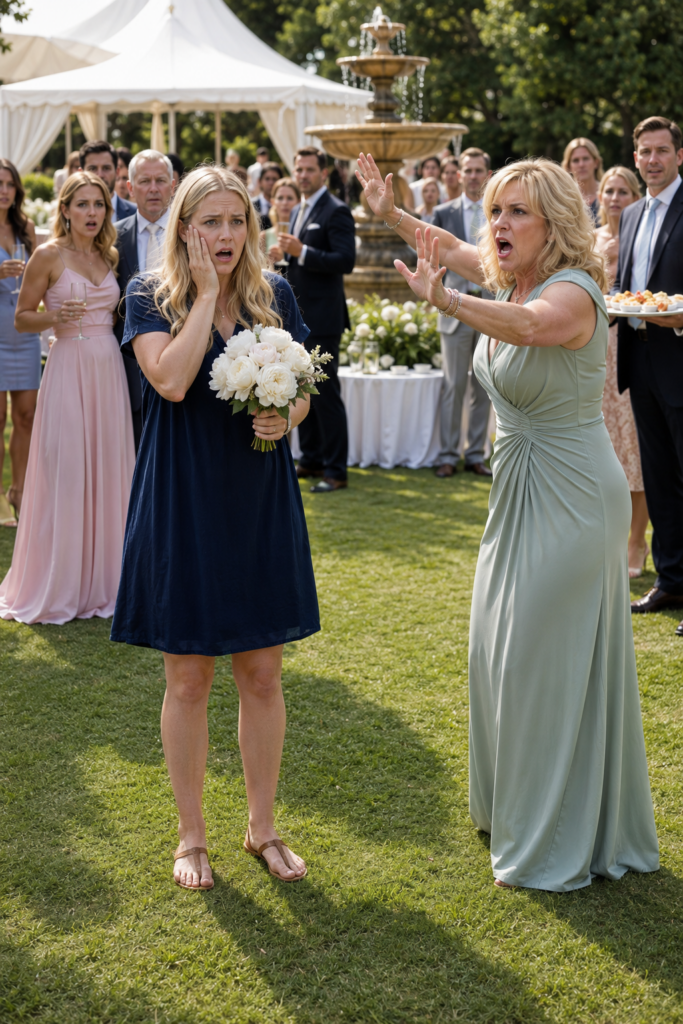
The garden party was already breathing when I pulled up—white canvas tents swelling like sails over a lawn so perfect it looked printed. The afternoon light had that careful, curated warmth my mother loved, the kind that made everyone’s skin glow and every champagne flute sparkle. Somewhere under the tents, a string quartet was threading through something Vivaldi-adjacent, the notes floating above laughter like perfume.
I sat in my car for a few seconds longer than necessary, hands resting on the steering wheel, watching the scene through the windshield the way you watch an aquarium.
Sixty guests, at least. Maybe more. Pastel dresses, linen shirts, expensive sunglasses pushed up into meticulously styled hair. Servers in crisp black-and-white moved like they had rehearsed their routes, balancing trays of canapés the size of coins. My mother’s annual spring celebration had always been big, but this was a full production. I could almost hear her voice in my head—bright, proud, slightly too loud—telling someone, “We do it properly here.”
My phone buzzed. A calendar reminder I’d set weeks ago: Mom’s Party. Bring flowers. Don’t be late.
I had flowers. They sat beside me on the passenger seat, pale peonies wrapped in butcher paper, beautiful in a soft way. They weren’t extravagant enough for her tastes, but they were real, and I’d picked them myself instead of paying a boutique to assemble something dramatic and spiky. There was a quiet satisfaction in that, the way there is in doing something with your own hands when you’re used to everything being outsourced.
I stepped out, smoothed my cotton dress—plain, navy, comfortable—and walked toward the house.
My mother’s home stood behind the party like a crown. Two stories, pale stone, tall windows with expensive curtains pulled just so. The marble fountain at the center of the yard threw water into the air in a steady, confident arc. Even the sound of it felt like money.
I spotted her near the fountain, exactly where she would want to be—central, visible, surrounded. She was encircled by women from the country club, their jewelry catching the sun in hard little flashes, and men who dressed casual the way certain people do when they can afford to look like they didn’t try.
My mother wore a designer dress I recognized immediately. I’d seen it on a mannequin last month at Neiman Marcus, its color somewhere between spring leaf and sea glass. Four thousand dollars, easy.
I remembered her twirling in front of the mirror, smoothing the fabric over her hips with reverent fingers. “I deserve this,” she’d said, and for a second I’d thought she meant she deserved joy, or peace, or freedom from the grief she rarely admitted existed.
But she’d meant the dress. She’d meant the status, the visible proof that she still belonged.
When her eyes found me, her smile tightened the way a ribbon pulls.
“There you are,” she said, stepping forward as if to greet me, but stopping just short of hugging. Her cheek met mine briefly, air-kiss style, a habit she’d adopted years ago. “You’re late.”
“Traffic was bad,” I said. It was true. But the truth never mattered if it didn’t flatter her schedule.
“Happy spring, Mom,” I added, and held out the flowers.
She glanced at them the way you glance at a menu item you already know you won’t order. “Oh,” she said. “How… sweet.”
One of her friends—Margaret’s friend Margaret, which always made me feel like my mother was in a club of women who shared not only taste but names—tilted her head and looked me over. Her gaze lingered on my dress, on my flat sandals, on the absence of anything that glittered.
“Is that what you’re wearing?” she asked, her voice light, like she was asking about the weather.
“It’s comfortable,” I said evenly.
My mother’s jaw clenched. I felt it more than saw it, like tension traveling through the air.
“Could you at least pretend to make an effort?” she murmured, just for me, her smile still pasted on for her audience. “These are important people.”
“I’m here,” I said. “Aren’t I?”
Her eyes sharpened. For a beat, her face looked like it did when I was twelve and she’d found a B+ on my report card. Disappointment that wasn’t about me at all, but about the story she wanted to tell with me as a prop.
Then she turned back to her friends and resumed laughing at something someone had said, dismissing me like a server she didn’t need anymore.
I stood there for a moment, the flowers suddenly heavy in my hands. Then I walked toward the beverage table.
As I crossed the lawn, faces turned politely, smiles offered and retracted. People I’d known since childhood—women who had pinched my cheeks when I was little, men who had said things like “There’s my favorite girl!” without ever learning what I actually liked. They had watched me grow up in this world of membership fees and charity galas, and they had always assumed I would become my mother’s reflection.
Instead I’d become… inconvenient.
I greeted a few guests I recognized, exchanged the small talk expected of me. “Work’s good.” “No, I’m not seeing anyone serious.” “Yes, the weather is perfect.” I had learned long ago how to be pleasant without being present.
I drifted toward a cluster of servers arranging appetizers, drawn by the efficiency of their movements. One of them—a woman about my age with hair pulled into a tight bun—caught my eye and offered a tray.
“Thank you,” I said, taking a small tart.
She smiled, and for a second her smile looked real, unpracticed. “Of course.”
Something about that made me want to speak to her like a person, not like furniture. So when I finished the tart, I asked quietly, “How long have you been catering events like this?”
Her expression warmed. “Oh, about five years. We started small. Weddings, mostly. Now we do these… sometimes.”
“These are intense,” I said, glancing around.
She laughed under her breath. “Tell me about it. But they pay on time, and that’s half the battle.”
I found myself smiling back. We talked for a few minutes—about logistics, about how their company handled staffing, about how she’d moved up from server to floor manager. It was ordinary conversation, grounded and practical. It felt like stepping onto solid earth after wading through a pool.
I didn’t realize my mother had approached until her perfume hit me—sharp, expensive, familiar. She appeared at my elbow like a shadow with lipstick.
“What are you doing?” she hissed.
I turned. The server’s smile faltered.
“I’m having a conversation,” I said, keeping my voice calm.
“Having a conversation with the help,” my mother said through her teeth, eyes flicking around as if cameras might be watching. “In front of everyone. Do you have any idea how this looks?”
The word help landed like a slap in itself.
“I was asking about their catering company,” I said. “They do excellent work.”
“You’re making me look bad,” she snapped, her voice rising just enough that heads began to turn.
A hush started in a few nearby pockets of the lawn, the way silence spreads when people sense drama and hunger for it.
“Mom,” I said, “I was just—”
“You’re an embarrassment,” she said loudly.
The words came out sharp, polished by years of being silently rehearsed. They cut clean through the party noise. The garden seemed to freeze around them. Even the fountain sounded suddenly too loud.
For a second, I stared at her, as if my face hadn’t understood what my ears had heard.
Then her hand connected with my cheek.
The slap wasn’t theatrical. It was real. Skin on skin, a crisp sound that echoed across the lawn. Pain flared hot and immediate, as if someone had pressed a heated coin into my face. My eyes watered involuntarily.
Sixty people stared. Some with shock. Some with delight masked as concern. A few with the careful blankness of people who didn’t want to be involved but absolutely wanted to remember every detail later.
My mother’s chest heaved. “Get out,” she screamed. “Get out of my house!”
My hand rose to my cheek, fingertips trembling against the burning skin. For a moment I couldn’t move, not because I didn’t know what to do, but because I couldn’t believe what had been done.
The server I’d been speaking to stood rigid, tray clenched in both hands, eyes wide. I met her gaze for a fraction of a second and saw something there—fear, sympathy, the recognition that cruelty like this could happen anywhere, to anyone, if the right person decided you deserved it.
I swallowed, forcing air into my lungs.
“Understood,” I said quietly.
My voice sounded strange to my own ears—steady, almost gentle. It surprised me that I could speak at all.
I walked through the silent crowd, past faces that suddenly couldn’t meet mine, past guests who pretended to look at their phones, past servers frozen with their trays. No one stopped me. No one said, “Are you okay?” Not one person.
I got into my car and drove home, cheek stinging, jaw tight, pulse pounding in my throat. I drove with the windows down even though the air was warm, as if fresh air could dilute what had happened.
In my apartment, the quiet felt enormous. The city outside my windows hummed with life that had nothing to do with my mother’s lawn or her fountain or her pastel-clad court. I stood in front of my bathroom mirror and looked at my face.
A red handprint bloomed across my cheekbone, already bruising at the edges. My eyes were bright with unshed tears I refused to let fall. The woman in the mirror looked like me, but also like someone I didn’t fully recognize—someone who had been struck and had not struck back.
I pressed a cold washcloth against the welt and let my mind drift, not toward revenge exactly, but toward accounting. Toward ledgers. Toward the quiet, invisible infrastructure that had kept my mother’s life suspended above reality for seven years.
By midnight, I had stopped trying to talk myself out of what I knew I needed to do.
It started the day my father died.
People say grief changes you, and that’s true, but not always in the ways they mean. When my father passed, it didn’t turn my mother into a softer woman. It revealed who she’d always been when no one was looking.
My father—Daniel Anderson—had been a man who knew how to fix things. Not just objects, but moods. Relationships. Broken days. He was the kind of person who could walk into a room where my mother was radiating stress and talk to her until she laughed, truly laughed, her shoulders lowering as if she’d remembered how to breathe.
He’d run a small consulting firm for years. It wasn’t glamorous, and it wasn’t one of those businesses you brag about at country club brunch, but it was steady. Until it wasn’t.
Two years before he died, the firm began to fail. Contracts dried up. A client refused to pay. A project went sideways. My father kept trying to keep it afloat, believing the next deal would fix everything. He took out loans. Maxed out credit cards. Borrowed from friends he shouldn’t have borrowed from.
My mother hated not knowing. She hated the idea that the life she showed off might be hollow underneath. So my father didn’t tell her everything, and she didn’t ask too hard, because asking might mean acknowledging. They lived in a kind of agreement built from denial.
When he died—sudden, a heart attack that came like a thief—there was barely anything left of the safety net she assumed existed.
The life insurance barely covered the funeral and some of the immediate debts. The house, the house she called “everything I have left of your father,” still had a mortgage so large it made my stomach drop when I saw the statement: $380,000. Property taxes: $15,000 annually. Credit card debt: $67,000. A luxury car lease with two years left at $890 a month. And the country club membership she insisted was “essential”: $18,000 per year.
I still remember the day she came to me, three months after the funeral.
She arrived at my apartment wearing oversized sunglasses even though it was cloudy. She sat at my kitchen table and cried without making much sound, like she had learned to cry the way she did everything else—controlled, curated. She slid a folder toward me, thick with bills.
“I can’t lose the house,” she whispered. “I can’t lose everything. It’s all I have left.”
I was twenty-seven then, newly successful in a tech career she didn’t understand and had never bothered to ask about beyond vague questions like, “So you sit at a computer all day?” I had just sold my first startup for eight million dollars.
She didn’t know. I hadn’t told her.
Not because I didn’t want her to be proud. But because I knew what money did to her. It didn’t make her grateful. It made her entitled. It made her see resources not as gifts but as proof she deserved more.
“How much do you need?” I asked.
She began listing numbers like a confession: mortgage behind three months, property taxes due, credit cards maxed, bills stacking. As she spoke, the color drained from her face, as if she couldn’t believe the words either.
I looked at the folder. It was bad. Really bad.
Without help, she’d lose everything within six months.
My father had always protected her from reality, and now reality stood in my kitchen like an unpaid invoice.
I could have said no. I could have told her to sell the house, to downsize, to cancel the country club membership, to stop living like someone else was paying the bill.
But grief had its hooks in me, too. The idea of my father’s home being taken felt like another death. The idea of my mother, for all her sharpness, being humiliated in front of those same “important people” she worshipped—something in me flinched away from it. Not because she deserved saving, but because I wasn’t ready to watch her fall.
So I made a decision that felt practical at the time and would later feel like a slow-motion mistake.
“I’ll take care of it,” I said.
Her shoulders sagged with relief so intense it almost looked like love. She reached across the table and squeezed my hand. “I knew you would,” she said, as if this were the natural order of things. As if my role had always been to catch her.
I didn’t want her gratitude. I wanted peace. I wanted to protect what little remained of my father’s world. I told myself that was my motive. I didn’t recognize, then, how much of it was also the child in me still trying to earn something my mother rarely gave: approval.
I called my financial manager the next day.
It felt almost absurd, arranging my mother’s survival the way I arranged investment portfolios. But that’s how I lived now: through systems. Through safeguards. Through contingency plans.
My manager—a careful man named Howard—listened as I explained the situation. He didn’t judge. He simply asked questions, the way professionals do.
“You want to pay her expenses,” he said slowly, “but you don’t want it directly tied to you.”
“Yes.”
“Why?”
Because she would use it. Because she would treat it like oxygen she was owed. Because if she knew, she’d never stop asking for more. Because she would never respect me for it, only resent me for not doing it loudly enough.
I didn’t say all that. I said, “She’s proud. She would feel… embarrassed.”
Howard didn’t look convinced, but he nodded. “We can set up a trust,” he said. “A structured disbursement. Something that looks like it came from an estate planning arrangement. Anonymous benefactor. Payments routed through an entity.”
“Can it be terminated?” I asked.
“Yes,” he said. “We can write it so it can be terminated at any time, for any reason. Discretionary support.”
I remember how that phrase sounded: discretionary support. Clinical. Clean. Like it had nothing to do with blood.
We set it up. Not in my name. Not with a neon sign pointing back to me. An entity, a manager, a set of automated transfers. Mortgage. Property taxes. Utilities. Country club fees. Car lease. Credit card minimums and then more. Everything.
My mother received a notification that an “anonymous benefactor” had established a trust for her benefit. She called me, breathless.
“Can you believe it?” she said. “Someone must have… I don’t know… your father must have had something arranged. He must have loved me more than I knew.”
The bitterness that rose in my throat surprised me. Not because my father didn’t love her—he had, in his way. But because she was already shaping the story into one where she was the deserving center and my father’s love was proven by money.
“Maybe,” I said carefully.
She never questioned it. Never asked who the benefactor was. Never wondered why money appeared when she needed it. She simply spent, grateful not to the person behind it, but to the universe for affirming her lifestyle.
For seven years, I funded her.
The house stayed hers. The parties grew larger. The designer shopping trips became more frequent. The vacations became more luxurious. She replaced the leased car with another one, and I quietly guaranteed the lease without her knowing. She carried credit cards like talismans and swiped them like the swipe was a form of prayer.
And in all that time, she never once asked me if I was okay.
I watched her life from a distance, checking statements the way you check a patient’s vitals. The numbers would flicker—one month she’d spend absurd amounts on renovations, another month on clothing, another month on a “girls’ trip” to someplace with private beaches. Howard would flag certain spending patterns.
“She’s increasing again,” he’d tell me gently. “The trust is covering it, but… it’s accelerating.”
I would nod, jaw clenched, and tell myself I could afford it. Eight million grew into forty million through my second startup, careful investments, and a level of discipline my mother had never practiced. Supporting her felt like a manageable line item. It felt easier than confronting the truth: I wasn’t helping her become stable. I was helping her avoid change.
There were times I almost told her.
At Thanksgiving, when she toasted “family” in front of her friends and called me “my smart girl,” the phrase said like a label she could wear. At Christmas, when she handed me a gift bag with a scarf I knew she’d bought with my money and then frowned when I didn’t squeal enough.
Once, two years ago, we sat together on her back patio while she held a glass of wine, watching the sunset like she owned it.
“I don’t know what I’d do without this house,” she said, almost softly.
I stared at the lawn where those same tents now stood. “You could sell it,” I said. “Downsize.”
She laughed, quick and dismissive. “And live like one of those people?” she said, meaning ordinary people, people without fountains. “Absolutely not.”
Then she glanced at me, eyes narrowing. “Why do you always talk like that? Like money is something to be afraid of?”
“I’m not afraid of money,” I said. “I’m afraid of what it does to people.”
She rolled her eyes, the conversation over.
I let it be over. I always let it be over.
Until the slap.
Sitting in my apartment with my cheek burning and my heart cold, I saw the entire system I’d built for what it was: a bridge made of my silence, leading my mother farther and farther away from any understanding of consequence.
And I realized something else: If I kept paying, she would keep believing she could treat me however she wanted. Because to her, I wasn’t the person saving her. I was the embarrassing accessory that didn’t match her dress.
By morning, the bruise on my cheek had deepened into purple, and my decision had deepened into certainty.
On Monday, I called Howard.
He answered on the second ring. “Good morning,” he said, voice calm, professional.
“The accounts supporting Margaret Anderson,” I said. “I want all automatic transfers stopped immediately.”
There was a pause—small, but significant. “All of them,” he repeated, making sure he’d heard me correctly.
“All of them,” I said. “Every single one. Mortgage. Credit cards. Utilities. Club memberships. Everything stops today.”
Howard exhaled softly. “She’ll receive notification that the trust support has ended.”
“Yes.”
“Are you sure?” he asked, and there was something human in his voice now, something like concern. Not for my mother. For me.
I glanced at the mirror on my wall where the bruise bloomed like a fingerprint. “Completely,” I said.
“Understood,” he replied. “I’ll process the terminations within the hour.”
I didn’t cry. I didn’t shake. I sat at my kitchen table and watched sunlight creep across the wood, feeling strangely calm. Like someone who finally stopped holding up a collapsing roof.
Next, I called the mortgage company.
“This is regarding the account for 2847 Riverside Drive,” I said. “I’m the guarantor on that mortgage. I’m formally removing my guarantee effective immediately.”
The representative’s keyboard clicked in my ear. “Ms. Anderson,” she said after a moment, “you’ve been the guarantor for seven years. If you remove your guarantee, the primary account holder will need to qualify on her own or the loan may be called.”
“I understand,” I said.
“And you’re certain?”
“Yes.”
“All right,” the representative said, tone shifting into procedural. “I’ll process the paperwork. Mrs. Margaret Anderson will be notified within forty-eight hours.”
I hung up and made the next call. Credit card company. Country club billing office. The luxury car dealership. Anywhere my name lived quietly behind her comfort, I pulled it back.
By Tuesday afternoon, the system I’d built over seven years was dismantled.
There was no dramatic moment. No thunder. Just an invisible shift, like turning off a machine you’d grown used to hearing in the background.
On Wednesday morning, my phone started ringing.
Mom.
I watched it buzz across my desk and didn’t answer.
A voicemail appeared. I didn’t listen. I didn’t need to.
She called again twenty minutes later. And again after lunch. Then from a number I didn’t recognize.
I muted my phone and worked.
It’s strange, how much easier it is to ignore a person once you stop being afraid of them.
On Thursday, she called six times. I deleted each voicemail without listening, like clearing spam. A small, cruel part of me enjoyed how powerless it made her feel.
But mostly I felt… tired. Like someone who had been carrying a weight for so long they’d forgotten the shape of their own shoulders.
Friday afternoon, she showed up at my office building.
Security called up. “Ms. Anderson, there’s a woman in the lobby asking to see you,” the guard said. “She says she’s your mother.”
“Tell her I’m not available,” I said, not looking up from my screen.
“She’s very insistent,” he said. “She’s saying it’s an emergency.”
“Tell her to make an appointment through my assistant,” I replied.
There was another pause. “She’s asking about some accounts,” he added. “She seems quite upset.”
“Not my concern,” I said.
The guard hesitated, then murmured, “Understood,” and hung up.
Later my assistant told me she’d stood in the lobby for twenty minutes, demanding, gesturing, wearing sunglasses indoors like she was on a reality show. She left only when security threatened to call the police.
That evening, a text arrived from Aunt Linda—my mother’s sister, the closest thing she had to an anchor.
Your mother called me crying. Something about her accounts being frozen. Do you know anything about this?
I stared at the message for a long moment. Then I set my phone down without replying and ate dinner alone.
Saturday brought more calls. Sunday, my phone buzzed constantly until I turned it off and spent the day reading on my couch, letting fictional characters solve fictional problems.
Monday, exactly one week after the party, Howard called.
“I’m getting calls from multiple creditors,” he said. “Your mother’s mortgage payment bounced. Her credit cards are being declined. The country club called about unpaid dues. The car company is threatening repossession.”
“As expected,” I said, voice neutral.
“She’s also hired a lawyer,” Howard added. “They’re trying to find out who was behind the trust.”
“They won’t find anything actionable,” I said. “The trust terms stated support could be terminated at any time, for any reason.”
“They’re claiming financial elder abuse,” he said carefully.
I let out a laugh that held no humor. “She’s sixty-two,” I said. “Perfectly capable of managing her finances. Or she would be if she lived within her means.”
Howard was silent for a beat, then said, “Our legal team can prepare a response.”
“Do it,” I said.
On Tuesday afternoon, my assistant buzzed my office. “Your mother is in the lobby again,” she said. “She has someone with her. Looks like a lawyer.”
I felt something inside me tighten, but it wasn’t fear. It was irritation, like a persistent insect.
“Same answer,” I said. “I’m not available.”