Not a cabin.
A lodge.
Three bedrooms. Stone fireplace. Wraparound porch facing west. High enough above the waterline to satisfy every engineer’s instinct about flooding. The structure had been built in the early 1980s by a couple from Madison who later retired to Arizona and forgot that houses need people or they begin returning to nature. It needed work, but the bones were right. The view was better than right.
I stood on the porch the first time and watched the sun set over Garrison Lake in bands of orange and violet, and for one impossible minute I felt Renee beside me.
Not as memory.
As presence.
I bought it in April 2016 for $260,000.
Renee and I had saved our whole lives. Used trucks. Modest vacations.
No credit card balances. We paid our mortgage early, contributed to retirement accounts automatically, and never once bought anything we could not pay for outright. Brad called that philosophy “old-fashioned.” I called it sleep.
I bought Garrison in cash.
Then I did something else.
I placed it inside an irrevocable trust named the Renee Logan Family Trust. I was lifetime beneficiary. The lodge could not be sold out from under me, borrowed against by impatient heirs, or dragged into family bargaining after my death without the terms I set. A separate estate attorney in Milwaukee, Raymond Castillo, handled the documents. Not the local lawyer the family knew. Not anyone Brad might think to call.
I told one person on earth.
Walter Pruitt.
Walter was an old friend, retired county recorder, a man who knew land documents the way some men know scripture: chapter, verse, and consequence. He had been widowed before me and understood the sacred privacy of grief.
He kept my secret for seven years and never once asked why.
That is what a real friend looks like.
For seven years, the boys came to Kerr. They fished, grilled, brought friends, asked questions, made assumptions, and circled the property as if inheritance were a table already set for them. The whole time, the real prize sat forty-three miles away on Garrison Lake.
Quiet.
Patient.
Waiting.
Like me.
The listing went up on a Wednesday.
I know because Walter called at 7:18 that morning.
“Jude.”
His voice had the tone of a man telling you to sit down.
“What?”
“Kerr Lake cabin just hit the MLS.”
I looked out the kitchen window toward the backyard maple.
“Listed by?”
“Mark Benson. Pewaukee office. Bradley Logan listed as co-owner contact.”
“Asking?”
“Three ninety.”
“Any showings?”
“Already. Marked hot.”
I breathed out slowly.
Walter waited.
“Let it run,” I said.
“You sure?”
“Yes.”
“Jude.”
“Walter.”
“You could stop this today.”
“I know.”
“You could call Mark Benson, tell him the listing is unauthorized, shut it down before buyers get involved.”
“I know.”
He was quiet for a moment.
“You’re a cold man sometimes, Jude Logan.”
“No,” I said. “I am a prepared man.”
“There’s overlap.”
“Maybe.”
Let me stop here and explain what Brad did not understand.
Years earlier, after Renee and I updated our estate plan, I had structured the Kerr property so the boys had recorded future interests tied to survivorship and family succession, but no unilateral authority to sell the place while I lived and retained controlling interest.
The deed work had been done properly. Brad had seen his name associated with the property and heard only what he wanted to hear. Co-owner. Future owner. Family asset. He never cared enough to read the whole structure. Neither did Mark Benson, apparently, or he allowed Brad’s confidence to do the work of diligence.
But no sale could close without my written consent.
All parties.
All signatures.
All facts, not just the convenient ones.
The showings happened. I let them.
Mark Benson put a tasteful sign near the road. I let him.
Photos appeared online: sunset shots, fireplace, dock, kitchen, old porch chairs cropped carefully so Renee’s favorite blanket did not show. I let that happen too, though I admit that one cost me something.
An offer arrived in eighteen days.
Ted and Connie Marsh from Naperville, Illinois.
Fortysomething professionals. Two children. Good credit. Preapproved financing. Looking for a Wisconsin lake house where their kids could grow up with fishing poles and mosquito bites and memories they would not appreciate until later.
They offered $382,000.
Brad called me practically vibrating through the phone.
“Dad, we got an offer.”
“So Walter said.”
He paused. “Walter?”
“Old habits.”
“Dad, it’s strong. Three eighty-two. Cash-heavy buyers, solid earnest money. We need to move fast.”
“We.”
“Dad, come on. This is good.”
“Is it?”
“It’s a great price.”
“For what?”
“For the cabin.”
“No,” I said. “For your patience.”
He did not understand that.
Not yet.
“We need your signature on the closing documents,” he said. “It’s just a formality.”
There it was.
Formality.
A man will reveal how little he respects you by calling your consent a formality.
“The Marshes need an answer by Thursday,” he said.
“Then I’ll call you Thursday.”
“Dad—”
I hung up.
That Thursday, I drove to Milwaukee.
Raymond Castillo’s office sat in a brick building near the river, third floor, clean lines, old wood, shelves full of real estate law books and framed photographs of his father and grandfather outside their first law office. Raymond was forty-nine, third-generation Mexican American, and the sharpest real estate mind I had ever met. He had a calm face, precise hands, and the quiet delight of a man who enjoyed a well-constructed legal surprise the way some people enjoy theater.
I laid everything across his conference table.
The Kerr listing. The offer. Brad’s calls. The deed structure. The Garrison trust. My notes.
Raymond leaned back, fingertips steepled.
“Jude,” he said slowly, “your sons listed a property they cannot legally sell without you.”
“Correct.”
“And a buyer is sitting at $382,000 expecting closing.”
“Correct.”
“And Brad called your signature a formality.”
“His word.”
Raymond smiled.
Not a large smile.
A small, dangerous one.
“And Garrison Lake?”
“Irrevocable trust. Renee Logan Family Trust. Recorded April 14, 2016. Successor beneficiary designations still as originally drafted.”
He nodded.
“What exactly do you want to do?”
I folded my hands on the table.
“I want to let it get to the closing table.”
His eyebrows lifted.
“I want Brad to put on his good jacket. I want Tim to stand there uncomfortable. I want Mark Benson to lay out his folder. I want the buyers to understand they were misled. Then I want you to make one phone call.”
Raymond looked at me for a long moment.
“You planned this.”
“I planned for the possibility.”
“Jude Logan, that is a distinction only terrifying people make.”
“I am prepared, Raymond. Not terrifying.”
“Prepared men terrify the unprepared.”
He pulled a legal pad toward him.
“All right. Let’s plan the phone call.”
The closing was scheduled for Monday, December 3, 9:00 a.m., at Lakeland Title in Delafield.
I arrived twelve minutes early.
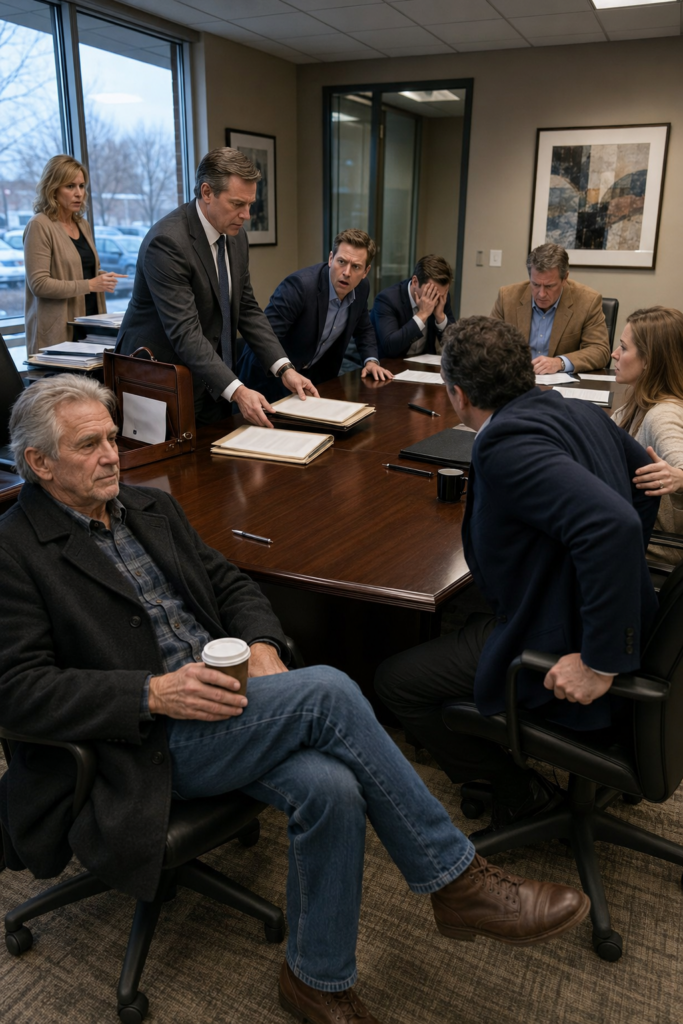
The office was exactly the sort of place where large sums of money change hands quietly: neutral carpet, glass walls, decent coffee, framed prints of sailboats, and a receptionist who spoke in a tone designed to make nobody panic. Paula Jennings, the title officer, had the documents stacked neatly in the conference room. Ted and Connie Marsh were already seated when I entered, pleasant-looking people dressed carefully for an important morning. Ted stood and shook my hand firmly. Connie smiled with the cautious warmth of someone meeting a seller connected to an emotional family property.
Mark Benson stood at the head of the table with his folder open, pen ready, efficient and pleased.
Brad came in at three minutes to nine, navy jacket, polished shoes, face bright with victory barely disguised as maturity. Tim followed, hands in his pockets, eyes moving around the room the way they always did when he felt he had chosen the wrong side but hoped no one would require him to admit it.
Brad saw me and relaxed visibly.
That hurt more than I expected.
He truly thought I had come to cooperate.
“Dad,” he said, crossing the room with his hand extended. “Glad you made it.”
I shook his hand.
“Wouldn’t miss it.”
“So we’re good?”
I looked at him.
“We’re good, Brad.”
He smiled and took his seat.
Paula began her opening remarks. Mark uncapped his pen. Ted Marsh leaned forward. Connie rested a hand on the folder before her. Tim stared at the table. Brad looked like a man already dividing money in his head.
My phone buzzed.
Raymond.
Ready when you are.
I stood.
Every head turned.
Paula looked up. “Mr. Logan?”
“I apologize,” I said. “There’s a call I need to take. My attorney needs to speak with someone in this room.”
Brad’s smile disappeared.
I looked at Mark Benson.
“Specifically you.”
Mark blinked. “Me?”
“Yes.”
Brad stood halfway. “Dad, what are you—”
“Sit down, Brad.”
I did not raise my voice.
I did not need to.
Something in my tone made him sit.
I stepped into the hallway and called Raymond. Thirty seconds later, I walked back in and handed my phone to Mark Benson.
I watched his face while Raymond spoke.
That is something I will remember as long as I live.
The color changed first. Then the pen lowered. Then his eyes moved from me to Brad to the documents on the table, and I saw the exact moment Mark Benson realized the transaction he had built was standing on air.
He said three words into the phone.
“Say that again.”
Then nothing.
He listened.
Finally, he handed my phone back.
He looked at Brad, then at Paula, then at Ted Marsh.
“Mr. Logan,” he said, and he was looking at Brad now, not me, “this closing cannot proceed.”
Ted Marsh’s chair scraped back.
“Excuse me?”
Paula’s face went white.
Mark swallowed. “The property cannot be transferred without unanimous written consent from all recorded parties and controlling interest holders. That consent has not been obtained. There is a structural issue with this transaction that should have been caught at listing.”
Should have been caught at listing.
That is professional language for this is now very much a problem.
Ted stood fully, his voice controlled in the way men sound when control is the last kindness they are willing to offer.
“We have been under contract for three weeks. We paid for inspections. We paid for an appraisal. My children already know about this property.”
Connie touched his arm.
Mark raised both hands. “Mr. Marsh, I understand your frustration completely, and I want to assure you we’ll get to the bottom of—”
“The bottom,” Ted said, “is that you listed a property your clients apparently had no legal authority to sell.”
Silence.
Brad turned toward me slowly.
“Dad.”
I picked up my coffee cup.
Took a sip.
Let silence do what silence does when it has a point to make.
Raymond arrived at 9:24.
He had driven from Milwaukee and timed it like a man who respected entrances. Dark suit. Leather briefcase. Unhurried. He shook my hand first, then set his briefcase on the table, opened it, and placed two documents side by side.
“Ladies and gentlemen,” he said, including everyone with a glance, “my name is Raymond Castillo. I represent Mr. Jude Logan. I want to clarify the status of this transaction because clarity will serve everyone better than confusion.”
He pointed to the first document.
“This is the Kerr Lake deed structure. Jude Logan retains controlling interest and lifetime authority. Bradley and Timothy Logan hold recorded succession interests but no unilateral authority to market, contract, or transfer the property. Any sale requires written consent from Mr. Jude Logan. That was never provided.”
Mark looked like a man who wanted to disappear into his chair.
“The listing was premature,” Raymond continued. “The purchase agreement is unenforceable as drafted. This closing does not occur today.”
Ted Marsh looked from Raymond to Brad.
“What are our options?” he asked.
Raymond turned to him with professional respect.
“You likely have claims relating to expenses incurred in reliance on a listing and purchase agreement that should not have been represented as valid without proper consent. Inspection costs, appraisal fees, travel, legal review, possibly other damages depending on what your counsel determines.”
Ted nodded once.
“My attorney is already on the phone.”
“That is wise.”
Mark Benson left first. He shook no hands and said nothing except a tight promise to Paula Jennings about follow-up. The door closed behind him with the specific sound of a man walking toward a professionally painful afternoon.
The Marshes left next.
At the door, Ted turned back.
He looked at me.
Not Brad.
Me.
“I’m sorry this happened,” he said.
“So am I.”
“I hope you understand we had no idea.”
“I do.”
He nodded. “Good luck, Mr. Logan.”
“Find the right lake house, Ted.”
He almost smiled.
Almost.
Paula gathered the documents and left with the quiet speed of someone experienced in removing herself from legal wreckage.
Then it was just me, Brad, Tim, and Raymond.
Raymond glanced at me.
I nodded.
He stepped into the hall and closed the door behind him.
Brad spoke first.
“So that’s it?”
His voice had changed. All the polish gone. What remained was rawer, younger, almost familiar.
“You let it get this far,” he said. “You let us list it. Let us take the offer. Let us sit here.”
“Yes.”
“You could have stopped this any time.”
“Yes.”
“You could have called me after that first conversation and said, Brad, you can’t sell without me.”
“Yes.”
He stood and walked to the window, hands in his pockets, back to me.
“Why didn’t you?”
I looked at Tim. He sat motionless, eyes wet, hands clasped.
Then I looked back at Brad.
“Because you needed to see it,” I said. “Not hear it. See it.”
He turned.
I continued. “You hired a realtor before asking your father. You listed property without understanding the deed. You called me and gave me a deadline to leave land I built with my own hands. What exactly did you think would happen?”
Brad had no answer.
“Sit down,” I said.
He did.
I moved to the head of the table and sat where Paula had been.
Not to dominate them.
To face them.
“I’m going to say some things,” I said. “I need both of you to listen. Can you do that?”
Tim nodded immediately.
Brad stared at the table, then nodded once.
“Good. I am not going anywhere. I will be at Kerr Lake every deer season opener until my body tells me otherwise. You are welcome there. Both of you. That has not changed.”
Tim exhaled shakily.
Brad looked suspicious, as if kindness might be another trap.
“The Marshes may sue,” I continued. “Raymond estimates their recoverable expenses and legal costs could land around eighteen to twenty-four thousand dollars. Primarily against you, Brad, because you signed the listing and represented authority you did not have. Tim’s name may be dragged in depending on how counsel frames it.”
Tim closed his eyes.
“Brad, Kelsey will find out.”
Something flickered across his face.
“She already thinks this is done,” I said. “You told her the price, didn’t you?”
Silence.
That was answer enough.
“You will have that conversation without my help.”
Brad’s throat worked. “Dad—”
“I am not finished.”
His mouth closed.
“Every consequence here has your name on it. Not mine. Not your mother’s memory. Not age. Not taxes. Not maintenance. Yours. Because you moved first, you moved fast, and you moved without asking.”
Then I turned to Tim.
“Timothy.”
He looked up, tears finally spilling.
“I know Brad started this. I know he came to you with the plan already half-formed. I know you went along because disagreement makes you uncomfortable and Brad makes disagreement feel like betrayal. But you are thirty-six years old. You are not nine. You are not waiting to see where your big brother runs before following him.”
“I know,” he whispered.
“You knew this was wrong. I heard it in your voice on the first call.”
He nodded.
“And you did it anyway.”
“I’m sorry, Dad.”
“I know.”
I reached into my jacket and placed a folded document on the table.
Both of them looked at it.
“I spent yesterday morning with Raymond,” I said. “We made changes.”
Brad’s eyes lifted slowly. “What kind of changes?”
“The kind a man makes when he realizes he needs to be deliberate about his legacy.”
I unfolded the document.
“Kerr Lake is now under my sole control. Your recorded succession interests have been revoked under the terms reserved in the original estate structure. The change was filed yesterday afternoon.”
Tim inhaled sharply.
Brad’s hand curled slowly into a fist on the table.
Not threatening.
Absorbing.
“You wanted to sell it so badly,” I said. “Now you cannot. It is not yours to sell. It never truly was. Now the paperwork agrees.”
No one spoke.
“And Garrison Lake,” I continued.
Brad looked up.
There it was.
He still did not understand.
“The Renee Logan Family Trust has also been amended. Successor beneficiary designations have changed.”
I laid the second document flat.
“Walter Pruitt’s daughter runs a land conservation nonprofit out of Madison. They preserve working waterfront properties across Wisconsin. Keep them wild, protected, and accessible for education and limited public use.”