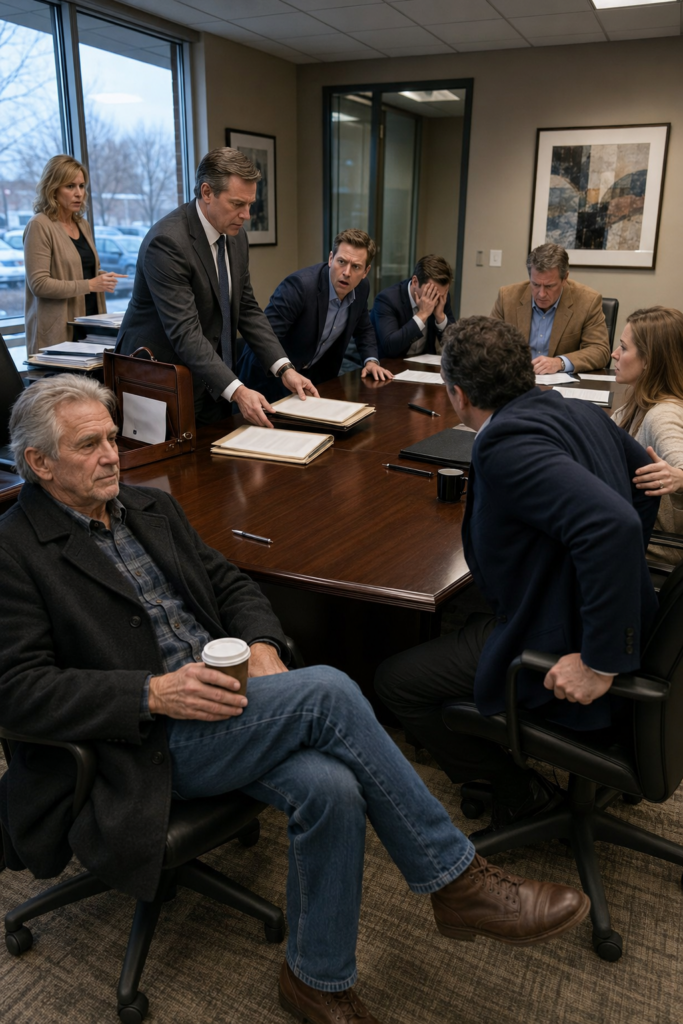
Tim’s face changed first.
Brad’s followed.
“When I am gone,” I said, “Garrison Lake Lodge goes to them.”
The air seemed to leave the room slowly.
“A nonprofit,” Brad said.
“Yes.”
“You’re giving it to strangers.”
“I am giving it to people who will protect what your mother would have loved.”
Brad stood abruptly and went back to the window.
For a moment, he looked like anger would save him.
It did not.
“I didn’t think it would go this far,” he said.
“I know.”
“I thought…” He stopped.
“What?”
“I thought we were helping.”
“No,” I said gently. “You hoped the word helping would make it sound better. A man trying to help asks first.”
Tim was crying quietly now. Not loudly. Tim never did anything loudly. Just two tracks down his face that he did not wipe away.
Brad turned back from the window.
“Is there anything left?” he asked.
And he asked it not like an heir.
Like a son.
For one second, he was not thirty-nine in a navy jacket. He was nine years old with a crooked nail in one hand, looking up at me from the unfinished floor of the Kerr cabin.
Time is cruel that way.
It shows you every version of a person at once.
I laughed softly.
Not because anything was funny.
Because Renee would have known exactly what I was about to say.
Brad recognized that laugh. His eyes sharpened.
“Garrison Lake Lodge was appraised last month,” I said.
Neither of them moved.
“Do you know what it came back at?”
Brad said nothing.
“$1.1 million.”
The number landed like a stone dropped in still water.
I watched the ripples move across both my sons’ faces.
“The property you never knew existed. Forty-three miles northeast of Cedarville. Hill above the lake.
Wraparound porch. Stone fireplace. Sunset view that makes an old man believe in something again.”
I paused.
“That was going to be your inheritance. Both of yours. Divided equally, as your mother would have wanted.”
Tim made a sound that was not a word.
Brad stood utterly still.
“You were about to sell Kerr for $382,000. Split two ways, that would have been $191,000 each before taxes, fees, and whatever trouble this failed deal creates.”
I held Brad’s eyes.
“You threw away $1.1 million to chase $191,000.”
His face went gray.
“I was not hiding Garrison to punish you,” I said. “I bought it because after your mother died, I needed somewhere that was mine. Somewhere grief could sit without everyone wanting to move it. But I always intended it to reach you when I was gone. When it was time. That is all.”
I folded the document.
“You got impatient and rushed the timeline. In doing so, you changed the destination.”
Silence.
A silence heavy enough to press the room flat.
I stood and buttoned my jacket.
“You are still my sons. Both of you. That does not have a deed. It does not go in a trust. Nobody can list it, sell it, or take it away at a closing table.”
I looked at Brad first.
“But trust does have paperwork, and yours is now empty.”
Then Tim.
“It can be rebuilt. But not by asking what is left for you. By asking what kind of men you want to be while I am still alive.”
Tim wiped his face.
Brad stared at the floor.
“Brad, call an attorney today. Not tomorrow. You need counsel for the Marsh situation. Tim, go home and sit with what you know about yourself after today. Don’t run from it. Sit with it.”
I walked toward the door.
“Dad.”
Tim’s voice cracked.
I stopped.
“We’re sorry,” he said.
And he meant both of them.
I could see Brad’s shoulders drop slightly near the window.
His version of agreement.
His version of sorry.
“I know you are,” I said.
Then I left.
Raymond was waiting in the hallway, leaning against the wall with his hands in his pockets.
“How did it go?”
“Like it needed to.”
We walked out together into the December morning.
I sat in my truck for a moment before starting the engine.
Then I drove northeast, past Oconomowoc, past the county road where the pines swallow the afternoon light, forty-three miles from Cedarville, to the gravel path the world did not know belonged to me.
The Garrison Lake Lodge stood waiting in the last gold of the day.
I sat on the west-facing porch with a drink in my hand while the sun lowered itself behind the pines and turned the water to fire. It was cold, but I did not go inside. Some silences deserve to be felt fully.
“Renee,” I said aloud, raising the glass toward the lake, “you would have had a lot to say about this.”
She would have. She would have shaken her head at Brad. Felt every one of Tim’s tears. Told me I was too calculated for my own good. Then she would have asked if I had eaten and handed me a sandwich.
“This one’s yours,” I said. “Always was.”
The lake held its ground.
Still.
Unhurried.
Settled.
Like the man who bought it.
The consequences unfolded without my help.
The Marshes filed a claim. Brad’s attorney settled for twenty-one thousand dollars covering inspection fees, appraisal costs, travel, legal review, and a bit more for inconvenience. Kelsey did not take it well. That was the phrase Brad used months later, and I suspect it was the polite version. She had already spent the money in her mind. New kitchen. Debt payoff. A trip. Whatever future she had attached to a sale that was never hers to count.
Mark Benson received a formal complaint against his real estate license filed by the Marshes. I did not file it. Some consequences do not need your help arriving.
Tim called the following Sunday.
No agenda.
No angle.
Just his voice and mine.
For forty minutes, we talked about weather, his job, a book he was reading, a leaky dishwasher, and finally, near the end, about his mother.
“I miss her,” he said.
“So do I.”
“She would be mad at us.”
“Yes.”
“She’d be mad at you too.”
“Also yes.”
He laughed quietly.
That was a start.
Brad did not call for longer.
Brad was always slower to approach a wound if he was the one who made it. I heard from Tim that he and Kelsey were “working through it,” which sounded like a polite way of saying money had become a third person in their marriage. Good. Let it sit there. Let them talk around it until they finally talked about it.
Winter settled in.
Kerr Lake froze first, then Garrison. I spent Christmas alone by choice at the lodge, not because I had nowhere to go. Tim invited me. Brad sent a text that read Merry Christmas, Dad, hope you’re well. I did not answer immediately. I made coffee, walked down to the frozen shore, and listened to the ice groan in the cold. Then I texted both boys a photograph of the sunrise over Garrison.
No caption.
Let them wonder.
In February, Tim drove out to Garrison for the first time.
I had invited him because he had asked plainly, not because he hinted.
He arrived in an old Subaru with a cracked windshield, stepped onto the porch, and stood there looking at the lake like a man entering a church after years away.
“This is…” He stopped.
“Yes.”
“You bought this after Mom died?”
“Yes.”
“Did it help?”
I thought about that.
“No,” I said. “Not at first. At first, nothing helps. Then one day, you notice you can sit still without drowning. This place was where I learned that.”
Tim nodded.
He walked through the lodge quietly. The fireplace. The bedrooms. The kitchen. The porch. He did not talk numbers. He did not ask about the trust. He touched the railing once and said, “She would have loved this.”
“Yes.”
We spent the afternoon repairing a loose section of porch step. Tim was not handy by nature, but he listened. He measured twice because I made him. He drove screws badly, then better. At dusk, we sat outside with coffee, both of us wearing coats and hats like stubborn fools.
“I’m sorry I went along with Brad,” he said.
“You said that.”
“I need to say it here.”
I looked at him.
“All right.”
“I was afraid he’d be angry. I was afraid Kelsey would call me useless. I was afraid if I pushed back, everyone would think I was making drama.” He stared into his mug. “So I let him do the wrong thing and told myself being quiet made me neutral.”
“Quiet is rarely neutral,” I said.
“I know that now.”
“Good.”
He stayed the night in the west bedroom.
In the morning, he made eggs badly.
I ate them anyway.
Brad came in April.
He did not ask to see Garrison first. He asked if he could meet me at Kerr.
That was the right question.
The old cabin smelled of pine boards, cold ashes, lake damp, and memory. I arrived early and opened the windows. Renee’s braided rug still lay in front of the fireplace. The blanket she loved sat folded over the porch chair, though I had washed it so often it was more idea than fabric by then.
Brad pulled up at noon.
No navy jacket.
Jeans. Work boots. Flannel shirt. No Kelsey.
He looked tired.
We stood in the yard for a long moment.
“Dad.”
“Brad.”
He looked toward the cabin.
“Can we walk?”
We walked the shoreline path, the same one he had run as a boy with Tim chasing behind him. The lake was still cold and gray, but spring had started working at the edges. Buds on the maples. Mud near the dock. Geese complaining in the reeds.
Brad spoke after ten minutes.
“I was angry for months.”
“I assumed.”
“At you. At Raymond. At Mark. At Tim. Even at Mom for making this place feel untouchable.”
That one cost him to admit.
“Then Kelsey asked me something.”
I waited.
“She asked why I cared so much about a cabin I didn’t even own yet.” He laughed once, not happily. “I told her it was family property. She said, ‘Family property is still property.’”
I did not comment.
“I realized I had started thinking the same way. Maybe before she did. Maybe she just said it out loud.”
We stopped near the dock.
Brad shoved his hands into his pockets.
“I forgot what this place was,” he said. “Or I chose to. Because if it was just an asset, then selling it made sense. If it was what it actually is, then what I did was awful.”
“Yes.”
He flinched, but stayed.
“I’m sorry.”
I looked out over Kerr Lake.
The water touched the dock posts softly.
“For what?”
He took a breath.
“For hiring Mark before asking you. For putting Tim in the middle. For acting like your age meant your wishes mattered less. For thinking inheritance was a right instead of a gift. For calling you with a deadline.” His voice broke slightly. “For making you feel like we were waiting for you to get out of the way.”
That last sentence reached the place the others circled.
I nodded.
“Thank you.”
“Is there any way back?”
“Back to what?”
He looked at me, confused.
“Back to before?”
“No.”
He swallowed.
“But forward, maybe.” I looked at him. “Forward is harder. It requires you to know what you did.”
“I know.”
“You are beginning to know.”
He nodded slowly.
We repaired the dock that afternoon.
Not because it needed much.
Because Brad needed to work with his hands beside me, and I needed to see whether he could do it without turning labor into performance. He could. He was rusty, but the old muscle memory remained. Measure. Hold. Cut. Screw. Check level. He smiled once when a board sat flush on the first try.
“Mom would have said we got lucky,” he said.
“Your mother would have said you finally listened.”
He laughed.
The sound startled both of us.
We ate sandwiches on the porch at dusk.
Ham and mustard, because I had remembered what Renee would do.
Brad held his sandwich in both hands and looked at it for a long time.
“Did you bring these because of Mom?”
“Yes.”
He took a bite and cried quietly while chewing, which is not dignified but is sometimes necessary.
I looked out at the lake and let him have that moment without comment.
The Garrison trust remained unchanged.
That surprises some people when I tell them the story. They expect the apology to reverse the consequence, as if regret is a magic eraser. But some decisions must stand because they teach beyond the immediate pain. Garrison will go to the Renee Logan Family Trust’s conservation beneficiary when I am gone. It will protect water, trees, shoreline, and silence. It will not become a bargaining chip, a forced sale, or a prize for whoever performs remorse most convincingly.
The boys know this.
They do not like it.
They accept it.
That is growth enough.
Kerr Lake remains mine.
I no longer pretend otherwise for the sake of future ease. The deed is clear. The authority is clear. When I die, the cabin will not pass automatically to Brad and Tim. I added conditions. Not punitive ones. Stewardship ones. If they want it, they will have to maintain it together for five years after my death before any sale is permitted. They will have to offer shared family use. They will have to preserve Renee’s porch, the dock, and the old west-facing chairs. If they cannot agree, the property goes to a local youth outdoor program Renee supported before she got sick.
Raymond called it “unusually sentimental for a man who weaponized closing documents.”
I told him he was overbilling me for sarcasm.
He said sarcasm was complimentary.
Walter laughed for a full minute when I told him.
Life settled into something smaller and cleaner after that.
Tim calls every Sunday now. Sometimes only for ten minutes. Sometimes longer. He came to Garrison twice that summer and brought tools without being asked. He still avoids conflict, but he catches himself now. He says things like, “I don’t agree with Brad on that,” and then looks surprised to have survived the sentence.
Brad comes to Kerr once a month. Sometimes with Kelsey, sometimes not. Their marriage changed after the failed sale. It had to. For a while, I thought they might split. Maybe they still will someday. That is not my business unless Brad makes it mine. Kelsey apologized to me once, stiffly, on the Kerr porch.
“I got carried away thinking about the money,” she said.
“That seems accurate.”
Her mouth tightened, then loosened. “You don’t make it easy.”
“No.”
“I suppose I didn’t either.”
“No.”
That was as close as we got to warmth.
It was enough for that day.
The first deer season opener after the closing disaster, both boys came to Kerr.
I arrived Thursday night. Tim Friday morning. Brad Friday afternoon. We did not hunt much. My knees are bad, Tim talks too loudly when nervous, and Brad spent half the time staring at the cabin like he was trying to see all the mistakes he had layered over it. But we sat by the fire, played cards, drank coffee, and told stories about Renee until the place felt less haunted and more inhabited.
At one point, Tim found the old coffee can of nails in the shed.
Brad picked it up.
“Remember this?”
I nodded.
“You made us hold these for hours.”
“I made you useful.”
“You made us cheap labor.”
“That too.”
Brad turned the can slowly in his hands.
“I really did almost sell this.”
No one said anything.
The fire popped.
Then Tim said, “You did not almost sell it. You staged a failed criminal-level real estate circus.”
Brad stared at him.
Then laughed.
We all laughed.
Not because it was funny.
Because sometimes laughter is the first sound a family makes after surviving the truth.
I am seventy-three now.
I still spend mornings on porches. Kerr in summer and deer season. Garrison when I want quiet. Harmon Ridge Road when the lawn needs mowing and the maple drops too many leaves. I still talk to Renee. Mostly at Garrison, because that place feels like a conversation she never interrupted. I tell her Brad is learning. I tell her Tim is braver than he thinks. I tell her Kelsey remains complicated. I tell her Raymond is still expensive. I tell her Walter is going deaf and pretending not to.
I tell her I miss her.
That most of all.
If there is a lesson in this, it is not that fathers should hide million-dollar lodges from their sons or stage failed closings like courtroom theater. Though, for the record, preparation has its uses.
The lesson is simpler and harder.
Do not treat living people like settled estates.
Do not confuse future inheritance with present ownership.
Do not call greed concern just because the person you are trying to move is old enough to be described as vulnerable.
And if you think your father has not planned six steps ahead, ask yourself whether you ever really knew him at all.
Brad and Tim are still my sons.
That never changed.
But they know now that being loved by me does not mean being handed everything I built. It does not mean I will accept deadlines disguised as care. It does not mean my grief, my memories, my home, or my wife’s favorite places become assets simply because they want liquidity.
Love is not the same as surrender.
Family is not a license to inventory someone before they are gone.
Kerr Lake still stands on Route 9, fourteen miles northwest of Cedarville, past the grain silos, down the road that turns muddy in spring. My name is on the deed now, just mine, the way it always should have been. The porch boards still creak. The dock still needs attention. Renee’s blanket still sits folded over the old chair.
Garrison Lake remains forty-three miles northeast, quieter than any secret deserves to be, held in trust for a future none of us will own.
One lake taught my sons what they tried to take.
The other taught me what I did not have to give.
And on certain evenings, when the sun drops behind the pines and the water turns gold, I raise a glass to Renee and thank her for marrying a man who thinks six steps ahead.
She used to say it like a complaint.
Turns out it was a compliment.
THE END.
✅ End of story — Part 3 of 3
← Read from Part 1