I stepped into the guest bathroom and locked the door. The woman in the mirror looked hollowed out. Soot lined my jaw. A thin cut sat near my hairline. I turned on the faucet, and the water ran pink when I scrubbed my sleeve.
Not my blood. Not all of it anyway.
The smell rose again, sharp and metallic, and suddenly I was back beside the extraction helicopter, one knee in the dirt, shouting for Jason over the rotors while the whole world turned orange.
I gripped the porcelain sink. Breathe in for four. Hold. Out for four.
A knock came at the door. “Clare?” Sarah. Only she still called me that.
I opened the door. Her face fell when she saw my shoulder. “God, Clara. Let me look at that. I’m a doctor.”
“There isn’t time,” I said, pulling down my sleeve.
We went back downstairs because leaving would have become the story, and I was tired of being the problem in rooms where I had done nothing wrong. Dinner glowed beneath the chandelier. My father stood at the head of the table, holding court. He looked briefly at me as I sat down at the far end. Not guilty. Not sorry. Just inconvenienced.
Then the television in the adjoining sitting room interrupted the ambient jazz with a breaking news alert.
“Tonight, Pentagon officials have confirmed the success of a classified rescue operation involving American aid workers trapped overseas.”
My fork stopped halfway to my mouth.
“Sources describe the mission as one of the most dangerous extractions conducted this year.”
Arthur glanced at the screen with mild interest, completely unaware that while he was calling me an embarrassment, I had been standing inside that very broadcast.
Then the heavy oak front door groaned. The doorbell rang once. Heavy.
The butler hurried from the side hall, his voice returning thin and nervous. “Sir? There’s a general here asking for Captain Bennett.”
The room went still. The kind of silence that presses against your ears until your own pulse feels too loud.
I stood carefully, my shoulder screaming. The foyer lights glowed amber as I walked toward the front door. Through the glass panels, I saw black government SUVs lining the wet curb. And in the entryway stood General Sterling. Four stars. Silver hair. Dress uniform.
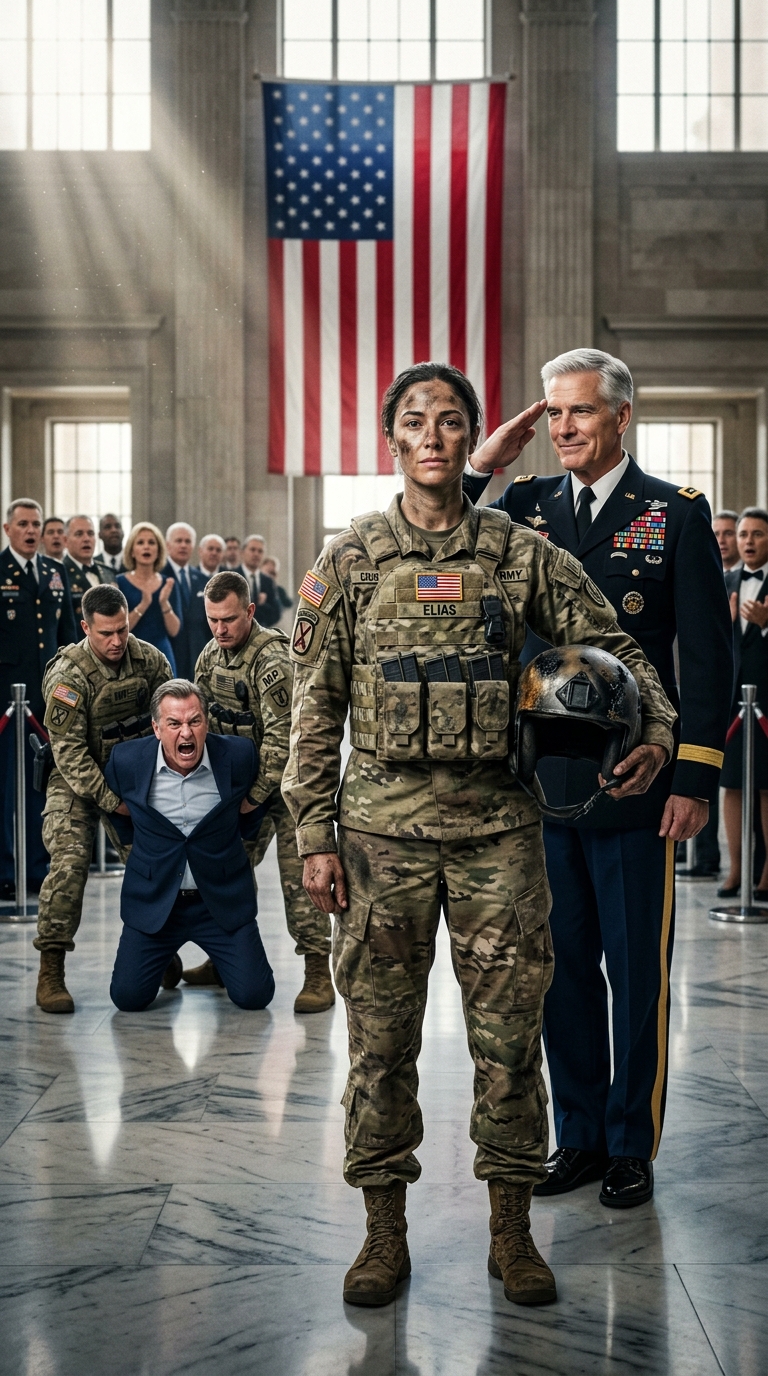
The second he saw me, his posture changed. Formally. In my father’s house, in front of my father’s guests, the four-star general raised his hand and saluted me first.
I returned it.
My father stepped into the foyer behind me, wearing his host smile. “General, Arthur Bennett.”
Sterling shook his hand briefly. Very briefly. “Mr. Bennett. I apologize for arriving unannounced, but Washington requested immediate transport for Captain Bennett.” He turned to the dining room, addressing the silent guests. “Eight hours ago, a humanitarian convoy was attacked.
Captain Bennett led the extraction team. Five American civilians are alive tonight because your daughter moved toward danger when most people would have frozen.”
Sarah’s hand flew to her mouth. Thomas stood motionless.
“She refused extraction after sustaining injuries to recover the final survivors,” Sterling continued, his eyes locking onto my father’s pale face. “I’m sorry about Specialist Jason Miller, Captain.”
My hands curled into fists. “Thank you, sir.”
Arthur’s mouth opened, but no sound came out. His eyes darted to my bloody sleeve, finally understanding the cost of my dirt. He looked terrified.
I walked out the door toward the idling SUVs, refusing to look back at the man who only valued me when someone else told him to. But as I slid into the leather backseat, my phone buzzed. A text from Sarah.
Clara. Dad went into his study after you left. He was looking for something. I found it. You need to see this before you ever speak to him again. He’s been lying to us for years.
Washington looked entirely different after midnight. Cleaner, somehow. The monuments glowed pale and stoic against the wet darkness, and rainwater shimmered across the asphalt like liquid glass. From the back seat of the government SUV, I watched the city pass in blurred streaks of white and gold. General Sterling sat across from me in comfortable, heavy silence. It was soldier silence—the kind that instinctively knows some memories need breathing room before words can touch them.
My reflection stared back from the tinted window. Bruised. Hollow-eyed. A woman who had survived the fire but brought the smoke home with her.
After a grueling three-hour debriefing deep within the Pentagon, beneath fluorescent lights that flattened every face into a mask of exhaustion, I was finally transported to Walter Reed. The medical wing smelled of aggressive antiseptic, floor wax, and the stale coffee sitting on the nurses’ station. A surgeon meticulously restitched the torn muscle in my shoulder while I stared blankly at the ceiling tiles, trying desperately not to think about the coarse desert sand, or Jason Miller’s final, silent nod before the shockwave hit us.
By ten o’clock the next morning, my hospital room was a quiet tomb of beeping monitors. Then, the heavy wooden door pushed open.
My sister, Sarah, marched in, her usual polished demeanor entirely absent. She was followed closely by a pale, grim-looking Thomas.
“I told the floor nurse I was a doctor,” Sarah said abruptly, dropping a battered, blue metal box onto my rolling tray table. It hit the plastic with a dull thud. “Eat your terrible hospital sandwich and look at this.”
I recognized the box immediately. The paint was chipped at the corners. It used to hold my mother’s sewing needles. I remembered the soft, metallic rattle it made when she opened it at the kitchen table. A cold dread coiled in my gut. “Where did you get that?”
“Dad’s locked desk drawer,” Thomas said quietly, his voice lacking its usual courtroom confidence. “He left the key in the lock last night after the General humiliated him. He was drinking heavily.”
I reached out with my good arm and popped the latch. The faint, ghostly scent of lavender sachets drifted out, instantly transporting me back twenty years. Inside were envelopes. Dozens of them. Military stationery. Some unopened, their seals yellowed with age.
My fingers went completely numb as I picked up the top one. It was an invitation to my commissioning ceremony from over fifteen years ago. Attached to it with a rusted paperclip was a formal response card.
Declined. Written in my father’s sharp, precise handwriting.
I pulled another. An invitation to an awards banquet after my first deployment. Declined.
A letter from my first commanding officer praising my “exceptional leadership under fire,” asking for family contact info. Across the top margin, my father had written a single, devastating word: Unnecessary.
My heart didn’t break; it sank quietly, like a stone dropped into freezing, dark water. I had spent years meticulously building excuses for them. I told myself my family didn’t attend because travel was hard, because Dad was busy running his empire, because normal people didn’t understand military life. But here was the physical proof. Arthur Bennett hadn’t just ignored my life; he had actively stood guard at the door to ensure no one else could celebrate it either.
“I’m leaving,” I said, kicking my legs over the side of the hospital bed, ignoring the sharp spike of pain in my shoulder.
“You have fresh stitches,” Sarah protested, reaching for my arm.
“I have a ride,” I countered, grabbing my jacket.
Forty minutes later, Thomas’s car pulled up to the Bennett estate. The red brick and white columns looked exactly the same, but the illusion of respectability had rotted away. Arthur opened the front door before we could even knock. He looked hollowed out, his hair uncombed, his skin gray beneath the porch light. But when his eyes landed on the blue box in Thomas’s hands, a flash of old, desperate authority ignited.
“You had no right to go into my study,” he snapped.
“You kept my entire existence hidden in a sewing box, and you want to talk about rights?” I pushed past him into the foyer. My left arm was bound in a sling, but my patience was utterly extinct.
I marched directly into his study. The room smelled oppressively of cigar smoke, leather, and intimidation. “Open the bottom right drawer. Now.”
“Clara, please,” Arthur’s voice cracked. He stayed in the doorway, physically unable to cross the threshold.
“Open it!” I practically snarled.
Trembling, he slowly pulled a heavy brass key from his pocket and unlocked the massive mahogany drawer. It opened with a dry, wooden scrape. Inside were thick, manila folders. Labeled by year. 2010. 2011. 2012. My entire career, filed away like criminal evidence. Printed emails, local newspaper clippings he had secretly collected, medical updates from when I was injured in Kandahar—a roadside bomb injury he knew about but never called me to discuss.
At the very bottom, buried beneath the weight of his silence, lay a sealed envelope. My mother’s elegant handwriting covered the front. For Clara. When you are ready to stop asking him to be someone else.
I snatched it up. Arthur stepped forward, his face twisting into genuine, naked panic.
“Don’t read that,” he begged, his voice dropping to a desperate, ragged whisper. “Clara, I swear to you, if you open that letter, you will never be able to unsee what she left behind.”
I did not listen to him. I took my mother’s sealed letter and walked down the hall to the sunroom.
This was the place she used to sit when the chemotherapy made the stairs impossible. She would tuck a knitted blanket around her legs and watch the cardinals land in the dogwood tree outside. The room still smelled faintly of dust and dried hydrangeas. Arthur stood in the doorway, practically vibrating with a fear I had never witnessed in him. Sarah and Thomas flanked me like silent sentinels.
I broke the wax seal.
My Clara, the letter began, the ink strokes shaky but entirely deliberate. If you are reading this, Arthur has hurt you badly enough that someone finally forced open his vault. I hope it is me handing this to you, but time is a cruel thief.
I traced the letters with my thumb, my chest tight.