Your father loves you in the most useless, damaging way I have ever seen. He loves you with fear, and fear, when left unchallenged, metabolizes into control. He lost his brother David in uniform when he was young. A training accident they said, though Arthur never believed the official report. He never forgave the military for bringing grief to his mother’s door. When you chose to serve, he did not see your courage. He saw a folded flag that had not arrived yet.
I stopped reading. The silence in the sunroom was absolute.
That explains him, the letter continued, but it does not excuse him. Do not spend your life waiting for him to understand the language your soul speaks. Some people only recognize worth when the rest of the world applauds it. Live unapproved if you must. Live anyway.
I carefully folded the fragile paper. Outside, a light rain began to fall against the glass.
“You punished me for dying in your imagination,” I said, looking up at the man who had cast a long, suffocating shadow over my entire life.
“I thought if I didn’t encourage it, you might finally come home,” Arthur choked out, pressing the heels of his hands into his eyes.
“I did come home. Again and again. After deployments, after injuries, after Mom’s funeral. You just wanted me smaller.” I walked past him, feeling a strange, hollow lightness. The old, desperate bargain was permanently broken.
I slept at Sarah’s house that night, collapsing into a dreamless sleep on her guest bed. But by eight o’clock the next morning, the illusion of peace shattered.
My phone was a vibrating brick of notifications. The morning news cycle had caught the clean, sanitized version of the story. Major rescue. Hostile territory. Heroism. But at 10:42 AM, Thomas walked into Sarah’s kitchen. His face was white with a rage so pure it made him look like a stranger. He slid an iPad across the marble island.
“You need to see this,” he said, his voice trembling.
Father of Rescue Hero Speaks: “Our Family Always Believed In Clara’s Calling.”
I stared at the screen, my vision tunneling. There was a high-resolution photo of Arthur standing on his front porch earlier that morning, looking impeccably solemn and patriotic beneath a snapping American flag. The article quoted him extensively, detailing our family’s “quiet, unwavering support” and the “deep private concern every parent of a service member carries in their heart.”
My hands went ice cold. The coffee in my stomach turned to acid.
“He actually spoke to the press?” Sarah asked, horrified, reading over my shoulder.
He hadn’t just spoken to them. He had weaponized my survival. He had co-opted my blood, my trauma, and Jason’s death to launder his own reputation. He saw the world’s praise, and he moved toward it, deciding the safest place to stand was right beside me in the spotlight, even if he had spent thirty-eight years shoving me into the dark.
My phone rang, slicing through the kitchen’s tense silence. It was General Sterling.
“Captain Bennett,” he said, his tone clipped and grim. “A network crew is asking whether your father will attend the formal commendation ceremony tomorrow as your official family representative. Someone from his PR camp indicated he would be sitting front row. What’s your move?”
I looked down at the iPad, at the man who was currently stealing my truth to feed his insatiable ego. A cold, absolute fury settled into my bones.
“Tell security to let him in,” I said, my voice dropping to a dead, mechanical calm.
“Are you sure about that, Clara?”
“Yes, sir. Because tomorrow, he’s going to learn exactly what happens when you stand in front of an open microphone and lie about a soldier.”
I ended the call. Almost immediately, the screen lit up again. An restricted number.
I answered it, expecting another reporter. Instead, a distorted, heavily synthesized voice whispered through the speaker, the sound scratching against my ear like sandpaper:
“Captain Bennett. Your father didn’t just hide your mother’s letters. If you want the real truth about your mission… ask him what he did to Jason Miller’s deployment orders.” The line went dead.
The Hall of Honor was significantly smaller than people usually imagined. I had expected marble grandeur, echoing, cavernous ceilings, and flags tall enough to make everyone feel tiny and insignificant. Instead, it was intimate. Contained. It was a room designed so that grief could not hide in the back rows.
I stood in the staging area, adjusting the cuffs of my dress uniform. My shoulder throbbed with a dull, rhythmic ache, a physical reminder of the dirt, the smoke, and the cost.
Jason Miller’s widow, Claire, sat in the very front row. She was pale, dressed in stark black, holding her youngest daughter’s hand with a white-knuckled grip. Sarah and Thomas sat two rows behind them, looking profoundly uncomfortable under the glaring lights.
And right on the center aisle, wearing a bespoke charcoal suit and a perfectly calibrated expression of solemn, patriarchal pride, sat Arthur.
The digital voice from the burner phone had haunted me all night. Ask him what he did to Jason’s deployment orders. My father was a man of infinite reach and corporate ruthlessness, but manipulating military orders? It seemed impossible. Yet, as I looked at his composed, camera-ready face, a sickening knot tightened in my stomach. I hadn’t confronted him yet. I needed to survive this next hour first.
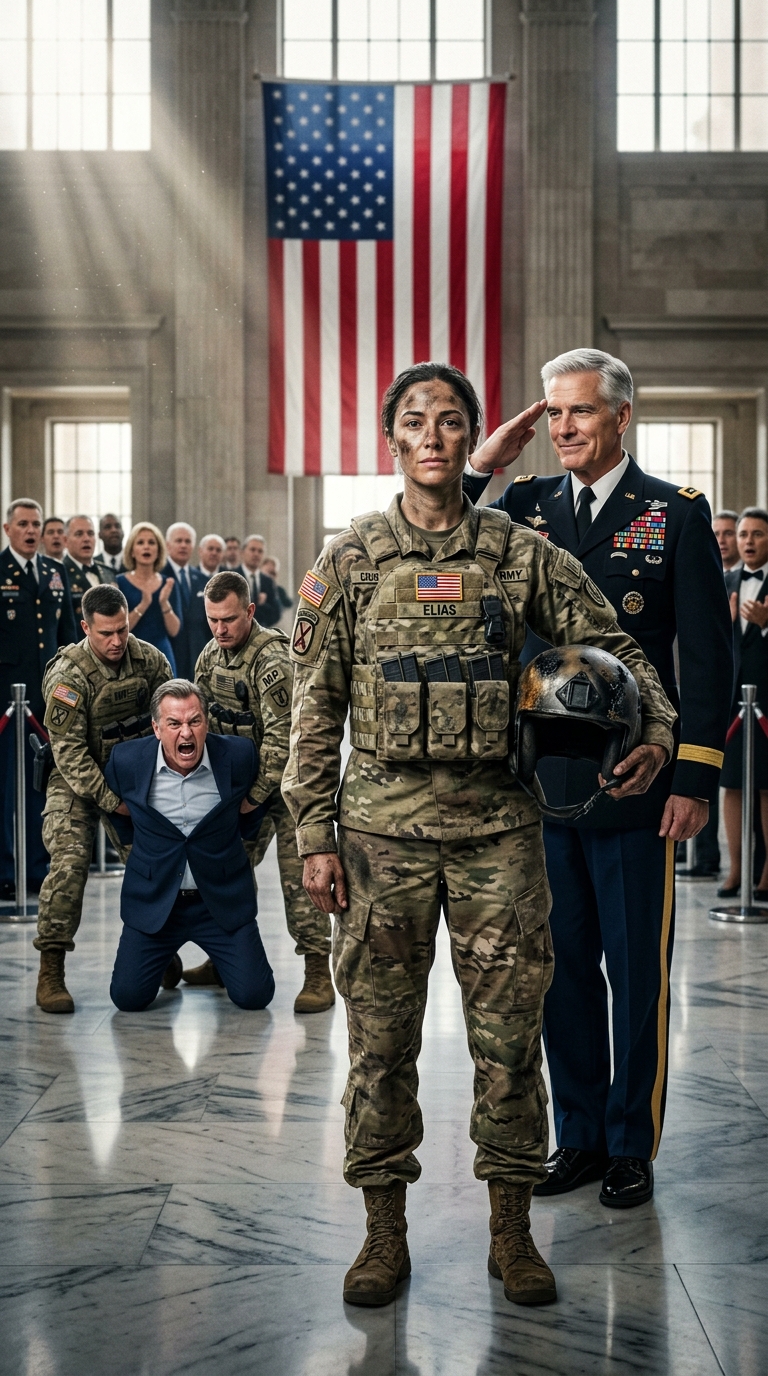
General Sterling approached the podium. He read the official commendation, his voice echoing off the polished wood paneling. He spoke of bravery, of suppressing fire, of the terrified civilians pulled from the concrete rubble. When he finally called me forward and pinned the heavy metal to my chest, his hands were remarkably steady. He stepped back and saluted.
I returned it, then stepped to the podium. The teleprompter screen embedded in the glass scrolled with my pre-approved, highly sanitized remarks.
I looked down at the text, then up at Arthur. I ignored the screen entirely.
“My father told me three nights ago that I shamed my family,” I said directly into the microphone.
A collective, sharp breath hitched in the room. The polished veneer of the ceremony cracked instantly. Arthur’s posture went rigidly stiff, his jaw locking. The network cameras stationed at the back of the hall suddenly swiveled, their red recording lights burning into my face like sniper dots.
“I believed him for a very long time,” I continued, my voice steady, carrying easily over the absolute, suffocating silence. “Because when you are fed criticism your whole life, you can mistake hunger for love. But this medal does not belong to a narrative of a family’s quiet support. It does not belong to PR statements. It belongs to Specialist Jason Miller, who gave his life so a little girl could go home.”
I looked directly into Arthur’s eyes. He looked utterly terrified. Not of being misunderstood. He was terrified of being fully, publicly seen.
“Do not,” I said, my voice dropping to a fierce, protective register, “turn his ultimate sacrifice into a cheap redemption story for people who only arrived after the applause began.”
I stepped back from the podium. The ceremony concluded in a haze of polite, deeply shocked applause. Nobody looked at Arthur.
Afterward, as the crowd thinned and the brass mingled, I walked toward the exit. Arthur was waiting by the glass lobby doors. In his hands, he held a massive bouquet of white roses—my mother’s favorite. He was actually trying to use her ghost as a shield.
“Clara,” he said, his voice stripped of its usual commanding baritone. “Please. I watched you up there. I was wrong about you. I’m trying.”
“I believe you’re trying now,” I said, stopping exactly three feet away, keeping a strict tactical distance. “But I also believe you only started trying when the world made it unbearable for you not to.”
I reached out and took the white roses from his hands. For a singular, pathetic second, a flicker of hope lit his aged eyes. Then, without breaking his gaze, I turned and laid the flowers beneath the memorial photograph of Jason Miller resting on a nearby table.
“I am your father,” he whispered, his voice finally breaking.
“You lost access to the version of me that kept waiting for you to act like it.” I turned away from him, walking toward the exit where Sarah and Thomas waited. I didn’t look back as the heavy glass doors hissed shut, leaving him completely alone in the lobby with his empty hands.
That night, I returned to my small, quiet house near the base. It smelled of stale coffee and laundry detergent. I placed my mother’s letter in my desk drawer. I was officially done bleeding for my father’s approval. The war with Arthur Bennett was over.
But as I sat at my kitchen table, staring at the rain lashing against the window, the heavy silence of the house was violently broken by a loud, rhythmic knock at my front door.
I glanced at the digital clock on the stove. 11:30 PM.
My heart rate spiked. I pulled my service sidearm from the biometric lockbox under the counter, keeping it concealed behind my back as I walked to the entryway. I pulled the door open just a few inches.
Standing on my porch, soaked by the rain, was an older man in a faded, military-issue field jacket. He looked at me with eyes that were identical to my father’s—the same sharp, calculating gray—though I had been told my entire life that this man was dead.
“Hello, Clara,” the man said quietly, stepping out of the shadows into the porch light. “My name is David Bennett. And your father and I have a hell of a lot to talk about.”
If you want more stories like this, or if you’d like to share your thoughts about what you would have done in my situation, I’d love to hear from you. Your perspective helps these stories reach more people, so don’t be shy about commenting or sharing.
✅ End of story — Part 3 of 3
← Read from Part 1