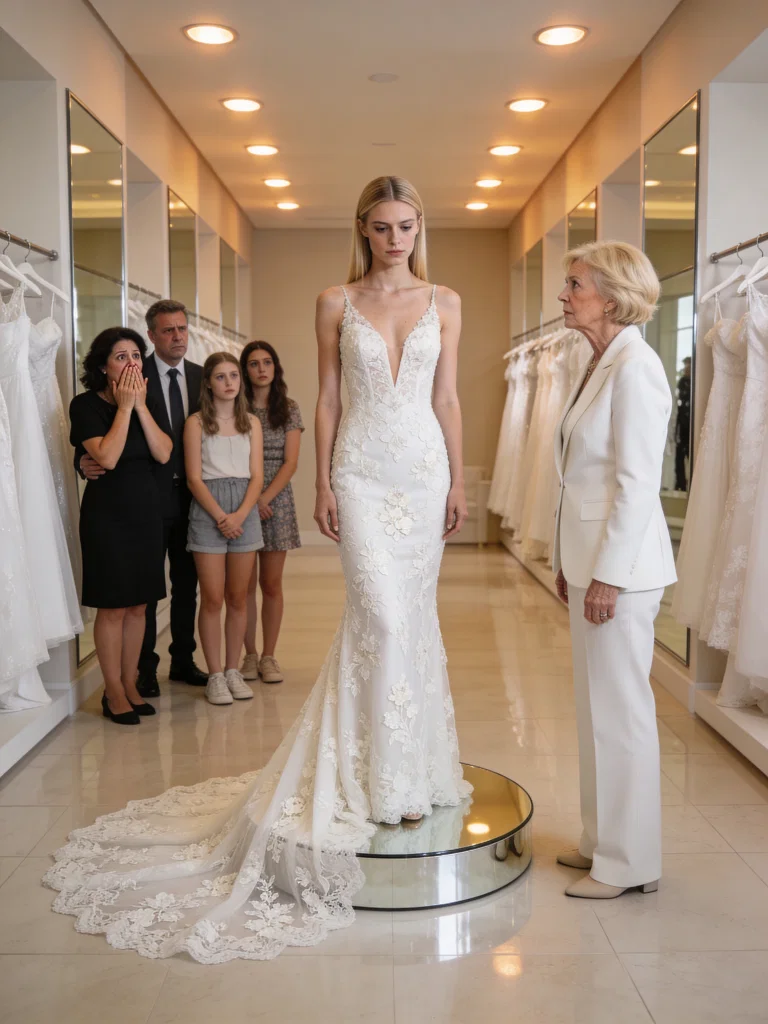
“White is for women who have a family waiting for them at the end of the aisle.”
The sentence did not arrive all at once. It came in parts, each word placed with cruel precision, as if Beatrice Sterling were selecting knives from a velvet case and testing their balance before deciding which one would cut deepest.
The bridal boutique on Rodeo Drive went so quiet that I could hear the whisper of satin as a consultant behind me shifted her weight.
Someone near the veil display inhaled sharply, and a woman I had never met lowered the crystal flute in her hand halfway to her mouth and stared at me with open pity.
Even the music, some soft instrumental arrangement of an old love song, seemed suddenly too loud and too mocking. And there I was, standing on a low mirrored platform in a gown that looked as though it had been made from winter light.
The dress was white in the purest sense of the word, not ivory, not cream, and not champagne. It featured hand-stitched French lace climbing over my shoulders like frost and pearls sewn so delicately into the bodice they seemed to float rather than shimmer.
A cathedral train spread behind me in a pool of silk and tulle. It was the kind of dress that made women put their hands to their throats and little girls imagine that weddings are the beginning of every good thing.
For one terrible second, I wasn’t thirty-two years old and one of the most powerful CEOs in San Francisco. I was eight again, standing by the window of a group home in Newark while another family came to pick up the girl who slept in the bed beside mine.
I was eleven, hearing one temporary guardian say to another that I was polite but there was something guarded about me, because children always know when they aren’t wanted. I was sixteen, sitting in a borrowed dress at a scholarship banquet, smiling through dessert while the parents at my table asked who had come with me.
“No one,” I had said back then. The old ache came back so fast it took the air out of my lungs, and my gaze moved to Miles.
He was standing just beyond the fitting area, one hand in his pocket and the other curled uselessly around the stem of a champagne glass.
He had one of those faces that photographed beautifully and apologized well, and in another life, maybe that would have been enough.
But in that moment, while his mother’s words still hung in the air for everyone to inspect, Miles looked down at the carpet as though the weave of it had become unexpectedly fascinating. He did not say my name, he did not tell her to stop, and he did not step toward me.
His silence spread through my chest like cold water. Beatrice smiled, almost sadly, as though she were the gracious one willing to say what others were too refined to mention.
She adjusted the cuff of her silk jacket and glanced around the salon with the faint awareness of an audience. She enjoyed an audience because women like her always called it poise when they possessed it and impropriety when anyone else did.
“I’m only trying to spare you embarrassment, Camille,” she said. “These things matter in our circles since white has meaning and tradition has meaning, so one should be respectful of both.”
Tabitha, Miles’s younger sister, shifted her designer handbag higher on her arm and looked away before I could catch her eye. Aunt Josephine gave a tiny, approving nod, as if Beatrice had merely corrected an error in place settings at a formal dinner.
Twelve strangers watched me decide what kind of woman I was going to be. A sales associate with a name tag that read Sarah looked as if she might cry for me.
I climbed carefully down from the platform, because women in fourteen-thousand-dollar gowns do not stumble no matter how hard someone is trying to make them bleed. I looked at Beatrice and simply said, “Okay.”
Beatrice blinked once in surprise and asked me to beg her pardon. I replied that she was right and I would change, using the same smile I used in negotiations when a man across the table mistook stillness for weakness.
For the first time since she had spoken, something uncertain flickered across her face. She had expected tears or perhaps a pleading explanation about how I meant no offense.
Instead, I turned, gathered a handful of skirt, and walked back into the dressing room. Inside, the air smelled of perfume and my own rising fury as the consultant who had zipped me in followed me with trembling hands.
“I am so sorry,” the young girl whispered. I met her eyes in the mirror and realized she was discovering in real time that wealth and cruelty often attended the same events.
I told her it was not her fault and reached up to unfasten the pearls at my shoulders myself. My hands were perfectly steady, and that part mattered to me more than anything else.
There are moments in life when the only victory available is composure. When everyone around you expects either collapse or retaliation, there is power in offering neither.
I had learned that in boardrooms and in kitchens where foster parents fought about money within my earshot. I stepped out of the dress and stood for a moment in the slip beneath it, looking at my reflection.