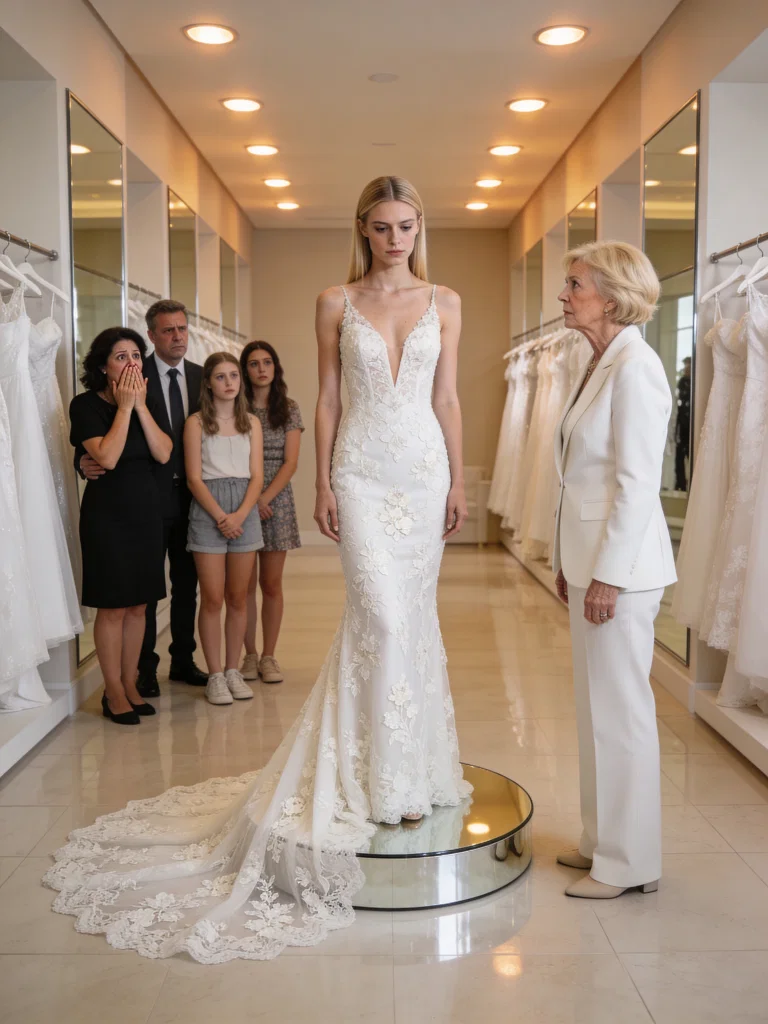
Women have complicated relationships with bridal gowns, but mine had always been simple. I had never dreamed of the spectacle of a wedding, but I had dreamed of the belonging implied by one.
That dress had made me look like I belonged, and that was precisely why Beatrice could not bear it. When I had changed back into my navy wool dress, I folded the gown across my arms with more care than I had ever handled some men’s careers.
Sarah took the dress from me as though receiving something sacred. I thanked her for her time and walked toward the exit.
“Camille, wait,” Miles finally called out. His voice chased me halfway to the door, so I stopped, but I did not turn around to face him.
He came closer and lowered his voice, telling me not to go like this. I asked him what he meant by that, and he exhaled through his nose while explaining that his mother just gets intense sometimes.
I looked at him then and really saw the handsome face I had kissed in candlelit restaurants. I saw the man who had just watched his mother tell his fiancée that she was unworthy of white because she came from nowhere.
And still he wanted me to help him make the scene smaller and easier for him to survive. I told him to enjoy the rest of his appointment and walked out into the winter air of California.
I did not cry in the car or the elevator. I did not cry when I let myself into the apartment Miles believed was the nicest place I’d ever lived, not knowing I paid more for its security than he did for rent on his loft.
I simply took off my heels, set them side by side near the console table, and stood in the silence. The apartment occupied the top three floors of a historic building overlooking the bay.
It had floor-to-ceiling windows, white oak floors, and a library with rolling ladders. No one outside a very small circle knew it belonged to me, and Miles had never been here.
That had not been an accident. From the beginning, I had kept parts of myself behind locked doors out of self-preservation.
I had wanted Miles to meet me unadorned by status. He knew I worked in finance and had done well for myself, but he did not know that Kensington Capital managed more than forty-seven billion dollars in assets.
He did not know that the tower in the Financial District with my surname in steel over the entrance was named after me. He did not know that his father’s law firm had spent months negotiating the most important transaction in its history with my company.
That night he came over with apologies shaped like excuses. He brought flowers and opened a bottle of wine from my kitchen without asking, because at some point he had begun to confuse access with intimacy.
“Camille, I’m sorry,” he said softly. I leaned against the counter and asked him what he was specifically sorry for.
He flinched and said he was sorry for the way his mother spoke to me and for not handling it better. I asked him if he knew what I heard when she said those things, but he remained silent.
“I heard that no matter how much I have built, I will always be the child no one claimed,” I said. “And when you said nothing, Miles, I heard you agreeing with her.”
He got defensive and told me that wasn’t fair. I almost laughed and asked him if he thought it was fair that his mother insulted me in front of strangers while he stood there concerned about his own comfort.
“You know how my family is,” he argued. I told him I finally did, but he continued to explain that his mother was just obsessed with appearances and under a lot of pressure.
I told him to stop and that I would not spend the rest of my life translating cruelty into stress so that powerful people could remain comfortable. His mouth tightened as he claimed he came there to make things right.
“No,” I said. “You came here to make this survivable.”
Something passed between us then, like the first crack through glass before the whole pane gives way. He told me his mother would apologize tomorrow and that we should all just calm down.
I studied him for a long moment and then told him to go home and sleep. It was the most mercy I could offer him.
He left close to midnight, and I listened to the apartment grow quiet again. Then I walked to the office at the far end of the hall and sat before the long black desk where I had signed agreements that changed industries.
I opened my laptop and logged into the secure server. I clicked on the file for the Sterling & Sons international expansion merger.
The proposed deal would inject capital and reputation into Henry Sterling’s aging litigation firm. For them, it was oxygen and survival, and Henry had likely already begun spending the money in his head.
I sat back and folded my hands. It would be easy to act out of wounded pride alone, but power is never clean and neither is revenge.
What I felt that night was a revelation. Miles’s silence had shown me what my life with that family would be, an endless series of insults reframed as misunderstandings.
If I married him, Beatrice would remain exactly as she was, only closer and more entitled. Once a truth reveals itself, pretending not to see it becomes a form of self-betrayal.
At 6:47 a.m., I sent an email to my head of acquisitions. I told her to pull us from the transaction effective immediately with no external explanation.
By 7:30, Rose was in the conference room on the forty-seventh floor. She had been with me since Kensington Capital was small, and she did not ask why I was canceling the deal.
“Sterling is contained,” she said, sliding a memo toward me. She watched me for a beat and noted that I was canceling a profitable transaction over something material that wasn’t in the room.
I met her gaze, and she reached a point of understanding. She asked if she needed to know the details, and when I said no, she simply accepted it.
By 9:00, financial reporters were sniffing around a story they couldn’t yet source. By market close, the damage to the Sterling firm had become impossible to spin.