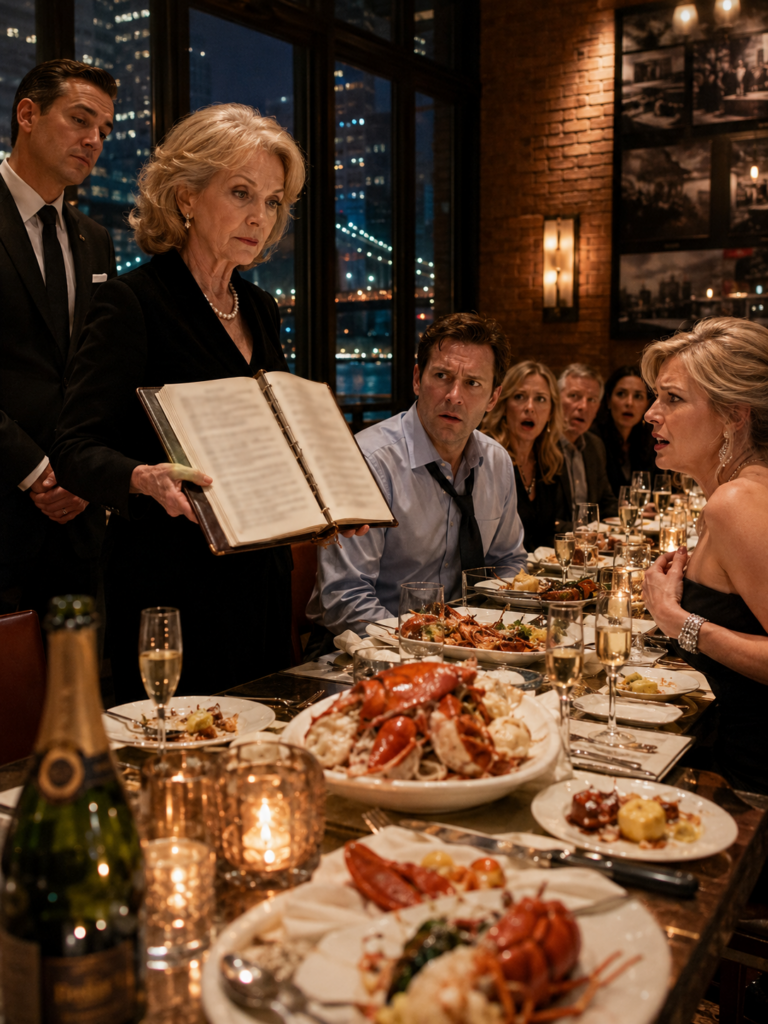
What they did not know, sitting across from me in the wreckage of their expensive dinner, was how long I had been preparing for this particular evening. Not the restaurant itself, not the exact table, not the amount printed on the bill, but the broader reckoning this night represented. I had known something like it was coming for nearly a year. I had been gathering what I needed slowly and carefully, the way I had always done things, without announcement and without drama.
Let me tell you what the notebook contained. The wedding had come first. Sebastian had looked at me with the eyes he had when he was small and wanted something he was embarrassed to ask for outright, a look that had never failed to produce exactly what it was intended to produce. Valerie had framed it as a simple request for help with a portion of the costs, and I had written a check for sixteen thousand dollars for a venue on Long Island. “We’ll pay you back,” Sebastian had said, his hand over mine. “Eighteen months, Mom. I promise.” I wrote the date, amount, purpose, and repayment timeline in the notebook the next morning. Not because I doubted him then. Because I had always kept records. Eighteen months passed. Nothing came back.
Then came the honeymoon in Key West, thirty-seven hundred dollars. Another signed note, another date, another silence where repayment should have been.
Then an online boutique Valerie described in detail over three separate dinners: suppliers already contacted, branding designed, market research done, a launch calendar written in gold ink on a planner she carried everywhere. She called it an opportunity. Sebastian called it a chance for them to become independent. I wrote a check for nine thousand dollars with a signed agreement. The boutique did not open. When I asked about it six months later, Valerie said the market had shifted and it was no longer viable, as if the market were a weather system that had personally blown my money into the sea. Then came the surgery that turned out to be a cosmetic procedure described to me as medically necessary. The credit card balance that had become “unmanageable.” The trip that was described as a professional obligation. The back rent that would apparently result in eviction if not covered immediately.
The car down payment. Each item arrived dressed in urgency and wrapped in the language of family obligation. Each one landed at my feet as if I were unkind for noticing the pattern. I paid each with the particular resigned love of a woman who wanted her son to be happy and believed, for too long, that his happiness and his wife’s demands were the same thing. Thirty-two thousand dollars in thirty-six months. Written down. Every cent of it.
The money was not the worst of it. Money can be recovered or not. Money leaves a trail. Money has numbers and dates and places to stand. The worst was the year they spent in my house. They moved in during the supposed water damage to their apartment. Two months, they said. It became twelve. Valerie rearranged my home with the confidence of a woman who had already decided it was hers. Curtains replaced. Furniture shifted. The tablecloth my mother had embroidered over one winter folded away somewhere I never found. The little brass lamp Arthur bought at a flea market before Sebastian was born disappeared into a closet because Valerie said it made the living room “feel old.” She packed Arthur’s photographs into boxes and stored them in the garage, and when I asked about them she described it as decluttering. Arthur had been dead for six years by then.
His absence was not a mess to be cleaned. It was a presence I had learned to live beside. Valerie treated it like visual clutter. When I found my engagement ring—the one Arthur had given me in Central Park when we were both young enough to believe the future was something you could hold in your hand—sitting in the kitchen trash under vegetable peelings, Valerie said she thought it was costume jewelry. Sebastian told me not to overreact. I did not overreact. I went to my bedroom and sat on the edge of the bed where Arthur had slept for twenty-two years, and I held the ring in my palm, and I began to wake up.
Waking up is not the same as deciding. It took several more months before I was ready to act, and several more before I knew exactly how to. I wish I could tell you that the ring in the trash was the instant everything changed, that I stood up, ordered them out, and reclaimed my house before sunset. Life rarely arranges itself so cleanly. Instead, I became quieter. I watched more. I stopped explaining my discomfort to people invested in misunderstanding it. I began saving receipts, printing bank records, copying messages, and writing down comments exactly as they were said. I noticed how Valerie’s mother, Patricia, looked at my house as if mentally measuring rooms for a future she expected to occupy indirectly. I noticed how Rachel, Valerie’s sister, opened my refrigerator without asking and joked that I “kept the good stuff hidden.” I noticed how Sebastian stopped saying thank you and began saying, “Mom, you know how it is.” I noticed how Valerie referred to Arthur’s study as “the spare room” and how she once told a friend over speakerphone that my house had “so much potential once the old lady energy is cleared out.” She laughed when she said it.
I stood in the hallway holding a folded towel and felt something hard and old settle behind my breastbone. The old lady. My house. My grief. My money. Their potential.
I hired Julian Martinez, a former detective who had built a small, discreet investigative practice in lower Manhattan. He was methodical, thorough, and entirely without sentiment, which was exactly what I needed. I found him through Andrew Salgado, my attorney of twenty years, though at first I did not tell Andrew everything. I told him only that I needed documentation of financial behavior connected to possible exploitation. Andrew understood enough not to ask for more over the phone. Julian Martinez met me in a quiet diner near Borough Hall, where the coffee was burnt and the waitress called everyone honey. He had gray at the temples, a notebook even smaller than mine, and the patient eyes of someone who had heard too many people explain away obvious harm because the person harming them was family. “What are you hoping to find?” he asked. I looked down at my hands. My wedding ring was still on one finger, Arthur’s engagement ring on another. “The truth,” I said. “Even if it makes me look foolish.” He nodded. “Truth is usually cheaper than denial. But it hurts more up front.” What he found took three weeks to compile and arrived in a manila envelope that I carried home on the subway without opening until I was sitting at my own kitchen table.
Sebastian and Valerie had twenty thousand five hundred dollars in a savings account they had never mentioned during any of the conversations in which they described themselves as financially struggling. Valerie’s spending records showed a consistent pattern of designer clothing, jewelry, spa treatments, and expensive dinners with people I did not know. Julian had also obtained, through means I did not ask him to specify and did not want explained, screenshots of messages between Valerie and her sister Rachel. In one of them, Rachel had written that I was an ATM with legs. Valerie had responded that I never said no. The final item in the envelope was a handwritten document in Valerie’s script laying out a plan for transferring my house in Brooklyn into Sebastian’s name. The stated reason was tax efficiency. The actual purpose, made clear by the numbers in the margins, was sale. The house was estimated at seven hundred thousand dollars, which was low, but that insult felt almost charming compared to the rest of it.
The planned disbursement included a new apartment for Sebastian and Valerie, a car, payments toward Patricia’s debts, a startup fund for Rachel’s business, and a remainder for personal use. My life, that is to say, had already been divided up and distributed in someone else’s imagination, in advance of my departure from it. I read the document three times. Then I called Andrew Salgado and told him everything.
That had been two months before the dinner at the Ivy Garden. The first thing Andrew did was grow very quiet. The second thing he did was ask whether they had access to my original deed, checkbooks, passwords, Social Security documents, or medical information. The third thing he did was tell me, in a voice gentle enough to frighten me, that we were no longer talking about family tension. We were talking about asset protection. Within days, he had reviewed my will, secured updated property records, placed alerts on financial accounts, and drafted a civil claim for repayment of documented loans. I changed passwords. I moved certain documents to a safe deposit box. I opened a new bank account for household expenses and stopped leaving checkbooks in drawers. Then I called Rodrigo. He listened without interrupting. He knew Sebastian only as my son and Valerie as the daughter-in-law I had once brought to brunch when I was still trying to build peace from the wrong materials.
When I finished, Rodrigo said, “Mrs. Eleanor, tell me what you need.” I told him. I did not need revenge. I needed a room where the truth could not be waved away. I needed independent confirmation of reservation times, the bill, and the fact that I had not authorized payment. I needed the people who had mistaken my kindness for access to find out, in public, that the house always keeps records. Rodrigo agreed to everything. He was the only person besides Andrew and Julian who knew what I was preparing, and he kept the confidence completely.
Now, sitting at the wreckage of the table, I opened the notebook and began to read. Dates, amounts, stated reasons, signed promises. I read them in the order they had occurred, in the flat, informational voice I had used for decades when presenting numbers to clients. The venue on Long Island. Sixteen thousand dollars. Repayment promised within eighteen months. No payment received. The Key West honeymoon. Thirty-seven hundred dollars. Repayment promised in installments beginning ninety days after return. No payment received. Boutique launch. Nine thousand dollars. Signed agreement. Business not opened. No repayment received. Medical procedure described as necessary. Later discovered to be cosmetic. Forty-two hundred dollars. Credit card emergency. Twenty-eight hundred. Professional trip. Nineteen hundred. Back rent. Six thousand. Car down payment. Four thousand four hundred. Grocery and household cash advances during the year they lived in my home. Totals noted separately. Sebastian’s face moved through several colors. Rachel stopped laughing before the third entry. Patricia’s posture changed, the triumphant rigidity softening into something more cautious as she began to understand the situation she had come to witness was not moving in the direction she had expected. Valerie leaned back in her chair, arms crossed, eyes fixed somewhere over my shoulder as if the wall behind me might provide an exit.
When I finished with the notebook, I placed the printed screenshots on the table. The words ATM with legs sat on white paper in the center of the table between the empty champagne bottles and the crusted dessert plates. Valerie did not look at them. She was looking at the window. I put the document about my house last, smoothing it flat with my palm before sliding it across the linen. Sebastian looked at it for a long time. “Mom, I didn’t know about all of this,” he said. His voice had gone small in a way that made my heart ache despite everything. I remembered him at five years old, asleep in the back seat after a day at Coney Island, one sticky hand curled around a plastic dinosaur. I remembered him at twelve, pretending not to need me at school events while still checking to make sure I was watching.
I remembered the boy who cried for three nights after Arthur died because he said he wished he had asked his father more questions. That boy was not gone. But he was not the man sitting in front of me either. “You knew enough,” I said. It was the truest thing I could offer him in that moment, and we both understood it. Valerie pressed her hand flat on the table. “This is a complete invasion of our privacy. We are family.” I leaned forward slightly. “Family does not invite an elderly woman to arrive at the end of a dinner in order to humiliate her and hand her the check. Family does not plan to take away her home. Family does not keep a ledger of how many times they can press someone before she stops being useful.” I straightened. “What you have been running is not a family.
It is a system. And systems, in my experience, eventually get audited.”
Rodrigo placed a card reader on the table with the quiet efficiency of someone completing a routine transaction. “The bill for this evening must be settled tonight,” he said. “Mrs. Eleanor did not authorize any charges to her account.” Patricia turned to Valerie with an expression that had abandoned all pretense of social grace. “You said she would pay,” she said. “She always pays,” Rachel muttered, then seemed to realize she had said the quiet part loudly enough for three tables nearby to hear. Four credit cards appeared on the table. The first declined immediately. The waiter’s face remained professional, which I admired. The second did not have sufficient limit for the full amount and had to be used for a portion. Rachel cried, not from remorse but from the particular frustration of someone caught in someone else’s plan and now personally inconvenienced by it. Patricia hissed at Valerie under her breath.
One of the unknown guests suddenly remembered an early morning and left cash for his portion before escaping. Sebastian sat with his hands flat on the table in front of him and said nothing at all. I watched him for a moment, and my anger wavered into grief, then hardened again into necessity. Before I stood, I laid the manila envelope on the table in front of my son. It contained copies of everything Julian had compiled, along with the civil claim Andrew had drafted for the recovery of thirty-two thousand dollars plus interest and a formal notice to vacate my property. Fifteen days to sign the payment agreement. Everything out of my house by six o’clock the following evening. Sebastian looked at the envelope and then at me. His eyes were wet. “Mom, please don’t do this.” “No,” I said, picking up my purse and notebook. “You did this.
All of you. I am simply the one who stopped helping you hide it.”
I walked out through the dining room, past the tables of people who had been trying not to watch and had watched anyway, past the hostess who had known something was wrong from the moment I arrived, and out through the front door into the cool night air of Brooklyn. I stood on the sidewalk for a moment. The street sounds rose around me: car engines, voices, a bicycle bell, the distant mechanical rhythm of the city that has always been home. I pressed the notebook against my chest and breathed. I thought I would feel victorious. I did not. Victory is too clean a word for what happens when you expose people you love. I felt steadier, yes. Lighter, perhaps. But also old in a way I had not felt that morning. There is a special exhaustion in finally doing what should have been done long ago. Rodrigo came outside a few minutes later.
He did not ask whether I was all right because he knew better. Instead, he said, “I’ll have someone call you a car.” “Thank you,” I said. He stood beside me in silence for a moment. “My mother would have been proud of you,” he said. That almost broke me. Mercedes had understood numbers too. She had understood quiet labor, invisible competence, and the danger of being underestimated by people who confuse kindness with weakness. I looked at Rodrigo, at the grown man whose restaurant had survived because someone once sat down with ledgers and refused to let debt swallow a family whole. “Your mother would have told me I waited too long,” I said. He smiled sadly. “Probably.” Then my car arrived, and I went home.