The following afternoon, they arrived with a moving truck. Valerie moved through my house with the angry efficiency of someone furious at being caught rather than sorry for what she did, throwing things into boxes with more force than necessary, muttering words she did not quite direct at me because Andrew was present and she had enough legal instinct to understand this was not the moment. Sebastian moved more slowly, carrying things with a heaviness that was not physical. Andrew stood near the staircase with a clipboard and the face of a man who had spent too many years watching families discover that entitlement is not a legal claim.
He stopped Valerie when she reached for my mother’s china. “That is not your property,” he said. Valerie’s hand froze above the cabinet. “It was in the kitchen,” she snapped. “So is the plumbing,” Andrew replied. “You may not remove that either.” I almost smiled despite myself. Valerie said something sharp and small that nobody responded to. Patricia arrived halfway through with two large tote bags and left fifteen minutes later after Andrew informed her she would be searched if she attempted to remove anything not listed on Valerie’s inventory. Rachel did not come at all. Cowards often avoid the cleanup after the feast.
At twenty minutes to six, they were gone. Sebastian stood on the porch after the last box went into the truck, his hands in his jacket pockets, looking at the front door as if trying to memorize the place he had mistaken for guaranteed shelter. “Mom,” he said.
I waited. He opened his mouth, closed it, and finally said, “I don’t know how to fix this.” “You start by not asking me to tell you.” He nodded, tears gathering but not falling. Valerie called his name from the truck. Her tone was impatient, sharp, already blaming him for everything that had failed. He flinched, and for one terrible second I wanted to pull him inside and shut the door against her. That is what motherhood does. It rises even when the child is grown, even when the child has stood by while your ring sat in the trash and your house was divided on paper. But a mother’s love does not mean rushing to rescue an adult from the consequences of choices they made while they were looking you in the eye and calling you family. So I stayed still. Sebastian walked to the truck. I closed the front door and changed the deadbolts myself, which I had been meaning to do for longer than I wanted to admit.
I walked through my house the way you walk through a place after something has happened in it, slowly and with attention, taking stock. There were marks on the walls where things had been moved. Drawers emptied. Spaces where photographs had hung, their outlines faintly visible in the slightly different shade of paint. In the study, under a folder Valerie had apparently forgotten in her anger, I found a notebook that was not mine. I knew before I opened it that I would not like what it contained, but there are some doors that cannot be closed once your hand is already on the knob. I sat down and read it. The debt she carried was larger than I had known: forty-five thousand dollars across credit cards, personal loans, and money owed to her own mother from a clothing business that had failed. There were calculations about my house, different from the ones Julian had found, messier and more desperate.
There were lists of what could be sold, what could be borrowed against, what could be “managed” once Sebastian’s name was attached to the deed. Tucked into the back pages were printed messages from a man named Ethan. His most recent message read: As soon as the old woman’s house sells, we’ll move to Miami. You said Sebastian won’t fight you if his mother signs first. Make it happen. I sat on the floor of my study for a long time, not crying, because there were no tears left that belonged to Valerie. The hurt that remained was for Sebastian, and it was the specific, quiet hurt of watching someone you love lose themselves so completely that the person sitting across from you in the restaurant had barely resembled the boy who used to fall asleep against your arm on long car rides.
Sebastian signed the payment agreement twelve days later. Fourteen hundred dollars a month for nearly two years. He sold his car. He closed his credit accounts. He moved into a small apartment in the neighborhood and started seeing a therapist, which I learned from the brief notes he attached to the monthly payments. Month five paid. Still in therapy. Month eleven paid. I am sorry for calling you clueless. Month eighteen paid. I did not deserve your patience. I kept every note in a box beside the letters Arthur wrote me when we were young. Valerie refused to sign initially. She threatened a public campaign, a social media account, a claim of elder abuse delivered with enough volume to cause trouble even if it never went anywhere. Andrew sent her legal counsel the full evidence file and the countersuit, and she signed the following day. She was in Miami within three months, with Ethan, who discovered the extent of her debts and did what people like Ethan do when the calculation no longer works in their favor. I did not feel satisfaction at that. I am not sure what I felt, exactly. Something more like the absence of a weight I had been carrying for so long that I had stopped registering it as weight.
I remodeled the kitchen that spring. Not dramatically. I was too tired for dramatic. I replaced the chipped tile Valerie had complained about but never paid to fix, painted the cabinets a soft blue, and put my mother’s tablecloth in the top drawer where I could reach it. I hung the photographs back on the walls, not all of them in exactly the same positions as before, which turned out to feel right in a way I had not expected. Life had shifted; the walls could too. I found Arthur’s photos in the garage, dusty in their bubble wrap, and chose the three I loved most. One from the summer we took Sebastian to Vermont and Arthur stood beside a lake with his sleeves rolled up, laughing at something outside the frame. One from our twenty-fifth anniversary, his tie crooked, my hand tucked under his arm. One of him holding newborn Sebastian with the terrified tenderness of a man who had just discovered love could be smaller than his forearm and larger than his life.
I put them where I could see them from the table where I had my morning coffee. I rescued the plants Valerie had let go dry. Two survived. One did not. I adopted a dog, a golden retriever mix the shelter had named Bella, who slept under my desk with her chin on my foot and required nothing from me except presence, reliability, and the occasional long walk. That was a kind of love I could understand.
I went to Savannah in October, alone, something I had never done in my life. Arthur and I had always talked about going. We said we would walk under the moss-draped trees, eat seafood by the river, and stay in a little inn with creaky floors. Then work happened. Parenting happened. Illness happened. Death happened. The trip stayed folded away like a good tablecloth saved too long for company that never came. So I went. I walked through the old market district and looked at paintings by artists I did not recognize. I bought a piece I could not entirely explain but felt something when I stood in front of it: a woman seated at a kitchen table with morning light across her hands. I ate dinner at a restaurant on the waterfront without looking at the prices on the menu, which sounds like a small thing and is not.
For years, even when I had money, I had ordered with other people’s needs in mind. What would Arthur want to share? What could Sebastian eat? What would Valerie criticize? What would the final bill require from me later? In Savannah, I ordered what I wanted. I sat on a bench in Forsyth Park in the afternoon and cried, not from grief exactly, but from the particular relief of a person who has arrived somewhere they did not know they were trying to reach. Living for yourself, I discovered there, is not selfishness. It is what happens when you finally stop trying to justify your existence through other people’s gratitude.
Sebastian completed his payments on a Tuesday morning. He sent a short message: The final deposit has been made. I am not asking for anything. I would understand if you do not want coffee. But if you ever do, I will be there. I took three days before I replied. On the fourth day, I sent him the address of a small coffee shop two blocks from my house. We met on a Sunday. The weather was the kind of mild gray that feels restful rather than gloomy. We sat across from each other at a corner table, and there was no hug, not yet, just two people with coffee cups and the kind of silence that exists between those who have too much to say to begin with any one thing. He looked older. Not ruined. Not punished in the theatrical way people imagine. Just older, as if the last two years had finally brought him into his own face.
He did not blame Valerie. He did not explain himself through what she had done to him or convinced him of or how her influence had clouded his judgment. He took the weight of it without distributing it anywhere else, which was the first thing he had said or done in years that sounded entirely like himself. “I let it happen,” he told me. “Every time you were humiliated in front of me, I laughed or I said nothing. I let them treat you like a resource. I let them talk about you the way they talked about you, and I told myself it wasn’t really that serious.” He stopped and wiped his eyes with a napkin. “That was a choice. Every single time. I made it.” He cried, and I did too, which I had not expected. I did not forgive him that afternoon, not fully, not in the way that would have meant pretending the previous three years had a different shape than they did.
But I left a door standing open, which was more than I had been able to offer for a long time.
My study smells like coffee and lavender now, the two candles I light in the morning when I sit down to work. Bella sleeps under the desk. The photograph of Arthur that I love most, the one from Vermont before Sebastian was born, is visible from where I sit. The wine-colored notebook on my shelf no longer holds debt figures. It holds the early notes for a video channel I am building, something modest and honest, where I talk about the particular experience of women who learned, often later than they would have liked, that the word enough is a complete sentence. I talk about documentation, not as bitterness but as memory with structure. I talk about elder financial abuse without making it sound like something that only happens to confused people in bad houses. I talk about how love can become a pressure point in the hands of people who know where to press.
I talk about the difference between generosity and access, between helping and being harvested, between forgiveness and returning to the same table to receive the same bill. Sometimes women write to me afterward. Widows. Mothers. Aunts. Grandmothers. Women whose children borrow and borrow until gratitude becomes irritation. Women whose daughters-in-law or sons-in-law treat inheritance like a calendar event they are impatient to reach. Women who feel ashamed that they did not see sooner. I tell them what I had to learn: seeing late is still seeing. Leaving late is still leaving. The door is still a door even if you should have opened it years ago.
Sebastian comes twice a month now. He brings pastries sometimes, the kind from the bakery on Atlantic Avenue that we used to visit on Sunday mornings when he was small. We do not talk about Valerie unless there is a practical reason. We do not talk much about money, except in the honest, careful way adults talk when one of them has broken trust and is trying not to do it again. We talk about therapy, which he describes with the cautious, discovering language of someone learning to see himself clearly for the first time. We talk about Bella, who adores him because dogs are generous in ways humans rarely deserve. We talk about Arthur sometimes, which we had not done in years, and those conversations feel like recovering something that had been stored in a garage in bubble wrap. Once, Sebastian asked if I thought his father would be ashamed of him. I looked at Arthur’s photograph for a long time before answering. “Yes,” I said. Sebastian flinched but did not look away. “But he would not stop loving you.” He nodded slowly, tears in his eyes. That is the hardest truth of parenthood, perhaps: love and disappointment can occupy the same chair. One does not erase the other. Neither should be used to excuse the other.
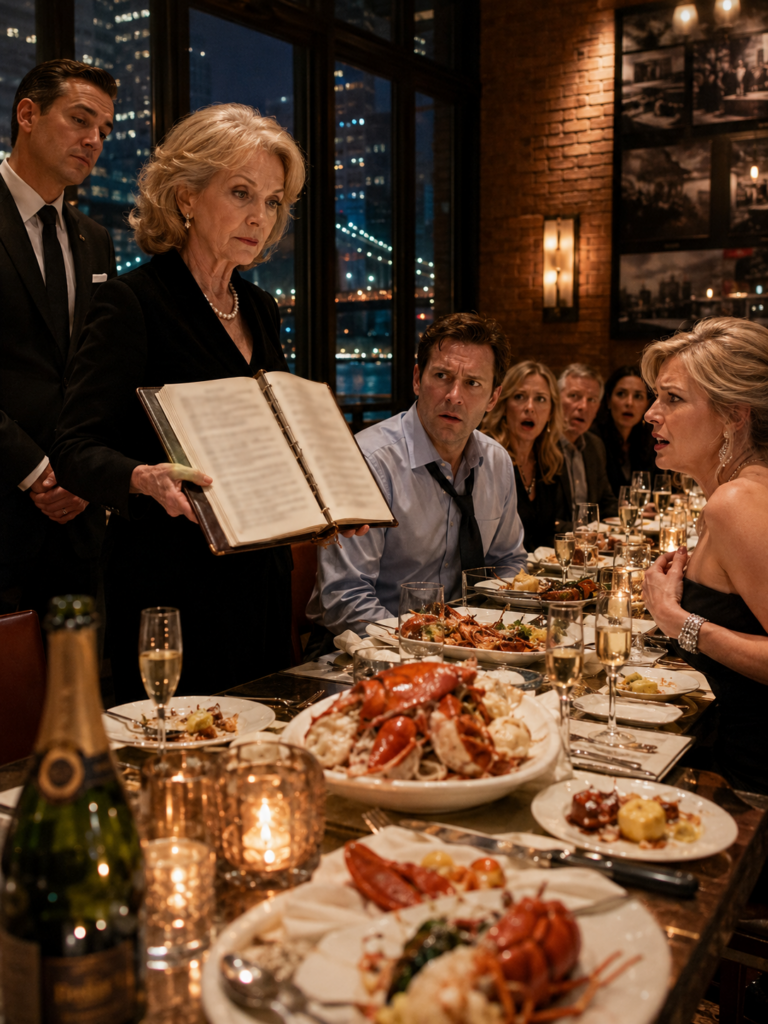
There is a particular satisfaction in the knowledge that my house is still mine. Not the dramatic satisfaction of victory in a contest, not the kind of satisfaction that needs witnesses or applause, but something quieter and more sustaining. The satisfaction of a woman who looked at what was being done to her and refused to be the last one to understand it. That night at the Ivy Garden, they believed I had arrived to pay a bill. They had arranged everything carefully toward that outcome: the time of the invitation, the extravagance of the order, the faces around the table positioned to watch, the assumption that my love for Sebastian would make refusal feel impossible. They underestimated, in the way people consistently underestimate quiet women who have spent decades paying close attention, the possibility that I had already seen the shape of what they were doing long before they brought me to the restaurant to complete it.
I did not arrive to pay a bill. I arrived to collect one. The debt they owed me was not only the thirty-two thousand dollars that now sits, recovered, in my account. It was the cost of three years of swallowed humiliation and deliberate blindness and the slow, patient work of a woman who kept a notebook and waited until the moment was exactly right. That bill, after everything, has been paid. And everything else—the coffee in the morning, the dog under my desk, the photographs back on the walls, the door slowly and carefully opening again for my son—is not repayment. That is simply what remains when you finally stop agreeing to disappear. THE END
✅ End of story — Part 3 of 3
← Read from Part 1