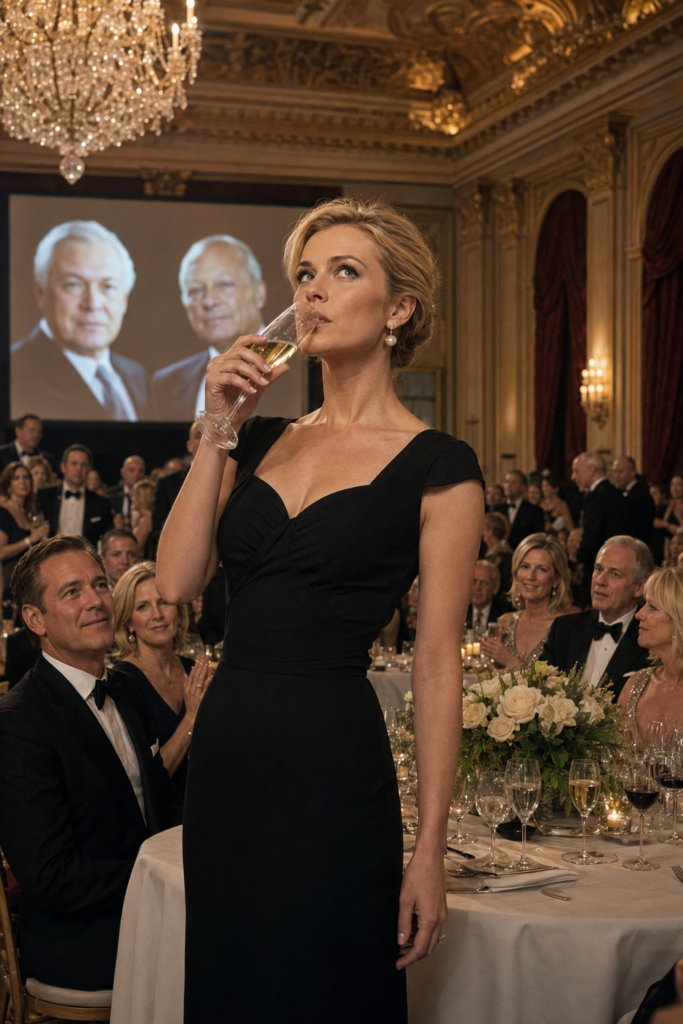
The last joke my father ever made about me landed in a ballroom glittering with crystal and money.
It was one of those country club evenings that smell like nostalgia and expensive perfume. The ceiling dripped chandeliers. Silver trays floated past with tiny things on toast. Somewhere a string quartet was doing unspeakable things to a Coldplay song. Two hundred people, give or take, milled around in suits that cost more than my first rent deposit.
I stood near the back of the room in a black Valentino dress, the kind of dress that looks simple if you don’t know what you’re looking at.
My grandmother’s pearl earrings brushed my neck when I moved my head. A Cartier watch circled my wrist, the metal cool against my skin. In my hand, a flute of champagne caught the light.
None of those things came from this family.
I watched my father hold court near the bar, that familiar silhouette in a tailored navy suit, silver hair combed back with the sort of care men reserve for important days and vanity. He was laughing with a cluster of men who all had the same posture: slightly leaned back, one hand in a pocket, drink held as if it were an accessory instead of an object.
Richard Evans, king of logistics in Fairfield County, was retiring.
He’d waited forty years for this victory lap.
I’d waited twelve for my exit.
He took the stage when the lights dimmed, moved the way he always did when he knew every eye was on him—shoulders relaxed just enough to look effortless, chin lifted just enough to look important.
The applause rolled over him like a wave he believed he’d created.
“Thank you,” he said, microphone in hand, voice warm and booming from decades of practice. “Thank you, all of you, for being here tonight.”
I watched him, my father, the man who had given me my last name and very little else. I watched, and I thought of every time I’d tried to earn his attention as a child. Every report card he’d barely glanced at. Every game he’d missed. Every conversation we hadn’t had.
He went through the usual script. Stories about the early days. A joke about starting the company with nothing but hustle and bad coffee. Gratitude to mentors and partners. He knew how to turn his life into a legend; he’d been rehearsing this moment for decades.
“And of course,” he said eventually, “I couldn’t have done any of this without my incredible family.”
The ballroom hummed. People shifted in their chairs, smiling politely, ready for the part where he showcased the photogenic support system.
“My wife, Linda.” He gestured toward the long head table in front. She dabbed at her eyes with a linen napkin as if on cue, the light catching on her diamonds. “Thirty years she’s put up with late nights and last-minute flights. I owe you everything.”
Applause. She tilted her face, gracious, composed.
“And my son, Marcus,” he continued, pride sharpening his voice. “He’ll be taking over as CEO in January. The future of Evans Logistics. I couldn’t be prouder.”
More applause. Marcus rose, one hand lifted in a modest wave that wasn’t modest at all. The woman at his side—toned, blonde, in a dress that looked painted onto her—is what people like my stepmother called “a great match.”
I felt the tiniest pressure building behind my ribs, familiar now, like a phantom bruise.
“And of course…” My father’s eyes swept the room and landed on me.
Here we go.
“…my daughter, Heather.”
The spotlight swung and pinned me in place, white and hot. Two hundred heads turned in the same instant, like flowers following the sun.
There I was: Table 14. Far from the family table. Tucked near the service doors where waiters slipped in and out with trays of food and frustration. My place had been set among distant relatives and “old family friends” who couldn’t quite remember how they knew us.
I smiled, small and polite. Raised my champagne glass just enough to be visible.
My father’s lips curved. It was a smile I knew well. To everyone else it looked warm, amused. To me it looked like the edge of a blade.
“And this is my daughter, Heather,” he said. “No degree. No real career. Just kind of… floats around and freeloads off the family.”
Laughter broke across the room in a bright, ugly wave.
It wasn’t hesitant laughter, either. It was the kind people give freely when they’re confident they’re safe—that they’re on the right side of the joke. People glanced at each other, at me, at him. Some looked relieved they weren’t the punchline. Some just enjoyed the show.
I didn’t flinch.
I didn’t flush red the way I used to. I didn’t duck my head or force out a weak smile. I didn’t dissolve into the carpet like I had so many times before.
I just watched him. And then I stood.
My chair scraped the polished wood with a sound that felt louder than the laughter had been. The room quieted almost instantly, the way rooms do when something unscripted happens.
I picked up my champagne glass carefully, aware of how steady my hand was.
“Congratulations on your retirement, Dad,” I said. My voice carried clearly across the ballroom, thanks to a microphone placed a little too close to our table. “Forty years in business. It’s a lot.”
A few people chuckled nervously, unsure where this was going.
“You’ve taught me a lot about hard work,” I continued, “and sacrifice. And about exactly how much loyalty family can expect from you.”
You could feel the air change.
The polite smiles faltered. Someone’s fork stopped halfway to their mouth. A waiter froze near the door, balancing a tray of champagne like a statue.
“So,” I lifted my glass a little higher, “here’s to you. Cheers. This is the last time any of you will ever see me.”
I set the glass down without drinking, slipped my Birkin bag over my shoulder, turned, and walked toward the exit.
My heels—Louis Vuitton, glossy, precise—struck the floor in a measured rhythm. Click. Click. Click. The room was so silent that each step sounded like a gavel.
I didn’t look back.
By the time the double doors closed behind me with a soft, padded thud, I felt like I’d shed a skin that had been choking me for years.
Outside, the air was cool and touched with the smell of cut grass and gasoline from the valet line. I walked past rows of expensive cars until I reached mine: a black Tesla Model S, sleek under the floodlights. The vanity plate read MRGD1—my private nod to the one person in my family who had ever really seen me.
My grandmother, Margaret Evans.
I was reaching for the door handle when I heard my stepmother’s voice.
“Heather! Heather, stop right there.”
Linda’s heels were less steady than mine as she hurried across the pavement, her dress rustling, her social smile gone.
I kept my hand on the door.
“What do you think you’re doing?” she hissed, grabbing my arm.
I looked down at her fingers on my skin, and then up at her face. The perfect blonde bob was still in place, the makeup still flawless, but her composure had cracked around the edges.
“You humiliated your father in front of everyone,” she said. “Do you have any idea—”
“I humiliated him?” I asked quietly. “You sure you didn’t get that backward?”
My father joined us then, his steps slower but heavier, like each one carried a different kind of weight. Up close, under the harsh white light of the parking lot, he looked older than he had onstage. The wrinkles around his eyes were deeper. His jaw was clenched hard enough to make the muscle jump.
“Get back inside,” he said, low and sharp. “You will apologize.”
I leaned against the car door, more tired than angry.
“No.”
“This isn’t a negotiation,” he snapped. “I am your father, and I am telling you—”
“You’re telling me what?” I cut in. “That I should go let you use me as the punchline again? Smile while you tell people I’m worthless?”
“It was a joke,” he said, but there was a waver in it.
“It was the truth,” I replied. “Or at least, it was your truth. And I’m done pretending I don’t hear you.”
I opened the car door.
“If you leave now,” he said, voice suddenly colder, “you’re done. No more family. No more support. Nothing.”
The words were supposed to be a threat. They sounded like a confession.
I met his eyes. “You cut me off twelve years ago,” I said. “You just never had the courage to say it out loud.”
I slid into the driver’s seat.
“Tonight,” I added, “I said it for both of us.”
I closed the door before either of them could reply, and for a second all I could see were their faces through the glass—Linda’s small and pinched with outrage, my father’s carved from something that looked a lot like fear.
Then I put the car in gear and left the country club—its chandeliers and gossip and judgments—shrinking in my rearview mirror.
I drove until the lights of the club and the neat rows of Fairfield houses fell away. Twenty minutes down the highway I stopped at an empty rest area, pulled into a space, and let the car idle.
My hands were still on the steering wheel. They weren’t shaking.
I stared straight ahead at the dark trees and the occasional streak of headlights passing on the interstate, and the strangest thing washed through me.
Relief.
Not the joyous kind. Not the Hollywood-montage, dancing-in-the-rain kind. A quiet, bone-deep loosening of something that had been knotted up since I was eight years old. As if some inner muscle that had clenched every time I heard my father’s voice had finally let go.
Because this wasn’t really about tonight.
It never had been.
It was about a study with wood-paneled walls and a leather chair. It was about a house that looked perfect from the outside and hollow from the inside. It was about a girl who learned to be invisible in order to survive.
It was about the first time my father decided what my future was worth.
When I was little, people used to tell me how lucky I was.
“You’re an Evans,” they would say. “You’ve got it made.”
We lived in a six-bedroom colonial on two manicured acres in Fairfield, Connecticut. The driveway curved in a graceful loop with a stone fountain in the center that ran in the summer and froze into a sculpture in the winter. A Mercedes S-Class always sat in the driveway like a punctuation mark.
Inside, the air was always cool. The furniture matched. The refrigerator hummed quietly, full of food that arrived like magic every week.
My father ran Evans Logistics, a midsized logistics company that specialized in getting things from where they were to where they needed to be, faster and more efficiently than the competition. He liked to say that we weren’t in the trucking business—we were in the problem-solving business.
He was good at solving other people’s problems.
Mine, he mostly ignored.
My mother died when I was eight. I remember those months in flashes: the smell of antiseptic, the quiet beeping of machines, my father’s face a blank mask, the way adults lowered their voices when I came into a room. I don’t remember ever being told directly that she had cancer; it was just this word that floated around, heavy and unanswerable.
What I remember vividly are her hands.
My mother’s face is mostly photographs now in my mind—smiling on the beach, laughing in the kitchen, tilting toward me on the first day of school. But her hands I remember like they’re in front of me: long fingers, soft palms, always reaching for mine.
“You’re so clever, Heather,” she used to say when I would line my stuffed animals up by height or color. “You’re going to do something big one day.”
After she was gone, nobody said things like that to me anymore.
Two years later, my father married Linda.
The wedding was in the same country club where he would one day host his retirement party. At ten, I wore a white dress with a sash the exact shade of the bridesmaids’ silk gowns. Linda’s son, Marcus, wore a miniature tux and stood beside my father in every photograph I wasn’t in.
Marcus was three years older than me. From day one, our roles were clear.
He was the son.
I was the shadow.
It wasn’t a Cinderella situation. No one made me scrub floors or sleep in an attic. I had my own room, my own bathroom, my own drawer of neatly folded sweaters in soft colors Linda preferred for girls. No one shouted at me. No one hit me.
They just looked through me.
At first, I tried to compete.
When Marcus came home in eighth grade with a science fair trophy, my father put it on the mantle and rested his hand on Marcus’s shoulder, pride practically glowing off him.
“Smart kid,” he said. “Knew you had it in you.”
The next year, I got a county-wide award for a short story I wrote. A glossy certificate arrived in the mail. I brought it to my father’s study, heart pounding.
“That’s nice,” he said, glancing at it for less than a second before sliding it under a pile of papers. “Did you say thank you to your teacher?”
He never hung it on the wall.
When Marcus turned sixteen, a new car appeared in the driveway, a shiny BMW with a bow on the hood. The whole neighborhood practically applauded. My father clapped Marcus on the back and said, “You treat her well, son. She’s your first real responsibility.”
When I turned sixteen, I got Marcus’s old sedan. Linda handed me the keys at the breakfast table.
“Isn’t it wonderful your brother takes such good care of his things?” she said. “You’re very lucky.”
“You’re very lucky” was a phrase I heard a lot.
Lucky you have a nice house.
Lucky your father provides for you.
Lucky to have a roof over your head.
Lucky Linda takes care of you like her own.
When Marcus joined the company as an intern one summer, my father announced it over dinner like a royal decree.
“Marcus is going to learn the ropes,” he said. “He’s the future of Evans Logistics.”
He didn’t look at me.
He almost never did.
If I existed in that house, it was as background. As a quiet daughter who did well in school and didn’t cause trouble. Someone who took up space in a room without filling it.
There was exactly one person who seemed to see me.
My grandmother, Margaret Evans.
She lived in a brick townhouse closer to Boston than to us. I didn’t see her often, but she called me every Sunday.
“How are your classes, sweetheart?” she would ask. “What are you reading? Are you still writing those little stories?”
She never asked about Marcus. She never asked about Linda. When she asked about my father, it was always with a sigh in her voice.
“You remind me of myself at your age,” she told me once. “Underestimated. But I see you, Heather. Don’t you ever forget that.”
I didn’t understand the weight of that sentence until years later.
At eighteen, I left home for the University of Connecticut. I went in as a business major because it seemed like the thing that would make my father proud, or at least less indifferent. Supply chain management fascinated me more than I expected—how one minor delay in one obscure warehouse could ripple out across markets and customers and other businesses.
If you understood the chain, you could control the flow.
Sophomore year, I had a 3.8 GPA and a scholarship application sitting half-finished on my desk for a summer program in London. It felt like the world was opening up, just a crack. I could almost see a life that wasn’t built around the layout of that big Connecticut house.
Then my father called.
“Family meeting,” he said. Two words I had never heard in my house but instantly distrusted.
I drove home that Wednesday and walked into the study that had always been off-limits unless summoned. The leather chair. The mahogany desk. The framed awards for “Businessman of the Year” and “Outstanding Leadership” and “Excellence in Logistics” lined up on the wall behind him like a jury.
Linda stood to his right, one hand resting lightly on his shoulder. A tableau of unity.
“Heather,” my father began, eyes on the papers in front of him instead of on me. “We need to talk about your education.”
My chest tightened. The future felt suddenly fragile.
“We’ve had a change in circumstances,” he continued. “Marcus has been accepted into the Wharton MBA program. It’s an incredible opportunity. But it’s expensive. Very expensive.”
I knew what was coming before he said it. There are some conversations that telegraph themselves: the angle of someone’s shoulders, the way their voice softens around certain words.
“We can’t afford both your tuition and his program,” he said. “Not right now. So we’ve decided that you’ll take a break from school. Just for now, of course. Marcus’s education will benefit the whole family.”
Linda’s fingers squeezed his shoulder.
“A girl doesn’t need an MBA to have a good life, Heather,” she chimed in, her tone syrupy. “You’re a pretty girl. You’ll find a nice husband one day. That’s what really matters, isn’t it?”
I stared at them.
Behind them, in a black frame, was a photo of my mother holding me as a baby, laughing at something outside the frame. My father had his arm around her in that picture, and he was looking at her, not the camera, as if she were the only person in the room.
“You said you’d support my education,” I heard myself say. “You promised Mom before she died.”
His jaw tightened. “Circumstances change,” he repeated. “When the company stabilizes, we’ll revisit this. I’ll make it up to you.”
He didn’t sound apologetic. He sounded annoyed that I’d brought up my mother.
I didn’t scream. I didn’t cry. I didn’t throw anything, even though one of the paperweights on his desk—the heavy one shaped like a globe—suddenly looked very throwable.
I just nodded.
Because I understood basic math. Not the math of tuition and salaries and bonuses.
The math of love, or the lack of it.
Marcus > me. Always.
Later, a cousin let something slip at a family barbecue. Something she wasn’t supposed to know, let alone say.
“Your dad just upgraded the yacht membership,” she said, reaching for a deviled egg. “All that Wharton tuition, too. You guys must be doing amazing.”
Yacht membership.
Wharton tuition.
Apparently there had been enough money to go around. Just not enough love.
I packed my things, withdrew from UConn, and moved out of the house for good two weeks later.
Twelve days after that, I was standing in a cramped studio apartment in Allston, a noisy neighborhood of Boston, with two suitcases, a futon mattress, and $2,000 in my bank account.
The radiator clanged at night like someone was trying to escape from inside the pipes. The walls were thin enough that I could hear my neighbor’s television and every argument he had with his girlfriend. The windows stuck in the winter and sweated in the summer.