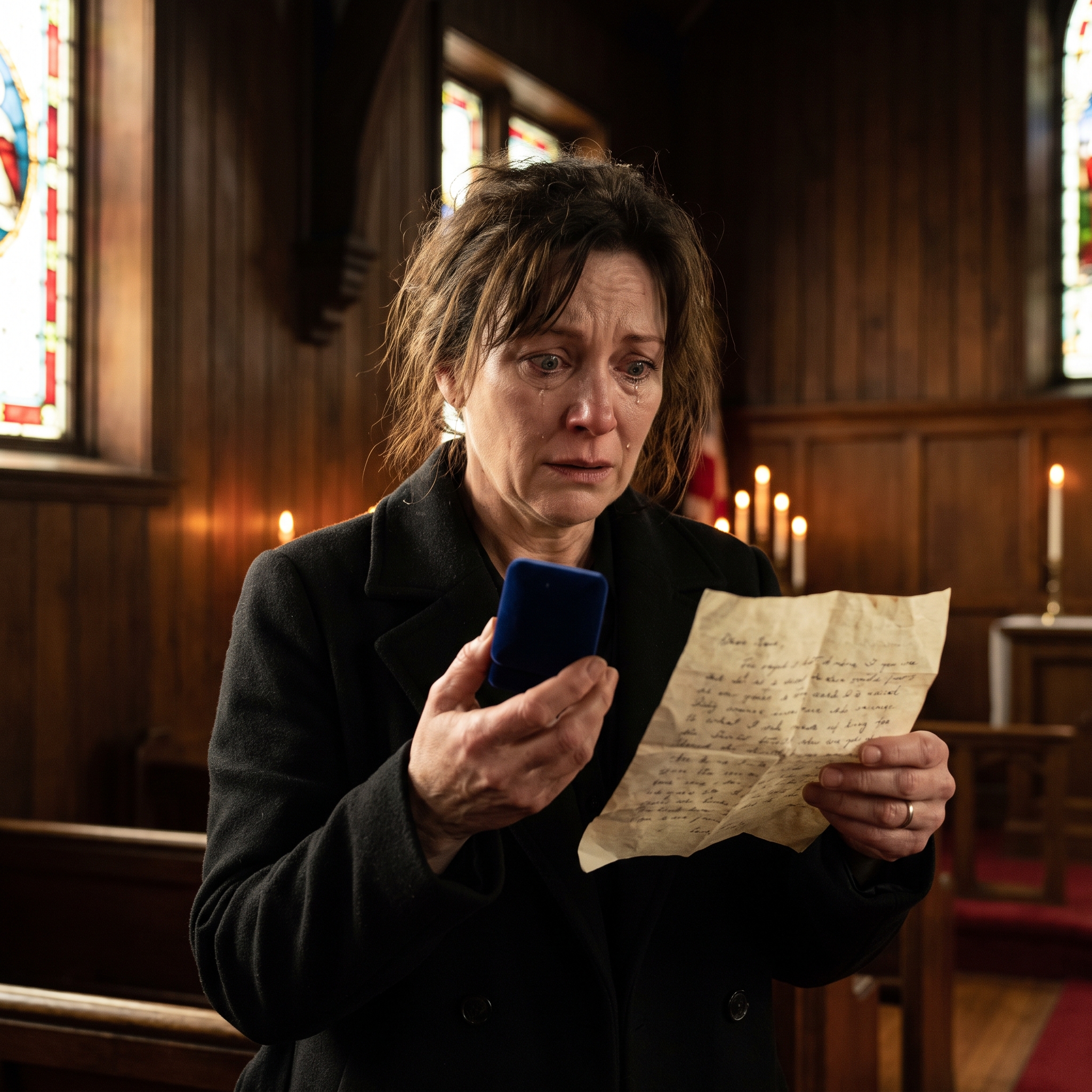
I stood at the back of the small chapel in Marietta, Georgia, staring at the mahogany casket draped in white lilies.
My mother-in-law, Margaret, was gone.
And to my shame, the first emotion I felt was relief.
I glanced at my husband Thomas, his eyes red-rimmed, holding a crumpled tissue.
I should have been mourning, but all I could think was that the icy, judgmental presence that had loomed over our marriage for two decades was finally silent.
She had never liked me.
From the very first moment we met.
I was 22, bright-eyed and head-over-heels in love with her son.
We drove down to her stately home in Savannah, a beautiful white colonial with a wraparound porch.
She opened the door, looked me up and down, and said, “So you’re the one. Thomas, you could have called ahead.”
Not a smile.
Not a welcome.
Just a cold, appraising stare that made my stomach knot.
That evening at dinner, she asked about my family.
When I told her my father was a schoolteacher and my mother a nurse, she set her fork down and said, “Well, you must be very resourceful then.”
The words were polite, but the tone dripped with dismissal.
Thomas squeezed my hand under the table, but the damage was done.
I cried the whole drive back to Atlanta.
I thought things might improve when we got engaged.
Instead, she refused to attend the engagement party, claiming a “prior commitment” she’d never mentioned before.
On our wedding day, she arrived late, wearing black, and left immediately after the ceremony without touching the cake.
“She’s just traditional,” Thomas would say.
“She’ll come around.”
She never did.
When our daughter Emily was born, I sent her a photo and a handwritten note, inviting her to visit.
A week later, a package arrived on our doorstep.
Inside was a silver rattle—beautiful, antique, and accompanied by a card that read only: “For the child.”
Not signed.
Not a single word of congratulations to me.
The rattle was expensive, but it was a weapon, not a gift.
Every Christmas, she sent Thomas a meaningful present—a watch, a leather-bound journal—and for me, the same thing every year: a generic drugstore candle in a scent I was allergic to.
I’d smile, say “Thank you,” and then hand it to a neighbor.
Once, I worked up the courage to ask Thomas why she disliked me so much.
He sighed deeply and said, “Mom had a very hard life. My father walked out when I was six. She never trusted anyone again.”
“But I’m not your father,” I whispered.
“I know,” he said, pulling me close.
“But she can’t see that.”
So I endured.
For twenty years, I endured the cold stares, the silence, the subtle slights that no one else seemed to notice.
At family gatherings, she’d talk to everyone but me.
If I asked her a question, she’d answer with one word and then turn away.
My own mother, God rest her soul, couldn’t understand it.
“Eleanor, why do you keep trying?” she’d ask.
“Because she’s Thomas’s mother,” I’d say.
“And I love him.”
I think, deep down, I hoped that one day she would see that I was not a threat.
That I would never hurt her son.
But the day never came.
Two years ago, Margaret was diagnosed with ovarian cancer.
It was aggressive.
The doctors gave her a year, maybe eighteen months with treatment.
Thomas was devastated.
I watched his face crumble when he heard the news, and my heart broke for him.
Despite everything, I insisted we move her into our home.
“We have the guest room on the ground floor,” I said.
“She can’t be alone.”
Thomas looked at me, his eyes filled with a gratitude I still can’t forget.
“Are you sure?” he whispered.
“After everything?”
“She’s your mother,” I said firmly.
“We do this together.”
So Margaret came to live with us in our cozy home in Peachtree Corners.
I turned the sunroom into a comfortable bedroom with a view of the garden, filled it with fresh flowers, and hung her favorite paintings.
I cooked her meals—broths and soft foods when the chemo made her nauseous.
I drove her to appointments, sat with her for hours during the treatments, held her hand when she was too weak to speak.
And she never thanked me.
Not once.
She would accept the soup, sip it, and then hand the bowl back without a word.
Once, after a particularly brutal round of chemo, she looked at me with those sharp, tired eyes and said, “You don’t have to pretend, Eleanor. I know what you really think of me.”
I froze.
“I’m not pretending,” I said quietly.
“I’m caring for you because it’s the right thing to do.”
She turned her face to the wall and didn’t speak for the rest of the day.
I cried in the laundry room that evening, muffling my sobs in a pile of towels.
But I never let her see.
Six months ago, the doctors told us there was nothing more they could do.
We brought in hospice.
Thomas sat by her bedside every night, reading to her from old novels.
I handled the medications, the bedpans, the silent, heavy work of watching someone fade.
One evening, a week before she passed, she called me into her room.
Thomas was asleep in the armchair, exhausted.
She grasped my wrist with a bony hand and pulled me close.
“I have something for you,” she whispered, her voice a dry rasp.
“But you can’t have it until after.”
“After?” I asked, confused.
“After I’m gone,” she said.
“Thomas will give it to you. Promise me you’ll open it.”
I felt a chill run down my spine.
What could she possibly have for me?
A final cruel joke?
A letter of condemnation?
I almost refused, but the look in her eyes—something fragile, something pleading—made me nod.
“I promise,” I said.
She let go of my wrist and closed her eyes.
She never spoke to me again.
Margaret passed away on a Tuesday morning, with Thomas and me on either side of her bed.
Her breath simply slowed, and then it stopped.
I felt a strange emptiness, not grief exactly, but the hollow echo of twenty years of conflict.
I held Thomas as he wept, but my own eyes stayed dry.
I was ashamed, but I couldn’t deny it: I was relieved.
The weight of her silent judgment was finally lifted.
I could breathe again.
Now, at the memorial, that relief filled me with a gnawing guilt.
I stood in my simple black dress, accepting murmurs of condolence from distant relatives and church friends.
Then Thomas approached, holding a small dark-wood box.
His face was pale, and his hands trembled.
“Eleanor,” he said softly, “Mom asked me to give you this on her funeral day.”
I stared at the box.
It was unremarkable, the size of a jewelry case, worn at the edges.
“What is it?” I whispered.
“I don’t know,” he said.
“She gave it to me two years ago and made me swear to hand it to you here. She said you’d understand.”
My heart hammered.
A few people nearby turned to watch.
I took the box, my fingers numb.
“Open it,” Thomas urged gently.
I lifted the lid.
Inside was a folded, yellowed envelope and a small velvet pouch.
I pulled the pouch open and tipped its contents into my palm.
Out fell an exquisite gold locket, antique, with delicate filigree engraving.
It was heavy and warm, as if it held a century of secrets.
I opened the locket and gasped.
Inside was a tiny photograph of Thomas and me on our wedding day.
She had cut it from one of our wedding pictures—a picture I didn’t even know she had.
My hands shook as I unfolded the envelope and pulled out several sheets of paper covered in her elegant, slanted handwriting.
I began to read.
“My dear Eleanor,”
“If you are reading this, I have left this world. I know you never felt welcome in my family. I know you believed I hated you. Please let me try to explain.”
“Twenty-five years ago, my own beloved husband left me for another woman. He walked out of our lives without a backward glance, and it shattered my heart beyond repair. I raised Thomas alone, and I swore that no one would ever hurt him the way I was hurt. I became a guard dog, fierce and untrusting.”
“When he brought you home, I saw the light in his eyes, and it terrified me. I thought, ‘She will break him too. They always do.’ So I built a wall of ice around myself to protect him—and to protect myself. I pushed you away with every tool I had. I was cruel, and I knew it.”
“But Eleanor, I watched you. Year after year, I watched you care for him when he was sick, support him through his business failures, and love him with a constancy I never thought possible. When my own son was diagnosed with anxiety and you held him through the panic attacks, I saw the truth: you would never leave him. You were everything I had been, and more.”
“I realized too late that my coldness was not strength; it was fear. I deprived myself of a daughter, and I deprived you of a mother’s love. I am so deeply sorry.”
“This locket belonged to my grandmother, the kindest woman I ever knew. She told me it should go to someone with a generous heart. I always hoped to pass it to a daughter. I never had one—until you. Please take it, Eleanor. Wear it and know that, from a distance I was too proud to cross, I loved you.”
“Forgive me.”
“With all my heart, Margaret.”
The letter slipped from my fingers.
I was shaking, sobbing, great heaving cries that tore from my chest.
Thomas caught me as my knees buckled.
“Eleanor, what is it?” he cried.
I couldn’t speak.
I just pressed the locket to my heart and wept.
All those years.
All that resentment.
All that distance.
She had been waiting for me to understand, but I had been too hurt to see it.
And now she was gone, and the apology I had longed for was here, in my hands, too late to be spoken aloud.
Thomas read the letter over my shoulder, and I felt his tears fall onto my hair.
“She never told me,” he whispered.
“She kept it all inside.”
We stood there, in the chapel, holding each other, surrounded by the scent of lilies and the murmurs of puzzled mourners.
Later that day, I asked him, “Did you know she had this locket for me?”
He shook his head.
“She just said to give you the box. I thought it might be something awful. I almost didn’t do it.”
“I’m so glad you did,” I said.
I put the locket on, and it rested against my collarbone like a promise.
In the weeks that followed, I learned more from some of Margaret’s old friends.
They told me she would often say, “My daughter-in-law is a saint. She puts up with me.”
One neighbor, Mrs. Allen, said, “She used to watch you gardening from her window. She told me you had the same green thumb her mother had. She was proud of you, dear.”
I cried again then.
Proud.
She had been proud of me, and I never knew.
I began to understand that some people love in hidden, broken ways.
They cannot speak it aloud because the words are locked behind years of pain.
Margaret’s love was a secret she kept until death, and it took a funeral and a small box to reveal it.
I think about her every day now.
I wear the locket whenever I need strength.
I sit in my garden, the very one she admired, and talk to her sometimes.
I tell her I’m sorry too.
Sorry I gave up on her.
Sorry I let bitterness grow where patience might have bloomed.
But mostly I tell her thank you.
Thank you for finally letting me in, even if it was from beyond the veil.
I’ve learned that love doesn’t always look like we expect.
Sometimes it’s hidden in a tiny box, waiting for the right moment to break your heart open and set it free.
Love can be late, but it is never wasted.
If you enjoyed this story, please tap the Like button, Follow our page for more heartwarming tales, and Share this with someone who needs to feel the power of forgiveness today.