Not, Are you alive?
Not, Are the children okay?
Please call before speaking to media.
I laughed once, quietly, and it scared the nurse beside me.
Graham arrived two hours later in his wedding suit, tie loosened, hair windblown. He found me in a staff break room with coffee I had not touched.
He stopped in the doorway.
For a second, he looked genuinely wrecked.
“Riley.”
I waited.
He crossed the room, then stopped short of touching me. Maybe the blood under my fingernails reminded him I was not part of his clean world anymore. Maybe I never had been.
“My family is shaken,” he said.
That was what he opened with.
Not you.
My family.
I stared at him.
He heard it too late and tried to correct. “I mean, everyone is shaken. You scared us.”
“I scared you?”
“The helicopter, the way you just ran—”
“People were dying.”
“I know. I know that now.”
Now.
The word landed between us like another body on asphalt.
He sat across from me and rubbed both hands over his face. “I should have defended you.”
“Yes.”
“I just didn’t want conflict before the wedding.”
“You chose conflict. You just made sure I was the only one standing in it.”
He flinched.
His phone buzzed. He looked down automatically. I saw the screen before he turned it away.
A family group chat.
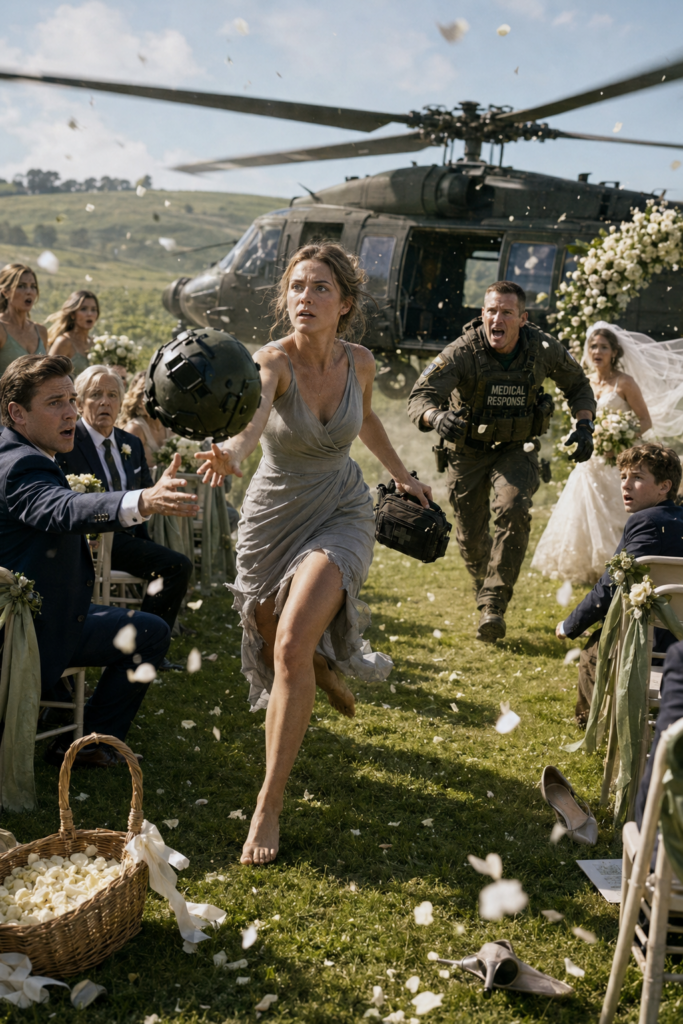
A photo filled the thread—me running barefoot toward the Black Hawk, dress torn, hair whipping across my face.
Under it, Brooke had written: Guess Army Nurse Barbie was useful after all.
Then Lydia replied: We need to manage this carefully. It could reflect well on the family if handled with grace.
My chest went cold.
Graham locked the phone too late.
I looked at the man I was supposed to marry and realized the crash had not ended on I-90.
Something else had just split open.
Part 8
Three weeks later, an envelope arrived at my duty station.
Real paper. Cream. Heavy. Hand-addressed in Lydia Whitmore’s looping cursive, the same kind she had used on the place cards that put me at the utility table. For a moment, I just looked at it on my desk while rain tapped against the narrow office window.
My name was different this time.
Captain Riley James.
Not Riley. Not Graham’s fiancée. Not the girl from the Army medical unit.
Captain.
I opened it with a trauma shear because that was what I had within reach.
Inside was an invitation to a garden luncheon at the Whitmore estate. Lydia wrote that the family had been “deeply moved” by what they witnessed.
She said they had “a renewed appreciation for the sacrifices made by service members.” She mentioned Eli, the cousin who had enlisted, and suggested I might share “a few inspiring words” with him and some guests.
Guests.
There it was, tucked under the apology perfume.
This was not a family lunch. This was a performance.
A second card fell out.
Local veterans’ foundation board members attending.
I sat back in my chair.
Outside my office, someone laughed near the coffee machine. A printer jammed and beeped angrily. The building smelled like burnt coffee, wet wool, and disinfectant. Normal Army weekday smells. Honest smells.
My phone buzzed.
Graham: Did you get Mom’s invite?
I did not answer.
He called.
I let it ring until it stopped.
Then he texted: Please don’t shut them out. They’re trying.
Trying.
I thought about Noah, the boy from the bus, whose mother had sent a photo of him sitting up in a hospital bed with a crooked thumbs-up. I thought about Cruz, still in recovery, who had left me a voicemail from the ICU calling me “a stubborn menace” in a voice so weak I had to sit down to finish listening. I thought about the little girl with the rabbit, who had asked a nurse if the barefoot soldier lady was a superhero.
And then I thought about Lydia worrying how my rescue might reflect on the family.
Graham came to my apartment that evening.
I knew it was him before he knocked. Two quick taps, one pause, one softer tap. Familiar patterns can hurt worse than surprises.
When I opened the door, he was holding flowers. White lilies. Expensive. Funeral flowers, though I doubted he realized that.
“You haven’t been answering,” he said.
“I’ve been working.”
“You’re always working.”
There was no affection in it. Only accusation dressed as fatigue.
I stepped aside because I did not want a hallway scene. He came in and set the lilies on my kitchen counter. Their smell filled the room, sweet and heavy.
“My mom’s luncheon matters to her,” he said.
“I’m sure it does.”
“She wants to make things right.”
“No. She wants to make things look right.”
He exhaled. “Why can’t you accept that people can change?”
“People can. Audiences don’t make it more sincere.”
He looked wounded, and once that would have softened me. I would have crossed the room, touched his arm, made room for his discomfort. I was good at making room. Too good.
He pulled out his phone. “Look, she drafted remarks. She wants to introduce you properly.”
“Introduce me?”
“As Captain James. Talk about your service. The rescue. How proud the family is to know you.”
I felt something inside me go very quiet.
“The family is proud to know me?”
“Yes.”
“Were they proud before the Black Hawk?”
He did not answer fast enough.
That was the answer.
I walked to the counter, picked up the invitation, and handed it back to him.
“No.”
His face hardened. “Riley, don’t be stubborn.”
“Careful.”
“I’m serious. This could heal things.”
“Not everything deserves healing.”
He stared at me like he had never seen me before. Maybe he hadn’t.
Then his phone lit up on the table.
A message preview from Lydia appeared.
Did she agree? The board will be disappointed if she refuses. Remind her this is good for Graham too.
I read it once.
Then again.
My mouth tasted like metal.
Graham snatched up the phone, but the damage had already walked into the room and taken a seat.
I looked at him and finally asked the question I should have asked months earlier.
“What exactly did you promise them I would do?”
Part 9
Graham did not lie immediately.
That was how I knew it was bad.
He set the phone face down on my table and looked toward the window. Rain made the city lights smear across the glass. My apartment was small, practical, and mine. Boots by the door. A stack of medical journals on the coffee table. A framed photo of my first medevac crew on the shelf, all of us squinting into desert sun, pretending not to be exhausted.
Graham had always called the place temporary.
I used to think he meant until we bought a home together.
Now I understood he meant until I became someone else.
“What did you promise?” I asked again.
He rubbed the back of his neck. “I told them you’d probably come around.”
“To being paraded in front of their foundation board?”
“That’s not fair.”
“It’s accurate.”
“They were embarrassed, Riley.”
“So was I. For months.”
“That’s different.”
“Why?”
He finally looked at me. “Because they didn’t know.”
I laughed, but there was no humor in it. “They knew enough. They knew I served. They knew I had a rank because you knew. They knew my job mattered because you knew. They chose not to care until a helicopter landed on their lawn.”
His jaw tightened. “You make everything sound malicious.”
“No. I make it sound clear.”
He walked away from the table, then back again. “Do you know what it was like for me? Sitting there while everyone stared? My mother crying, Marissa’s wedding ruined, reporters calling—”
“Marissa’s wedding was interrupted because children were dying.”
“I know that.”
“Do you?”
His face flushed. “Of course I do.”
“Then stop saying ruined.”
He went silent.
There it was again, the thing under the thing. Not just that his family had mocked me. Not just that they wanted to use me now. It was that Graham still believed the real tragedy was discomfort. Embarrassment. Social damage. The ugly inconvenience of truth landing in the middle of a pretty event.
He sat down slowly.
“My parents are traditional,” he said. “They had expectations.”
“For you?”
“For us.”
I waited.
He swallowed. “Mom thought after the wedding you might move into a less active role. Consulting, maybe. Teaching. Something safer.”
“And you?”
“I thought…” He stopped.
“Say it.”
“I thought once we started a family, you’d want that too.”
The room seemed to shrink around me.
All those little moments rearranged themselves. The way he winced when my phone rang at dinner. The way he called deployments “interruptions.” The way he smiled proudly when strangers thanked me for my service but went quiet when service actually required something from him. The way he had not corrected “nurse with boots” because some part of him preferred it.
A smaller job. A softer woman. A wife easier to explain.
“You never asked me,” I said.
“I didn’t think I had to.”
That sentence did what no insult from his family had managed.
It reached the center.
I took off my engagement ring. Not fast. Not dramatically. I twisted it once, over the small callus at the base of my finger, and set it on the table between us.
Graham stared at it.
“Riley.”
“No.”
“We can talk about this.”
“We just did.”
“You’re angry.”
“I’m awake.”
His eyes filled, and I hated that part of me still noticed. I had loved him. That was real. But love being real does not make it right. A bullet is real too.
He reached for my hand.
I stepped back.
“You let them make me small because it made your life easier,” I said. “Then when they found out I wasn’t small, you tried to hand me back to them as proof you had chosen well.”
“That’s not what this is.”
“It is.”
He stood, panic breaking through his polished calm. “I should have done better. I know that now.”
“Now,” I said.
The word was almost gentle.
That made it worse.
He looked at the ring, then at me. “So that’s it? You’re just done?”
I thought about the bus. About Noah’s first breath after the needle. About Cruz coughing his way back into the world. About how quickly everything important becomes simple when time runs out.
“Yes,” I said. “I’m done.”
He left the lilies on the counter and the ring on the table.
When the door closed behind him, the apartment did not feel empty.
It felt returned.
Then my phone rang.
Restricted number.
For one second, I thought it was command.
But when I answered, a woman’s voice said, “Captain James? This is Noah’s mother. He’s awake, and he’s asking if the barefoot lady is real.”
Part 10
I met Noah two days later.
The pediatric floor had murals on the walls—cartoon animals in hot air balloons, clouds with smiling faces, a sun too cheerful for a place where parents learned how thin the line could be. The hallway smelled like hand sanitizer and cafeteria fries. Somewhere, a machine beeped in a steady rhythm. A child laughed from a room down the hall, high and sudden, and I felt my chest loosen.
Noah was propped up in bed with a stack of pillows behind him, thinner than he had been on the highway but very much alive. His mother stood when I entered and covered her mouth with both hands.
“Oh,” she said, like she had been holding one breath for three weeks.
Noah looked at me with wide eyes. “You’re real.”
“Last time I checked.”
“You were wearing a dress.”
“I was.”
“And no shoes.”
“Also true.”
“My dad said you came in a helicopter.”
“I borrowed it.”
He smiled carefully, like it hurt but was worth it.
His mother hugged me before I could prepare for it. I stood there stiff for half a second, then hugged her back. She smelled like laundry detergent, hospital soap, and sleepless nights.
“Thank you,” she whispered.
People say that all the time in my line of work. Sometimes I can accept it. Sometimes I can’t. That day, I let it land.
“You fought hard,” I said, looking at Noah. “I just helped.”
He lifted one hand. In it was a small orange candy from the hospital gift shop.
“These were all over the bus,” he said. “I remember that.”
“So do I.”
He held it out to me. “For luck.”
I took it because refusing would have been cruel. It sat in my palm, bright and ridiculous and holy.
On my way out, I checked my phone.
Three missed calls from Lydia.
One voicemail from Henry.
Six texts from Graham.
I deleted none of them. Not yet. Evidence has its uses, even when the only court is your own memory.
At home, I opened Lydia’s latest message.
Captain James, I hope you will reconsider. This family would like the opportunity to honor you properly.
Honor.
I looked at the word for a long time.
Then I wrote back.
Mrs. Whitmore, thank you for the invitation. I will not attend the luncheon. I hope Eli builds a life in service surrounded by people who respect him before they are forced to understand him. Please do not contact me again for public appearances, family events, or personal reconciliation. My decision regarding Graham is final.
I read it once, then sent it.
My hand did not shake.
Graham came by the next evening, but I did not open the door. He spoke through it anyway.
“I love you,” he said.
The hallway was quiet around his voice.
“I know I was late. I know I failed you. But I can fix this.”
I stood on the other side in socks and an old Army sweatshirt, holding a mug of coffee that had gone cold.
There was a time when those words would have broken me open.
Now they only sounded like weather after the roof had already been repaired.
“You don’t get to fix what you helped break just because the damage became visible,” I said.
“Riley, please.”
“No.”
One word. Clean. Final.
After a while, his footsteps moved away.
I returned the ring by certified mail. I donated the lilies to the chapel on base because flowers do not deserve blame. I changed my emergency contact. I slept eight straight hours for the first time in months.
Life did not transform overnight. It never does. I still had early calls, hard landings, bad coffee, and days when the memories followed me home. Cruz recovered slowly and complained constantly, which meant he was healing. Noah sent me a drawing of a helicopter with a stick-figure woman jumping out of it, hair flying like flames. At the bottom he had written, The barefoot lady is real.
I pinned it above my desk.
Weeks later, Eli emailed me from basic training. He said his family still didn’t understand, but he was beginning to. He asked for one piece of advice.
I wrote back: Don’t chase applause. Learn your job. Protect your people. And never shrink yourself to make someone else comfortable.
That summer, I stood on a flight line at dusk while a Black Hawk cooled behind me, its blades ticking slowly in the heat. The sky was orange at the edges, fading into blue. My boots were dusty. My hands smelled faintly of fuel and antiseptic. Somewhere across the field, Martinez was arguing with maintenance about a hydraulic leak.
Nothing about it was soft.
Nothing about it was neutral.
It was mine.
The Whitmores had needed a helicopter to see me clearly, and even then, they had only seen a story they could use. Graham had needed disaster to understand the woman standing beside him, and by then, understanding had arrived too late to matter.
I did not forgive them.
I did not hate them either.
I simply stepped out of the place they had assigned me and left it empty.
Because my worth was never waiting at their table. It was in every life I fought for, every hard choice I made, every quiet morning I got up and put the uniform back on.
And when the next call came, I answered—not to prove anything to them, but because that is who I had always been.
THE END!
✅ End of story — Part 3 of 3
← Read from Part 1