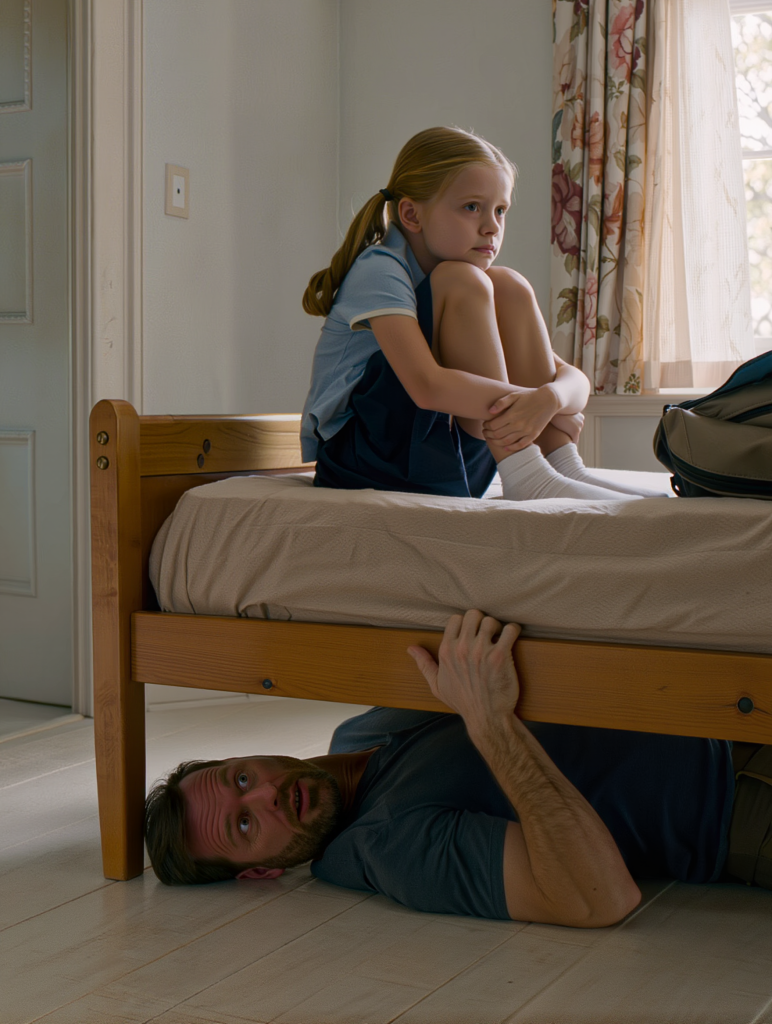
There was no possible defense for my absence, so I asked the question that had been burning my throat for hours.
“Why is Katelyn targeting you specifically, Josephine?”
Josephine lowered her gaze to her lap.
“Because she says that you ruined her mother’s life years ago.”
Rebecca slowly turned her head toward me, her eyes widening in realization.
“Did you actually know that woman, Elias?”
I was frozen in place, feeling the weight of my past choices crashing down on me. Yes, I had met Sarah Monroe many years before I ever met Rebecca, during a brief and poorly concluded relationship that I had buried deep down, believing that time would eventually erase the consequences of my own cowardice.
I had walked away without a proper explanation and never looked back, never imagining that the ghost of that story would return to poison my daughter’s life.
“Katelyn told me that her mother spent years crying because of you,” Josephine whispered. “She told me that now it was my turn to pay for what you did.”
Rebecca stood up, her entire body trembling with shock and anger.
“Are you telling me that a grown woman is allowing her own child to torture ours out of pure, petty revenge?”
I didn’t know how to answer her because the guilt was suffocating me. The next day, the three of us went to the school to meet with the administration. The principal greeted us with a fake, plastered-on smile, while Professor Sarah Monroe sat there, impeccably dressed and perfectly calm, as if her position of authority somehow validated her version of reality.
“We really need to handle this situation with a great deal of calm,” the principal said, gesturing toward the chairs.
“The time for being calm is over,” I replied, my voice echoing in the small office.
I slammed a folder down on the table containing screenshots, time-stamped messages, nursing reports, and a list of all the days Josephine had been forced to miss school.
Sarah barely glanced at the papers, acting as if they were nothing more than trash.
“Teenagers tend to exaggerate things quite a bit,” she said, her voice dripping with artificial sympathy.
“Repeat that while looking my daughter in the eyes,” I said, pointing directly at Josephine.
She couldn’t do it, so I turned my gaze toward her.
“Your daughter isn’t punishing mine for some childish schoolyard squabble, Sarah. She is using my daughter as a weapon to collect a debt you think I still owe you.”
The principal looked at Sarah with sudden concern, and for the first time, the teacher completely lost her composure.
“There are men who destroy lives and then turn around and try to act like saints,” she spat at me.
In that singular, suffocating instant, we all understood that Josephine had never been a student to her, but the perfect target. Just as I thought the truth was about to explode in that small office, Sarah Monroe smiled and said something that completely took our breath away.
Chapter Three: The Breaking Point
“You have absolutely no way to prove that I ordered my daughter to do anything,” Sarah Monroe said with a cold, terrifying smirk. “And if you continue with these ridiculous accusations, your daughter is going to look like nothing more than a troublesome, pathological liar.”
Josephine shrank back into her chair, her face draining of all color. Rebecca squeezed my hand so hard that my fingers throbbed, and I felt the overwhelming urge to smash the table into pieces, but I knew that blind anger would only play right into their hands. We left that office without a single apology and without any path to a solution, but we did not leave that building feeling defeated.
That very same night, we began reaching out to other parents, even though at first, nobody wanted to get involved. In this town, most people prefer to say that it is not their problem until the problem finally shows up on their own doorstep. However, when we sat them down and showed them the screenshots, one mother broke down in tears, admitting that her son had also been humiliated by Katelyn’s group. Another woman confessed that her daughter had begged to transfer classrooms just to get away from them, and one father revealed that he had reported threats months ago, only to be told by the administration that it was just typical teenage behavior.
It wasn’t an isolated incident; it was a carefully maintained pattern of abuse. A pattern, when properly documented, ceases to be mere gossip and becomes evidence. Over the next two days, we gathered witness testimonies, photos, copies of aggressive messages, and recordings. We filed a formal complaint with the district board and went to the authorities to report the harassment. Rebecca contacted a local investigative journalist who covered private school violence, and we didn’t make a public scene, but we did something far more damaging to them: we presented the cold, hard evidence to the people in power.
On the third day, we woke up to find rotten eggs smashed on our front gate and bright red paint sprayed across our living room wall with the words “PAY THE PRICE” in jagged letters. Josephine saw the damage from the top of the stairs and went completely white with fear.
“It was Katelyn, I know it was her,” she whispered.
I installed high-definition security cameras that very afternoon, and that night, as if the universe had finally decided that the silence had lasted long enough, the missing piece of the puzzle fell into our laps. A mother sent us an audio recording that her own daughter had secretly saved on her phone. Katelyn’s voice could be heard clear as day, laughing in a way that made my skin crawl.
“My mom says that Elias’s daughter needs to be humbled properly,” the recording said. “She says that her father owes my family a lifetime of grief and she is going to make sure she gets it.”
Then another voice on the recording asked, “What happens if the parents eventually find out what is going on?”
Katelyn responded, “My mom arranges everything in the administration office, so there is literally nothing they can do.”
That audio changed everything. The supervisors summoned us to the school again, but this time we were not alone. There were other parents, an official district representative, and the principal wasn’t wearing that fake, professional smile anymore. Sarah Monroe didn’t look impeccable, either; she looked like a cornered animal realizing her web of lies had finally snapped.
The representative was crystal clear: an administrative investigation was being opened immediately. Sarah would be suspended as a precautionary measure while the inquiry took place, and Katelyn was to be removed from the school while the process continued. The school would be held accountable for years of systemic negligence and active cover-up.
I didn’t feel a sudden rush of joy; I felt something much heavier and more necessary: a belated, quiet justice. Sarah looked at me with pure venom before she walked out of the room for the last time.
“You started all of this, Elias,” she told me through gritted teeth.
“No,” I replied firmly. “I made adult mistakes a long time ago, but you are the one who chose to place that burden on a child’s shoulders.”
She didn’t answer me, but she knew the truth. Katelyn was removed from the school a week later, and the principal was eventually fired when other cases of cover-ups came to light. Sarah’s perfect reputation crumbled not because someone fabricated a lie about her, but because everyone finally stopped pretending not to see what was right in front of them.
Josephine didn’t heal overnight; saying that would be a lie. There were months of therapy, long, sleepless nights, and a deep-seated fear of trusting anyone in a classroom again. But little by little, she began to find her own voice again.
One afternoon, she asked me to go to the local park with her, carrying a small, worn-out shoebox. Inside were all the notes, the torn drawings, the printed screenshots, and the fragments of a stage she no longer wanted to carry through life. She dug a small hole next to a sturdy oak tree and buried everything deep in the earth.
“She does not control me anymore,” she said to the wind.
I stood there and cried without trying to hide it. Afterward, I went over to see Mrs. Gable, who opened her front door wearing her favorite flowered robe and holding a steaming cup of coffee.
“I have come to thank you, Mrs. Gable,” I said sincerely.
“I only listened, Elias,” she replied with a kind smile.
“You listened to the things I was too busy to hear.”
That phrase will stay with me for the rest of my life. I had worked so hard to ensure Josephine had everything she needed in terms of material comfort, but my daughter was missing the most vital thing of all: someone who truly, actively cared. I learned far too late that providing for a family is not the same thing as protecting them, and that a house with plenty of food on the table can still be filled with dangerous, suffocating silences.
There are adults in this world who do not know how to handle their own ancient wounds and end up dumping them onto their children’s shoulders. There are institutions that prioritize their own image over the actual well-being of the students in their care. And there are parents, like me, who falsely believe they are present simply because they pay the bills, when in reality they have been arriving late to their families’ hearts for years.
My daughter survived, but she did not survive because of the silence. She survived because someone finally dared to listen to it break. And ever since that day, at our house, whenever Josephine says that “everything is normal,” I refuse to just accept that answer.
THE END.
✅ End of story — Part 2 of 2
← Read from Part 1