
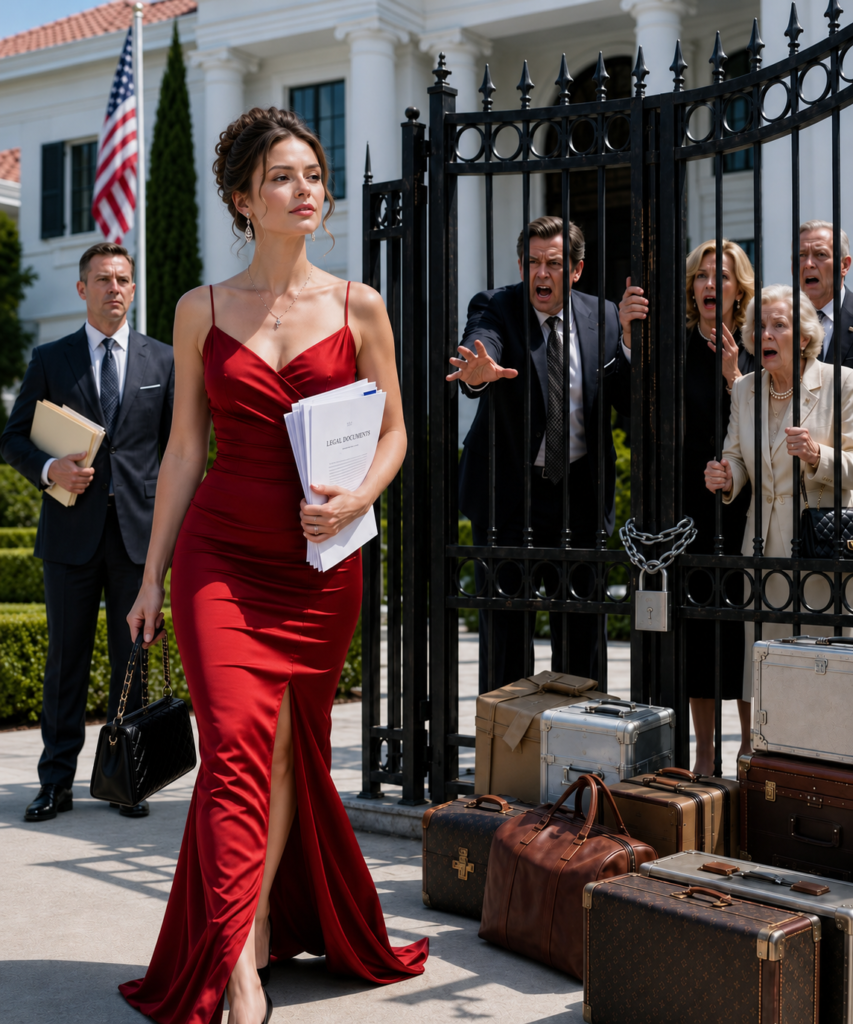
Minutes After The Divorce, My Ex’s Mother Arrived With Moving Trucks And Said, “Open The Gate, This House Is Ours Now”—But The Empty Mansion, The Locked Gate, And My Lawyer Wiped The Smile Off Her Face — Part 3

Preston swallowed.
“You’re bluffing.”
Caroline smiled slightly.
“I charge too much to bluff.”
Another patrol car turned the corner. Someone had called about the bat.
Preston let it fall to the pavement.
The sound was hollow.
I thought that night might be the end of it.
I was wrong.
At 12:18 in the morning, Audrey climbed over the back fence wearing black leggings, a cap, a backpack, and carrying bolt cutters.
PART 3
I did not sleep that night.
People think revenge tastes like champagne, but most of the time it tastes like cold coffee, tight nerves, and the strange metallic fear that follows you even when you know you are right.
Caroline had told me to stay at a hotel.
I refused.
Not because I was brave.
Because I was tired of leaving places that belonged to me.
I sat in the security room, watching six cameras glow in the dark. When the rear sensor flashed, I saw Audrey drop awkwardly into the garden, land in the ivy, and crouch like she was starring in a movie no one wanted to watch.
I turned on the exterior lights.
The backyard flooded bright as noon.
Audrey screamed, dropped the bolt cutters, and stumbled into a shrub.
Security arrived in four minutes. Police arrived in seven.
Inside Audrey’s backpack were gloves, a screwdriver, and a printed screenshot of the old garage keypad, taken from a video she had posted years earlier while pretending my home was hers.
When the officer asked why she had the tools, Audrey said, “I was just looking for Preston’s documents.”
I said, “Those documents were already sent electronically to his attorney.”
The officer looked at the bolt cutters.
“Then what were these for?”
Audrey stared at me, mascara running down her cheeks.
“Because she ruins everything.”
For one brief second, I almost felt sorry for her.
Almost.
Audrey had spent years filming in my kitchen, by my pool, and in front of my closet, always careful never to say the house was not hers. That night, her fantasy finally became official enough to appear in a police report.
By morning, Cynthia had called thirty-eight times.
I did not answer.
At 8:05, Caroline and I met Preston at the police station. He looked as though the night had aged him in public. Cynthia was there too, smaller somehow without her sunglasses, begging me not to press the issue with Audrey because her daughter was “sensitive” and “under pressure.”
She reached for my hand.
“Claire, please. We’re family.”
I stepped back.
“No. We were paperwork.”
Preston said he would sign whatever was necessary if I agreed not to make Audrey’s situation worse. Caroline opened her folder again.
The final agreement was stricter than the one offered at the gate.
Full no-contact terms for the entire family. Payment for property damage, security, and legal fees. Initial repayment for hidden assets. Cooperation with the financial review. Written acknowledgment that the Riverside house belonged only to me.
Nolan objected until Caroline mentioned Audrey’s backyard entry and the tools in her backpack.
After that, the room became very quiet.
Within two hours, they signed.
Preston found the money by liquidating investments he had failed to disclose, selling an apartment held under one of his firm’s entities, and admitting just enough to his partners that the rumors arrived before he did.
By Monday, Vale Sterling had placed him on leave.
The man who once told me I was nothing without his name lost his office before I even chose new curtains.
That fall, the Riverside house was renovated.
Not for parties.
Not for clients.
Not for Cynthia’s approval.
For me.
The living room became warm instead of impressive. The kitchen became bright and practical, with deep drawers, copper pans, and a round breakfast table where no one felt small. The dining room where Cynthia had spent years correcting me became a library with soft chairs, oak shelves, and gentle lamps.
The main bedroom was painted ivory, with linen curtains and warm light.
For the first time since my marriage began, I slept there without feeling watched.
Months later, I founded the Bennett House Legal Fund in honor of my parents. It offered emergency legal support to women leaving marriages where money had been used like a leash.
The first woman we helped was a nurse whose husband had hidden her passport. The second was a teacher whose in-laws tried to push her out of a house she had bought before marriage. The third was a grandmother whose adult children had quietly drained her savings and called it “helping.”
Every time I signed an assistance approval, I remembered Cynthia standing at my gate, insisting my house belonged to her son.
No.
My home was mine.
My name was mine.
My life was mine.
Two years later, the Riverside house appeared in a regional magazine as the headquarters of the Bennett House Legal Fund. The writer described it as “warm, serene, and quietly powerful.” I laughed when I read that.
If those walls could talk, they would tell stories about Preston’s bat, Nolan’s locked SUV, Audrey falling into the ivy, and Cynthia discovering there was no Wi-Fi in the mansion she tried to claim.
But they would also tell better stories.
They would tell of women arriving with shaking hands and leaving with folders, plans, phone numbers, and enough courage to take one more step. They would tell of coffee brewed late into the evening, attorneys volunteering after work, neighbors dropping off blankets, and the quiet relief that comes when someone finally says, “Let’s look at the documents before we believe what he told you.”
One afternoon, a letter arrived from Cynthia. She had moved to a smaller town in Vermont. Her handwriting was stiff but familiar.
She wrote that she understood now the house had never been hers to enter, arrange, or claim.
She did not exactly apologize.
Cynthia was not built for that kind of surrender.
But she admitted the truth, and perhaps that was the closest she could come.
Caroline asked if I wanted to reply.
I said no.
Some admissions arrive too late to deserve a door.
On the anniversary of my divorce, I hosted dinner in the library that used to be the dining room. My friends came, along with Caroline, several women the fund had helped, and Hank Porter—the moving foreman who had made Cynthia pay for the trucks that never unloaded.
We ate roast chicken, warm bread, and lemon cake. We laughed harder than the occasion required, which is sometimes the best proof that healing has entered the room quietly.
At the end of the night, Caroline raised her glass.
“To Claire,” she said, “who turned an attempted takeover into a movement.”
After everyone left, I walked alone into the garden. The black iron gate stood at the end of the drive, shining beneath the trees, firm and quiet as it had been on the day the Vales arrived with trucks and confidence.
Once, that gate had kept the wrong people out.
Now, it helped the right people find their way in.
My phone vibrated with an alert from the fund. A woman had sent a message through the emergency form.
**My husband says everything belongs to him. I don’t know what’s true anymore.**
I looked back at the glowing windows of my house, the library lights warm behind the glass, the garden finally peaceful around me.
Then I typed back.
**That’s often the first thing they say. Now let’s look at what the truth says.**
And that was when I understood my story had not ended in the courthouse, or at the gate, or even in the empty mansion that made Cynthia Vale lose her smile.
It ended the day I stopped asking why they had tried to take my life apart—and began using that life to help other women put theirs back together.