They Broke My Daughter’s Jaw to Bu:ry a Secret. They Forgot Her Father Had Spent His Life Digging Truth Out of War Zones. — Part 2

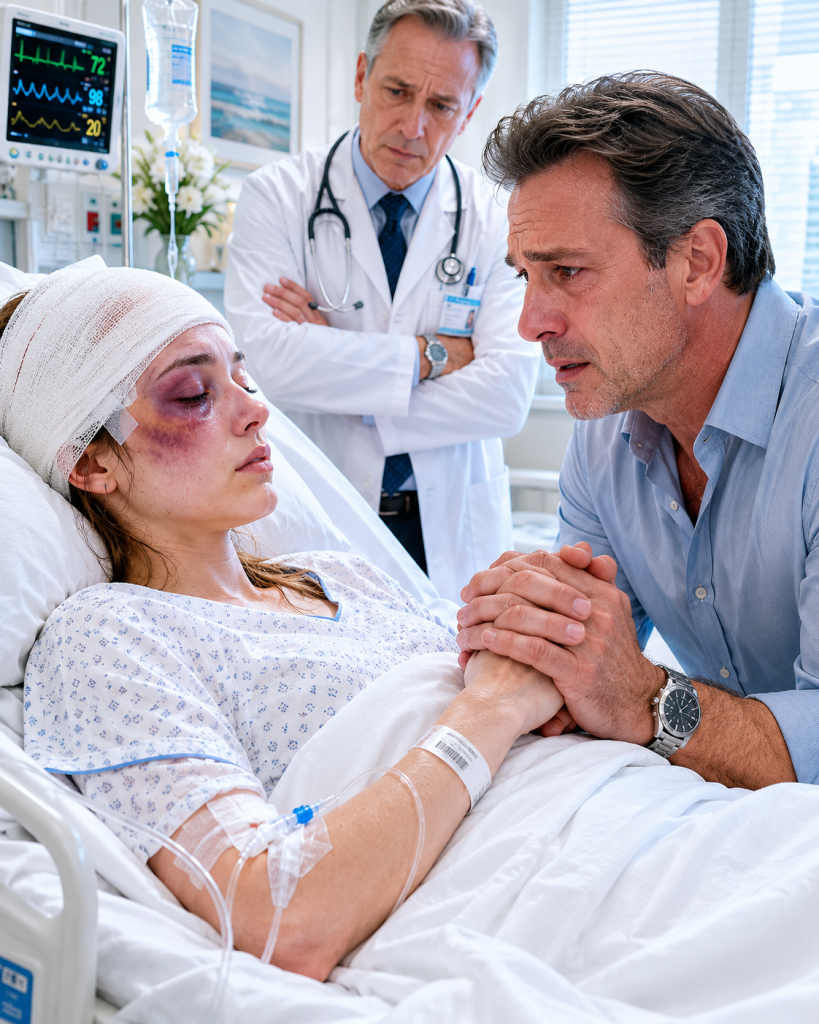
“Sweetheart, take it easy, do not try to talk yet,” I said, leaning over her.
MASON.
Maya’s hand shook violently, and she wrote again: NOT HIM.
My breath caught in my throat as I looked at the name.
“Who is Mason?” I asked the officer.
The officer frowned. “Mason Foster, he is a junior, and the son of Senator Gregory Foster.”
The room went cold, and even before the officer said the rest, I understood why the cameras went dark, why the witnesses disappeared, and why nobody wanted to speak. It was a senator’s son, a prestigious college campus, a girl with a shattered jaw, and a silence that was so thick it smelled like old money and political protection.
By noon, a woman from the university arrived wearing a sharp gray suit and a sympathetic smile that never reached her eyes.
“Mr. Anderson, I am Dean Pamela Clark, and I want to say how deeply sorry we are for what happened,” she said.
“Do not,” I said, holding up a hand.
She blinked, clearly surprised. “Excuse me?”
“Do not start with being sorry if you only came here to manage me,” I said.
Her smile tightened. “We are cooperating fully with the authorities, I assure you.”
“That is currently under review by our technical team,” she said.
“Was Mason Foster questioned about my daughter?” I asked.
“I cannot discuss the actions of other students,” she replied, her voice growing colder.
“Was my daughter found alone, or was someone else there?” I asked.
“Campus security discovered her, and that is all we know,” she said.
“That is not what I asked, and you know it,” I said, stepping closer to her.
Dean Clark looked toward Maya’s bed and then back at me. “Mr. Anderson, emotions are running high, and I understand that, but public speculation could harm your daughter’s future.”
I laughed once, a short, humorless sound. “You think I am worried about speculation? My daughter cannot speak because someone broke her face, and you are worried about the headlines hurting the school’s reputation.”
Her face hardened for a second, and then she said the sentence that confirmed everything I suspected.
“Powerful families are involved in this, so you should think very carefully before making wild accusations,” she said.
There it was, not comfort, not help, but a direct warning.
“I have buried friends in places you could not even find on a map,” I said, my voice ice cold. “I have watched men with guns lie much better than you ever could, so listen carefully to me, Dean Clark. I am not making accusations, I am making a promise.”
That afternoon, I went to the university campus, and it looked peaceful in the pale light of the afternoon. There were wet sidewalks, red brick buildings, and students walking around with backpacks and coffee cups, the kind of place parents paid for because they believed their children would be safe. Near the science building, yellow tape fluttered weakly in the wind, and a campus security guard blocked my path.
“The area is restricted,” he said, trying to look tough.
“I am Maya Anderson’s father,” I said, and his expression changed to one of sheer panic.
“I am sorry, sir, but you need to leave right now,” he said.
“Who told you to say that?” I asked, looking past him.
He glanced toward a black SUV parked near the curb, and inside, a man in a dark coat was watching me. I knew that posture; it was security detail, not campus police, but professional private protection. I walked toward the SUV, and the man stepped out before I even reached the bumper, looking clean cut and expensive.
“Mr. Anderson, I suggest you go home,” he said.
“You seem to know my name,” I said, stopping in front of him.
“People are concerned,” he said.
“About my daughter, or about this getting out of hand?” I asked.
I looked past him at the science building, and then I saw something. A security camera above the loading entrance was angled downward, and it was not one of the two cameras the officer had told me were down.
“Is that camera down too?” I asked, pointing up.
The man’s jaw tightened, and that was all the confirmation I needed. I walked away before he could stop me, but I did not go home. I went to a small bar two blocks from campus, ordered a coffee, and made a call I had sworn I would never make again.
The line clicked, and a gravelly voice answered. “Anderson?”
“Hello, Ghost,” I said.
There was a long silence on the other end, and then he asked if I was dead or retired.
“I am retired,” I said.
“No retired man calls me at this hour,” he replied.
“My daughter was attacked,” I said, and the humor vanished from his voice.
“Send me everything you have,” he commanded.
“I do not have everything, but I know where to look,” I said, and I gave him the names, the times, and the location of the cameras.