
My Sister Changed The Locks While I Was At Work—But When $38 Million Hit My Secret Account, Her 91 Missed Calls, My Mother’s Letter, And Derek’s Debt Exposed The Real Family Thief.. — Part 3

Lena began crying again, more quietly this time, directing the tears toward our mother.
For once, Mom did not reach out to comfort her.
She was reading too.
Slowly.
Painfully.
Every few seconds, her gaze rose to me before dropping back down to the page.
When she reached the section that restricted borrowing against the trust property, her hand started to shake.
“Derek,” she whispered.
He said nothing.
“Did you take the credit line for the kitchen renovation?”
Lena’s head snapped toward him.
Derek’s jaw clenched.
“The house needed improvements,” he said.
“There was no kitchen renovation,” my mother said.
The temperature in the room seemed to drop.
I had already known, from Paul’s review, that only part of the borrowed money had actually gone toward household expenses. The rest had disappeared into accounts and payments Derek could not explain. I had chosen not to open with that. Some truths had to arrive in familiar voices.
Lena stared at her husband.
“What did you do?”
Derek laughed, but it came out crooked.
“Don’t let her manipulate you. This is exactly what she wants. Divide us, control Mom, play the hero.”
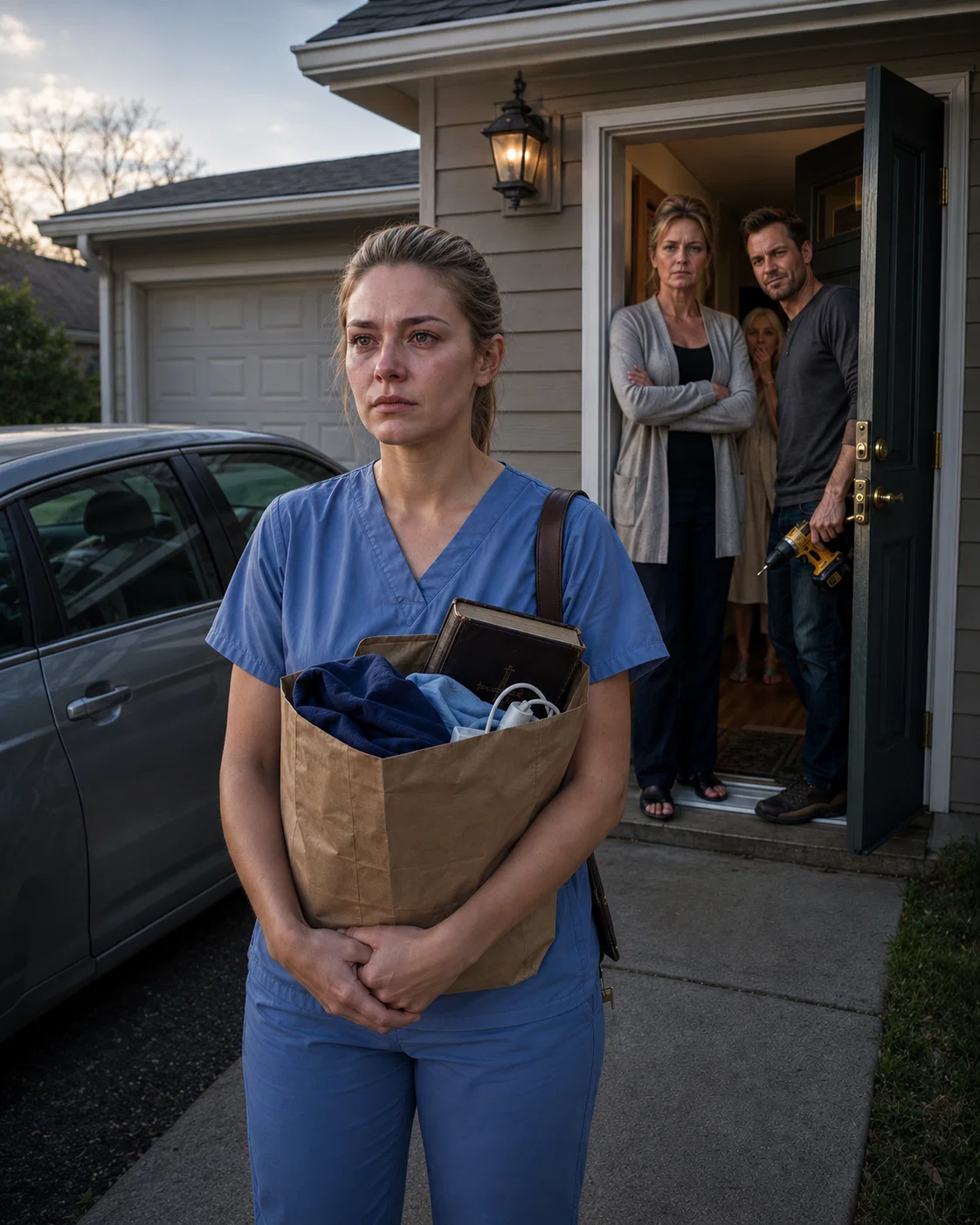
“I paid the mortgage for four years,” I said quietly. “I took Dad to the hospital. I slept in the den. I left with a paper bag. I don’t need to play anything.”
He pointed a finger at me.
“There it is. The martyr speech.”
Paul’s voice sliced through the conference room.
“Mr. Hale, I would advise you not to continue in that tone.”
Derek looked at him. “Or what?”
Paul did not so much as blink.
“Or I will suggest we pause this meeting and proceed through formal enforcement channels.”
That silenced him.
Lena had gone pale. For the first time, she was not putting on a show. She was mentally retracing her own life, seeing the late bills, the sudden explanations, the moments Derek claimed he had taken care of it, the times he told her not to trouble her pretty head.
She had enjoyed being shielded from responsibility.
Now she was beginning to understand what that protection had cost.
“Sign,” my mother said.
All of us looked at her.
Her voice was small, but there was steel underneath it.
“Mom,” Lena said.
“No.” My mother wiped her cheek. “You let your husband borrow against my house. You let him push your sister out. And I let it happen because it was easier to believe Audrey would survive than admit the rest of us were failing her.”
The words struck me harder than I expected.
I lowered my eyes to the table.
My mother turned toward me.
“I am sorry,” she said.
Not theatrically.
Not loudly.
Not with excuses wrapped around it.
Just four words.
I had pictured hearing them so many times that the real version almost felt too small to hold. But small did not mean meaningless.
Lena began crying again, but this time no one looked at her.
Derek signed first.
His signature was harsh and ugly, carving across the paper like a warning.
Lena signed second. Her hand shook. She avoided my eyes.
My mother signed last.
When she lifted the pen from the page, she closed her eyes.
Paul collected the documents.
“I’ll file the necessary paperwork Monday,” he said.
Derek got up so fast his chair struck the carpeted wall.
“This isn’t over.”
I looked up at him.
“Yes,” I said. “It is.”
He left the room.
Lena followed after a moment, but she stopped at the doorway.
For one second, I saw the sister from the Easter photo: lovely, adored, certain that the world would always move aside to make space for her.
Then I saw the woman who had stood behind a locked door and told me it was better for everyone.
“You changed,” she said.
I almost smiled.
“No,” I said. “I stopped disappearing.”
After they were gone, my mother remained.
She sat opposite me in the empty conference room, gripping her purse with both hands.
“I thought,” she began, then stopped. “I thought you were stronger than Lena.”
“I was.”
“That made it easy to lean on you.”
“I know.”
She swallowed. “That is not an excuse.”
“No,” I said. “It isn’t.”
For a long while, neither of us said anything.
Far below the windows, traffic moved in tiny, orderly lines.
At last, she asked, “Do you hate me?”
I gave her the truth.
“Some days, I did.”
She shut her eyes.
“But not today,” I said.
Her eyes opened again.
“Today I’m tired.”
She nodded as though she deserved that answer.
Maybe she did.
Over the following weeks, the house was transferred into the trust. The credit line was settled. Derek’s access was cut off. A professional trustee managed the practical details. My mother stayed in the house, but the house itself changed without moving anywhere.
Derek’s golf clubs vanished from the garage.
Lena’s storage boxes were taken out of the den.
The room where I had once slept on the fold-out couch became a reading room.
My mother asked whether I wanted any of my old belongings.
I said no.
The condo had taught me something: not everything you leave behind has to be reclaimed.
Sometimes freedom looks like an empty closet.
Derek did what men like Derek tend to do when they lose power. He rebranded himself in public.
He launched a podcast called Real Wealth, Real Men.
In the first episode, he spoke about betrayal, family businesses, and “female financial manipulation.” It had seventeen plays, and six of them were probably his own.
Lena texted me twice.
The first message said she needed closure.
The second said she hoped I was happy.
I answered neither one.
My mother called every Sunday at four.
At first, our calls were awkward. She talked about the weather, the neighbor’s dog, the church bulletin. Then one afternoon, she said, “Your father knew you were special.”
I almost ended the call.
Not because I was angry.
Because grief can strike more violently when it arrives carrying love.
“He told me once,” she continued, “that you had the kind of mind that built bridges out of broken boards.”
I lowered myself onto the floor of my kitchen.
“He never told me that.”
“I know,” she said. “He should have.”
That became the shape our relationship took.
Not fixed.
Not erased.
But honest enough to start again.
PART 6
Eight months after the locks were changed, I resigned from Mercy General.
My final shift ended at dawn. The sky beyond the hospital had turned pale pink, and the city looked soft in the way cities only do before they fully wake. Priya met me in the parking lot with coffee and started crying before I did.
“You know you can still change your mind,” she said.
“I know.”
“You love bedside nursing.”
“I do.”
“But?”
I glanced back at the hospital entrance.
“But I can help more people from the other side now.”
That was true, but it was not the entire truth.
The full truth was that I was tired of being needed only after everything had already become an emergency. I wanted to create something that kept the crisis from swallowing people whole in the first place.
The second company began in a rented office above a bakery. I could have leased a full floor downtown, but I liked the smell of bread in the hall. We built software for smaller clinics that could not pay for the expensive systems used by major hospitals. We focused on missed follow-ups, medication conflicts, confusion after discharge, the quiet administrative failures that turned poor patients into emergency-room cases.
I hired nurses before anyone else.
Not consultants.
Not men in expensive shoes who said phrases like market capture before they understood what a night shift did to a person.
Nurses.
People who knew.
I also anonymously funded two scholarships at my nursing school, one for students who were supporting family members and one for students returning after financial hardship. The dean wanted to put my name on a donor wall. I declined.
I had spent enough of my life invisible for the wrong reasons.
Now I wanted privacy for the right ones.
By thirty-one, I had a company, a condo, a lawyer who had become a friend, and a mother who was learning to apologize in fragments.
I did not have Lena.
People expect that part of the story to become tender. They expect sisters to reunite over coffee, to cry together, to confess envy, to remember childhood, to become whole again because endings feel cleaner when everyone receives forgiveness.
That is not how it happened.
Lena stayed Lena.
She sent a birthday card with a long paragraph about missing “what we used to be,” but what we used to be was an arrangement where she received gentleness and I received responsibility. I did not miss that arrangement.
Months afterward, she called from a number I did not recognize.
I answered because I was waiting for a contractor to call.
For one moment, neither of us spoke.
Then she said, “Derek left.”
I looked out the window of my office at the street below.
“I’m sorry.”
“He took money,” she said. “More than I knew.”
“I’m sorry,” I repeated.
“I didn’t know everything.”
“I believe that.”
Her breath caught, as though she had expected blame and did not know what to do with restraint.
“Can I see you?” she asked.
I closed my eyes.
In another life, maybe I would have said yes right away. Maybe the little girl in the Easter dress would have run toward her big sister with forgiveness already packed in her hands.
But I was no longer that girl.
“Not right now,” I said.
“Audrey—”
“I hope you get help. I mean that. But I can’t be your emergency exit.”
Silence.
Then, almost whispering, she said, “You really are different.”
This time, I smiled.
“I really am.”
I ended the call and cried for ten minutes.
Then I wiped my face and returned to work.
Boundaries are not walls made from hatred. Sometimes they are doors you finally have the right to lock from the inside.
The next spring, my mother invited me to dinner at the house.
I almost refused.
But there was something different in her voice. Not neediness. Not manipulation. Just hope.
So I went.
The brass deadbolt Lena had put in was still there.
For a moment, I stood on the porch and remembered the paper bag. The scrubs. The Bible. Derek’s voice telling me not to make anything dramatic.
My mother opened the door before I could knock.
She looked older, smaller, but steadier than before.
“I’m glad you came,” she said.
Inside, the house smelled of roast chicken and lemon polish. The den was no longer a storage space or a temporary bedroom. There was a small bookshelf, a lamp, and a framed photograph on the side table.
The Easter photo.
Me and Lena in matching dresses.
I stared at it.
“I can put it away,” Mom said quickly.
“No,” I said.
Because the girl in that picture deserved to exist somewhere. Not as evidence that everything had to be forgiven, but as proof that I had once loved without armor.
Dinner was quiet. We talked about Dad. We talked about my work. My mother asked real questions and waited for real answers.
After dessert, she handed me something wrapped in tissue paper.
My father’s watch.
“I should have given it to you years ago,” she said. “He wanted you to have it.”
The watch was scratched, simple, and far too large for my wrist.
I held it as if it had been made from light.
On the drive home, I did not cry.
I felt something better than relief.
I felt ownership.
Not of the house.
Not of the money.
Of myself.
Years before, my family had called me capable because it served them. They labeled me independent so they would not have to show up for me. They praised my strength while placing more weight on my back.
But capability had never belonged to them to define.
It belonged to me.
It was in every night shift. Every unpaid bill I survived. Every quiet humiliation I swallowed until I finally stopped swallowing. Every idea I created in stolen hours. Every boundary I held while people called it cruelty because they could no longer call it access.
The paper bag was gone.
The fold-out couch was gone.
The girl standing in the driveway was gone too, at least the version of her who still believed love had to be earned by being useful.
In her place was a woman with her father’s watch in her purse, her mother’s apology still flawed but real, her sister’s number blocked, and a life no one could enter without permission.
Sometimes people will lock you out of the only home you have ever known and call it an opportunity.
Sometimes they will return when your bank account finally makes you visible.
Sometimes they will call ninety-one times and confuse persistence with love.
Let them call.
Let them knock.
Let them stand outside the door they taught you how to close.
And when they ask what changed, tell them the truth.
Nothing changed.
You finally understood the lock was yours.
THE END