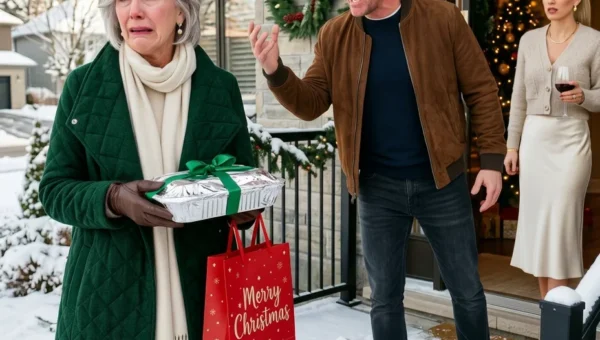
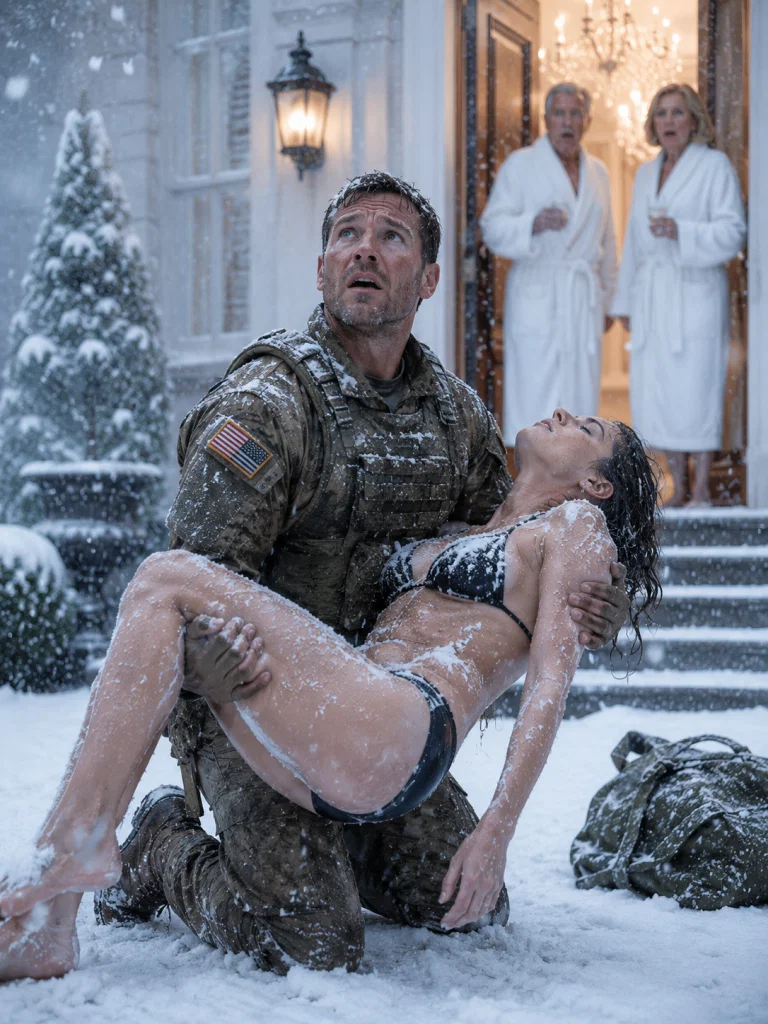
After eighteen months deployed overseas, I came home through a blizzard expecting warmth, but found my wife collapsed on the frozen porch, clutching our baby. “Your parents said we were no longer family,” she whispered. Something inside me went cold. I carried her past them and said, “You threw out my whole world. Now I’ll take back every dollar, every key, and every secret you stole from us.” — Part 2

“I have been conducting a full audit of your activities,” I corrected him.
He laughed and sat down in the leather chair. “You think a soldier can frighten me with a few spreadsheets, but I built this company, Ironwood Defense.”
“No, you did not,” I replied. “Grandfather built it.”
“And he left it all to me,” he retorted.
“He left you forty-nine percent of the shares,” I said, watching the color drain from his face.
Silence suddenly filled the room, heavy and suffocating. Years ago, my grandfather had placed the remaining fifty-one percent in a private trust for me, appointing an independent bank as the trustee until I reached the age of thirty-five.
I had turned thirty-five while I was deployed. My father had concealed all the legal documents, believing the bank notices were just lost in the military mail system.
I placed a certified legal letter on his mahogany desk. “As of last Tuesday, I am the one who controls this company,” I said.
My mother went deathly pale, and my father reacted by tearing the letter into small pieces. “A piece of paper changes absolutely nothing,” he roared.
“It changes exactly who has the authority to order a forensic audit,” I said.
That afternoon, he called the board together and announced that my combat stress had made me completely delusional. He claimed that Giselle had manipulated me and demanded that I be declared mentally incompetent.
My parents both smiled as their personal attorney presented the forged power of attorney documents. Then the heavy conference room doors swung open.
My grandfather’s trustee entered the room with a federal forensic accountant, two military investigators, and the company’s outside legal counsel. The accountant projected six years of illegal transactions onto the wall for everyone to see.
There were lists of false vendors, diverted military contracts, stolen payroll taxes, and my entire deployment fund routed through their shell company. My father finally stopped smiling and gripped the table until his knuckles turned white.
My mother leaned toward me and hissed, “They still need proof that we intended to commit any of these crimes.”
I reached into my pocket and felt the phone that was recording every word she just said. “You just gave them everything they need,” I whispered to her.
The boardroom became so quiet that I could hear the fan of the projector spinning in the corner. My father recovered his voice first and slammed both palms down on the polished table.
“This is my company and these people answer to me,” he shouted at the room.
The outside counsel slowly closed her folder and looked at him. “Not anymore,” she said. “The controlling shareholder has officially removed you as the chief executive, effective immediately.”
I picked up the pen and signed the formal resolution. My father stared at me as if I had pulled a weapon on him in the middle of the office.
“You ungrateful coward,” he spat.
“No, I am not,” I said, standing up to face him. “A coward is someone who throws a woman and her infant child into a blizzard simply because she discovered his trail of theft.”
I pulled out my phone and played the recordings for the entire board to hear. First came the sound of my father admitting he had stolen my money, then my mother’s voice describing how she copied my signature and read my private messages.
Finally, I played the recording of the security system capturing them ordering Giselle out into the snow while she begged for the baby’s supplies. Several directors looked away in disgust and one of them began to cry.
The investigators moved in to arrest my parents for identity theft, fraud involving military pay, and conspiracy. The federal agents added charges for wire fraud and tax evasion to the list.
My father tried to bargain by blaming my mother, and she responded by screaming that the shell companies were entirely his idea. Their marriage collapsed right there in the boardroom before they even reached the elevator.
But I was not finished yet.
The house had been placed in my trust by my grandfather, and my parents only held a right to live there that was conditional on their behavior. Their fraud effectively terminated that right immediately.
I changed the locks that very afternoon. When my mother was released pending her trial, she arrived at the front door with a suitcase and demanded that I let her inside.
Giselle stood right beside me on the porch, with little Hazel warm and safe against her chest. “You cannot just leave your own mother homeless,” Eudora cried out in the cold.
Giselle’s gaze was hard and cold. “You left a baby in the snow,” she said simply.
I handed my mother the address of a pre-paid motel room in the next town over. “One week,” I said. “That is significantly more mercy than you ever showed my family.”
My father pleaded guilty after the forensic audit uncovered over eleven million dollars in diverted funds. He was sentenced to eight years in federal prison and had to forfeit his shares, his vehicles, and all his hidden assets.
My mother received four years for her part in the conspiracy, forgery, and identity theft. The stolen money was eventually restored, the employees recovered their benefits, and every military subcontractor who was cheated was paid back in full.
I sold the old mansion because Giselle never wanted to see that porch again. One year later, I left active duty and took over as the chairman of the rebuilt company.
We renamed the firm Shield Construction and created a new housing program for military families who were facing emergencies while their partners were deployed. Giselle directed the program with the same fierce compassion that my parents had once mistaken for weakness.
On the first snowy evening in our new, smaller home, I found Giselle by the fireplace, rocking Hazel beneath a soft knitted blanket. There were no chandeliers or marble staircases here.
There was only warmth, safety, and quiet. “Do you ever miss what they lost?” she asked me softly.
I looked through the window as the snow gently covered our garden. “They lost everything because of their greed,” I said. “We saved our family.”
Hazel reached out for me, laughing at the sound of my voice. For the first time in years, I felt no anger at all, only peace.
This time, when I came home, the door was already open.
THE END.