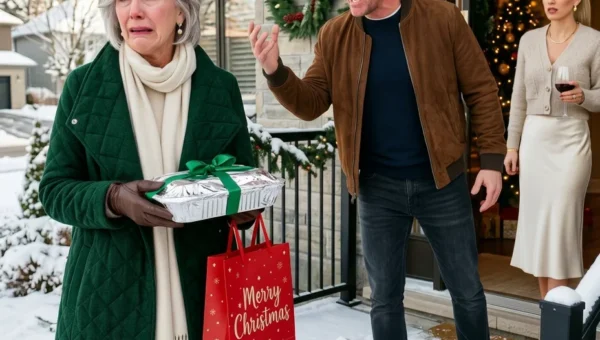
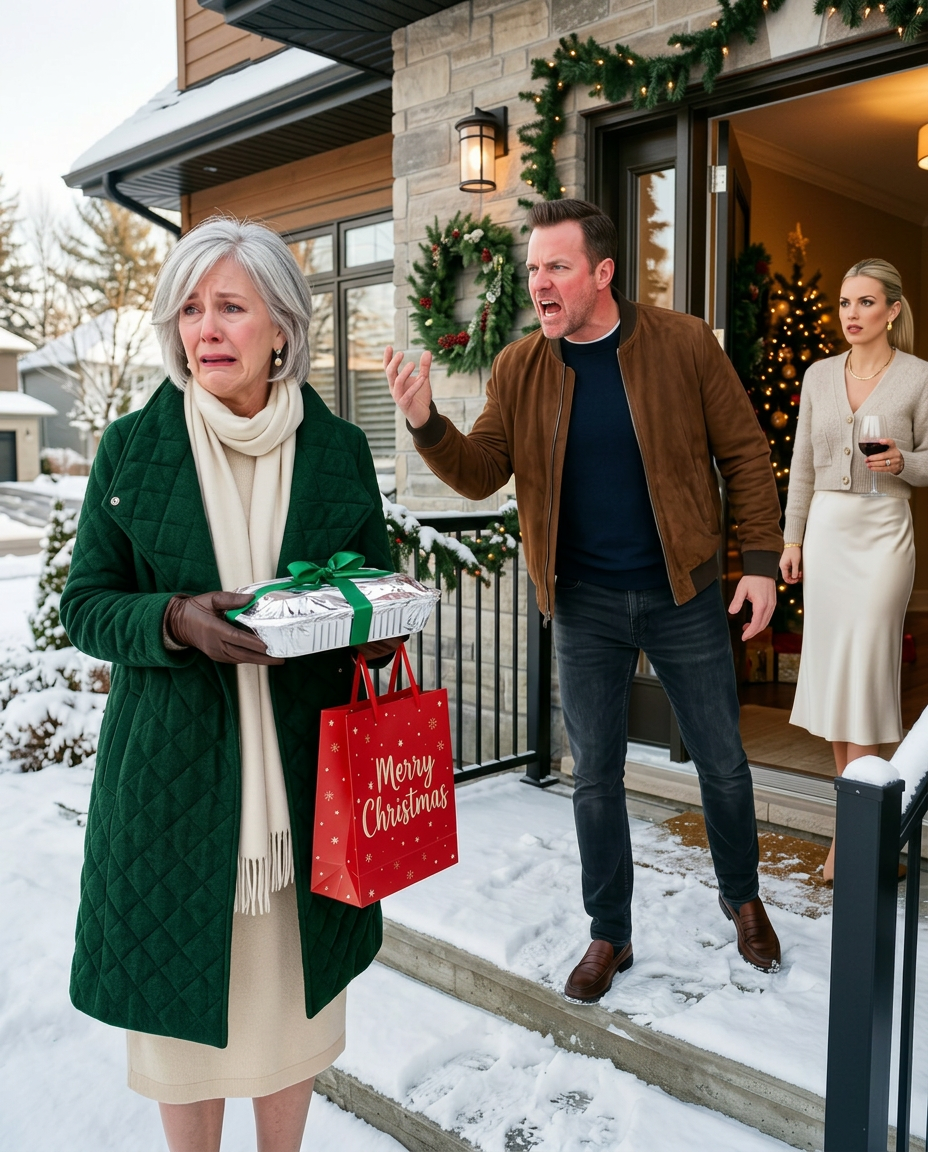
At Christmas, My Son Looked Me in the Eye and Said, “Wrong House.” Later That Night, I Heard Him Laughing on the Phone About Me: “Money Can’t Buy Her a Spot Here.” I Stayed Silent, Cut Off Every Transfer, and Woke Up to 25 Desperate Missed Calls. — Part 2

“And?”
He looked away. Margaret’s voice remained gentle. “And what did you say on the phone?”
His face flushed.
“I was drunk.”
“That was not my question.”
Daniel gripped the doorframe.
Eleanor stepped closer. “Answer your mother.”
Daniel swallowed.
“I said money couldn’t buy you a spot here.”
Margaret nodded slowly.
“And you were right,” she said. “So I stopped trying.”
Daniel’s eyes widened.
“Mom…”
She closed the door quietly. This time, Daniel was the one left standing outside in the cold.
PART 3
The following morning, Daniel returned before sunrise.
Margaret saw his car from the upstairs window. It was parked crookedly along the curb, the engine running, exhaust fogging in the pale December morning. He stayed inside for twenty minutes before he finally got out.
This time, he did not pound on the door.
He knocked once.
Then again, softer.
Margaret came downstairs already dressed. She had barely slept, but she did not feel weak. For years, exhaustion had followed every conversation with Daniel because every call required mental arithmetic: how much he needed, how much she could give, and how much guilt she would have to swallow.
Now the arithmetic was gone.
Eleanor had slept in the guest room and was standing at the bottom of the stairs in a robe, arms crossed.
“You don’t owe him a meeting,” Eleanor said.
“I know.”
Margaret opened the door. This time, there was no chain.
Daniel stood on the porch holding a folder. His face looked older than it had two days earlier. Panic had stripped away the polished confidence he usually wore like a tailored coat.
“Can I come in?” he asked.
Margaret studied him. “Are you here to talk or to collect?”
He lowered his eyes.
“To talk.”
She stepped aside.
Daniel entered the house where he had grown up. The hallway still held the narrow table where he used to drop his backpack after school. Above it hung a framed picture of him at twelve, smiling with braces beside Robert during a fishing trip in Maine.
Daniel glanced at the photograph, then quickly looked away.
They sat in the kitchen. Eleanor stayed near the counter, making it obvious she was not going anywhere.
Daniel opened the folder and took out several papers.
“I didn’t realize how much was connected to your accounts,” he said.
Margaret gave a small laugh without humor. “That is exactly the problem.”
He winced. “The mortgage is two months behind.”
Margaret raised her eyebrows. “Two?”
“I moved money around.”
“From where?”
His mouth tightened.
Margaret already knew.
“The business account,” she said.
Daniel nodded.
Robert had left Margaret financially secure, but not foolish. After he died, she had taken classes in estate planning, investments, and tax law. She knew what panic looked like when it was written on paper.
“Daniel,” she said, “how bad is it?”
He stared down at the table.
“The business is failing.”
Eleanor muttered, “Of course it is.”
Margaret lifted one hand slightly, and Eleanor went quiet.
Daniel continued in a low voice. “It started during the pandemic. We lost contracts. Then I took loans. Then interest rates changed. I kept thinking one big client would fix it.”
“And the vacations?”
His face burned.
“Claire said we had to keep appearances. The kids’ school, the club, the house… everyone knows us a certain way.”
Margaret leaned back.
Everyone knows us a certain way.
There it was. The sentence beneath everything.
Not need. Not survival. Appearance.
Daniel had not been feeding his children with her money. He had been feeding an image.
“Do the children know?” Margaret asked.
“No.”
“Does Claire know everything?”
Daniel hesitated for too long.
“She knows enough.”
Eleanor gave one cold laugh.
Margaret folded her hands. “Why did you turn me away?”
Daniel’s eyes filled quickly, but Margaret no longer trusted tears as evidence of truth.
“Claire’s parents were there,” he said. “And her brother. They think we’re doing better than we are. Claire told them we paid for the Vermont trip ourselves. She said if you came in, you might mention money or make things awkward.”
“I brought turkey and sweaters.”
“I know.”
“No,” Margaret said. “You knew I was useful. You forgot I was human.”
Daniel flinched.
The kitchen fell silent except for the ticking of the wall clock.
For a moment, Margaret saw him as a little boy again, five years old, holding a broken toy truck and asking her to fix it because he believed mothers could repair anything. But the man seated across from her had broken things deliberately, then handed her the pieces as though repair were still her duty.
“I can’t lose the house,” Daniel whispered.
Margaret looked out the window at the snow-covered yard.
“You may lose it.”
His head snapped up. “Mom.”
“I am not saying that to be cruel. I’m saying it because it is true.”
He pushed the papers toward her. “There has to be something you can do.”
“There is.”
Hope flashed across his face.
Margaret said, “I can help you meet with a bankruptcy attorney. I can pay directly for a financial advisor for three months. I can pay for a therapist for you and Claire, separately or together. I can set up a small education fund for the children that you cannot touch.”
His hope faded.
“But I will not pay your mortgage. I will not rescue your business. I will not fund vacations, private clubs, luxury cars, or lies.”
Daniel stared at her as if she had switched languages.
“That’s not help,” he said.
“It is the only help I am offering.”
His old anger tried to surface. She saw it in his jaw, in his shoulders, in his eyes. But then he looked at Eleanor, who stared back like a locked gate, and something inside him gave way.
“I don’t know how to tell Claire,” he said.
“Start with the truth.”
“She’ll leave me.”
Margaret did not answer immediately.
“Maybe,” she said at last. “Or maybe she will finally have to live in the same reality as you.”
Daniel covered his face with both hands.
For once, Margaret did not reach across the table to comfort him. She let him sit inside the consequences of his own life.
At 9:12 a.m., Claire called.
Daniel looked at the screen and did not answer.
It rang again.
Then Margaret’s phone rang.
Claire.
Margaret answered.
“Is he there?” Claire demanded.
“Yes.”
“Put him on.”
Margaret handed the phone to Daniel.
Claire’s voice was loud enough for everyone in the kitchen to hear.
“Daniel, what did she say? Did she fix it?”
Daniel closed his eyes.
“No.”
A sharp silence followed.
“What do you mean no?”
“She’s not paying anymore.”
Claire exploded. “Then make her! Daniel, the mortgage company called again. My mother is asking why the Vermont booking was canceled. The school sent an email. Do you understand how humiliating this is?”
Margaret watched Daniel closely.
He looked at his mother, then toward the old photograph in the hallway.
And for once, he did not blame her.
“Claire,” he said, “we’re broke.”
The words landed like glass shattering.
Claire’s voice dropped. “Don’t say that.”
“We’re broke,” he repeated. “The business is failing. The house is behind. Mom has been covering us for years.”
“She offered. That’s what mothers do.”
Margaret’s eyes narrowed, but she said nothing.
Daniel swallowed hard. “No. That’s what I let her do.”
Claire said something fast and furious that Margaret could not fully make out. Then one sentence came through clearly.
“If your mother loved her grandchildren, she wouldn’t do this.”
Daniel’s expression changed.
It was not dramatic. There was no shouting, no sudden transformation. Just a tired man finally hearing his own tactics from someone else’s mouth.
“She set up money for the kids,” he said quietly. “Money we can’t touch.”
Claire stopped speaking.
Daniel went on, “She’s offering to pay for an attorney and financial counseling. That’s it.”
“That’s it?” Claire snapped. “So we’re supposed to become some sad little middle-class cautionary tale?”
Margaret took the phone from Daniel’s hand.
“Claire,” she said.
“What?”
“You are already a cautionary tale. The only question is whether the children have to become part of it.”