
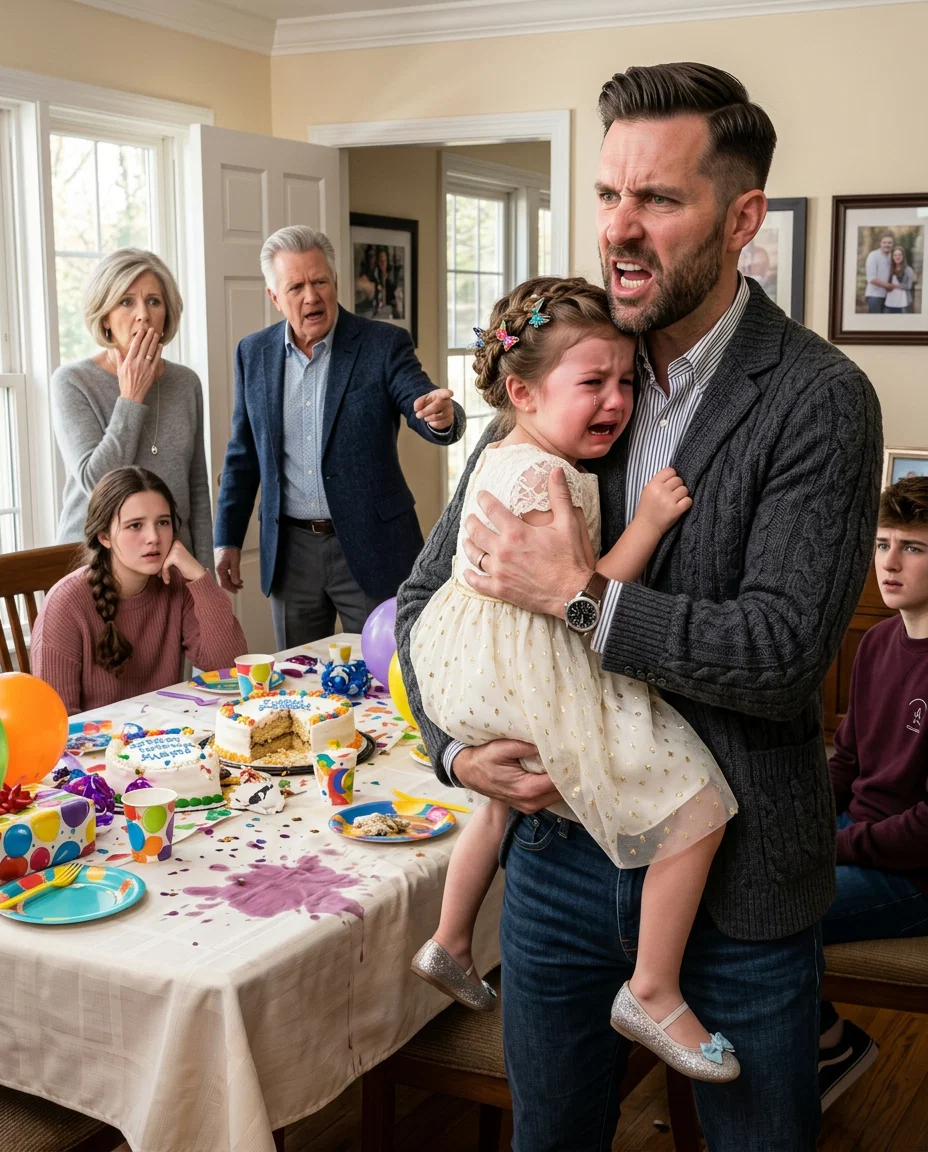
During my husband’s birthday dinner, our 7-year-old daughter was suddenly sent to another room because his family wanted space for his “real children.” — Part 2

Then Chloe stood up.
She walked over to Lily and offered her own chair.
“Sit with me.”
Lily’s eyes filled with tears again.
For the first time, Patricia realized nobody was supporting her.
Not even her grandchildren.
Before leaving, Lily handed Daniel the birthday gift she had made herself.
Inside was a small wooden picture frame she had painted by hand.
The photo showed the three of us at the county fair.
At the bottom, she had written two simple words:
**My Family.**
Daniel held the frame against his chest.
Then he turned toward his parents.
“You wanted my real family at this table,” he said quietly.
“You just tried to throw her out.”
We left without cutting the cake.
Without opening presents.
Without saying goodbye.
Later that night, as we drove home, Lily sat in the back seat holding Daniel’s hand.
After several minutes she whispered:
“Are you still my daddy?”
Daniel immediately pulled the car over.
Tears filled his eyes.
“I was your daddy yesterday,” he said softly. “I’m your daddy today. And I’ll be your daddy tomorrow.”
Lily wrapped her arms around him.
Neither of them let go for a long time.
The following week, Patricia tried to rewrite what happened.
According to her version, she had merely been arranging seats.
She never pushed Lily.
She never excluded her.
She never used the words “real children.”
But nobody believed her.
Not Daniel.
Not Mason.
Not Chloe.
Not even Daniel’s ex-wife Rachel.
When Rachel heard the story, she was horrified.
“Patricia should be ashamed of herself,” she told us.
That support meant more than she probably realized.
A few weeks later, Patricia arrived at our house carrying cupcakes and pretending she wanted peace.
Daniel gave her one chance.
“Apologize to Lily.”
Patricia reluctantly looked at my daughter.
“I’m sorry if your feelings were hurt.”
Daniel immediately handed the cupcake box back.
“That’s not an apology.”
PART 3
Patricia grew frustrated.
Then Lily surprised everyone.
She stood up, looked directly at Patricia, and said:
“I’m not holding a grudge. I just remember.”
The room went silent.
Then Patricia lost control completely.
She admitted she still didn’t consider Lily one of Daniel’s real children.
That was the moment everything finally ended.
Daniel asked his parents to leave.
Mason opened the door for them.
Chloe said she no longer wanted to visit their house.
And for the first time, Patricia realized she was losing far more than an argument.
She was losing her family.
Months later, Daniel made a decision.
He filed adoption papers.
When he sat down to discuss it with Lily, he explained that he already considered himself her father. The adoption would simply make it official.
Lily thought for a moment.
Then she smiled.
“You picked us,” she said.
The adoption hearing was simple.
No dramatic speeches.
No grand celebration.
Just a judge, some paperwork, and a little girl who already knew the answer.
“Do you want Daniel to become your legal father?” the judge asked.
Lily grinned.
“He already is. We’re just telling everyone else.”
There wasn’t a dry eye in the room.
Afterward, we took photos outside the courthouse.
For the first time, everything felt complete.
Patricia found out through social media.
Her only response was a text message accusing us of destroying the family.
Daniel deleted it without replying.
“She doesn’t get to stand in the doorway anymore,” he said.
That Thanksgiving, we hosted dinner ourselves.
Rachel joined us.
Mason burned the dinner rolls.
Chloe laughed at him.
Lily made handmade place cards for everyone.
The house was loud, messy, and happy.
As we gathered around the table, Daniel looked at all three children and smiled.
“I’m thankful,” he said, “for the people who taught me that family isn’t biology. It’s behavior.”
Lily immediately raised her hand.
“Yes?” Daniel asked.
“Can we eat now?”
Everyone burst out laughing.
Later that night, Daniel told me something I’ll never forget.
“I used to think peace meant staying quiet.”
“And now?” I asked.
He smiled toward the living room where the children were arguing over a blanket.
“Now I think peace means knowing nobody at your table has to earn their seat.”
And in that moment, I realized something important.
Patricia could keep her perfect table, her traditions, and her narrow definition of family.
In our home, every chair was filled by someone who belonged.