My husband’s stepmother texted me a photo of them sleeping in my bed, wearing my late mother’s emeralds. “Poor — Part 3

“No, Vivienne,” I said, the chill in my voice dropping the temperature in the room. “It is authenticated. It is irrefutable. And wearing my dead mother’s necklace in my bed to take the photo was a particularly arrogant touch. It made tracking the exact date of the encounter exceptionally easy.”
Julian finally found his voice. It was small, reedy, and pathetic. “Eleanor. Ellie, please. Listen to me. Let’s talk about this in private.”
“I did listen to you, Julian,” I said, my eyes boring into his terrified skull. “I listened to you call me frigid. I listened to you tell me I was too sensitive. I listened to you for five years. My turn to speak is entirely overdue.”
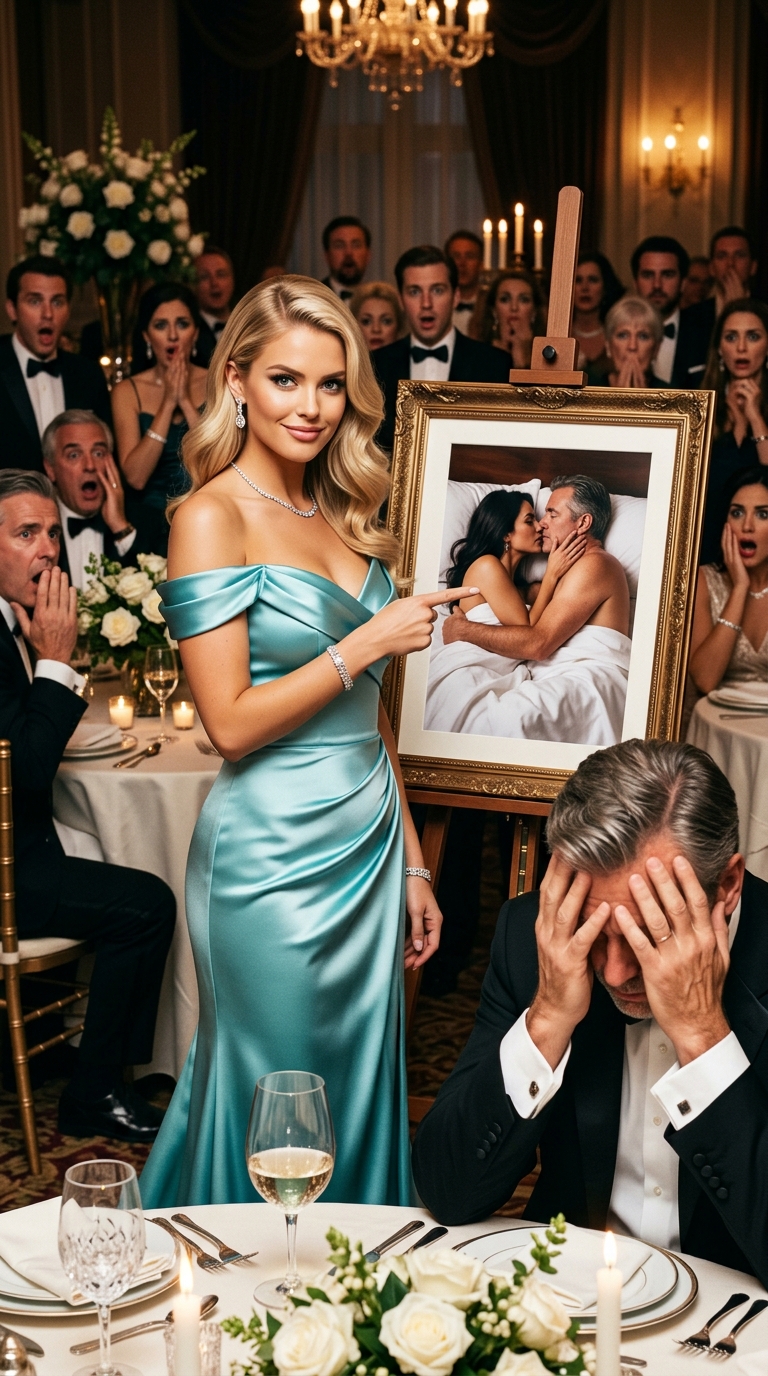
His sisters were huddled together, staring at the giant image like it was a live explosive about to detonate. Harrison turned slowly, rigidly, toward Vivienne. He looked like a man who had just been stabbed but hadn’t quite felt the pain yet.
“Tell me this is a lie,” Harrison growled, his fists clenched at his sides. “Vivienne. Tell me.”
She reached out to touch his arm, tears spilling down her cheeks. “Harrison, please—”
He violently slapped her hand away.
“A fascinating display of morality,” I interrupted, projecting my voice to command the room. “But infidelity is terribly common. And honestly? It’s boring.”
I turned the remote back to the television.
“Since we have Mrs. Gable from the charity board, and Mr. Sterling from the bank here with us tonight, I thought we should move past the bedroom and discuss something far more compelling.”
Click.
The screen shifted. The scandalous photograph vanished, replaced by columns of numbers. Bank routing codes. Wire transfer receipts.
“Let’s talk about felony fraud,” I said softly, watching Harrison’s breath hitch in his throat.
“While we are on the subject of betrayal,” I announced, walking slowly down the length of the table toward Vivienne, “let’s examine the Harrison Family Philanthropic Trust.”
On the screen, red lines highlighted specific transactions.
“Over the past twenty-four months,” I narrated, my voice steady and clinical, “the foundation paid exactly eight hundred and forty thousand dollars to three distinct independent consulting firms. Apex Solutions, Meridian Global, and Zenith Logistics.”
Mrs. Gable sat bolt upright, her face hardening into a mask of pure institutional fury. She pulled her reading glasses from her purse.
“I traced the incorporation documents,” I continued. “All three LLCs are registered in Delaware. All three utilize the same registered agent. And all three route their incoming capital directly to an offshore account in the Caymans. An account whose primary beneficiary is listed as Marcus Vance.”
I stopped directly behind Vivienne’s chair. I leaned down, my voice dropping to a whisper that carried across the dead-silent room. “Your maiden name is Vance, isn’t it, Vivienne? And Marcus is your younger brother.”
Vivienne choked out a sob, covering her face with her hands.
“None of these companies ever provided a single service to the charity,” I stated loudly. “It was a ghost payroll. Embezzlement. Pure and simple.”
Mrs. Gable stood up, her napkin falling to the floor. “Harrison. Is this true?”
Harrison looked completely destroyed. He swayed on his feet, staring at his wife as if she had morphed into a monster before his eyes. “I… I didn’t know. I swear to God, Helen, I let her manage the vendor accounts—”
“I know you didn’t know, Harrison,” I said calmly. “Because if you did, you wouldn’t be facing the Internal Revenue Service investigation that I triggered yesterday. I submitted the complete forensic audit to the State Charity Bureau, the Attorney General, and the IRS at exactly 4:00 PM today.”
Vivienne let out a wail, a horrific, animalistic sound of pure ruin.
“You had no right!” she screamed, lunging up from her chair toward me.
Before she could take a second step, two men in dark suits stepped out from the shadowy alcove of the hallway. One was Marcus, my attorney. The other was a hulking, off-duty police officer working private security.
Vivienne froze, shrinking back into her chair.
Julian, desperate to regain some semblance of control over his imploding life, turned his anger on me. He marched toward me, his face twisted in rage. “You psychopathic bitch! You brought security into my house to ambush my family?”
“Correction,” Marcus, the attorney, stepped forward, opening a thick leather portfolio. “Mr. Hale, according to the infidelity clause of the prenuptial agreement—which we have just irrefutably proven you breached—you immediately forfeit any and all claims to spousal support, division of Ms. Eleanor’s business assets, and, crucially, residence rights.”
Julian let out a harsh, broken laugh. “Residence rights? I’m on the deed! This is our house!”
I looked at him, feeling absolutely nothing. No anger. No sorrow. Just the cold satisfaction of an equation balancing out perfectly.
“No, Julian. It is my house. It was purchased by my irrevocable blind trust six months prior to our marriage. You were merely an authorized occupant. That authorization was legally revoked via electronic filing three hours ago.”
His mouth hung open. The reality of his situation was finally penetrating his arrogance.
But I wasn’t finished. I turned to face the head of the table, where the bank director sat in stunned silence.
“Mr. Sterling,” I said, gesturing to a silver tray resting on the side buffet. On it sat several thick envelopes, sealed with heavy red wax. “I believe you came here tonight to finalize the underwriting for Julian’s multi-million dollar restaurant expansion loan.”
Mr. Sterling cleared his throat nervously. “I… yes. That was the understanding.”
“I suggest you open the envelope with your name on it,” I said.
As if on cue, I clicked the remote one final time.
A high-resolution scan of a commercial loan guarantee document appeared on the screen. At the bottom, my signature was penned in sprawling black ink.
“Julian needed a co-signer with pristine credit and substantial liquid assets to secure the capital,” I explained to the room. “He knew I would never agree to leverage my firm for his failing business. So, he improvised.”
I looked dead into Julian’s eyes. “You forged my signature, Julian. You committed wire fraud and identity theft to secure a federal bank loan.”
Mr. Sterling ripped open the red wax seal on his envelope, quickly scanning the forensic handwriting analysis report I had provided inside. He stood up immediately, his face flushed with professional outrage.
“Mr. Hale,” Mr. Sterling said, his voice trembling with anger. “Consider your application terminated. The bank’s legal department will be contacting the authorities in the morning regarding this fraudulent submission.”
Ping.
A sharp electronic tone echoed in the room. Then another. Ping. Ping. Ping.
Julian scrambled to pull his phone from his pocket. Vivienne did the same.
“Oh, and check your alerts,” I said softly. “As of five minutes ago, my legal team successfully filed an emergency injunction. All joint accounts are frozen. The credit cards are suspended. You currently have zero access to my capital.”
Julian’s sisters began to weep. They weren’t crying for me, of course. They were crying for the scandal. They were crying for the loss of their inheritance, for the destruction of their pristine social standing, for the family name cracking loudly and publicly down the very center.
Harrison silently removed his heavy gold wedding band. He didn’t say a word. He simply dropped it into Vivienne’s shattered wine glass on the floor, the metal clinking dully against the crystal shards.
He turned and walked out the front door without looking back.
“You have exactly five minutes to vacate my property,” I told Julian and Vivienne, gesturing to the security officer. “If you are not out the door, the police cruisers parked at the end of the block will assist you. I suggest you take only what you can carry.”
Vivienne looked at Julian, her eyes wide with desperate pleading. But Julian wasn’t looking at her.
He was staring at me. He was looking at me with the sheer, unadulterated terror of a man who was finally, comprehensively seeing the woman he had fatally mistaken for weak.
The security officer stepped forward, resting a hand on his utility belt. “Time to go, folks.”
They stumbled out like refugees from a war they had started and spectacularly lost. They walked right beneath the giant, glaring photograph of their own sin, out into the humid night air, carrying nothing but the clothes on their backs and the crushing weight of their immediate poverty.
I did not scream. I did not cry. I didn’t even feel the urge to pour myself a glass of wine.
I simply stood in the doorway, watching the taillights of their Uber fade down the long, winding driveway. Julian looked back once, his face pale in the moonlight, waiting for a flicker of hesitation. Waiting for the soft, compliant wife to call him back.
I closed the heavy oak door and locked the deadbolt.
Six months later, I woke up in a new, hyper-modern apartment overlooking the city skyline, the morning sunlight spilling warm and clean across crisp, white sheets.
My divorce was finalized in record time; Julian didn’t have the funds to fight the ironclad prenup or the criminal charges. He was currently under federal indictment for bank fraud and forgery, facing a minimum of five to seven years.
Vivienne was a ghost. She had lost Harrison, the diamonds, her social standing, and every elite door she had spent a decade forcing open was permanently slammed shut in her face. The Attorney General was actively prosecuting her brother, and Harrison’s foundation was slowly recovering the stolen funds through aggressive asset seizure.
Julian’s sisters abruptly stopped laughing whenever my name was mentioned in polite society. In fact, they stopped attending galas altogether.
As for me? I expanded my firm. I bought my mother’s emerald necklace back from the pawnshop Vivienne had desperately sold it to in her first week of exile, and I wore it every single day as a badge of honor.
I kept the massive, six-foot photograph, too. It sits securely in a climate-controlled storage unit on the outskirts of the city. I didn’t keep it because it hurt to look at. The pain had long since evaporated.
I kept it because it reminded me of a fundamental truth: the day they arrogantly exposed their shame was the exact day I finally stopped carrying it for them.
If you want more stories like this, or if you’d like to share your thoughts about what you would have done in my situation, I’d love to hear from you. Your perspective helps these stories reach more people, so don’t be shy about commenting or sharing.