My billionaire husband brought his mistress to our divorce meeting and I brought our 11-day-old son sleeping against my chest. H — Part 3

David Harrow stiffens beside me. “Under what conditions?”
“Under the condition,” Charles says softly, looking directly into my soul, “that Richard remains in this boy’s life. Supervised, structured, but present. I will not have my grandson raised entirely outside the sphere of my family’s influence. You will get your money, Claire. You will get your houses and your security. But you will not sever the boy from his legacy.”
I stare down the billionaire titan. My heart is hammering a frantic rhythm against my ribs, but my voice is dead calm. “I am not afraid of you, Charles. I gave birth two weeks ago. I am functioning on three hours of sleep. I am vastly too tired to be intimidated by rich men making demands. Leo’s safety and routine will dictate Richard’s access. Not your ego. Not Richard’s guilt. If you try to force my hand, I will release Rebecca Vance’s emails to the Wall Street Journal, and I will let the public decide what happens to the Montgomery stock price.”
For a long, agonizing minute, Charles says nothing. He studies me like a complex chess puzzle. Then, surprisingly, he smiles. It is a terrifying, genuine expression of respect.
“There is vastly more steel in you than my son ever realized,” Charles murmurs. “Very well. We have an accord.”
The negotiations shift rapidly after that. Charles enforces a brutal pragmatism. The paternity test proves what I already know. I secure everything: an ironclad trust for Leo, housing stability, medical coverage, an education fund, and child support that reflects the true depth of the Montgomery fortune. Most importantly, I secure primary custody, with Richard allowed only gradual, strictly supervised visitation.
Richard is utterly furious that his father usurped him, but he is completely powerless. His empire is built on his father’s foundation; he cannot rebel without losing everything.
The first supervised visitation takes place in a sterile, brightly lit family services center near Columbus Circle. Leo is exactly six weeks old.
Richard arrives looking profoundly out of place. He wears a casual cashmere sweater, likely advised by a crisis coach to appear less corporate. He looks terrified. This man who regularly addresses shareholders with icy confidence is trembling at the sight of a seven-pound infant.
The social worker instructs him to wash his hands and sit down. When she gently places Leo into Richard’s awkward, rigid arms, Richard stops breathing.
His face crumples. The slick, arrogant billionaire vanishes. For one fleeting, heartbreaking moment, I see the man I fell in love with—a man holding his son for the very first time, crushed under the realization of everything he has destroyed.
“He’s so small,” Richard whispers, his voice cracking.
I stand against the far wall, my arms crossed tightly over my chest. “He was smaller when he was born.”
Richard squeezes his eyes shut, a single tear slipping down his cheek. “I’m so sorry, Claire. God, I’m so sorry.”
I nod slowly. “Be sorry by being consistent, Richard. Show up.”
For a brief second, I feel a fragile sliver of hope. Maybe the war is finally ending.
But as Richard rocks his son, my phone vibrates loudly in my pocket. I pull it out. It’s an urgent Google Alert I set for Richard’s name.
I click the link, and all the blood drains from my face.
It is an exclusive article from a major gossip syndicate. The headline screams: BILLIONAIRE MONTGOMERY EXTORTED BY UNSTABLE EX-WIFE USING SECRET LOVE CHILD. The article is filled with “anonymous insider quotes” painting me as a manic, manipulative gold-digger who trapped Richard and is now demanding a ransom.
The war wasn’t over. Richard’s rogue PR machine, acting on delayed orders or blind loyalty, had just launched a nuclear strike.
I do not scream. I do not confront Richard while he holds our child.
Instead, I screenshot the article, attach the zip file containing all of Rebecca Vance’s damning emails and audio recordings, and forward the entire package to Richard’s personal email, Charles Montgomery’s private address, and David Harrow. My subject line is a single word: Tick-tock.
By the time Richard hands Leo back to the social worker and checks his phone in the hallway, the color has completely washed out of his face. Within two hours, the article is scrubbed from the internet with terrifying speed. Retractions are published. A PR executive is abruptly fired. The nuclear threat of the truth forces a permanent, chilling surrender.
After that, the true grueling work of consistency begins.
Richard struggles. Men who are accustomed to bending the universe to their will often panic when a screaming infant absolutely refuses to adhere to a schedule. At first, he tries to buy his way out of the awkwardness. He arrives for supervised visits with absurd gifts: a Hermes cashmere baby blanket, a sterling silver rattle, designer shoes Leo cannot walk in.
I pack them all in a box and hand them back. “He doesn’t need a silver rattle, Richard. He needs you to learn how to change a soiled diaper without looking like you’re handling toxic waste.”
Slowly, painfully, the billionaire learns how to be a father. He learns the specific angle to hold the bottle. He learns the difference between a hungry cry and a tired cry. One afternoon, Leo violently spits up all over Richard’s designer sweater. The old Richard would have been disgusted, perhaps even shouted. The broken, rebuilding Richard merely stares at the mess, laughs softly, and mutters, “Well, I certainly deserved that.”
The divorce is finalized in a quiet, heavily guarded courtroom when Leo is eight months old.
There is no dramatic thunder. No swelling music. Just the scratch of a fountain pen on thick parchment, and the heavy thud of the judge’s gavel. The legal death of my marriage is recorded at exactly 10:43 a.m.
In the long, marble hallway afterward, Richard approaches me. The shadows under his eyes are deep; the arrogance is gone.
“Claire,” he says quietly. “I know I have absolutely no right to ask you for anything. But someday… when he’s old enough to understand, I hope you’ll tell Leo that I wasn’t always a monster. That there was a time I loved you.”
I look at him. I could be cruel. I have earned the right to be cruel. But I choose the heavier burden. “I won’t lie to him, Richard. I won’t erase the betrayal, but I won’t erase the good years, either.”
Years pass. They do not pass smoothly like a montage in a film. They are jagged and exhausting. I build a new life from the ashes. I return to my career in architecture, transforming my part-time consulting into a thriving boutique firm. I buy a beautiful, sun-drenched brownstone in Brooklyn with a small garden where Leo learns to walk, his tiny hands covered in the rich, dark soil of my tomato plants.
I learn the bone-deep exhaustion of single motherhood, the terror of midnight fevers, the solitary weight of making every decision alone. But I also learn the fiercely protected joy of it.
Leo’s first word is “Mama.”
Richard happens to be sitting on my living room rug for his scheduled Saturday visit when it happens. The word drops between us like a heavy stone. Richard swallows hard, his eyes shining with unshed tears, but he forces a wide, encouraging smile for his son. I pretend to be deeply focused on folding laundry so he can have the dignity of his private grief.
Leo grows into a thoughtful, serious little boy. He inherits Richard’s dark, intense eyes and my stubborn, unyielding jaw. He loves building complex train sets, eating blueberries by the handful, and correcting adults with a polite but firm “actually…”
When Charles Montgomery dies suddenly of a massive stroke, Leo is six.
The funeral is a sprawling, gothic affair at St. Patrick’s Cathedral, crowded with politicians and titans of industry whispering in the pews. I attend only to support Leo. My son stands between me and his father, wearing a tiny, perfectly tailored navy suit, holding my hand on one side and Richard’s on the other.
As the mahogany casket is lowered into the earth, Richard kneels in the damp grass beside Leo. He pulls the boy close and whispers something urgently into his ear. Leo’s small face grows intensely serious, and he nods solemnly.
Later, driving home in the quiet warmth of the car, I look at my son through the rearview mirror. “What did your dad say to you today, baby?”
Leo stares out the window at the passing city. “He said Grandpa was a very powerful man, but he built his castle out of ice. He told me to build mine out of warmth.”
A lump forms in my throat. Richard is evolving. Slowly, painfully, he is actively trying to break the generational curse of the Montgomery men.
But a week after the funeral, Richard arrives at my brownstone unannounced after Leo has gone to sleep. He stands on my porch, the collar of his coat turned up against the autumn wind. The porch light casts deep shadows across the lines of his face. He looks older. Exhausted.
“Claire,” he says, his voice vibrating with a nervous energy I haven’t seen in years. “My father’s will was unsealed today.”
I cross my arms against the chill. “And?”
Richard steps closer, the shadows hiding his eyes. “There’s something I never told you about Rebecca. About the Trust. About why I abandoned you.” His voice drops to a ragged whisper. “Something my father forced me to do to ensure I inherited the company.”
I freeze on the porch, the cold wind whipping my hair across my face. “What are you talking about, Richard?”
He shakes his head, looking down at his hands. “My father knew about my affairs. He knew my marriage was fracturing. And he despised the fact that I was splitting my focus. Before he died, he left a sealed letter with his attorneys. It wasn’t just a Trust amendment, Claire. It was a loyalty test. He threatened to trigger a boardroom coup and strip me of my CEO title unless I proved I was ruthless enough to cut liabilities.”
“I was a liability?” The words taste like ash.
“Love was a liability to Charles Montgomery,” Richard says bitterly. “He wanted to see if I had the stomach to prioritize the empire over my own unborn flesh and blood. I panicked. I chose the empire. And by the time I realized I was drowning in my own ambition, I had lost you.”
He isn’t asking for absolution. He is simply laying the final, ugliest piece of the puzzle on the table.
“I don’t expect forgiveness,” he adds, backing away toward the steps. “I just… I couldn’t carry the lie anymore.”
I watch him walk away into the dark street. For the first time in nearly a decade, I feel the final, heavy knot of resentment in my chest loosen. I finally understand the machinery of my own destruction. And understanding it strips it of its power.
Four years later. Leo’s tenth birthday.
My house is vibrating with the chaotic energy of ten pre-teen boys hopped up on sugar and pizza. The backyard is littered with wrapping paper, deflated balloons, and half-empty cups of soda. As the sun begins to set, the last of the parents arrive to collect their exhausted children, leaving a comfortable, ringing quiet in their wake.
Richard stays behind to help clean up. This still surprises me occasionally. The man who once employed a staff of fifty to manage his life is now quietly rolling up his sleeves and tying off heavy black trash bags in my kitchen.
Leo sits at the kitchen island, swinging his legs, eating a leftover slice of the lopsided, aggressively frosted homemade cake Richard baked for him.
“Hey, Mom?” Leo asks, his mouth full of blue frosting. “Can I see the pictures from when I was a baby?”
I dry my hands on a towel and pull my laptop open on the counter. We click through the digital albums. There is Leo in the hospital, wrapped in a striped blanket. There he is in the Brooklyn apartment, sleeping in his bassinet next to a towering stack of legal binders.
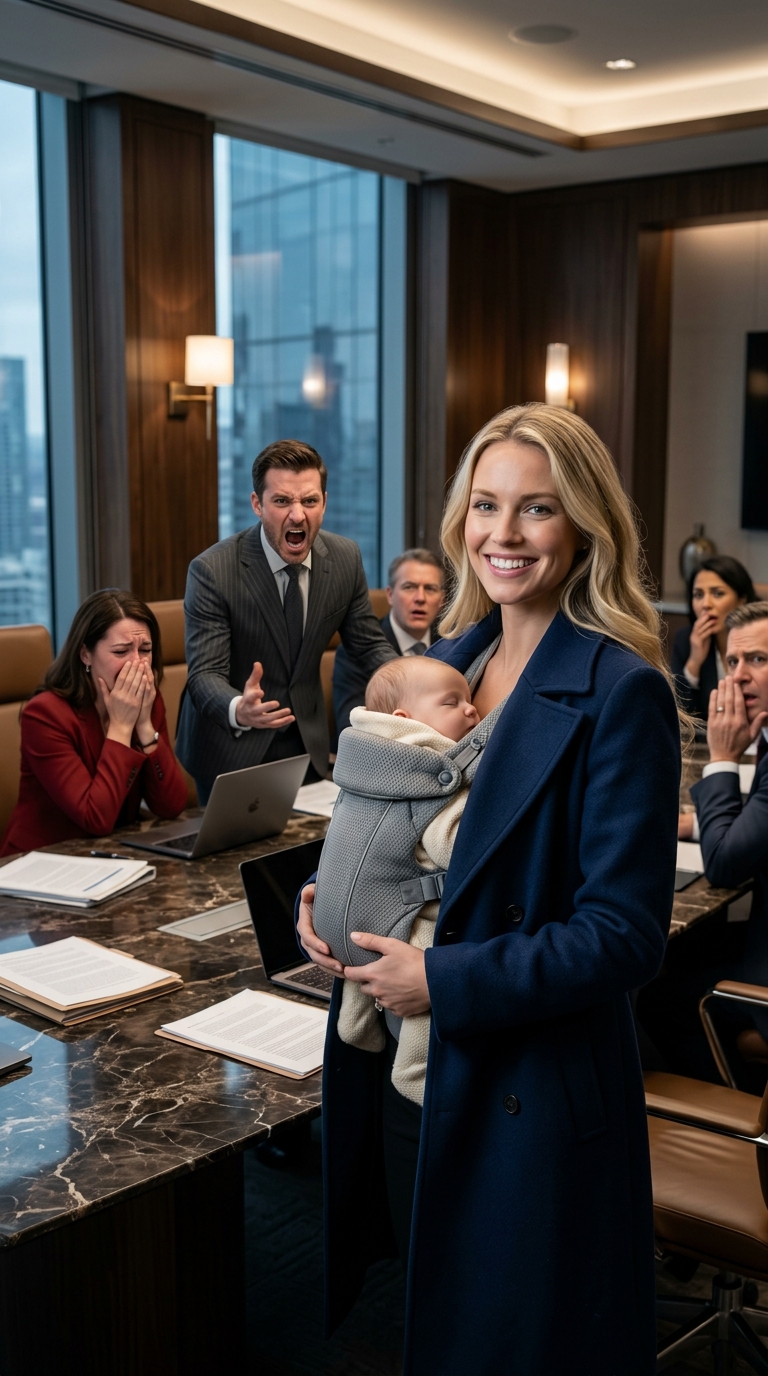
Leo points a sticky finger at the screen. It is a photo taken by David Harrow’s assistant, secretly, on the day of the divorce settlement meeting. I am standing in the reception area, wearing the cream blouse and the heavy navy coat. Leo is strapped to my chest, fast asleep. I look pale, exhausted, and utterly terrified.
“Where were we going?” Leo asks, tilting his head.
I glance up. Richard has stopped moving. He is standing by the sink, holding a wet sponge, staring intently at the screen. The three of us exist in these moments now—not as a reconciled family pretending the war never happened, but as survivors who decided the peace of a child was worth more than old vengeance.
“We were going to a very important meeting,” I tell Leo softly. “A meeting to decide how your dad and I were going to take care of you.”
Leo studies the photo. “You look really tired, Mom.”
I laugh, a genuine, warm sound. “I was exhausted, baby. More tired than I ever thought possible.”
“But you look brave, too,” Leo decides firmly. He leans his head against my arm. “Dad told me about that day.”
I blink, stunned. I look at Richard. He swallows hard and looks down at the sink.
“He did?” I ask carefully.
Leo nods. “Yeah. He said that was the day you walked into a room full of monsters and protected me before I could even open my eyes. He said I should always respect you because you fought for me when nobody else would.”
My throat tightens so violently I can barely breathe. Tears prick the corners of my eyes, sudden and hot.
Leo panics instantly, dropping his fork. “Mom? Did I say something wrong?”
“No,” I whisper, pulling him into a tight, fierce hug, burying my face in his hair. “No, baby. You said something beautiful.”
Over Leo’s shoulder, I look at Richard. He meets my eyes. There is no lingering romantic longing in his gaze, no desperate begging for a second chance. There is only profound, absolute gratitude.
I nod at him. A silent truce. A final closing of the book. Peace does not always look like a fairy-tale reconciliation. Sometimes, peace looks like a child laughing safely between two people who finally stopped using him as leverage and started treating him like a soul.
Later that evening, after Richard has hugged Leo goodbye and driven away, I sit alone at the kitchen island. The house is dark, save for the warm, yellow glow of the pendant lights over the counter. Outside, the rain begins to tap against the glass, a soothing, rhythmic sound.
I pull open the bottom drawer of my desk and extract a thick, heavy envelope.
It bears the wax seal of the Montgomery legal estate. It had been delivered to my lawyer years ago, with strict, legally binding instructions from the late Charles Montgomery that it was only to be given to me on the exact day of Leo’s tenth birthday.
I trace my thumb over the brittle wax. Charles was a man who planned his chess moves decades in advance. What final trap, or final gift, had the old titan left behind?
I slide a silver letter opener under the flap and break the seal. The heavy parchment slides out. The letterhead is stark black. I unfold the paper, my heart beating a slow, heavy rhythm in my ears.
I read the first handwritten line, and all the breath vanishes from my lungs.
Every single thing I believed about my survival, about Richard’s affair, and about the brutal, icy machinery of the Montgomery family… had been a meticulously orchestrated lie.
If you want more stories like this, or if you’d like to share your thoughts about what you would have done in my situation, I’d love to hear from you. Your perspective helps these stories reach more people, so don’t be shy about commenting or sharing.