
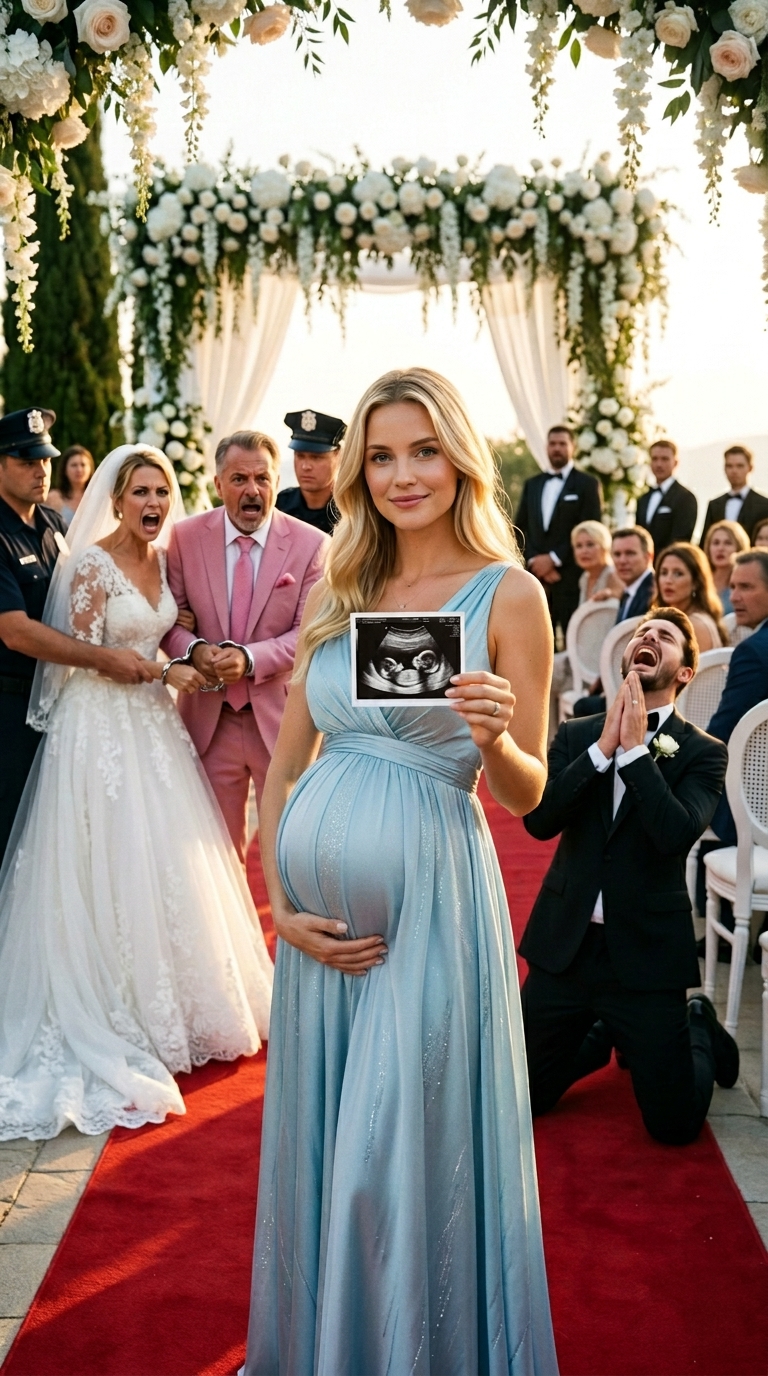
At 26 weeks pregnant, when I lay in the clinic watching my baby’s ultrasound, the TV flashed breaking news: My billionaire — Part 3

He didn’t pull away. He shifted his grip on the steering wheel, taking my hand and lacing his warm fingers tightly through mine.
“Hold on to me, Amara,” he whispered, his eyes fixed intensely on the slick road, though I could see a muscle jumping erratically in his jaw. “I’ve got you. I’m not going anywhere.”
We burst through the emergency room doors, but as the nurses rushed me onto a gurney, the monitors suddenly flared to life with a frantic, high-pitched alarm. The doctor’s face went completely white.
“Her blood pressure is crashing,” the doctor shouted over the chaos, looking at Beckett. “The baby’s heart rate is dropping. We need to cut, now!”
Everything went dark.
I awoke to the blinding glare of fluorescent hospital lights and the steady, rhythmic beeping of a heart monitor. My mouth was dry as cotton, and a dull, deep ache radiated from my abdomen. I panicked, my hands flying instantly to my stomach, finding it empty.
“She’s okay. She’s right here.”
The voice was a low, soothing balm. I turned my head. Sitting in a plastic chair beside my bed, looking completely wrecked, was Beckett. His blue button-down shirt was wrinkled, his hair was a messy tangle, and dark, heavy circles bruised the skin under his eyes. He looked like he had lived a lifetime in the hours I was unconscious.
In his arms, wrapped tightly in a pink striped hospital blanket, was a tiny, sleeping bundle.
“You had a placental abruption,” Beckett explained softly, leaning closer. “It was close, Amara. It was really close. But the doctors were fast. She’s perfect.”
Coraline Rose was born in the chaotic, terrifying hours of a Tuesday morning. Seven pounds, three ounces of absolute perfection, with a head full of dark, wild curls and lungs that the nurses assured me had announced her arrival with fierce, undeniable determination.
“Come meet her,” I whispered, tears blurring my vision.
Beckett stood up, approaching the bed as if approaching a sacred altar. When I reached out, he didn’t hand her over immediately; instead, he sat gently on the edge of the mattress, allowing me to cradle her while he still supported her weight. He looked at Coraline with a gentleness that broke my heart in the best possible way.
“Hello, Coraline,” Beckett whispered, a single tear slipping free and tracking down his rough cheek. “I’m your Uncle Beckett. I promise you… I promise nobody in this world is ever going to hurt you.”
Watching him look at my daughter, I realized something profound. I hadn’t survived the fire just to walk away unburned; I had survived it to finally see the man who had been holding the bucket of water the entire time.
While I recovered in the quiet maternity ward, the outside world was burning to the ground.
Preston’s scandal hit the news cycle like a detonated bomb. The financial fraud, the affair, the betrayal of the board—it was a media feeding frenzy. The engagement was spectacularly called off. Preston was ousted from Hartwell Innovations in a unanimous, brutal board vote. He avoided federal prison only by liquidating every personal asset he possessed—his penthouses, his cars, his stock options—to pay off the fraudulent debt he had accrued under Celeste’s manipulation. He was left a social pariah, entirely stripped of his wealth, his title, and his pride.
Beckett officially took over as CEO of Hartwell Innovations. He immediately steered the massive corporation away from cutthroat acquisitions and focused its immense resources on sustainable technology and public infrastructure. He hated the boardroom, but he wielded its power with a steady, ethical hand.
Months passed. My life in Brooklyn became a beautiful, chaotic rhythm of warm bottles, midnight lullabies, and Beckett. He was at the townhouse every evening. He cooked dinner. He built Coraline’s crib, cursing softly at the instruction manual. He slept on my sofa on a Tuesday night when Coraline had her first fever and I was too terrified to close my eyes. He never pushed. He never demanded a label for what we were slowly becoming. He simply stayed.
It was late April, on a bright, crisp Sunday, when the ghost of my past tried to drag me backward one last time.
I was pushing Coraline’s stroller through the large public park near the townhouse. The cherry blossoms were in full, magnificent bloom, raining soft pink petals onto the pavement. I was laughing at something Coraline was babbling, the sun warm on my face, when a shadow fell across our path.
It was Preston.
He looked entirely hollowed out. His clothes were standard, off-the-rack, hanging loosely on his frame. His formerly arrogant, expansive posture had collapsed into a defensive slouch. But the immediate danger wasn’t in his pathetic appearance; it was in the man standing next to him. A man in a sharp, cheap grey suit, holding a worn leather briefcase. A lawyer.
My blood ran instantly cold. I immediately pulled the stroller behind me, positioning my body as a physical shield between them and my daughter.
“Amara,” Preston said, his voice carrying a desperate, jagged edge that set my teeth on edge. “I want to see my daughter.”
“You don’t have a daughter,” I replied, my voice steady despite the massive surge of adrenaline flooding my veins. “You signed away your moral rights to her when you sent a corporate mercenary to threaten her existence before she was even born.”
“Actually, Ms. Whitfield,” the lawyer stepped forward, adjusting his wire-rimmed glasses with a smarmy, practiced smile. “Biological rights are not so easily dismissed in family court. Given Mr. Hartwell’s current… financial restructuring, he is legally entitled to seek joint custody. Furthermore, we are aware of the substantial, multi-million dollar trust fund Vivian Hartwell set up in the minor’s name. As her biological father, Mr. Hartwell has grounds to petition for managerial oversight of those funds to ensure the child’s ‘proper’ upbringing.”
He wanted the trust fund. Preston was so broke, so entirely ruined by his own hubris, that he was trying to use his own infant daughter as an ATM to fund his lifestyle. The sheer disgust physically choked me.
“You touch one piece of paper involving my daughter, Preston, and I swear to God I will tear you apart,” I hissed, taking a step closer to him, my fists clenched.
“You don’t have the resources to fight me in a protracted court battle, Amara,” Preston sneered, a fleeting ghost of his former, cruel arrogance surfacing. “I have nothing left to lose. I will drag this out for years. I will make your life a living hell.”
“He might not have anything left to lose, Preston. But you certainly do.”
The voice sliced through the warm spring air like a diamond cutter. We all turned.
Walking down the paved path, flanking me like a royal honor guard, were Vivian and Beckett. Vivian looked utterly magnificent, wielding a sleek, black walking cane less like a mobility aid and more like a lethal weapon. Beckett’s eyes were fixed intensely on his younger brother, cold, unyielding, and vibrating with protective rage.
Vivian stopped directly in front of Preston. She didn’t look at him like a mother looks at a wayward son; she looked at him like a monarch looks at a traitor caught stealing from the treasury.
“Hello, Mother,” Preston muttered, visibly shrinking under her gaze.
“Do not address me,” Vivian snapped, her voice cracking like a whip. She gestured sharply to the lawyer standing nervously beside Preston. “You, the suit. Open your cheap briefcase.”
The lawyer blinked, entirely intimidated by her sheer, overwhelming presence. He fumbled with the brass clasps.
Vivian reached into her own designer tote bag and pulled out a thick, legal-bound document stamped with red seals. She slammed it hard against Preston’s chest, forcing him to catch it against his ribs.
“That,” Vivian said, her voice echoing loudly in the quiet park, causing passersby to turn their heads, “is an irrevocable declaration of total disinheritance. It states, in excruciatingly iron-clad detail, that if you ever file a single legal motion regarding Coraline, Amara, or the trust fund I established, you will be permanently cut off from the minor family stipends currently keeping you out of a homeless shelter. Furthermore, my private investigators have compiled a very thorough, very damning dossier of your remaining hidden offshore accounts. Accounts the IRS conveniently missed during your audit.”
Preston stared at the document in his hands, his face turning an ashen grey.
“Walk away from this park, Preston,” Vivian whispered, stepping into his personal space. “Walk away, and never look back. Because if you breathe in their direction again, I make one phone call, and you go to federal prison for a very, very long time.”
Preston looked from his mother, to me, to the baby sleeping peacefully in the stroller, and finally, to his older brother.
“You took everything from me,” Preston spat at Beckett, tears of impotent rage welling in his eyes.
“No,” Beckett replied, stepping up to stand shoulder-to-shoulder with me. He reached out, seamlessly intertwining his strong fingers with mine. “You threw it all away because you thought you were entitled to more. I just picked up what was actually valuable.”
Preston’s jaw worked silently, searching for a comeback that didn’t exist. The lawyer, recognizing a catastrophic, losing battle when he saw one, turned on his heel and walked rapidly away down the path without uttering a single word. A moment later, Preston dropped the legal document onto the grass. He turned and followed his lawyer, disappearing into the crowd, becoming nothing more than a bad memory fading into the distance.
He never came back.
That evening, back in the absolute safety of the Brooklyn townhouse, I put Coraline down to sleep in her crib. I walked softly downstairs to the kitchen, where Beckett was standing at the sink, washing the dinner dishes. The window was propped open, letting in the intoxicating scent of the blooming rose bushes from the garden and the cool evening breeze.
I leaned against the doorframe, watching him. My fortress. My peace. My best friend.
“You know,” I said softly, breaking the comfortable silence. “You never actually asked me.”
He paused, turning off the rushing faucet and wiping his wet hands on a dish towel. He turned to look at me, a slow, devastatingly handsome smile spreading across his face, reaching his eyes.
“Asked you what?”
“You’ve fought off vicious paparazzi for me. You’ve held my hand through emergency surgery. You’ve faced down your own flesh and blood in a public park to keep us safe,” I stepped closer, stopping mere inches from his chest, looking up into his eyes. “But you’ve never actually asked me to be yours.”
Beckett dropped the towel onto the counter. He reached up, gently cupping my face in his large, warm hands. His eyes, usually so guarded and analytical, were completely open, filled with a love so deep and profound it felt like looking into an ocean.
“Amara,” he murmured, his thumb brushing softly across my cheekbone. “I have loved you since the exact moment you walked down those porch steps in the dark. I was just waiting for you to realize you were finally ready to be loved the way you actually deserve.”
He kissed me. It wasn’t the frantic, demanding kiss of a man trying to claim territory or exert power. It was a promise. It was a homecoming. It was the physical sealing of a vow made long before the words were ever spoken aloud.
Six months later, we were married in the back garden of the townhouse. The wild rose bushes were in full, glorious bloom. I didn’t wear white; white was for naive beginnings. I wore a deep, stunning crimson dress—the color of women who survive the fire and rise from the ashes. Vivian walked me down the short, grass aisle, tears of genuine joy streaming freely down her face. My mother, Harlo, held Coraline, who babbled happily and clapped her hands through our vows.
When Beckett slipped the simple gold band onto my finger, I didn’t think about the sterile boardroom, the crushing NDA, or the cowardly man who had tried to erase my existence. I looked at my husband, my beautiful daughter, and the fierce, protective family we had forged from the smoldering ashes of a spectacular ruin.
I had chronicled my own coup d’état. I had taken the shattered, bleeding pieces of a broken promise and built a kingdom where I was the absolute ruler of my own heart. And as Beckett kissed me under the late autumn sun, the cheers of our family echoing around us, I finally understood the truth.
True power wasn’t in tearing people down or hoarding wealth. True power was in knowing exactly what you are worth, and never, ever settling for anything less than forever.
If you want more stories like this, or if you’d like to share your thoughts about what you would have done in my situation, I’d love to hear from you. Your perspective helps these stories reach more people, so don’t be shy about commenting or sharing.