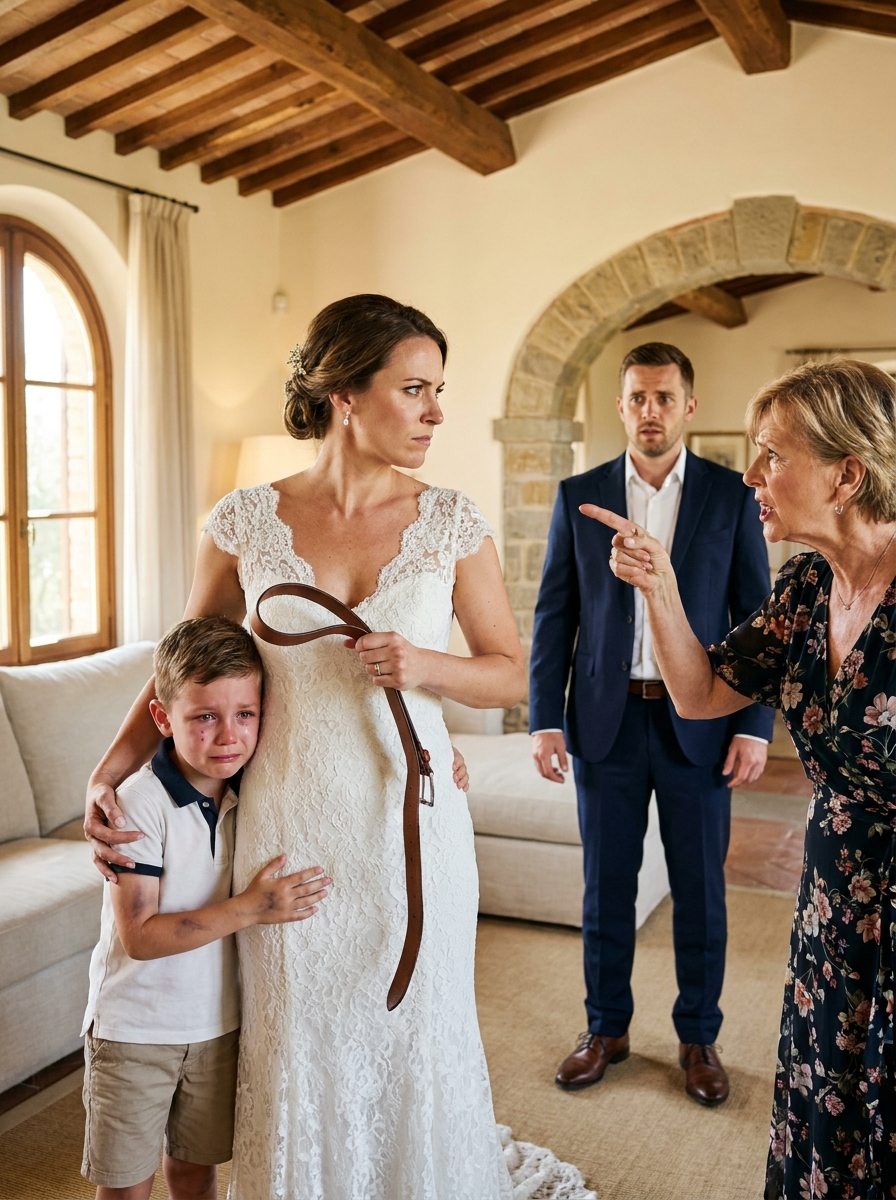
The bride found her husband’s son covered in b:ruis:es on their wedding night and confronted the entire family: “If you touch him again, your money won’t be able to save you”… but the secret behind the punishment was even worse. — Part 2

I made it very clear that, from that second on, any sign of trouble would be reported directly to me and the local police, or I would make sure the school’s funding was the least of their worries.
When I accidentally dropped a potato on the table, I watched in horror as he flinched, raised his arms in a defensive posture, and started stammering apologies.
He looked at me with tears pooling in his eyes and asked, “Did my mother die because I was a bad boy?”
When we returned to the estate, Conrad was waiting for us in the foyer with a legal contract, offering to sign over full parental authority to me, but only if I agreed to relinquish every single one of my financial rights to the marital estate.
I signed the papers without a single moment of hesitation.
“Your son is not a piece of property that you can trade for stocks and bonds,” I told him, tossing the pen aside. “I don’t need a dime of your fortune to keep him safe.”
I then demanded that Toby and I move into the guesthouse at the far edge of the garden, a request Conrad agreed to, even though he warned me his mother wouldn’t sit back and accept this loss of control.
He was right, as she immediately cut off our internet, stopped the staff from delivering food, and ordered the estate manager to sabotage the electricity and appliances in our little cottage.
Yet, in that small, simple space, Toby finally began to smile again, as we cooked meals over a camp stove, watered the garden, and sat down to dinner without the weight of fear looming over us.
One evening, Conrad showed up carrying boxes of groceries and new kitchen appliances, admitting that he had spent his days watching his son’s laughter from afar and felt a deep, gnawing shame.
Toby came down the stairs, hesitated for a long time, and finally offered his father a cookie, which Conrad took with trembling fingers.
It looked like the start of a genuine reconciliation, but the illusion was shattered two days later when Madam Helen stormed into our cottage with her own high-priced legal team.
She slammed bank statements onto our kitchen table and accused me of being “part of a family of con artists,” claiming that my mother had received three million dollars from a company linked to the Wheeler firm years ago, and that if I didn’t return Toby to her, she would press criminal charges against my mother.
I calmly pulled out the medical files, the photographs of the injuries, the doctor’s confession, and a recording of our conversation on the wedding night.
“Go ahead and file your complaint,” I said, meeting her cold, calculating stare. “I’ll be filing mine, and I have much more to lose than just a name.”
Madam Helen’s mask finally slipped, but as she walked out, she leaned in close to my ear and whispered, “You still have no idea who actually killed Toby’s mother.”
Conrad, who had just walked through the door, dropped his keys with a clatter, and in the sudden, suffocating silence of that room, I knew the deepest, darkest secret of the Wheeler family was finally about to surface.
Chapter 3: Facing the Truth
Madam Helen swept out of the house without offering a single shred of context, leaving behind a silence so heavy it felt like the air had been sucked out of the room.
Conrad remained frozen by the door, staring down at the hardwood floor as if he were waiting for the ground to swallow him whole.
“What exactly did your mother mean by that?” I asked, my voice barely above a whisper.
He didn’t answer for a long time, his jaw working as he tried to process the implications.
“Laura died from a sudden infection following a routine surgery,” he said, his eyes unfocused. “That is what I was always told.”
“And who gave you that information, Conrad?”
He closed his eyes tight, a vein throbbing in his temple. “My mother.”
We spent that entire night pouring over the remnants of Laura’s life, going through old digital files, bank receipts, and boxes of documents tucked away in a dusty corner of the main house.
Helen had micromanaged every single detail of the funeral and the estate, and according to the official version of events, Laura had checked into a private clinic for a minor procedure and then suffered an unavoidable, tragic complication.
But the more we dug, the more obvious the discrepancies became.
The surgeon listed on the chart was completely different from the one in the surgery notes, and the time of death didn’t match the hospital billing records at all.
Even worse, we uncovered monthly transfers from the Wheeler construction firm to a mysterious shell company that provided medical services and vanished into thin air just months after Laura’s death.
Conrad slumped into a worn armchair, his face pale. “I was away in the northern territory launching a new infrastructure project,” he murmured, his voice cracking. “My mother told me not to come back, that she would handle everything for me. By the time I arrived, Laura was already gone.”
I looked at him with a mix of white-hot anger and profound pity, realizing he had spent his entire adult life confusing blind obedience with loyalty.
His mother had effectively acted as his brain, his conscience, and his eraser, wiping away anyone or anything that threatened the family’s public image.
The next morning, we tracked down Laura’s former personal driver, a man named Ernesto who had moved to a quiet suburb on the edge of the city.
He was terrified at first, but when I showed him the files detailing Toby’s abuse, he broke down and began to weep.
He told us that “Laura hadn’t been sick at all; she was planning to divorce Conrad and take Toby with her because she had uncovered massive embezzlement schemes within the construction firm.”
She had also gathered ironclad evidence that Helen was bribing government inspectors to sign off on substandard building materials.
A week before she died, Laura had confronted her mother-in-law in a heated argument.
“Madam Helen looked her right in the eye and told her that a woman without a high-profile last name was never going to be allowed to destroy what they had spent a generation building,” Ernesto recalled, his hands shaking. “Then, she ordered me to take her to that specific clinic, and I was too cowardly to stop it.”
“Why did you stay silent for all these years?” Conrad asked, his voice trembling with disbelief.
Ernesto kept his head bowed low. “They threatened to go after my daughters if I breathed a word to anyone, and they paid me to disappear, so I took the money and lived with the shame every day.”
While his testimony didn’t prove a murder charge on its own, it provided the roadmap we needed to blow the lid off the entire cover-up.
We found a retired nurse who had been on shift at that clinic, and she confirmed that Laura was admitted for a procedure that was absolutely not urgent, and that Helen had insisted on moving her to a private suite where she personally ensured no one else saw the patient.
With the evidence stacked high, we finally took everything to the state prosecutor’s office and hired a ruthless, independent attorney who specialized in high-stakes family law.
When Helen caught wind of the formal investigation, she tried to stage a coup at the board meeting, claiming “Conrad was mentally unfit and that I was a gold digger trying to dismantle the family legacy.”
She saved her final, most cruel attack for last.
One morning, while I was driving Toby to his therapy appointment, two social workers appeared at our guesthouse with a warrant, alleging that I was holding the child against his will and that Conrad was being blackmailed.
Helen was banking on our fear, thinking we would crumble under the pressure of a government inquiry.
She was wrong.