
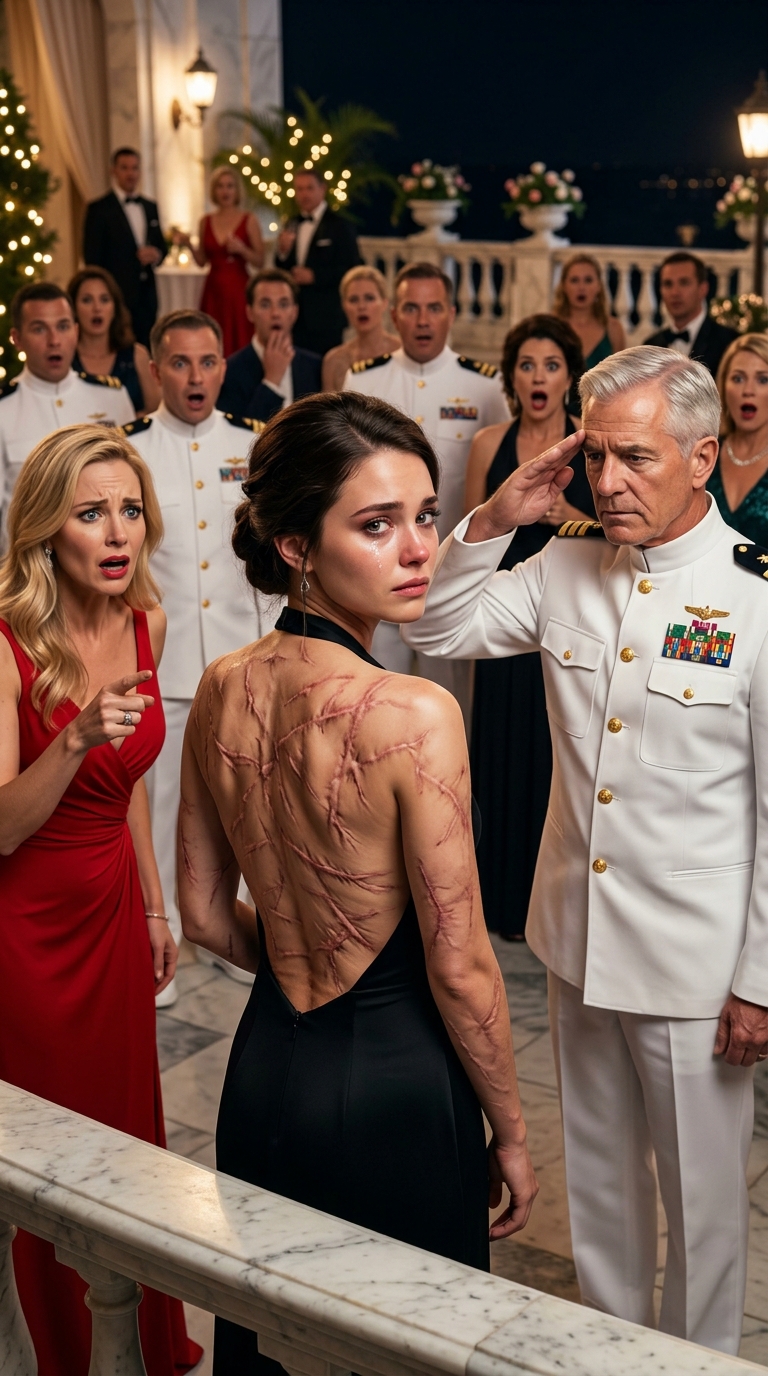
At my father’s luxury retirement party, my sister grabbed my collar and violently tore my shirt open to humiliate me. “L — Part 2

A few of the younger executives chuckled nervously.
“I came to see Father,” I said, my voice steady, devoid of the tremor she was so desperately hoping to hear.
Harper stepped uncomfortably close. The cloying scent of her jasmine perfume was nauseating. “He doesn’t want to see you. Nobody wants you here. You’re an embarrassment, Evie. No husband. No job. Just a head full of crazy conspiracy theories.”
She reached out, her manicured fingers brushing the shoulder of my white blouse. I felt the warning prickle of adrenaline.
“You should have stayed vanished,” she whispered.
And then, with a sudden, vicious yank, she twisted her fist in the collar of my silk blouse and pulled hard.
The sound of the tearing silk was like a gunshot in the elegant room.
The fabric gave way down my back, ripping diagonally from my right shoulder to my left hip. The cool, air-conditioned draft of the ballroom hit my bare skin.
For one frozen, terrible second, even the champagne stopped moving. The string quartet scraped to a discordant halt. Two hundred pairs of eyes locked onto the ruined back of my shirt.
I didn’t scramble to cover myself. I didn’t gasp. I stood perfectly still, letting them look.
Where flawless, pampered skin should have been, there was a violent landscape of destruction. Thick, silvered ridges of keloid scarring crawled across my shoulder blades, crisscrossing over my spine. They were angry, puckered burns—the permanent, indelible receipts of melting steel, burning jet fuel, and a collapsed corridor that smelled of roasting flesh and despair.
Someone in the crowd gasped. A woman dropped her clutch, the metal clasp clattering loudly against the marble floor.
Harper stood behind me, holding the torn scrap of white silk. She laughed. It was a cruel, bright sound. “Look at her,” she announced to the horrified crowd, her diamond bracelet flashing under the chandeliers. “Just scars. Broken and pitiful.”
My father moved. He handed his bourbon to a startled waiter and marched to the edge of the stage. The veneer of the charming patriarch had vanished, replaced by the cold, calculating CEO who handled defective products by burying them.
“Evelyn,” he said, his voice vibrating with a dark, contained fury. “Leave before you embarrass this family further.”
My mother finally looked at me, covered her mouth with a gloved hand, and turned her back. Carter merely smirked, taking a sip of his drink.
I felt the air touch my scars. The sensation dragged my mind backward, violently, to the belly of the Pacific Star.
The emergency bulkheads. Sterling Defense Mark IV doors. They were supposed to seal the fire, starve it of oxygen. Instead, the cheap, altered servos melted in the first three minutes. I remember the heat blistering my skin through my uniform. I remember dragging Petty Officer Miller by his tactical vest, the skin of my own back pressing against a superheated pipe as the corridor collapsed around us. I remember the screams of the thirty-one men and women who were trapped behind doors that my father’s company had promised would hold.
I pulled my mind back to the ballroom. I let the memory of the fire calcify into absolute ice.
I looked up at the stage, meeting my father’s furious stare.
“Are you sure you want me to leave, Arthur?” I asked. The omission of the word ‘Dad’ echoed loudly in the quiet room.
His jaw tightened. “You were never good at threats. Security will escort you out.”
Before the men in dark suits could take a single step toward me, the heavy brass doors at the back of the ballroom swung open with a sound like a thunderclap, stopping every heartbeat in the room.
The atmosphere instantly thickened, the air growing heavy and unbreathable. Every active-duty officer in the room stiffened, their casual postures evaporating into rigid attention. Conversations didn’t just die; they were suffocated.
Admiral Thomas Reed had arrived.
He was a man carved from granite and saltwater, an institution unto himself. He was the Commander of Naval Sea Systems, the man whose single, scrawled signature could make a billion-dollar defense contract materialize or evaporate overnight. He wore his dress whites, the chest heavy with ribbons that told stories of blood, duty, and terrifying competence.
The security guards froze, unsure if they should intercept a four-star admiral.
Reed didn’t look at my father. He didn’t look at the glittering cake or the wealthy donors. He walked straight down the center aisle, his heavy black shoes striking the marble with rhythmic finality.
He stopped exactly three feet in front of me. His weathered face, usually an unreadable mask of command, was tight with raw emotion. He looked at the scars exposed on my back, then met my eyes.
Slowly, deliberately, in front of my father, my cruel sister, and every senator and billionaire who had mocked my existence, Admiral Reed raised his right hand and snapped a flawless, knife-edge salute.
“Captain Sterling,” he said, his voice a low, gravelly rumble that shook the crystal glasses on the tables. “Welcome home.”
The ballroom went dead quiet. It was the kind of silence that follows a bomb drop, the vacuum of sound before the shockwave hits.
Harper’s smile vanished first. The color drained from her face, leaving her chalky and hollowed out beneath her expensive makeup.
On the stage, my father’s hand twitched. The crystal bourbon glass he had just retrieved from the waiter slipped through his numb fingers. It hit the floor, shattering into a hundred glittering pieces at his expensive leather shoes.
“Captain?” someone whispered in the back.
I held Reed’s gaze. I raised my own hand, ignoring the agonizing pull of the scar tissue across my shoulder blade, and returned the salute.
“Thank you, Admiral,” I said quietly.
He lowered his hand. The officers in the room remained at rigid attention, their eyes darting between me and the stage in profound confusion.
Harper stared at me as if I had suddenly grown a second head. The reality of the situation was violently rejecting the narrative she had built her entire life upon. “That’s impossible,” she stammered, her voice shrill and panicked. “She didn’t even finish college. She had a breakdown!”
“I finished at sea,” I replied, turning my head just enough to look at her.
My father finally moved. He stepped off the stage, practically shoving a waiter out of his way. His charming smile was plastered back onto his face, but it was a gruesome, desperate imitation of a smile.
“Admiral Reed,” my father said, his voice overly hearty, projecting across the room. “I’m sure there’s been a massive misunderstanding here. My daughter… Evelyn has always had a flair for drama. She’s been unwell.”
Reed turned his head slowly. He looked at Arthur Sterling the way a man looks at a maggot writhing on a piece of rotting meat.
“There is no misunderstanding, Mr. Sterling,” Reed said, his voice carrying the weight of an ocean. “Your daughter commanded a classified maritime recovery unit for the past four years. She led the final sweep of the Pacific Star wreckage. She personally saved thirty-one sailors from the engineering bay before it went under.”
The murmurs erupted into outright gasps.
The Pacific Star wasn’t just a ship; it was a national tragedy. Five years ago, a Navy supply vessel burned for seven agonizing hours after its emergency suppression systems failed. My father’s company, Sterling Defense, had supplied those exact systems.
My father closed the distance between us. He reached out and grabbed my bare arm. His fingers dug into my bicep, hard enough to leave deep, purple bruises. The scent of bourbon and panic washed over me.
“You will not ruin this night,” he hissed through gritted teeth, his back to the crowd so only I could see the absolute murder in his eyes.
I didn’t flinch. I looked down at his white-knuckled grip on my arm. “Remove it,” I commanded.
He hesitated, his eyes flashing with the old, tyrannical dominance. But I was no longer a child. I was a Captain. For the first time in my entire life, my father obeyed. He slowly opened his hand and let his arm drop.
As he stepped back, he glanced toward the foyer. Through the glass panels of the main entrance, the red and blue strobes of federal vehicles were silently reflecting off the polished marble. The FBI had arrived.
I saw the exact moment Arthur Sterling realized he could not buy his way out of this room. The mask didn’t just slip; it shattered.
He didn’t surrender. Men like him never do. They escalate.
My father’s hand shot into his tuxedo jacket. He pulled out a small, encrypted communication device and pressed a single button. He looked up, making eye contact with the chief of his private mercenary security detail—a broad-shouldered ex-contractor named Vance who stood by the east wing doors.
Vance nodded.
Suddenly, the heavy, motorized steel shutters designed for hurricane protection began to slide down over the floor-to-ceiling windows with a mechanized grind. The main brass doors slammed shut, and the heavy deadbolts engaged with a sharp clack.
Guests gasped. Several people pulled out their phones, only to stare in horror at the screens.
“No signal,” a senator muttered loudly, his voice cracking. “Cell service is dead. What the hell is going on, Arthur?”
My father backed up onto the first step of the stage. He smoothed his jacket, though his hands were trembling. He had fifty armed, private security personnel in the room, and he had just taken two hundred of the most powerful people in Washington hostage.
“Nobody is leaving,” my father announced, his voice echoing coldly in the sealed room. “Admiral Reed, you and I are going to have a private conversation about my daughter’s state of mind. Vance, if anyone touches those doors, break their legs.”
The ballroom erupted into chaos, then fell into a terrified, suffocating silence as Vance and his heavily armed team drew their batons and unholstered their sidearms, forming a perimeter. The elite guests—senators, billionaires, media moguls—huddled together, the expensive champagne forgotten on the floor.
Admiral Reed did not blink. He stood beside me, a monolith of naval authority facing down a corporate warlord. “You are compounding treason with terrorism, Arthur. Open those doors. The FBI is already in the lobby.”
“They can’t breach hurricane shutters without heavy explosives, and they won’t risk the VIPs in this room,” my father sneered, his confidence returning as the adrenaline took hold. He pointed a finger at me. “Give me whatever files she brought you. Give me the drive, Thomas, and I will let you all walk out of here with a generous donation to the widows’ fund. If not, we stay here until my lawyers dismantle whatever fairy tale my deranged daughter has spun.”
He thought he had time. He thought a lockdown would force a negotiation.
I stepped past the Admiral. The torn silk of my shirt fluttered against my scarred back. I walked straight to the podium on the stage, where the projector was connected to a master laptop meant to display my father’s glowing career retrospective.
“Step away from the console, Evelyn,” my father warned, gesturing to Vance, who took a threatening step forward.
I ignored him. I reached into my pocket, pulled out a small, encrypted black flash drive, and jammed it into the port.
My fingers flew across the keyboard. I bypassed the gala slideshow and executed a master script I had written three nights ago in the belly of a submarine.
The twenty-foot screen behind the stage flickered, then flared to life. It didn’t show my father’s face. It showed a stark, glaring digital clock.
03:00.
02:59.
02:58.
“What is that?” Harper demanded, her voice shrill, clutching her brother Carter’s arm.
I turned around to face my family and the trapped audience.
“That is a dead man’s switch,” I said clearly. “In exactly two minutes and fifty seconds, this drive will autonomously transmit four terabytes of data. It contains every original safety report for the Pacific Star. Every falsified test result. Every offshore bank transfer. Every audio recording of Arthur Sterling bribing the naval auditors.”