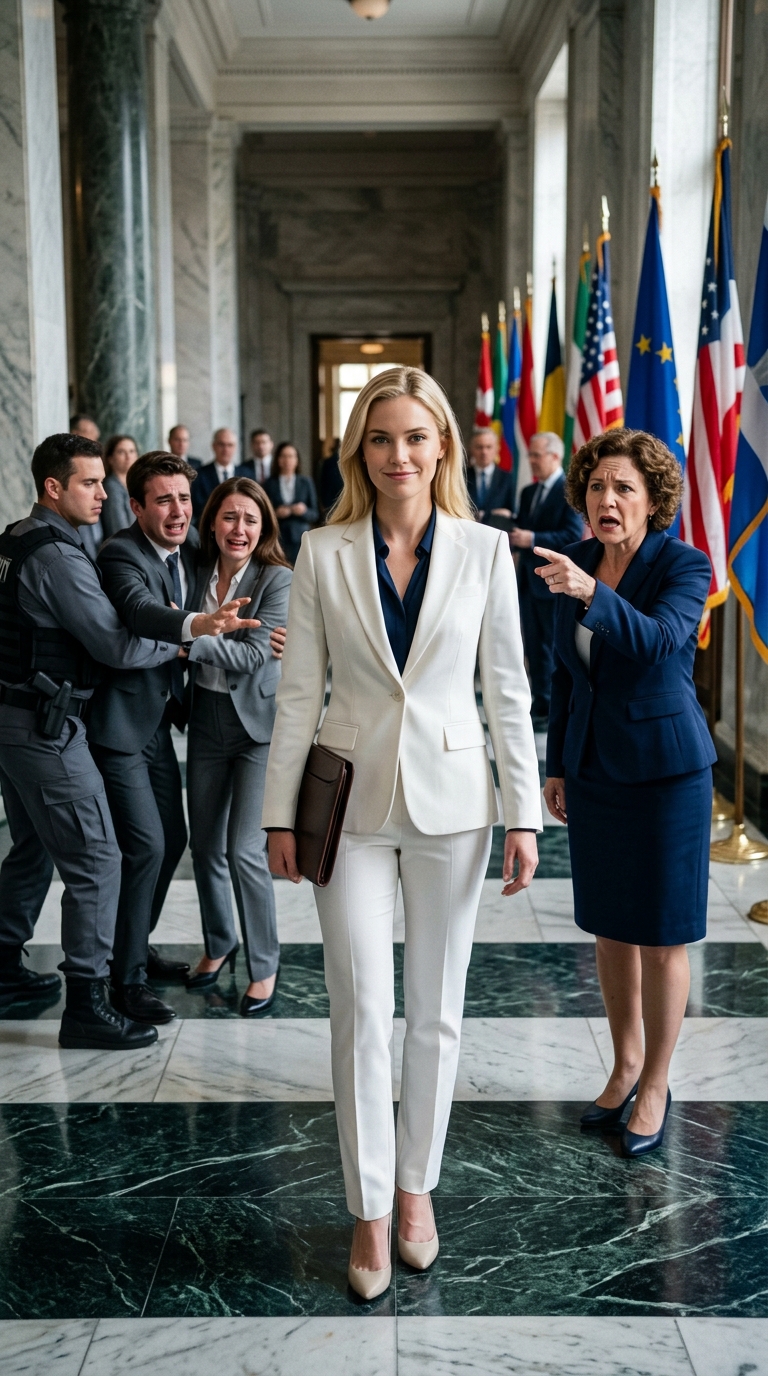
Rebecca turned toward me, her automatic, camera-ready political smile firmly in place. “Dr. Mitchell, thank you so much for—”
She stopped dead.
The smile didn’t just fade; it violently shattered. The color rapidly drained from her cheeks, leaving her looking almost ghostly under the harsh exhibit lights. “Mitchell,” she breathed, the word barely a whisper. “Sarah… Mitchell? As in Derek’s sister?”
“Yes,” I said, my expression an unreadable mask of polite authority.
The silence that crashed down upon the group was absolute and deafening.
Tom Bradford looked wildly confused. The press liaison slowly lowered her camera, acutely aware that the political optics had just drastically shifted.
“I didn’t realize,” Rebecca stammered, her legendary composure fracturing. “Derek said you worked at a museum.”
“He didn’t mention that I run it,” I finished for her, my voice laced with cold steel. “He doesn’t actually know what I do here.”
I turned on my heel and ruthlessly led them through the museum, systematically dismantling the “gift shop” narrative with every step. I detailed our overarching institutional mission, our 145 million biological specimens, and the secure research facilities where hundreds of world-class scientists conducted groundbreaking work.
In the Ocean Hall, I looked directly at Rebecca. “We are a premier research institution. My scientists publish over six hundred peer-reviewed academic papers annually. I actively advise Congress on environmental policy and cultural preservation, and I recently testified before the House Appropriations Committee.”
Rebecca visibly flinched as if I had struck her.
By the time we reached my expansive corner office suite on the third floor, with its sweeping, unobstructed view of the National Mall and the framed National Medal of Arts sitting squarely on my mahogany desk, Rebecca looked entirely shell-shocked.
Suddenly, my assistant Jennifer knocked sharply and entered. “Dr. Mitchell, apologies. The Secretary’s office urgently needs your final sign-off on the French delegation’s security request. Also, the Director of the Louvre is asking for a pre-summit phone call this afternoon.”
Rebecca watched the exchange with mounting horror. “The Director of the Louvre,” she repeated, her voice hollow.
An agonizing, suffocating tension settled over the room. Rebecca turned to her staff, genuine distress swimming in her dark eyes. “Could we have a moment?” she asked Tom, her voice shaking. “Alone.”
The moment the heavy oak door clicked shut, Rebecca collapsed heavily into a leather guest chair, burying her face in her hands. “Derek told me you worked in a gift shop.
He explicitly uninvited you from New Year’s Eve because you weren’t at the ‘right level’ to socialize with my colleagues. Half the people in my living room that night write federal cultural policy. They would have drawn blood to get a private meeting with you.”
“Derek constructed a narrative about me that makes him comfortable,” I said quietly, taking my seat behind the massive desk. “I stopped trying to shatter that illusion years ago.”
Rebecca stood up, pacing like a caged animal. The political titan returned, her jaw locked in absolute determination. “I need to make a phone call. May I use a private space?”
I pointed her to the secure conference room down the hall.
Twenty agonizing minutes later, the door opened. Rebecca walked slowly back into my office. Her eyes were red-rimmed, her makeup slightly smudged, but her expression was carved from stone.
“I called Derek,” she said, her voice entirely devoid of emotion. “I asked him, point blank, what his sister does for a living. He laughed and said you worked ticketing. I asked him if he had ever bothered to look at your professional bio. He told me he didn’t need to.”
She let out a harsh, bitter laugh that sent a chill straight down my spine, looking me dead in the eye as she delivered the final, catastrophic blow.
“I told him the wedding is postponed.”
“You don’t have to do that,” I said automatically, the ingrained instinct to protect my brother surfacing despite the sharp ache in my chest.
“Yes, I do, Sarah,” Rebecca fired back, pacing the expanse of my office. “I am a United States Congresswoman. I campaign on shattering glass ceilings. I cannot stand on a podium and preach empowerment while privately marrying a man who aggressively diminishes his brilliant sister simply because her staggering success threatens his fragile ego. The wedding is postponed.”
She left me alone in the creeping twilight of my executive suite. The silence felt heavy, charged with the electric static of an impending storm. The remainder of my day was a high-velocity blur of diplomatic crisis management. A senior Japanese delegate fell ill; the British director threw a territorial tantrum. I functioned purely on adrenaline and muscle memory, burying the familial debris beneath my professional armor.
At exactly 7:00 p.m., my assistant Jennifer buzzed my line, her voice trembling slightly. “Derek is down in the main lobby. He bypassed security and is loudly demanding to see you.”
Before I could instruct her to call the guards, my heavy oak door violently slammed open. Derek stood in the threshold, looking entirely unhinged. His expensive silk tie was yanked loose, his hair a chaotic mess, his eyes wide and wild. He had clearly sprinted all the way from his law firm.
“Sarah, what the hell did you do?!” he yelled, slamming the door shut behind him. “Rebecca called me in the middle of a partner meeting and postponed the wedding! She said it was because of you!”
“It is entirely because of you,” I replied, standing up slowly, planting my palms flat against the cool mahogany of my desk. “Because you do not know a single, solitary thing about my life.”
“That’s ridiculous! You work at a museum! You do museum stuff! What did you tell her?!”
Four years of violently suppressed rage finally shattered the dam. “I am the Executive Director, Derek. I run this entire institution. I command a staff of over a thousand people. I manage a budget larger than the GDP of some small nations. I dictate international cultural policy. Two years ago, I received the National Medal of Arts directly from the President of the United States. You were formally invited. You didn’t even bother to show up.”
He froze. The arrogant, untouchable lawyer vanished instantly, replaced by a man who looked as though he had just been struck by a falling steel beam. His eyes finally, truly scanned the massive room—the priceless artifacts, the presidential photograph, the terrifying scale of the corner office.
“You never explicitly told me you were in charge,” he whispered, his voice hollowing out.
“I explicitly told you four years ago! You patted my shoulder and called me a ‘manager’!”
He sank heavily into a leather chair, aggressively rubbing his face. “You were always the undisputed genius,” he confessed, his voice breaking into a rough rasp. “I subconsciously needed you to be less successful to feel secure about my own ruthless, soul-sucking career. I’m so sorry, Sarah.”
The raw, ugly honesty caught me entirely off guard. The anger drained away, leaving a profound, aching exhaustion. “You could learn,” I said quietly. “You could actually try to understand.”
He looked up, tears gleaming in his eyes under the fluorescent lights. “Tell me about tomorrow night. The global summit. Can I come? I need to see what I’ve been blinding myself to.”
I agreed to clear his name with the State Department. He left, looking broken and entirely humbled. But just as the room settled into silence, my private, secured emergency line began to ring with an aggressive shrill. The caller ID flashed a classified restricted number I recognized instantly from the summit threat matrix. The night wasn’t over; the real sabotage was just beginning.
The restricted call turned out to be a minor diplomatic security scare, quickly resolved by my team, but it kept my nerves frayed as I walked into the National Gallery of Art the following evening. The International Museum Directors Summit opening reception was held under the West Building’s legendary, soaring marble rotunda. Two hundred elite guests—foreign cultural ministers, global ambassadors, and powerful congressional representatives—gathered under the dome.
I wore a severe, floor-length midnight-blue gown, my armor for the night. As the host, I orchestrated the room, brokering high-stakes introductions and bridging tense international divides with practiced grace.
At 7:00 p.m., the heavy bronze doors opened. Rebecca arrived in a stunning crimson dress, radiating political power. Walking half a step behind her, looking utterly terrified in a sharp tuxedo, was Derek.
They approached me during a brief lull. “Dr. Mitchell,” Rebecca smiled, a wicked, triumphant spark in her eyes.
Derek stared at me as if I were a mythological creature. “Sarah,” he breathed, his voice thick with emotion. “I read everything. Your entire Yale dissertation, the congressional testimonies, your published book. I spent six hours reading. I am a colossal, arrogant idiot. You are literally shaping the world while I bill hours for corporate mergers.”
“Your work has value too, Derek,” I offered gently.
He shook his head, gesturing wildly to the elite crowd. “These people flew across oceans because you commanded them to. Because they respect you.”
Before I could reply, the Secretary called me to the stage. I walked up the marble steps, the room falling into a heavy, expectant silence. I spoke passionately for eight minutes about preserving humanity’s collective soul and navigating global crises through art. When I finished, the applause was deafening. I caught Derek’s wide, tear-filled eyes in the second row.
Later that night, as the crowd thinned out, Derek and I stood alone beneath a massive Monet painting. “Can we start over?” he asked, his voice entirely stripped of its usual bravado. “Can I actually learn who my sister is?”
“It has to be real, Derek. You have to be present.”
“I am. Starting right now.”
Over the next three months, he kept his word. He attended my public lectures, asked brilliant questions, and fundamentally changed the toxic dynamic of his relationship with Rebecca.
Then, on a rainy Saturday afternoon, my phone rang.
“Sarah, I just got off the phone with Mom,” Derek said, his voice crackling with static. “I told her exactly what you do. The medals, the global summits, everything.”
“How did she react?” A cold knot of anxiety formed in my stomach.
“She cried. She said she had absolutely no idea. She asked for your private number, Sarah. She wants to fly down to D.C. next week. She wants to finally see her daughter.”
I closed my eyes, leaning my forehead against the cool glass of my apartment window. Decades of heavy, suffocating exhaustion finally began to drain away into the rain-slicked city below. I had spent my entire life building a massive empire just to prove my worth to a family that wasn’t looking. But standing there, I realized what I had wanted all along was terrifyingly simple.
I just wanted to be seen. And finally, they were opening their eyes.
If you want more stories like this, or if you’d like to share your thoughts about what you would have done in my situation, I’d love to hear from you. Your perspective helps these stories reach more people, so don’t be shy about commenting or sharing.
✅ End of story — Part 3 of 3
← Read from Part 1