We changed passwords. Removed secondary access. Added alerts. Discussed opening a separate account at another institution if necessary. By the time I left the bank, I felt lighter. Not happy. Not yet. But lighter, as if I had set down a suitcase I had been carrying so long I had forgotten it was not part of my body.
When I turned onto my street, I saw three cars parked in front of my house.
My relief vanished.
Max’s car. Lena’s car. A third car I did not recognize.
Movement shifted behind my front windows.
For a moment, I sat in the driver’s seat with both hands on the wheel.
They had keys. Of course they did. I had given them keys because mothers give keys to their children and call it trust. I had imagined Max using his if I fell, if I got sick, if a pipe burst while I was away. I had not imagined him letting himself in with his wife and a stranger because I had stopped funding his life.
I took a deep breath and got out.
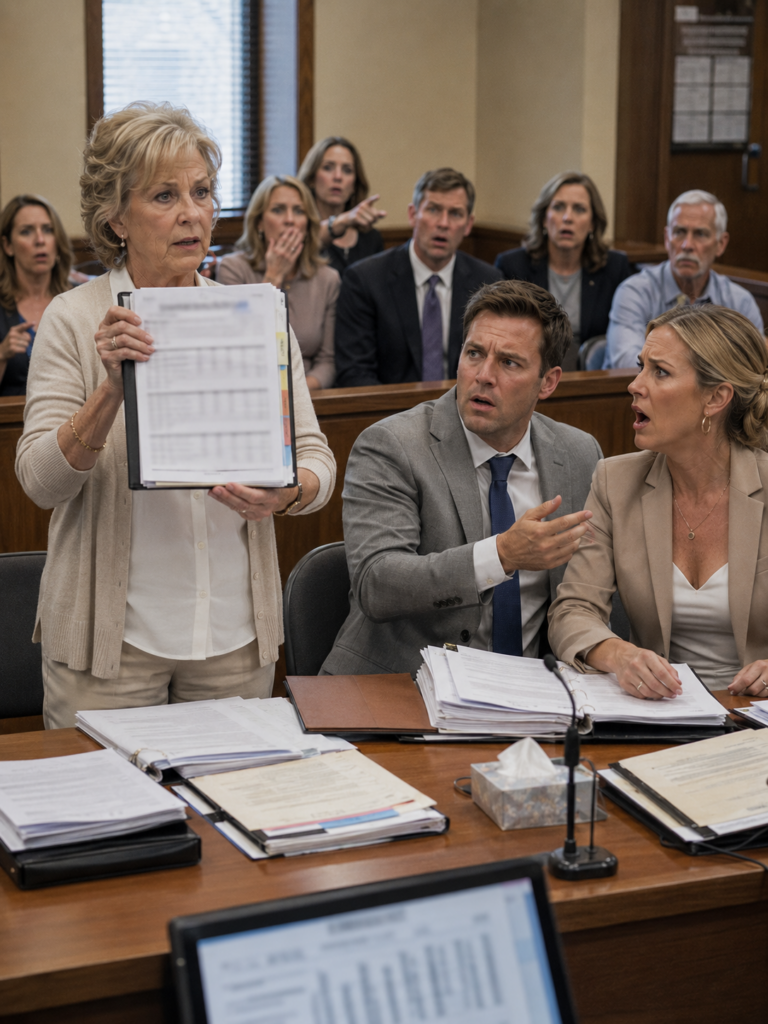
When I opened my front door, I found Max sitting on my sofa with his elbows on his knees and his head in his hands. Lena paced near the fireplace like an actress rehearsing a crisis. At my dining table sat an older man in a gray suit, going through a stack of papers.
My papers.
Bank statements. Insurance documents. Medical bills. Private correspondence. The yellow legal pad on which I had written the $33,400 total.
“What is happening here?” I asked.
All three looked up as if I were the intruder.
Lena rushed toward me. “Renate, thank God. We need to talk.”
I looked past her to the stranger at my table. “Who is he?”
The man rose, extending a hand. “Mrs. Richter, I’m Dr. Fischer, a family law attorney.
Your children asked me to come because they’re concerned about your situation.”
I did not take his hand.
“My children?” I said.
Lena’s mouth tightened. “Max and I are your family.”
“My situation,” I repeated. “What situation?”
Max finally lifted his head. He looked awful, but not in the way grief makes a person awful. He looked panicked, cornered, inconvenienced. “Mom, we went to the bank. Mr. Klein said you canceled the transfers and removed access protections. We don’t understand why you’d do something so sudden.”
“You don’t understand why I stopped paying rent for people who didn’t invite me to their wedding?”
Lena flinched, then recovered. “This isn’t about the wedding.”
“No,” I said. “To you, it’s about rent.”
Dr. Fischer stepped forward with the smooth confidence of a man who made a living turning other people’s crises into paperwork. “Mrs. Richter, abrupt changes in financial behavior can sometimes indicate stress, confusion, or cognitive decline, especially when accompanied by social withdrawal and hostility toward close family members.”
The word confusion rang in the room like an alarm bell.
Now I understood.
They had not come to apologize. They had not come to talk.
They had come with a lawyer to suggest I was mentally incompetent.
Lena softened her face into something that might have fooled me a month earlier. “Renate, honey, we’re worried about you. You’ve been under so much stress. The loneliness, your age, all these financial decisions. We think maybe you need professional help.”
“At my age,” I said.
She reached for my hand. I stepped back.
“I am not confused,” I said clearly. “I am clearer than I have been in years. And you are going to leave my house right now.”
Max stood. “Mom, don’t be unreasonable.”
“There is that word again.”
“We have obligations. The rent. The car payments. The credit card you co-signed for. You can’t just cut us off overnight.”
“I can,” I said. “I did.”
His face hardened, and in that instant I saw not my little boy but a thirty-five-year-old man furious that the appliance he depended on had developed a will.
Dr. Fischer opened a folder and placed it on my dining table. “Mrs. Richter, we prepared documents that could make this transition easier. A power of attorney would allow Max and Lena to manage your finances temporarily while you recover from this stressful episode.”
I picked up the folder without opening it.
Then I walked to the kitchen trash can and dropped it inside.
“The only transition happening today,” I said, “is yours to the front door.”
Lena began to cry.
I had seen those tears before. They arrived exactly when useful. Not one second earlier. Not one second later.
“You can’t do this to us,” she said. “We were counting on you. We made plans based on your support. We took on obligations because we knew we could count on you.”
“Obligations based on my money,” I said. “Not my happiness. Not my well-being. Not my presence in your lives. My money.”
Max took one step toward me. “Mom, the wedding was a mistake. Lena was nervous. I was under pressure. We can fix that if you just become reasonable again.”
“Reasonable means paying your rent after being told I am not special enough to see you married?”
He looked away.
For the first time, guilt crossed his face, but it did not stay long enough to become courage.
Dr. Fischer gathered his papers with stiff efficiency. “Mrs. Richter, this is not over. If your family believes you are making irrational financial decisions due to declining mental capacity, they have legal options.”
I turned to him. “Mr. Fischer, I suggest you do careful research before threatening a seventy-one-year-old woman who managed household finances for forty years, raised her son alone after her husband died, worked until retirement, owns her home outright, pays every bill on time, and until last week financially supported two able-bodied adults who apparently cannot afford their own lives.”
Lena’s tears stopped.
There she was.
Cold. Angry. Real.
“Everything you have will belong to Max one day anyway,” she said. “We’re just trying to make sure it’s managed responsibly.”
There it was. The naked truth beneath all the sweet voices and second-mom lies.
In their minds, I was already dead. My bank account was an inheritance delayed by the inconvenient fact that I was still breathing.
“Out,” I said.
Max stared at me. “Mom, this is going to end badly for you.”
I looked at my son, and I felt sadness so deep it seemed to pass through anger and come out the other side as calm.
“I am already alone, Max,” I said. “The difference is that now it’s by my choice, not by your neglect.”
When the door closed behind them, I stood in my living room surrounded by the silence they left behind.
It was the most beautiful sound I had heard in years.
I did not sleep that night, but not because I regretted anything. Adrenaline moved through me like electricity. If Max and Lena wanted a battle, I needed a plan. Not tears. Not pleading. Not long messages explaining my pain to people who had already calculated its value and found it lower than rent. I needed facts, documents, lawyers, locks, witnesses, and a record.
At six the next morning, I was dressed and ready.
My first stop was the office of Martin Weber, the attorney who had helped me years earlier when Robert died and I had to settle his small estate. Mr. Weber was not charming like Dr. Fischer. He did not use soft words to disguise hard motives. He was practical, exact, and known in our county for protecting older clients from predatory relatives, dishonest caregivers, and “helpful” family members who developed sudden concern once money was involved.
He listened as I told him everything. The secret wedding. The special people remark. The years of payments. The rent call. The bank cancellations. The lawyer in my house. The power of attorney. The threat of guardianship.
When I finished, Mr. Weber leaned back in his chair and removed his glasses.
“Mrs. Richter,” he said, “what you are describing is elder financial abuse.”
The phrase hit me strangely. Abuse was a word I associated with bruises, shouting, locked doors, dramatic things that happened in other people’s lives. But Mr. Weber’s face told me not to minimize it.
“It can be emotional, financial, legal, or all three,” he continued. “They have been dependent on your money, and when you withdrew access, they immediately attempted to question your capacity and obtain financial control. That is serious.”
“I thought maybe I was overreacting.”
“You are underreacting.”
For three hours, we reviewed my records. Every transfer. Every gift. Every expense. He whistled softly when he saw the total.
“Thirty-three thousand four hundred dollars in three years,” he said. “That is not occasional help. That is financial support.”
He made copies. He created a file. He advised me to change the locks immediately, install security cameras, open a new account at a different bank, update my will, and document every contact from Max and Lena. He also warned me that people willing to bring a lawyer to my house might not stop after one failed attempt.
“They may escalate,” he said. “Do not meet them alone again. Do not sign anything. Do not allow them into your home. If they come without permission, call me and call the police.”
Leaving his office, I felt both frightened and steadier. Fear is easier to carry when it has a name.
I drove to Summers Hardware, a store I had visited countless times over the years, usually because something had broken in Max and Lena’s apartment. Mr. Summers himself was behind the counter, a broad man with silver hair and kind eyes.
“Mrs. Richter,” he said. “Another emergency for your son?”
“No,” I said. “This time, it’s for my own house. I need the best locks you have.”
His eyebrows rose, but he did not pry. His son Ethan, who installed security systems, happened to come in from the back while I was choosing deadbolts.
“Ethan,” I said, surprising myself with how decisive I sounded, “I need cameras. Front door, back door, driveway, maybe the side entrance too. A complete system.”
“The price can climb,” he warned gently.
“The price is not the issue anymore.”
While Mr. Summers prepared the locks and Ethan scheduled installation for the next morning, my phone rang from an unknown number. I almost ignored it, then answered because I wanted to know how quickly the next performance would begin.
“Renate,” Lena said. “Please don’t hang up.”
“You have one minute.”
“We need to talk like civilized adults. I understand you’re upset about the wedding. It was a mistake. Max and I talked, and we want to make it up to you. Maybe we could have a special dinner at your house. Cook together like we used to.”
Like we used to. We had never cooked together. I had cooked. She had eaten or criticized seasoning.
“How much rent do you owe exactly?” I asked.
Silence.
“Lena?”
“Two months,” she admitted. “One thousand dollars. But that’s not why I’m calling.”
“It is exactly why you’re calling.”
“We love you, Renate.”
“When was the last time you called me without needing money?”
She said nothing.
“Not texted to ask about a transfer. Not dropped by because you needed groceries. Called to ask how I was.”
Still nothing.
“Goodbye, Lena.”
I hung up and turned off the phone.
Then I did something so small and ordinary that it felt revolutionary. I went to the beauty salon.
Cynthia, my stylist, looked up in surprise when I entered. “Mrs. Richter! I thought you had forgotten us.”
“I didn’t forget,” I said. “I forgot I deserved to be here.”
I asked for a cut, color, manicure, and pedicure. The full treatment. For the first time in years, I spent money on myself without mentally subtracting it from someone else’s emergency. As Cynthia worked, she chatted about her children, her garden, the terrible parking downtown, and a new restaurant she liked. No one asked me for rent. No one mentioned overdue bills. No one made my presence feel like a delay before the real request.
When she finished, she turned the chair toward the mirror. My hair was shaped softly around my face, the gray blended into warm silver-brown, my nails neat and pale pink.
“You look beautiful,” Cynthia said. “But more than that, you look free.”
“Something good happened,” I said.
“What?”
“I learned to say no.”
When I returned home, a woman I barely recognized was sitting on my porch steps holding a covered mug.
My heart jumped, but she rose with a friendly awkwardness. “Mrs. Richter? I’m Eleanor Brooks. I live next door. We’ve waved for years, but I don’t think we’ve ever properly talked.”
“Oh,” I said, relaxing slightly. “Of course. Hello.”
“I heard raised voices yesterday,” she said. “I didn’t want to intrude, but I wanted to make sure you were all right.”
The concern in her voice nearly undid me.
Here was a neighbor who had no claim on me, no financial interest, no wedding to explain, no rent to ask for, and she had noticed I might be in trouble.
“Come in,” I said. “I’ll make coffee.”
By the time the coffee was poured, the whole story came out. Eleanor listened with the stillness of a woman who recognized familiar weather. She was seventy-three, widowed, with soft white hair, clear eyes, and a spine made of steel beneath her floral blouse. When I finished, she covered my hand with hers.
“I went through something similar with my daughter,” she said.
“You?”
“Oh, yes. For years, I believed if I stopped helping, she would stop loving me. Then one day I realized she had already stopped loving me in any way that didn’t include my checkbook.”
“What happened?”
“I cut her off. It was awful at first. Tears, accusations, threats, guilt. But after six months, she got a second job, her husband stopped golfing every weekend, and eventually she called me with an apology that did not include an invoice.”
I smiled despite everything.
“Do you think Max will understand one day?”
“Maybe,” Eleanor said honestly. “Maybe not. But that is no longer your responsibility. Your responsibility now is to live your own life.”
The next morning, Ethan and Mr. Summers came to change the locks and install the security system. While they worked, my phone lit up repeatedly with calls from unknown numbers. Lena was trying every route back to me. I ignored them all.
The irony was not lost on me: at seventy-one, I was installing cameras and changing deadbolts to protect myself from my only child. But the act did not feel as tragic as it should have. It felt practical. I had spent decades mistaking exposure for love. Now I was learning that privacy could be a form of dignity.
While Ethan mounted a camera over the front door, I called Diana in Chicago.
“Renate?” she answered, startled. “Is everything all right?”
“No,” I said. “But I think it will be.”
I told her everything. Unlike Lena, Diana did not interrupt. Unlike Max, she did not defend the indefensible. When I finished, she sighed so deeply I could hear years in it.
“Sister,” she said, “it was about time.”
I blinked. “What?”
“Every time we talked, it broke my heart to hear you brag about how much you gave them, as if love could be proven with receipts.”
“Why didn’t you say anything?”
“Because you weren’t ready to hear it. And because when people are buying love, they defend the purchase.”
Her words hurt, but not cruelly. They hurt like disinfectant.
“There’s something else,” Diana said. “At family gatherings, Max never talked about you like a mother. It was always, ‘Mom helped with this,’ or ‘Mom bought that,’ or ‘Mom covered this.’ Not ‘I miss Mom.’ Not ‘I should visit Mom.’ Lena was worse. She spoke about you in future tense.”
“What does that mean?”
“When Renate is gone, we can remodel. When we inherit, we’ll invest. When the house is ours. That sort of thing.”
I sat down slowly.
They had not merely used me. They had been waiting past me.
After we hung up, I remained at the kitchen table for a long time, letting reality settle. Then Eleanor rang the bell and handed me a mug of coffee she had brought from her house.
“I thought you might need company,” she said.
We sat in the living room while workers moved in and out with tools. Eleanor told me more about her daughter, about the emotional manipulation handbook no one publishes but everyone seems to read.
“Chapter one,” she said, “make her feel indispensable. Chapter two, create constant emergencies. Chapter three, when she resists, question her sanity.”
I laughed, bitterly but genuinely.
That afternoon, for the first time in months, I visited Robert’s grave.
The cemetery was quiet. His stone needed cleaning, and the flowers in the small vase had withered. I knelt slowly, joints protesting, and brushed away dirt and leaves.
“Robert,” I whispered, “I think I lost myself for a while.”
The wind moved softly through the trees.
“After you died, I put everything into Max. I thought if I gave him enough, loved him enough, supported him enough, he would never feel the loss the way I did. But somewhere along the way, I disappeared. And the money you left so I could live peacefully went to people who didn’t respect me enough to invite me to their wedding.”
I cried there, beside my husband’s grave, but not as helplessly as before. I cried like a woman reporting back to the one person who would have seen the truth sooner than she did.
“I’m done now,” I told him. “I’m sorry it took me so long.”
When I returned home, three cars were parked in front of my house again.
My body reacted before my mind did: heart racing, palms sweating, breath tightening. But this time, I did not get out of the car. I opened the security app Ethan had just installed and saw Max, Lena, and two people I did not recognize standing on my porch, gesturing angrily toward the door.
I called Mr. Weber.
“They’re at my house again,” I said. “They brought people.”
“Stay in your car,” he replied. “I’m on my way. I’m also calling the police. The temporary notice I filed this morning is enough to warn them off the property.”
Within minutes, Mr. Weber arrived, followed by two patrol cars. I watched from behind my windshield as officers spoke to Max and Lena. Max gestured wildly. Lena cried. One of the strangers argued until an officer pointed toward the street. When I finally stepped from my car, Max shouted from the sidewalk.