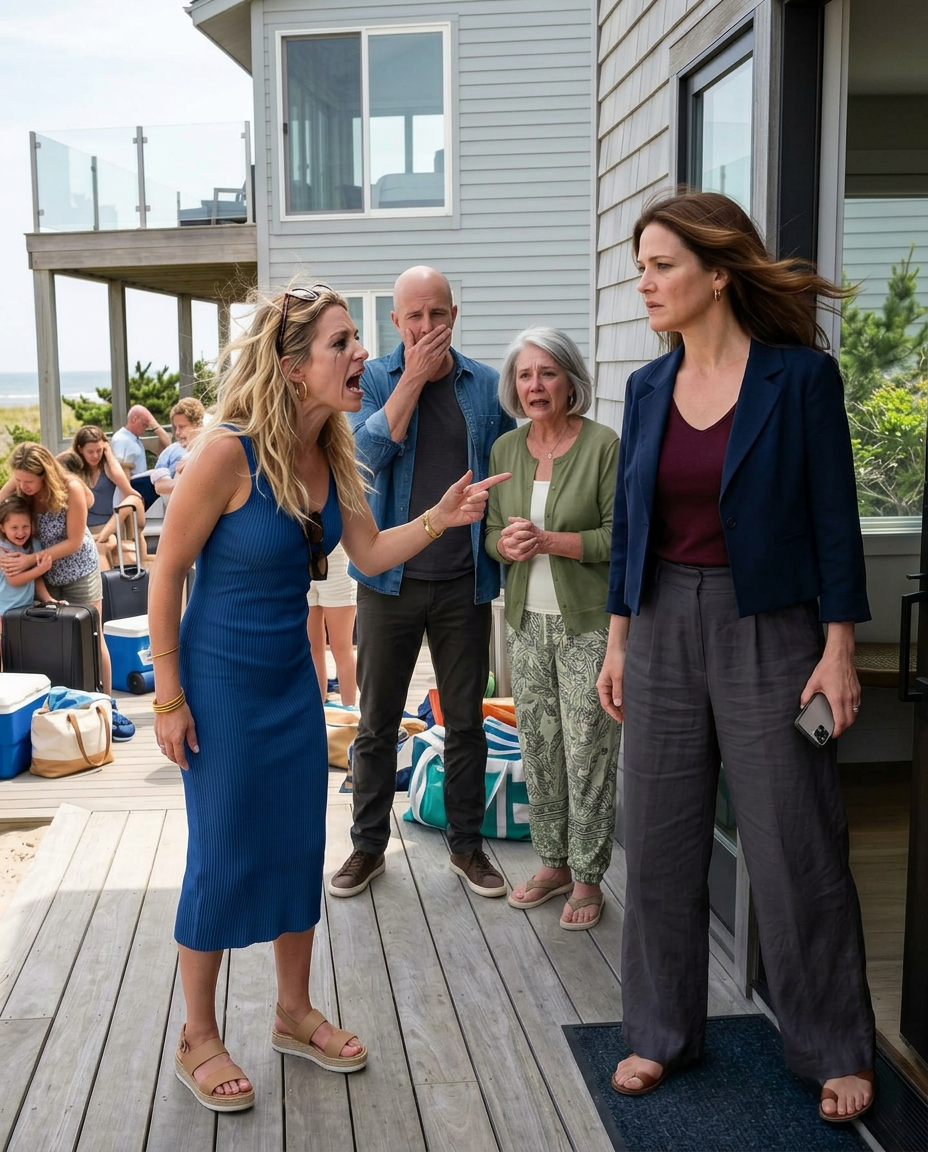
From the hotel lobby, I watched her knock, wave her phone around, and smile at Greg’s relatives like a woman trying to sell a property she did not own. Children spilled out of cars and raced toward the dunes. A teenage boy kicked off his sandals and dropped a backpack in my flower bed. Someone’s uncle opened a cooler and began handing out cans of soda.
Then Greg came up beside her, his face flushed red.
The camera microphone picked up his voice clearly.
“Marissa, what is going on?”
“She’s being difficult,” Marissa said.
“She knew we were coming?”
“She knew.”
That was when I opened the saved folder on my phone.
For years, I had deleted proof because I thought keeping it made me petty.
Screenshots of Marissa demanding money. Text messages where she called me useless, bitter, jealous. Voicemails where she cried until I paid for problems I had not caused. But after Mom died, I stopped deleting. I began saving.
Not for revenge. For memory.
And now, for clarity.
I sent Greg one screenshot.
It was from three days earlier.
Marissa: You don’t need to ask Claire. She never says no to me for real. I’ll handle her. Just tell your family it’s confirmed.
Then I sent another.
Me: You are not allowed to bring anyone to my house.
Marissa: We’ll see.
Another.
Me: Do not come. You do not have permission to stay.
Marissa: Try explaining that to twenty-two people after they drive six hours.
On the camera, Greg looked down at his phone.
His mouth opened slightly.
“Marissa,” he said, his voice quieter now, “what is this?”
She glanced at his screen and tried to snatch the phone from him. “Why is she texting you?”
He stepped out of reach. “Did you lie to my family?”
“She’s twisting it.”
“Did you tell them she invited us?”
“She basically did!”
“No,” he said. “That is not basically.”
Greg’s mother, Patricia, walked up the steps then. She was tall, with silver hair cut just below her chin and a beach tote slung over one shoulder.
“What is happening?” she asked.
Greg lifted the phone.
Marissa’s expression hardened.
I knew that look. It meant the crying would begin soon, but only after anger stopped working.
Patricia read the messages. Her eyes moved slowly across each line. The more she read, the straighter her posture became.
Then she looked up at the camera.
“Claire?” she asked.
“I’m here,” I answered.
Her voice changed. It no longer sounded annoyed or confused. It sounded embarrassed. “Did you give any of us permission to come here?”
“No, ma’am.”
“Did Marissa know that?”
“Yes.”
Silence spread across the porch. Even the children seemed to sense that something ugly and adult had stepped into the daylight.
Patricia turned toward my sister.
“You told me your sister begged you to bring us because she was lonely.”
Marissa’s head jerked up. “I never said begged.”
“You said she wanted a full house.”
“She does! She’s just punishing me because she’s always hated me.”
That sentence landed with the familiar old weight. It was the kind of accusation that used to make me panic, apologize, and hand over whatever she demanded.
But this time, I was not standing in front of her. I was not twelve years old in our parents’ hallway while Marissa cried because I would not give her my birthday present. I was not twenty-six, paying her rent while she told relatives I was “good with money” and therefore should help. I was not thirty-four, setting aside my own grief after Mom’s funeral because Marissa wanted me to arrange the reception, pay the caterer, and smile while she received condolences like applause.
I was forty-one.
The house belonged to me.
And the door stayed locked.
“Marissa,” I said through the speaker, “you need to leave my property.”
Her eyes narrowed at the camera. “You wouldn’t dare call the police.”
“I already spoke to them.”
Greg muttered, “Oh my God.”
Patricia stepped back from the door as though the porch itself had become too humiliating to stand on.
Marissa pointed at the camera. “You are destroying my marriage.”
“No,” I said. “I am protecting my house.”
That was when the youngest child started crying because he needed to use the bathroom.
A practical problem can collapse a fantasy faster than any argument. Suddenly, they were no longer a glamorous beach-vacation group. They were twenty-two tired people who had driven for hours because Marissa had promised free lodging, free meals, and an ocean view.
Greg’s father opened a map app on his phone. Patricia began calling hotels. One cousin asked Marissa whether she had collected money from everyone for groceries.
The camera caught Marissa turning away a little too slowly.
I heard it.
So did Greg.
“What money?” he asked.
Marissa crossed her arms. “It was for supplies.”
“How much?”
“It doesn’t matter.”
“How much, Marissa?”
Patricia’s voice turned sharp. “I gave you eight hundred dollars for our family’s share.”
A man near the driveway said, “We gave five hundred.”
Another woman added, “We Venmoed three hundred last week.”
Marissa looked toward the dunes, trapped between my locked door and the people she had deceived.
I felt no happiness watching it unfold. But I did feel a strange, steady relief. For once, I was not the person expected to clean up the mess she had made.
Greg stared at her. “You took money for a trip you never confirmed?”
“I was going to confirm it,” she snapped.
“With whose permission?” Patricia asked.
“My sister’s!” Marissa shouted. “She was supposed to say yes!”
There it was.
Not “I thought she said yes.”
Not “There was a misunderstanding.”
Not “I made a mistake.”
She was supposed to say yes.
Six words that summed up our entire lives.
The police arrived at 4:46 p.m.
I had not called them yet. One of my neighbors had.
Later, Mrs. Alvarez from two houses down told me she had seen cars blocking the private lane and people gathering around my porch. She knew the property had just sold, and the scene seemed wrong.
The officers did not make a dramatic entrance. No sirens. No yelling. Just two calm men in dark uniforms asking who owned the property.
Marissa began speaking immediately.
“My sister is having some kind of breakdown,” she said, pressing one hand to her chest. “We’re family. We drove all this way, and she locked us out.”
One officer looked toward the camera.
“Are you the homeowner, ma’am?”
“Yes,” I said. “My name is Claire Whitman. I can send my ID and deed confirmation.”
“Please do.”
I emailed the documents from my phone.
The officer reviewed them, then turned back to the group.
“The homeowner has stated you do not have permission to enter or stay. You’ll need to leave the property.”
Marissa’s mouth fell open. “You’re kidding.”
“No, ma’am.”
“This is a family matter.”
“It’s a property matter,” the officer said.
That sentence felt almost beautiful.
Greg put his hands on his hips and stared at the driveway. Patricia began ushering people back toward their vehicles. The mood had shifted completely. No one looked at my sister with pity anymore. They looked at her like a bad check that had just bounced.
Marissa walked straight up to the camera one final time.
“You think you won,” she whispered.
I leaned closer to my phone.
“No,” I said. “I think I’m done losing.”
She slapped the camera.
The image jolted, tilted sideways, and then showed a crooked view of the porch ceiling.
The officer saw it happen.
“Ma’am,” he said, “do not damage the property.”
Marissa spun around. “I barely touched it!”
Greg said, “Stop. Just stop.”
It was the first time I had ever heard him speak to her that way.
By sunset, the driveway was empty.
The porch was littered with sand, one crushed juice box, and a single pink child’s flip-flop. I waited another hour before leaving the hotel. When I finally drove back, the sky above the water had turned purple and gold. The house stood exactly as I had left it—locked, quiet, mine.