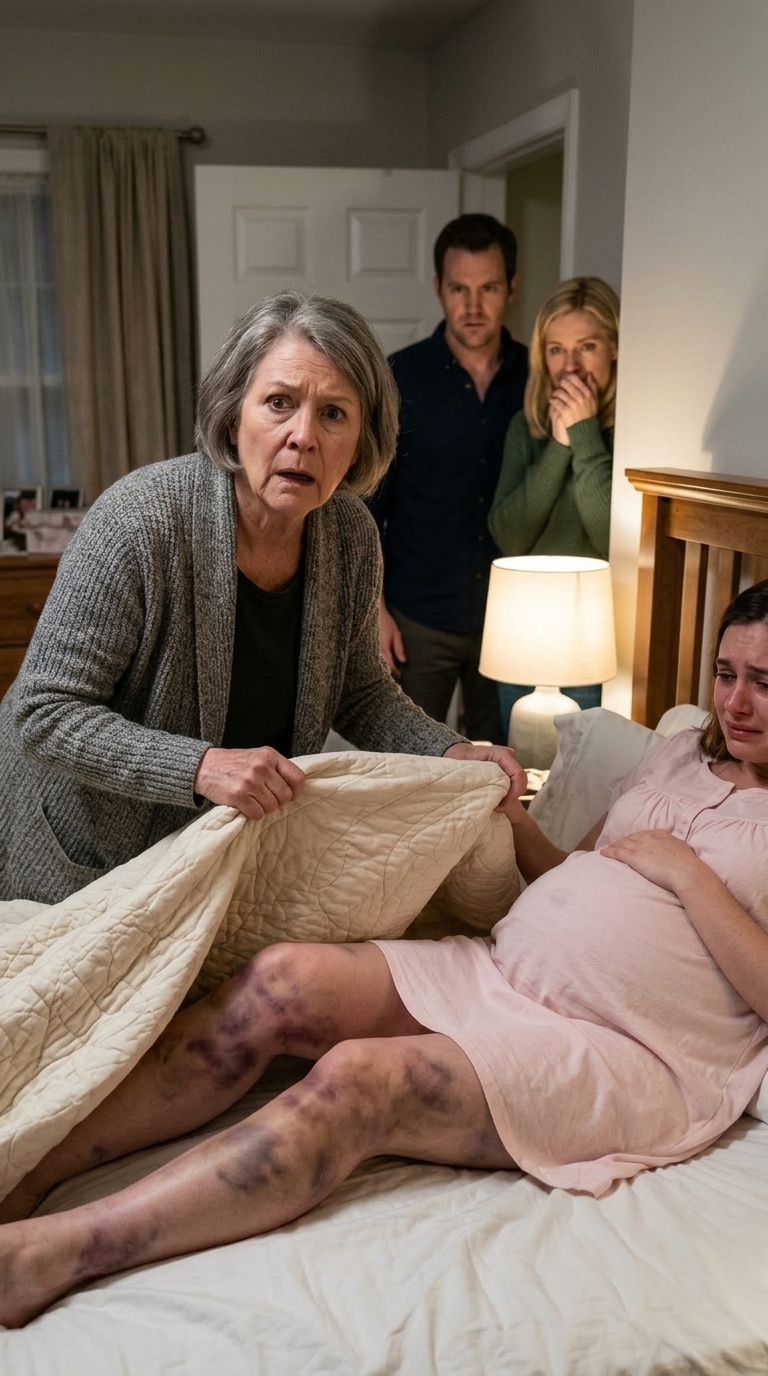
She covered her mouth to stifle another sob. “They want me to sign over the trust Dad left me. The principal, all of it. They said after the baby comes, I won’t be useful to them anymore.”
I looked slowly toward the heavy oak door of the bedroom.
Useful.
That single word settled inside me. It didn’t bring tears. It didn’t bring panic. It brought a terrifying, absolute clarity. It felt like a cold steel blade finding its sheath perfectly in the center of my chest.
They weren’t just abusing her. They were orchestrating a legal and psychological execution.
“Mom,” Chloe begged, pulling my attention back. Her nails dug into my skin. “You can’t fight them. You don’t understand. They own half this town. They can destroy us.”
I looked down at my daughter. My beautiful, brilliant girl, reduced to a trembling prisoner in a gilded cage. I gently unpried her fingers from my wrist and leaned down, pressing a long, firm kiss to her forehead.
“No, sweetheart,” I said softly, the quiet widow persona evaporating into the shadowed room. “They rent fear in half this town. There’s a difference.”
Chloe stared at me, blinking through her tears. I knew what she saw.
The soft, simple mother in the cardigan was gone. In her place sat the woman who had spent twenty-two years as a senior forensic accountant for the state attorney’s office. The woman who had dismantled multi-million-dollar embezzlement rings, who had untangled dark money webs for the FBI, who had sat across from men twice Sterling’s size and wealth and smiled while sending them to federal prison.
I had retired. I hadn’t died.
“Sleep,” I told her, my voice echoing with an authority she hadn’t heard since she was a teenager. “Lock the door behind me. Do not open it for anyone but me.”
I stood up, smoothing the wrinkles from my skirt. Downstairs, I could hear the faint, muffled sound of Sterling laughing at something his father said.
I walked toward the door, my mind already calculating variables, assessing risks, building a timeline. I stepped out into the dark hallway, pulling the heavy door shut behind me, waiting for the soft click of the lock.
When I turned around, my blood ran cold.
Standing at the top of the grand staircase, halfway down the long, shadowed hall, was Sterling. He was holding a fresh crystal glass of bourbon, watching me in the gloom.
“Is everything all right with my emotional little wife, Eleanor?” he asked.
Sterling took a slow step toward me, the ice in his glass clinking against the crystal.
The sound was deafening in the cavernous hallway. He was smiling, but it was the kind of smile a predator gives a wounded animal before breaking its neck.
I let my shoulders slump. I brought a trembling hand up to my mouth, playing the frightened, overwhelmed mother perfectly.
“She’s… she’s just very tired, Sterling,” I stammered, looking away from his dead eyes. “The pregnancy is taking a toll.”
Evelyn’s voice floated up from the base of the stairs. She swept up to join her son, her silk dress rustling like dry leaves. “As I said at dinner, Eleanor, the girl is unstable. We are deeply concerned for the welfare of our grandchild. Chloe requires… management.”
Arthur joined them on the landing, forming a solid wall of wealth and malice between me and the stairs. “Harlow women don’t break, Eleanor. If your daughter can’t handle the pressure of our lifestyle, perhaps she isn’t fit to be part of it.”
“Is that what she is to you?” I asked, allowing a tremor of genuine emotion into my voice, letting them think I was cracking. “Just an outsider you made a mistake on?”
Sterling stepped closer, invading my personal space. The smell of bourbon and expensive cologne was nauseating. “She is family, Eleanor,” he said, his voice dropping to a dangerous, low register. “When she behaves like family. And right now, her behavior is a liability.”
There it was. The absolute, unvarnished arrogance. The ingrained belief that their money built an impenetrable fortress around their actions. They thought I was a bug they could step on.
I looked down at my sensible shoes. I let a tear slip down my cheek. “I don’t want any trouble, Sterling. I just want my daughter to be happy.”
Beatrice scoffed, a vicious, ugly sound. “Then I suggest you don’t create any trouble. Leave tomorrow morning as planned. Chloe needs a stable environment. Not panic from a woman who still clips coupons and drives a ten-year-old sedan.”
I nodded slowly, subserviently, as if deeply wounded by the insult.
“Of course,” I whispered. “I’ll pack my things.”
I turned my back on them and walked toward my guest room down the hall. I heard Sterling chuckle, a dark, victorious sound, before the three of them descended the stairs to finish their drinks.
As soon as I was inside my room, the tears stopped instantly.
I reached into the deep pocket of my cardigan. My thumb rested on the volume-down button of my smartphone. I pressed it twice, stopping the hidden voice recorder app I had activated the moment I stepped out of Chloe’s room.
“She is family when she behaves like family.”
“Chloe requires management.”
It wasn’t enough for a conviction, but it was a thread. And in my line of work, you only need one thread to unravel a sweater.
I sat on the edge of my bed and waited. I listened to the grandfather clock in the downstairs foyer chime eleven, then midnight, then one in the morning. I listened as the heavy oak doors of the master suites clicked shut. I waited another hour, listening to the deep, resonant silence of a sleeping house.
At 2:00 AM, I moved.
I dressed in dark clothing and slipped a small penlight, my phone, and a pair of latex gloves into my pockets. I opened my door without making a sound.
My first stop was Chloe’s room. I scratched lightly on the wood. She opened it a crack, her eyes wide. I slipped inside.
“Mom, what are you doing?” she whispered.
“Gathering ammunition,” I replied.
I pulled out my phone and turned on the flash. “Show me the bruises again. All of them.”
She hesitated, then silently complied. I took timestamped, high-resolution photographs of the marks on her legs, her arms, and a faint, yellowish thumbprint on her jaw she had hidden with makeup. I photographed the broken deadbolt on her bedroom door—the metal casing splintered where it had been forced open. In her bathroom trash, I found what I was looking for: her prenatal vitamins, crushed into a fine powder, mixed with the residue of something else. I scraped a sample into a small tissue and pocketed it.
“Lock the door,” I told her again.
I slipped back into the hallway and made my way downstairs. The shadows were deep, the moonlight slicing through the tall windows in sharp angles. I moved with the silent, practiced grace of a woman who had spent decades hunting ghosts in paper trails.
I bypassed the living areas and headed straight for the east wing. Sterling’s home office.
The door was locked. A solid brass keypad handle. I didn’t bother trying to guess the code. I pulled a small, flat piece of rigid plastic from my pocket—cut from a binder hours earlier—and slipped it into the doorjamb, manipulating the latch. Less than ten seconds later, the door clicked open.
The office smelled of leather and secrets. I closed the door behind me and clicked on my penlight.
I didn’t waste time on the desk drawers. People like Sterling didn’t hide their true sins in wood. I moved to the large oil painting on the far wall. Behind it, exactly as I expected, was a wall safe. A modern, digital keypad model.
How does a narcissist think? I asked myself, staring at the keypad. They are arrogant. They believe they are untouchable. They never use random numbers because they believe their own lives are the center of the universe.
I tried his birthdate. Error. I tried the date he founded his company. Error. I paused, thinking about his massive ego. What was the most important day of his life? Not his wedding. Not his child’s due date.
I typed in the date his grandfather passed away—the day Sterling inherited his massive fortune.
The light flashed green. The heavy steel door clicked open.
I exhaled a slow, steady breath and reached inside.
There were stacks of cash, velvet boxes of jewelry, but I ignored those. I pulled out a thick leather folio.
I placed it on the desk and clicked my penlight on, holding my phone above it. I began taking photos of every single page.
It was worse than I thought.
There was an unsigned property transfer agreement, essentially a legal document designed to drain Chloe’s irrevocable trust into an offshore holding company controlled by Arthur Vance. But the real horror was the medical file.
Psychiatric Evaluation – Chloe Vance.
It was signed by a Dr. William Aris—a man who, a quick glance at the letterhead revealed, was on the board of a charity Beatrice Vance ran. The evaluation diagnosed Chloe with severe postpartum psychosis—a diagnosis made months before she had even given birth.
And then, the final folder. Labeled simply: Post-Birth Custody.
It was a drafted petition to the state, citing Chloe’s “violent instability” and requesting immediate, sole custody of the infant be granted to Sterling, with Beatrice listed as primary caregiver, and a motion to have Chloe committed to a private psychiatric facility in Switzerland.
They weren’t just stealing her money. They were stealing her baby, and locking her away where no one would ever hear her scream.
My hands were shaking. Not from fear. From a rage so pure and blinding it felt like a physical heat radiating from my skin.
As I photographed the final page of the custody petition, a small, mechanical whirring sound caught my attention.
I froze.
Slowly, I raised my penlight toward the top shelf of the massive mahogany bookcase across the room. Nestled between two leather-bound encyclopedias, a tiny black lens was moving. A faint, pinpoint red light blinked in the darkness.
A hidden camera.
Motion-activated. Connected to the cloud.
My heart hammered against my ribs. I was caught. They would have the footage of me breaking into the safe on their phones in the morning. They would call the police. They would destroy the evidence before I could leave the house.
I stood there for a long moment, bathed in the red blinking light of their surveillance.
And then, slowly, deliberately, I looked directly into the lens.
I didn’t panic. I didn’t run.
I smiled.
It was a cold, terrifying smile.
“Perfect,” I whispered to the empty room.
My phone vibrated in my pocket. A text message from Chloe.
Mom. I hear footsteps in the hall. He’s waking up.
I had exactly sixty seconds.
I shoved the folders back into the safe, slammed the heavy steel door shut, and spun the dial to lock it. I didn’t bother trying to wipe my fingerprints; the camera had already seen me. I straightened the oil painting, clicked off my penlight, and slipped out of the office, pulling the door shut behind me until it latched with a soft click.
I moved down the hallway like a shadow, pressing myself against the cold wall. Above me, the floorboards on the second-story landing groaned under a heavy weight.
Sterling.
I slipped into the downstairs powder room, leaving the door unlatched, and waited in the pitch black. A moment later, the motion-sensor lights in the foyer flared to life. Heavy footsteps padded down the stairs. I held my breath, my back pressed flat against the floral wallpaper, the timestamped evidence burning a hole in my pocket.
Sterling walked past the powder room. He paused in front of the office door. I heard the brass handle jiggle. Locked. He grunted, apparently satisfied, and walked toward the kitchen to get a glass of water.
I didn’t wait for him to return. I slipped out of the bathroom, glided up the staircase, and made it into my guest room, locking the door silently just as I heard him start back up the stairs.
I sat on the edge of the bed in the dark, my heart hammering a frantic rhythm against my ribs.
The camera in the office was a problem, but in the mind of a forensic accountant, every problem is just a misfiled asset. If they had cameras in the office, where else did they have them?
I opened my laptop and connected a dummy cable to my phone, transferring the encrypted files. I spent the next four hours working in the glow of the screen. I didn’t sleep. I didn’t blink. I drafted affidavits. I cross-referenced Dr. Aris’s medical license. I organized the photos, the audio recordings, the financial documents into a pristine, impenetrable digital fortress.
Then, at 5:00 AM, I made three phone calls.
By dawn, the sky outside the window was the color of a bruised plum. I showered, tied my hair back, and put on my sensible cardigan and modest shoes. I looked perfectly ordinary. I looked defeated.
I walked downstairs to the kitchen.
The smell of freshly brewed espresso filled the air. Beatrice was already there, wearing a flowing silk robe, looking like a queen surveying her conquered territory.
“Good morning, Eleanor,” she said, her voice dripping with false sympathy. “You look absolutely exhausted. Didn’t sleep well?”
“Not much, no,” I replied, pouring myself a cup of coffee. My hand trembled slightly—a deliberate touch.
Sterling entered the kitchen a moment later, dressed in a sharp, slate-gray suit, adjusting his expensive cufflinks. He looked invigorated, practically glowing with the anticipation of victory.
“Shame,” Sterling said, grabbing a piece of toast. “It’s a big day. Chloe is signing the trust amendment at ten o’clock sharp. The notary is coming here so she doesn’t have to stress herself by traveling.”
I took a slow sip of my coffee, the heat grounding me. “Is she?”
Arthur walked in, reading the financial times on a tablet. He scoffed without looking up. “Don’t start, Eleanor. You’re leaving right after breakfast. You think you can stop what’s happening?”