My grip on the gun tightened. Anger surged through me, hot and blinding. Not just at what she’d done, but at the utter lack of remorse in her voice.
“He gave the evidence to Emma,” I said. “That’s what you think, isn’t it? That he tucked it away where no one would look. On a child.”
“Emma was his favorite,” she spat. “He trusted her with everything. Little Sarah, the golden child, and her precious daughter. Always them. Never me.”
She was closer now. If I stepped out, I’d have a clear line of sight. But if she had backup, if someone was waiting downstairs, if—
My phone buzzed in my pocket.
I risked a glance at the screen.
Sarah: Police en route. 2–3 minutes out.
Two or three minutes could be an eternity or an instant in moments like this.
“I would have found it sooner if you weren’t so boringly competent,” Victoria said, her shadow sliding along the hallway. “That security system actually put a dent in my schedule. But then I remembered something. No system is perfect. Especially not when the man who designed it is married to my sister and trusts her implicitly.”
She laughed, low and cruel.
“Do you know how easy it is to guess someone’s admin code when you know the dates that matter to them?” she asked. “Wedding anniversaries. Birthdays. The day Dad took the bench. You might as well have handed me the keys, Daniel.”
I swore under my breath. Stupid. So stupid. I’d layered the system with two-factor authentication and encrypted logs, but I’d still used Sarah’s birthday in part of the master code, thinking it was memorable and personal. Unpredictable to strangers. Completely predictable to family.
“Where is she?” Victoria asked suddenly.
“Who?”
“Emma.” Her voice sharpened. “At ballet? At a friend’s house? Hiding under the bed?” A beat. “Did she tell you Grandpa gave her something? Did she show you my inheritance?”
“She’s safe,” I said simply. “That’s all you need to know.”
“That’s not all I need to know,” she snapped. “I need that card. The one Dad thought would ruin his precious daughter if anyone discovered he’d given it to her child. The one that proves he finally decided to grow a spine at the wrong time.”
“Is it worth all this?” I asked. “The corruption, the bribes, the dead bodies in your wake, the camera in a six-year-old’s bedroom?”
“Don’t be dramatic,” she said. “Dad made his choices. I make mine. That’s life.”
Sirens keened faintly in the distance. Getting closer. Victoria must have heard them, too. Her shadow stilled.
“Well,” she said softly. “That was quicker than expected.”
“You should put the taser down,” I said. “Walk downstairs. Wait for them. Turn yourself in. With what I have, they’ll find you regardless.”
“What you have?” she repeated, amused. “You mean what you think you have.”
She took a step backward. For a second, I thought she might retreat. Then her shadow shifted in my direction.
“You’re not as clever as you think, Daniel,” she said. “You forgot one thing.”
“What’s that?”
“I know exactly the kind of man my father respected,” she said. “Men who follow rules. Men who wait for backup. Men who hesitate because they don’t want to escalate.”
She moved fast. Faster than I thought she could in heels. She lunged toward my office doorway, taser raised.
I jerked away from the wall, gun lifting almost automatically, years of training compressing time into a staccato burst—assess, aim, command.
“Don’t—”
“Drop it, Victoria!”
The voice came from behind her.
Both of us froze.
Sarah stood at the far end of the hallway, just beyond Emma’s room. Her hair was loose now, tumbling over her shoulders. Her blazer was gone. Her hand was outstretched, fingers clenched around a compact pistol.
The barrel was pointed directly at her sister.
“You weren’t supposed to be here,” Victoria said, her voice going oddly flat.
“You weren’t supposed to be trying to tase my husband in my house,” Sarah replied, her voice somehow steady despite the tremor in her arms. “Yet here we are.”
Victora’s eyes flicked between us. Me with the gun. Sarah with the gun. Sirens wailing louder now, so close the sound vibrated through the walls.
“This is ridiculous,” Victoria said. “Put the gun down, Sarah. You have no idea what you’re doing.”
“I’m an attorney,” Sarah said. “I’ve spent a decade staring down men three times your size in the courtroom. Don’t condescend to me.”
“You’re pointing a weapon at your own sister,” Victoria hissed. “Think about what you’re doing. Think about Mom. The family.”
“I am thinking about family,” Sarah said. “I’m thinking about my daughter. The one you watched while she slept. The one you used as storage for your dirty secrets.”
Victoria’s mouth twisted.
“She’s just a child,” she said. “She doesn’t understand any of this. She’ll forget. Kids are resilient.”
“She will not forget the day her aunt came after her parents in their own home,” Sarah said. “She’ll read about it in case files and news articles for the rest of her life.”
The first patrol car screeched to a stop outside. Doors slammed. Boots pounded on the walkway.
Victoria’s jaw clenched. “If you turn that card over,” she said, “you’re not just ruining me. You’re ruining Dad’s legacy. You’re throwing everything away.”
“Dad ruined his own legacy when he took those bribes,” Sarah said quietly. “You ruined yours when you decided money mattered more than people.”
The front door burst open. Shouted commands echoed up the stairs.
“Police! Show me your hands! Upstairs! Now!”
Victoria’s eyes flickered. I saw the calculation there—the split-second assessment of odds, angles, outcomes. She shifted her weight.
“Don’t—” I started.
She spun toward me, taser crackling.
I dove sideways. The taser’s prongs shot past my shoulder, embedding in the wall with a sharp, sizzling pop. Plaster dust rained down.
I hit the floor hard, my elbow slamming into the wood. My gun skidded a couple of inches away. Before I could grab it, Victoria lunged, her hand reaching for my face, nails curved like claws.
Sarah moved.
She didn’t shoot. Later, in the calm postmortem with the detectives, they would tell her she had been justified if she had. But in the moment, she chose differently.
She tackled her sister.
The two of them went down in a tangle, limbs flailing, the taser sliding across the floor and clattering against the baseboard. Victoria hauled back, fist connecting with Sarah’s cheek. Sarah grunted, grabbed her wrist, twisted. Years of self-defense classes she’d taken after a shaken witness had been attacked in the courthouse lobby suddenly paid off.
“Get off me!” Victoria snarled. “You’re making a mistake!”
“Shut up,” Sarah hissed through clenched teeth.
I scrambled to my gun, scooped it up, and pointed it squarely at Victoria’s center mass.
“Don’t move,” I said, voice low.
For the first time since she’d arrived, I saw something flicker across her face other than arrogance or irritation.
Fear.
The officers stormed up the stairs a heartbeat later, weapons drawn.
“Freeze!” one shouted. “Hands where we can see them!”
I raised my free hand immediately, gun still pointed down, finger off the trigger. Sarah let go of Victoria’s arm and rolled away, both hands up, breathing hard. Victoria lay on her side, chest heaving, eyes darting between the uniformed officers and us.
“It’s okay,” I said, voice steady now. “I’m Daniel Hale. This is my wife, Sarah Hale. That’s Victoria Hale. She entered our home without permission, was armed with a stun device, and admitted on record to obstruction of justice in the Martinez case. There’s also a hidden camera in our daughter’s room that we’ve already removed, with footage stored in my office.”
It all spilled out in one long, coherent sentence, my brain automatically packaging the chaos into something intelligible for the responding officers.
“Hands on your head,” one of them barked at Victoria.
She hesitated just long enough to make everyone nervous, then did as she was told. Cold metal cuffs snapped shut around her wrists.
“You can’t do this,” she said, her voice higher now, strained. “You don’t know what you’re getting into. The people involved—”
“The people involved can talk to your lawyer,” Sarah said flatly, her cheek already swelling from the punch.
They led Victoria down the stairs. She didn’t go quietly. She twisted, spat accusations, tried to drag my name, Sarah’s name, even Emma’s name into her shrill protests about loyalty and gratitude and family betrayal.
By the time the front door shut behind them, the house felt like it was exhaling after holding its breath for hours.
The next few hours blurred.
There were statements to give. Evidence to hand over. Copies of logs and footage and security codes to explain. Detectives and uniforms coming in and out, cataloging the camera, photographing the hallway, measuring scorch marks from the taser prongs.
I gave them the microSD card from the locket and explained how I’d found it. A tech from the department took possession like it was made of glass and plutonium.
Sarah sat at the kitchen table with an ice pack on her face, her hand wrapped around a mug of coffee that had gone cold. I kept one eye on her the whole time, making sure she didn’t shatter into pieces.
When the last cruiser finally pulled away and the house grew quiet again, the clock over the stove read almost midnight.
I sank into the chair across from her.
“How are you doing?” I asked softly.
She let out a laugh that wasn’t really a laugh. “My sister got arrested in my house for trying to attack my husband over evidence in a case that might prove our father was corrupt,” she said. “I’ve been better.”
I looked at her face—at the bruise starting to darken along her cheekbone, the faint imprint of rings on her skin.
“I’m sorry,” I said.
“For what? Victoria made her choices. Dad made his. None of that is on you.”
“I keep thinking about that admin code,” I said. “About how I seeded your birthday in it. How that let her in without raising any flags. I should have known better. I did know better. I just… let myself get comfortable.”
Sarah reached across the table and took my hand.
“Don’t you dare start blaming yourself for the fact that my family is a mess,” she said. “You didn’t make Dad take bribes. You didn’t make Victoria agree to those deals. You didn’t put that camera in Emma’s room. You built us a security system that caught them.”
“She still got in,” I said.
“And you still caught her,” she countered. “If you hadn’t noticed that red light…”
We both fell quiet.
I thought of Emma’s voice that night. The way she’d said it blinked when it was dark. How seriously she’d watched my face.
“She saved us,” I said. “She knew something was wrong even before we did.”
Sarah’s eyes filled with tears. “How do we tell her?” she whispered. “What do we say? ‘Hey, sweetheart, remember that necklace Grandpa gave you? It had evidence of a crime on it. Oh, and Aunt Victoria’s going to prison.’”
“We tell her the truth,” I said slowly. “The version she can handle now. The rest can come later.”
“What version is that?” she asked.
“That Grandpa realized he’d done something wrong and tried to make it right,” I said. “That he trusted her to keep something important safe, and she did. That Aunt Victoria made bad choices because she cared more about money than people, and now she has to face the consequences. That none of it is Emma’s fault.”
Sarah stared at me for a long moment, then nodded.
“She’s going to ask if she did something wrong,” Sarah said. “If she got somebody in trouble.”
“Then we tell her she did something right,” I said. “She told us about the red light. She trusted us. Because of her, we were able to protect a lot of people who didn’t even know they needed protecting.”
Sarah sniffed and smiled at the same time. “You’re going to make a great witness when this goes to trial,” she said.
“I’m retired,” I reminded her.
“You’re married to a prosecutor,” she countered. “You’re never really retired.”
We sat in companionable silence for a while. The house creaked around us, settling. The fridge hummed. Somewhere outside, a dog barked and then quieted.
My phone buzzed on the table.
Unknown number.
I frowned and picked it up.
“Hello?”
“Mr. Hale?” a man’s voice said. “This is Detective Ramos. We just ran a preliminary check on the card you gave us. I thought you might want to know…”
He didn’t need to finish.
“I was right, wasn’t I?” I said.
“You were right,” he confirmed. “There are recordings on here. Documents. Account ledgers. Audio files. It’s… a lot. Your father-in-law was a very thorough man when he decided to turn on his friends.”
“Are you going to need Emma to…”
“No,” he said quickly. “God, no. She’s a minor. She had no idea what she was carrying. That’s not going to change. We won’t put that on her.”
I exhaled slowly. “Thank you.”
“We’ll be in touch once we’ve processed everything,” he said. “In the meantime, keep your doors locked and your heads down. Some of the people in these files are not going to be happy about this.”
“We figured,” I said.
After I hung up, I relayed the gist to Sarah. She absorbed it with the same tired, determined expression she’d worn all night.
“So Dad tried to do one decent thing at the end,” she said. “I guess that’s something.”
“It’s more than some people ever manage,” I said.
She looked at me, eyes shining. “Promise me something.”
“Anything.”
“When this is all over,” she said, “we get rid of the dollhouse.”
I blinked, surprised. “I thought it was a family heirloom.”
“It is,” she said. “I hate it.”
I thought of the way it had loomed in Emma’s room, its tiny windows staring back at her bed. A Trojan horse of nostalgia and wood paneling.
“We’ll donate it,” I said. “Or burn it. Your call.”
“Burning sounds good,” she said.
For the first time that night, we both laughed. It wasn’t a joyous sound. But it was human.
We picked Emma up from Jack’s house the next morning.
She barreled into me the second the door opened, wrapping her arms around my waist with the kind of force only kids can manage.
“Daddy!” she yelled. “Uncle Jack let me stay up so late and we watched a movie and he gave me pizza for breakfast and—”
“Snitch,” Jack said from the couch, raising a hand in greeting.
I gave him a look that said I’d scold him later and hugged my daughter like I might never get another chance.
“How was your adventure?” I asked, kneeling so we were eye level.
“The best!” she declared. “But I missed Mr. Flippers. And Mommy. And my room.”
Her room. The word twisted something in my chest. Her room, which had been a crime scene. Her room, which I’d spent an hour that morning quietly reclaiming—checking every corner, sealing up holes, patching baseboards, throwing away a camera that would never hurt anyone again.
We drove home with Emma chattering in the back seat, her little legs swinging, the stuffed penguin perched on her lap.
“Did you fix my locket?” she asked halfway through the drive, apropos of nothing, like kids do.
Sarah and I exchanged a look.
“Not yet, sweetheart,” Sarah said gently. “But we’re going to. And this time, we’re going to get you a really strong chain. One that doesn’t break so easily.”
“So it can’t fall off ever again?” Emma asked.
“Exactly,” I said.
She seemed satisfied with that.
As we pulled into the driveway, the house looked… different somehow. Same bricks. Same windows. But the illusion of perfect safety was gone. And in its place was something more grounded. More honest.
We took Emma upstairs to her room. She ran in ahead of us, skidding to a halt as she realized something was missing.
“Where’s the dollhouse?” she asked.
Sarah crouched beside her, brushing a hand through her hair.
“We decided to move it,” she said. “It was taking up a lot of space, and we thought maybe you’d like more room for your drawings. What do you think?”
Emma considered the empty corner, then shrugged. “It was kind of creepy,” she admitted. “Sometimes it felt like the little windows were looking at me.”
I felt the skin at the back of my neck prickle.
“Why didn’t you tell us?” Sarah asked.
“I thought you’d say I was being silly,” she said. Then, thoughtfully, “But if it’s gone now, then it’s okay.”
“We want you to tell us when something feels creepy,” I said, crossing the room to kneel in front of her. “Always. Even if it seems small. Even if you think we’ll say you’re being silly. Deal?”
She nodded solemnly.
“Deal.”
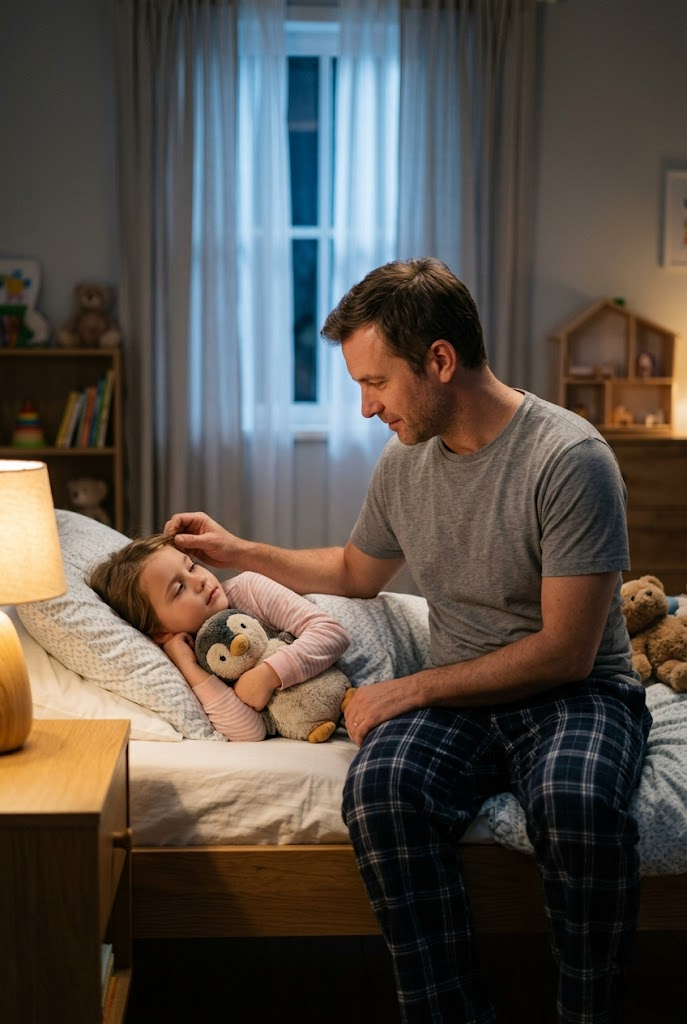
That night, after we tucked her in and double-checked every lock, I stood in the doorway for a long time, watching her sleep. No cameras. No hidden microphones. Just my daughter, wrapped in her blankets, safe in a house that had seen too much but was still standing.
A whisper from behind me made me turn.
“You okay?” Sarah asked.
I leaned against the doorframe, pulled her into my side.
“I keep thinking about how close we came to missing it,” I said. “If Emma hadn’t noticed that light—”
“If you hadn’t built the system that logged the entries,” she countered. “If you hadn’t followed your instincts. If Dad hadn’t given her that locket. There are a lot of ‘if’s, Daniel.”
“Too many,” I said.
“That’s life,” she said softly. “Messy. Complicated. Full of secrets you don’t know are secrets until they explode.”
“Comforting,” I said.
She rested her head on my shoulder.
“Do you think she’ll be okay?” she asked.
“Emma?” I looked at our daughter. At the way she clung to Mr. Flippers, at the smudge of chocolate at the corner of her mouth from dessert, at the faint imprint of her unicorn night-light projected on the ceiling.
“She noticed a red light in the dark and told us,” I said. “She kept a secret safe without even knowing it. She got her grandfather justice without meaning to. She’s stronger than we are.”
Sarah smiled against my shirt.
“We’ll get stronger,” she said. “Like the chain on that locket. We’ll fix what’s broken and make it harder to break next time.”
Sometimes, it takes a blinking red light in a child’s bedroom to reveal the rot beneath a family’s polished surface. To drag decades of secrets into the unforgiving glare of truth.
Sometimes, that revelation shatters everything you thought you knew.
But sometimes—if you’re lucky, if you’re willing to look at the ugly parts and choose differently—it also gives you a second chance. A chance to build something better on the ruins. Something honest. Something that can hold weight without cracking.
As I turned off the hallway light and followed Sarah downstairs, I slipped my hand into my pocket and felt the faint outline of the empty locket there—the tiny heart that had once carried so much danger and now would carry something else entirely.
Not guilt. Not evidence.
Just a reminder.
That trust is both the most fragile and most powerful thing in the world.
And that my daughter’s quiet little whisper in the dark had saved us all.
THE END
✅ End of story — Part 3 of 3
← Read from Part 1