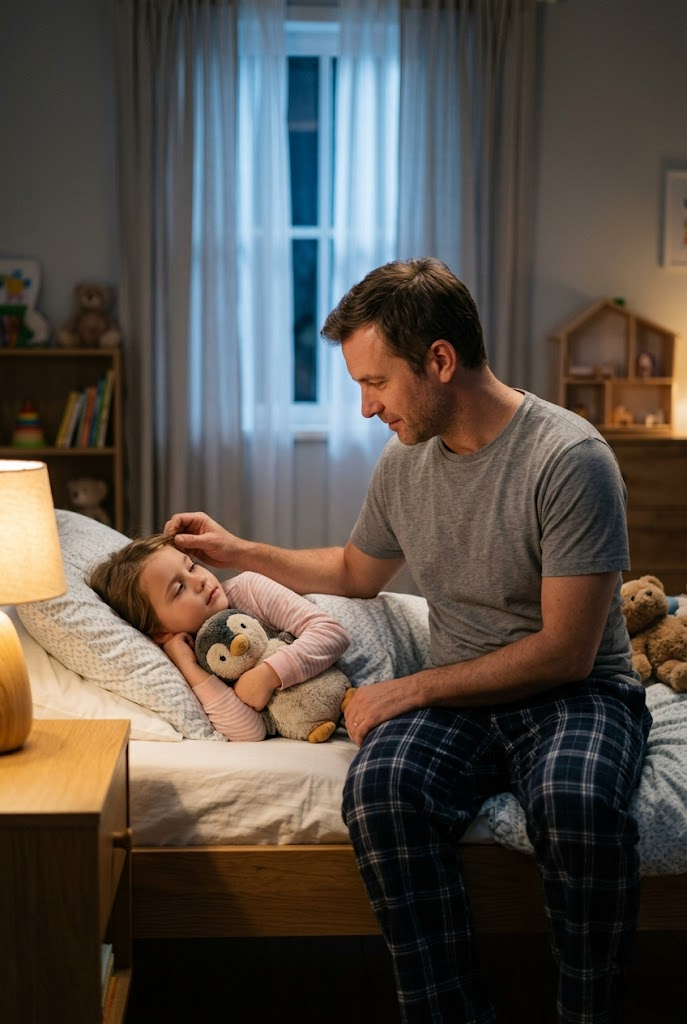
My daughter saved our lives with a whisper.
“Daddy… there’s a red light behind my dollhouse.”
At the time, it sounded like the kind of thing kids say all the time—shadows that look like monsters, creaking floorboards that become footsteps, toys that move “by themselves.” I barely looked up from tucking the blanket under her chin. It had been a long day. I’d been in back-to-back meetings, my eyes still gritty from too many hours staring at screens, my mind already halfway to the email I needed to answer once she fell asleep.
But something about the way she said it made me stop.
Her small fingers tightened around my sleeve, the way she used to when she was a toddler and thunder scared her. She didn’t sound whiny or dramatic. She sounded… cautious. Like she was afraid that if she spoke too loud, whatever she’d seen might hear her.
“It blinks when it’s dark,” she added, her voice dropping into something close to a secret.
My name is Daniel, and in that moment I had absolutely no idea that one sentence from my six-year-old would rip my entire life apart and then stitch it back together into something unrecognizable.
I forced my eyes away from her big brown ones and glanced toward the corner of the room. The dollhouse sat where it always did, perfectly positioned under the window, its tiny porch facing the bed like it was keeping watch over Emma while she slept.
It was an old Victorian-style thing, passed down through Sarah’s family for generations—peeling white paint, little green shutters, a miniature brass door knocker. Sarah liked to say it was more “historical artifact” than toy.
At first, I didn’t see anything strange. The night-light cast its usual soft glow across the walls, turning the corners of the room into gentle shadows. The dollhouse loomed like a little ghostly mansion, its windows empty and black.
Then I saw it.
In the gap between the back of the dollhouse and the wall, something glowed. Very faint. Very small. A tiny red dot, pulsing every second like the heartbeat of some insect hiding in the dark.
The air left my lungs in one slow, controlled exhale. My training kicked in before my conscious mind could catch up. My heart rate spiked, but my face stayed neutral.
“It blinks when it’s dark,” she’d said.
Oh, God.
“It’s probably nothing, sweetie,” I heard myself say, voice calm, steady. “Maybe a reflection, or a little light from one of your toys.”
She studied me, like she could sense the lie behind my easy tone.
“Can you check?” She clutched her stuffed penguin tighter, the faded black-and-white plushie practically a fifth limb at this point. “I don’t like it.”
She shouldn’t have liked it. I didn’t like it. I also didn’t like the way my hands suddenly felt cold.
“Of course.” I kissed her forehead. “Tell you what. Why don’t we turn this into a mini adventure?”
Her eyes brightened despite her fear. “An adventure?”
“Yeah.” I grabbed the little flashlight she kept on her nightstand for “reading under the covers” and clicked it on. “Monster inspection. Red-light patrol. Official business.”
She giggled, just a little, and that sound kept me from unraveling as I crossed the room toward the dollhouse.
Every step I took, that tiny red light seemed to pulse a little more insistently. Blink. Blink. Blink. It was the kind of detail I’d trained myself to notice back when I wore a badge. A dot like that meant technology. A sensor. A status indicator. A camera.
Don’t jump to conclusions, I told myself. Kids’ toys had lights. Cheap electronics glowed. Maybe some old battery-operated thing had fallen back there.
I set the dollhouse aside as gently as I could. The moment I moved it, I knew I’d been lying to myself.
There, screwed cleanly into the baseboard, was a small black device. It was about the size of my thumb, with a glassy circle in the center and that tiny, raised LED shimmering red at me like an accusation.
The lens was pointed directly at Emma’s bed.
My mouth went dry. I’d seen hidden cameras before in my time with the police. I’d seen the cheap knockoff ones you could order online by the dozen, disguised as alarm clocks or smoke detectors. This was not that. This was high-end, discreet hardware—flush with the wall, wires neatly routed through the baseboard. Professional work.
Behind me, the mattress creaked as Emma sat up, sensing that something was wrong.
“What is it, Daddy?” she asked.
I could feel the urge to tell her the truth rise up hard and fast in my chest. Someone put a camera in your room. Someone watched you sleep. And I don’t know who.
I forced that truth back down where it belonged for now.
“Just some old wiring, princess,” I said, making sure my face looked bored, maybe even mildly annoyed. “Probably something leftover from when Grandpa Edward had the house renovated. Nothing to worry about.”
It was insane how easy the lie came to me. Protecting people with half-truths and calm expressions… that part of being a cop never really leaves you.
“Oh,” she said slowly. She squinted at the corner, not entirely convinced, but not wanting to argue. “Can I sleep with you and Mommy tonight?”
I hesitated. If there was one thing I was suddenly sure of, it was this: she was not sleeping in this room.
“I have a better idea,” I said, keeping my tone light. “How about a sleepover in the guest room? You, me, and Mr. Flippers.”
She hugged the penguin closer. “And Mommy?”
“And Mommy, when she gets home.” I stroked her hair. “We’ll make a fort out of blankets and eat cookies in bed. I’ll even let you pick the movie.”
“Even if it’s the mermaid one you hate?”
I smiled. “I will suffer for my child.”
That got a real laugh out of her. I held onto that sound like a lifeline as I helped her gather her things—penguin, favorite blanket, the little unicorn night-light that projected stars on the ceiling. I walked her down the hallway, every sense heightened now, every creak of the floorboards like a shout.
The guest room was right across the hall from the master bedroom. Neutral colors, a bed that was too firm, nightstands that barely got used. I tucked her in, made a big show of checking for “monsters,” turned on the unicorn stars and left the door cracked just the way she liked it.
“Daddy?” she called softly as I turned to go.
“Yeah, bug?”
“If it’s not scary, why do I have to sleep in here?”
Kids. They always cut straight through the fluff.
I sat back down on the edge of the bed. “Because,” I said carefully, “I want to take a really good look at that wiring. And I know it’ll make me feel better if you’re someplace super safe while I do it. Okay?”
She considered this, then nodded decisively. “Okay. But if you see a ghost, you have to tell me.”
“If I see a ghost, I’m calling you to fight it.”
“Deal,” she said, satisfied.
I kissed her forehead again and watched her tiny body relax into the mattress, her eyelashes fluttering as the unicorn light painted constellations across her cheeks.
Then I closed the door behind me, and the second it latched, the mask dropped.
My hands were trembling.
Back in Emma’s room, I shut off the main light and closed the door so only the dim hallway glow seeped under the frame. The red dot in the corner seemed even brighter now, the only true color in the shadows.
I crouched in front of it. My breath sounded too loud. The hum of the air conditioner suddenly felt like it was roaring.
Up close, the camera was even more obviously professional. The casing was matte, no brand logo, just clean machined edges. The wiring had been threaded behind the baseboard instead of exposed. It was the kind of thing you installed if you knew what you were doing and you had a specific purpose in mind.
I took out my phone and snapped a few photos, forcing myself to be methodical. Equipment like this meant money. Planning. Intent.
Who had enough access to our house to plant this? And who would want to?
We didn’t have many people coming in and out. I kept the security system tight. Sarah sometimes teased me about it, said I was turning the house into a fortress because I missed my old patrol days.
There were only a handful of people who had the code: me, Sarah, our nanny Mrs. Thompson, and Sarah’s sister Victoria—at least, last I’d checked. We’d changed the locks and codes after a string of break-ins in the neighborhood, and I’d been very clear that we were limiting it.
Victoria had thrown a fit about that, actually. Something about “family not needing permission to visit.” Sarah smoothed it over, like she always did, caught between her sister’s temper and my stubbornness about security.
I pushed that memory aside and focused on the device. There was no tiny Wi-Fi antenna, no blinking indication of wireless connection or transmission. The LED pulsed steadily, but nothing suggested it was sending data anywhere.
Local storage, then.
Which meant whoever put it here had to come back for it.
The thought made my skin crawl. How many nights had someone walked into my daughter’s room and taken footage of her sleeping? Playing? Changing?
My stomach twisted. The protective rage hit me so suddenly I had to breathe through it.
I took more photos, careful to get every angle. Camera. Mounting points. Wiring. The surrounding wall for context. I documented everything the way I’d done a hundred times at crime scenes, telling myself the procedure would keep me from losing it.
Once I had enough, I stepped back and pulled out my phone for a different reason.
I called Sarah.
She answered on the second ring, her tone brisk and distracted. “Hey, I’m just finishing up at the office. Can it—”
“Did you install a camera in Emma’s room?” I cut in.
There was a beat of silence. “What?”
“A camera, Sarah. Behind her dollhouse. Did you put one there? Did you ask anyone to?”
“Of course not,” she said, sharper now. “Why would I— Daniel, what are you talking about?”
I walked back to the doorway and looked into the darkened room, at the smashed-up innocence of pink bedding, stuffed animals, and one predatory little red dot in the corner.
“I just found a hidden camera,” I said quietly. “Pointed at her bed.”
The line went dead silent. I could hear something in the background on her end—a printer maybe, or the faint echo of voices in the corridor of her law firm—and then nothing but the sound of her breathing.
“Are you sure?” she whispered.
“I’m looking at it.”
“How— who—”
“I don’t know yet,” I said. “That’s what I’m trying to figure out.”
“I’ll be home in twenty minutes,” she said, all trace of distraction gone from her voice now. “Don’t touch anything.”
“I’ve already taken pictures,” I told her. “I’m not removing it until I understand how it’s wired.”
“Good.” Her lawyer voice came back—controlled, precise. “Daniel… is Emma—”
“She’s fine,” I said quickly. “In the guest room. She doesn’t know what it is. I told her it was old wiring.”
Sarah exhaled, a shaky sound. “Okay. I’m leaving now.”
We hung up. For a second, I just stood there in the hallway, phone still raised, staring into that room where my daughter had spent dozens of nights under surveillance without us knowing. Every parenting book I’d ever read, every safety precaution we’d ever taken suddenly felt like a cruel joke.
I went to my office to wait for Sarah, because I knew if I stayed near that camera I would rip it out of the wall with my bare hands and smash it into pieces.
My office was my one indulgence in the house. Shelves lined with security manuals and old case files, a neatly organized desk, two monitors, the soft glow of the router in the corner. The framed certificate from my years on the force hung beside the more recent one from when I opened my security consulting firm.
People paid me to keep them safe. To design systems that prevented exactly this kind of violation.
I felt like a fraud.
When Sarah came barreling through the front door, her heels clicking a staccato panic on the hardwood, she didn’t even pause to put down her bag. She went straight upstairs. I followed her into Emma’s room.
She stood in the doorway for a heartbeat, taking everything in. Her eyes landed on the camera. I watched the color drain from her face.
“Oh my God,” she breathed.
She walked in slowly, as if stepping into a crime scene, careful not to disturb anything. In her navy suit and white blouse, with her dark hair twisted into a low chignon, she looked like the prosecuting attorney she was—except for the way her hands shook.
She knelt by the wall, squinted, then glanced back at me. “This isn’t some toy,” she said. “This is… expensive.”
“How can you tell?”
“Because I dated a tech guy in law school who wouldn’t shut up about gear like this,” she said absently, her mind clearly racing. “Where would someone even get—”
“I can get it,” I said. “There are suppliers. But they don’t sell to just anyone.”
We stared at the camera together like it might answer our questions if we glared hard enough.
“We need to call the police,” she said finally.
“Not yet.”
She whipped her head toward me. “Daniel—”
“Look at it,” I insisted. “No Wi-Fi module. No cellular antenna. This thing is recording to local storage. A microSD or internal memory. Whoever put it here is expecting to come back and collect the files. If we call the police now, it’ll be yanked out, bagged, and logged. We’ll have the footage, sure. But the person who did this will know we found it. And they’ll disappear.”
Her jaw clenched. “I don’t care if they disappear. I want them arrested.”
“And so do I,” I said. “Trust me. But if we give them a chance to come for the camera, we might also catch them in the act. If it’s someone we know…”
I didn’t need to finish that sentence.
“The only people who have our security code are us, Mrs. Thompson, and—” She cut herself off mid-sentence, eyes widening.
“And Victoria,” I finished.
Sarah sank onto the edge of Emma’s bed, her gaze unfocused. “Why would she…”
I didn’t want to say something unfair. Victoria and I had never exactly been close, but friction between in-laws wasn’t a crime.
“We’re not jumping to conclusions,” I said. “We’re looking at evidence.”
“Then let’s look,” Sarah said, wiping her eyes quickly. “You keep logs for the system, right? Entry times, codes used?”
“You know I do.”
We went to my office. I sat at my desk and woke up the monitors. The security software popped open—my own design, a little more robust than the standard consumer crap.
Sarah hovered behind me, one hand on the back of my chair, the other gripping her wrist so tightly her knuckles were white.
I pulled up the logs for the last month. A scroll of timestamps and code IDs filled the screen.
“At first glance, everything’s normal,” I said, narrating more for my own sanity than for hers. “We’ve got you leaving at 7:45 most mornings, me at 8:10, Mrs. Thompson arriving at 8:30, leaving around five. The cleaning service on Wednesdays. My brother when he came over to fix the dryer. Nothing unexpected.”
“Keep going,” she said.
I paged further down. Same pattern. Same rhythm.
Then something caught my attention. A little cluster of entries in the middle of endless sameness.
“Wait,” I murmured. I zoomed in. “Every Friday.”
“Every Friday what?”
“Every Friday there’s an additional entry. Mid-afternoon. Between two and three.” I highlighted the entries. “Code ending in 7-3.”
Sarah frowned. “Is that Mrs. Thompson’s code?”
“No. That’s—” I scrolled up to the legend where I kept track of who had which code. My stomach lurched. “That’s the old code we assigned Victoria. But we changed the codes when we updated the system.”
“I thought we did,” Sarah said slowly.
“We did,” I said. “I deactivated that code months ago.”
“Then how is it in the logs?” she demanded. “You can’t have phantom codes, right?”
“You can’t,” I said, already typing furiously. I pulled up the system configurations, my fingers moving almost automatically through menus I knew better than my own reflection.
“All right,” I muttered, more to myself than anything. “The code is marked as deactivated. But the logs show successful access. That shouldn’t be possible.”
I stared at the lines of text like I could will them to make sense.
Unless someone had manual override access.
Unless someone knew the administrator code.
I’d never given that code to anyone outside our immediate family.
My mind skittered away from the implication. I switched over to the video archive for the front door camera. If a code was used, there would be footage of whoever came in.
“Here,” I said. “Friday, two-thirteen p.m.”
The video loaded. Grainy but clear enough. The front porch appeared on-screen, bathed in afternoon light. A second later, a figure moved into frame.
Sarah inhaled sharply behind me.
Her sister walked up the front steps like she owned the house. She wore a tailored coat, sunglasses perched on her head, a leather tote on her arm. She glanced around once, casual as anything, then pulled a key from her bag and let herself in.
“She doesn’t have a key,” Sarah whispered. “She’s not supposed to have a key.”
“We changed the locks after the break-ins,” I said slowly. “I remember. You were there when I had the locksmith swap them out.”
“Yes, I know, I—” She broke off, shaking her head. “Did she… did she make a copy before?”
“Before we changed them?” I said. “That wouldn’t help her now. This is a new lock.”
“Then how—”
I didn’t have an answer. We scrubbed forward. The camera inside the foyer picked her up next—Victoria entering the house, closing the door behind her, moving with the casual familiarity of someone who knows exactly where everything is.
“Watch,” I said.
She set her bag down, glanced at her watch, then headed straight up the stairs. No hesitation. No wandering.
Emma was at ballet on Fridays. Mrs. Thompson always left early to drop her off and run errands before coming back.
By the time we switched to the upstairs hallway camera, Victoria was already standing in front of Emma’s bedroom door. She opened it, stepped inside, and closed it behind her.
Fifteen minutes later, she came out. No Emma. No Mrs. Thompson. Just Victoria, eyes slightly sharper now, mouth tight. She grabbed her bag, left the house, and locked the door behind her.
“You said every Friday?” Sarah murmured.
“Every Friday for the last… eight weeks,” I said, checking the logs. “Always around the same time. Always for fifteen to twenty minutes.”
Sarah moved away from the desk, pressing a hand over her mouth.
“Okay,” she said through her fingers. “Okay. So Victoria is letting herself into our house when we’re not here, going straight to Emma’s room, and spending time in there alone. And now we’ve found a hidden camera pointed at our daughter’s bed.”
Saying it out loud made my stomach flip.
“We need to know what she’s doing in there,” I said quietly. “The camera might have captured her. It might have captured everything.”
Sarah nodded, eyes hardening. “Emma stays with someone we trust until this is sorted. My mom—”
“No,” I said immediately, more sharply than I intended.
She blinked. “Excuse me?”
“I don’t want Emma anywhere near your family until we know what this is,” I said. “I’m sorry, but if Victoria is involved in something… whatever this is… we can’t risk it spreading wider than it already has.”
Her eyes flashed. “My mother has nothing to do with this.”