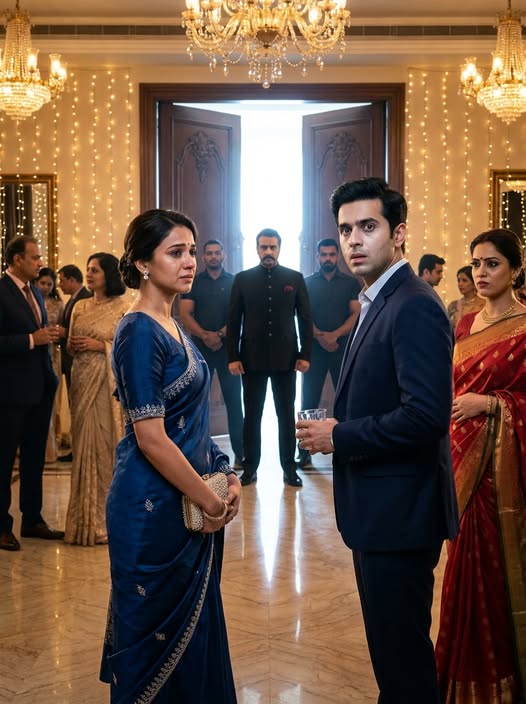
He did not look at the host.
He did not look at the investors.
He did not look at the men already straightening their backs, preparing their best smiles, calculating how to turn one handshake into business.
He looked only at me.
For one second, the room did not understand.
Then he smiled.
Not the polite smile he gave newspapers.
Not the controlled smile from business magazine covers.
The real one.
The one I saw every morning when he found me reading in the balcony with cold tea beside me.
The one that still made me feel like I had been found after years of hiding in plain sight.
He walked toward me.
Slowly.
Deliberately.
Every step took something from Raghav’s face.
Confidence first.
Then amusement.
Then colour.
By the time Arvind stopped beside me, Raghav looked like a man watching his own reflection change into a stranger.
“Sorry I’m late,” Arvind said softly.
I looked up at him.
“You said five minutes.”
“Delhi traffic fears no billionaire.”
A laugh moved through the room, but it was nervous.
Because everyone was staring.
Arvind turned toward Raghav then.
Not rudely.
Not dramatically.
Just enough.
“Mr. Malhotra,” he said.
Raghav blinked.
“You know me?”
Arvind’s smile stayed calm.
“I know most people who send proposals to my office every week.”
Raghav’s throat moved.
“Of course. Sir, I have been trying to meet you regarding the logistics expansion—”
Arvind lifted one hand.
“Tonight is not for that.”
Then he reached for my hand.
Not to display me.
Not to prove a point.
Just because he always did when rooms became too sharp.
His fingers closed around mine.
Warm.
Steady.
Home.
The host, suddenly remembering his job, spoke into the microphone.
“Ladies and gentlemen, please welcome Mr. Arvind Khanna and his wife, Mrs. Ananya Khanna.”
Wife.
The word moved through the hall like thunder under silk.
Priya’s smile died first.
Raghav stared at our joined hands.
Then at my face.
Then at Arvind.
His mouth opened slightly, but nothing came out.
Someone at the back whispered, “His wife?”
Another voice said, “Ananya married Arvind Khanna?”
Then a third, softer, crueler voice:
“Raghav didn’t know?”
No, he did not.
Because after the divorce, Raghav had made sure everyone heard his story.
I had made sure no one heard mine.
I did not post wedding photos.
I did not announce my new life to college groups.
I did not send old classmates proofs of happiness like court evidence.
I simply lived.
And living well in silence had become the revenge Raghav never saw coming.
Arvind placed his hand at the small of my back.
“May I?” he asked.
I knew what he meant.
The stage.
The room.
The moment.
I nodded.
Together, we walked past Raghav.
He did not move aside until Priya touched his arm.
Only then did he step back.
As I passed, I heard him whisper, “Ananya…”
I did not stop.
The stage lights were warm, almost harsh. From there, I could see every face.
Old friends.
Old judges.
Old gossipers.
People who had watched my fall and called it entertainment.
People who had never asked if I was okay because my pain was less useful than Raghav’s version.
Arvind took the microphone.
“Thank you for inviting me,” he said. “Though technically, I invited myself after sponsoring the event.”
People laughed.
This time, properly.
He continued, “I came tonight because my wife studied here. She speaks of this place with complicated affection.”
Complicated affection.
That was very Arvind.
He never turned wounds into speeches without asking them permission.
“When I first met Ananya,” he said, “she was interviewing for a leadership role at one of our education funds. The panel expected a polished corporate answer about growth. Instead, she spent fifteen minutes explaining why talented women leave systems that keep calling their ambition selfish.”
My throat tightened.
I remembered that interview.
My saree had been plain blue.
My confidence had been borrowed.
I had sat before five executives and thought, If I fail, at least I will fail as myself.
Arvind looked at me briefly.
“She was the only candidate who told us our foundation model was wrong.”
A few people chuckled.
“She got the job,” he said. “Not because she impressed us. Because she scared us into becoming better.”
That laugh in the hall was warmer.
I glanced at Raghav.
He stood near the bar, his face stiff, Priya beside him, one hand pressed protectively to her stomach.
His eyes were not on Arvind anymore.
They were on me.
Not with love.
Not even regret.
With calculation.
The same old calculation I had seen when he decided which insult could be said in public and which had to wait until the car.
Arvind continued, “Tonight, I was asked to speak about success. But I would rather speak about dignity.
Because success without dignity becomes only performance. And many people perform very well.”
The room understood just enough to shift uncomfortably.
Arvind did not look at Raghav.
He did not have to.
“My wife taught me that rebuilding after humiliation is not a comeback story. It is a daily discipline. Sometimes it means signing a lease when your hands are shaking. Sometimes it means sitting alone at dinner and not going back to the person who broke you. Sometimes it means building a new life so quietly that the people who buried you keep speaking to your grave.”
My eyes burned.
I looked down.
His thumb moved once over my knuckles.
Small.
Steady.
I did not cry.
Not there.
Not for them.
Then he smiled.
“So tonight, I will keep my speech brief. To the batch of 2010, congratulations. Some of you built companies. Some built families. Some rebuilt yourselves after people mistook your silence for defeat. That last work is the hardest.”
Applause began.
Not loud at first.
Then stronger.
Some people stood.
Maybe because of him.
Maybe because of me.
Maybe because everyone loves redemption once it arrives wearing power.
We stepped down from the stage.
Immediately, the room changed.
The same women who had whispered “alone” now came forward with sparkling eyes.
“Ananya! You should have told us!”
“You look amazing!”