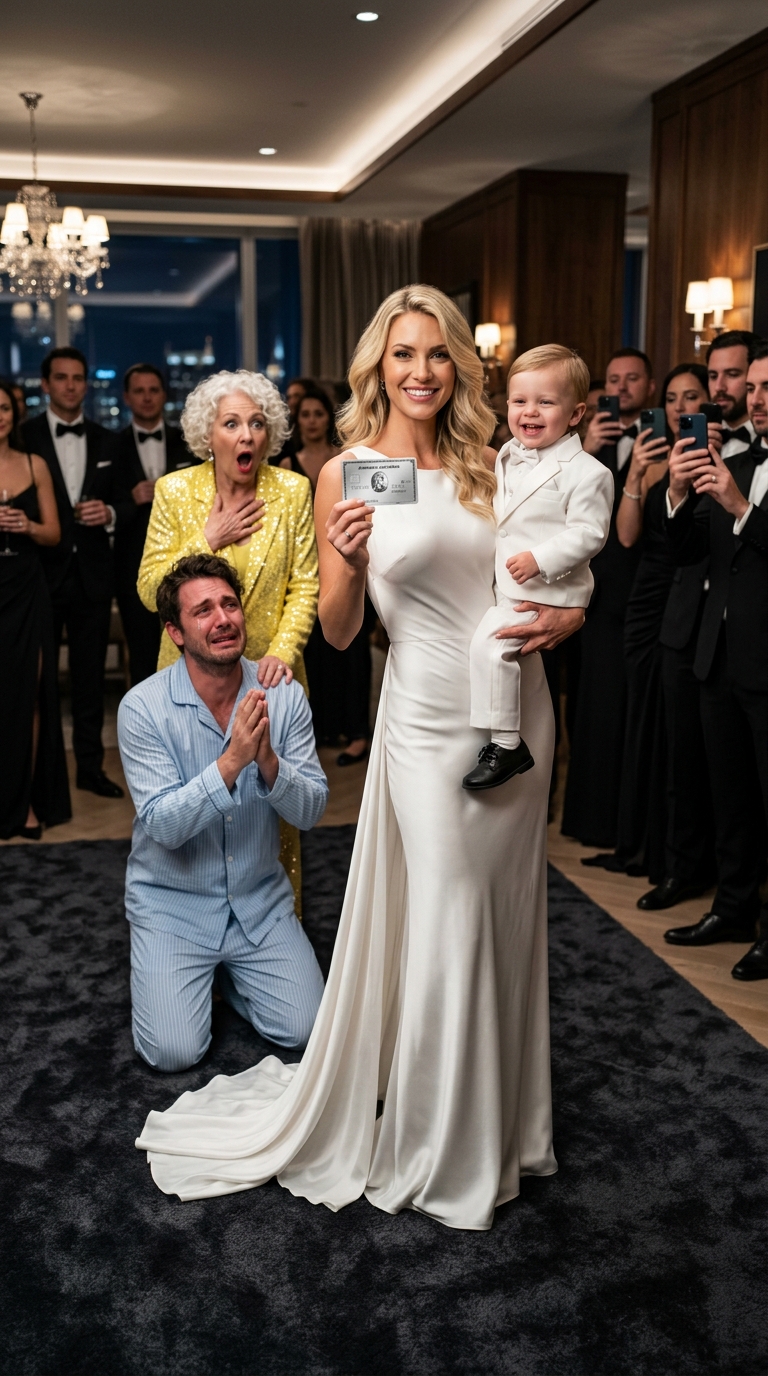
We didn’t just present our pitch. We dismantled their previous marketing strategy and rebuilt it in front of their eyes. We dominated the room.
When Triton’s CEO leaned forward, a slow, impressed smile spreading across his face as he signed the multi-million-dollar retainer, I didn’t feel the phantom urge to call Preston for validation. I didn’t need a pat on the head.
Instead, I took my entire senior executive team out to dinner at Le Bernardin—the exact same Michelin-starred restaurant where Beatrice had once loudly insulted my ‘pedestrian’ palate on my thirty-second birthday.
This time, when the astronomical bill arrived in its leather folio, I laid my black card down without a single ounce of resentment.
Because this time, I was spending my hard-earned money to celebrate people who actively respected the grit and brilliance it took to earn it.
I was untouchable. Or so I thought.
Four months later, a biting November wind was whipping through the concrete canyons of the Financial District. I was exiting a boutique coffee shop, balancing a cardboard tray of oat milk lattes for an early morning strategy meeting, checking my phone.
I stepped onto the crowded sidewalk and violently collided with a man rushing in the opposite direction.
“Watch it!” he snapped, before his voice abruptly hitched in his throat.
I looked up, ready to offer a sharp New York apology, but the words died on my tongue. Standing in front of me, looking like a hollowed-out ghost of a man I once knew, was Preston.
And as he looked at me, his eyes wide and terribly desperate, he grabbed my forearm.
“Harper,” he gasped, his breath smelling of stale coffee and fear. “Harper, please. You have to help me. They’re going to indict me.”
That evening, the grand ballroom of The Plaza Hotel was a dizzying, opulent symphony of crystal light, overflowing champagne, and the relentless, blinding flashbulbs of industry photographers. The global launch for Triton Athletics was not merely a public relations success; it was a masterclass in corporate theater, a flawless, undeniable victory for my firm. The air smelled of expensive, imported orchids, the metallic ozone of camera flashes, and the intoxicating, visceral scent of raw power.
I was standing near the heavy velvet ropes of the VIP section, swathed in a backless black silk gown that felt like liquid armor against my skin. I was mid-conversation with Triton’s CEO, Richard, elegantly navigating the delicate nuances of quarterly market projections, when the heavy, gilded oak doors at the grand entrance burst open with the force of a detonated bomb.
The elegant, low-level hum of the gala shattered instantly.
Security guards were suddenly shouting, their heavy boots scrambling and slipping against the polished marble as they rushed toward the threshold.
A woman was violently fighting her way through the human barrier. Her hair, usually sprayed into an immovable, aristocratic helmet, was wild and tangled. Her makeup was smeared across her pale cheeks in jagged, terrifying streaks, and she was screaming my name with a manic, unhinged ferocity that made the hair on the back of my neck stand up.
It was Beatrice Vance.
She hadn’t come to beg for forgiveness, nor had she come to quietly surrender. As she lunged past a startled waiter, sending a silver tray of crystal flutes crashing to the floor, her bloodshot eyes locked onto mine with a murderous, desperate gleam. I realized the terrifying truth in a fraction of a second. She had come to burn my empire to the ground on live television. She wanted to drag me down into the absolute squalor of her own ruin.
“You ruined my family!” Beatrice shrieked, her voice cracking as it echoed off the vaulted, frescoed ceiling of the ballroom. “You stole my son’s money! You are a fraud, Harper! A cheap, new-money fraud!”
The string quartet abruptly stopped playing, their bows hovering frozen over their cellos and violins. Dozens of high-definition cameras, originally positioned to capture the polished glamour of the sportswear launch, swiveled synchronously toward the commotion. Beatrice was thrashing wildly against the grip of two massive security guards. Her once-immaculate Chanel jacket tore audibly at the shoulder seam. The strand of heirloom pearls around her neck snapped, sending dozens of milky white beads scattering across the marble floor. They bounced and rolled with a sharp, clicking sound, like the ticking seconds of a countdown to her ultimate social execution.
A cold dread did not coil in my gut. My palms were not slick with sweat. The terrified, obedient girl who used to meticulously fold Beatrice’s cashmere sweaters to avoid a passive-aggressive reprimand was dead and buried. In her place stood a woman entirely forged in the fires of their betrayal.
I gently touched Richard’s arm, offering him a reassuring, flawlessly practiced smile. “Excuse me for just a moment, Richard. A minor logistical hiccup. The catering staff must have let a disgruntled contractor through the service elevator.”
I stepped out from behind the velvet rope. I did not rush. I walked slowly, deliberately, my heels clicking in perfect rhythm against the marble as I moved toward the chaos. The cameras flashed furiously, capturing the stark, brutal contrast: Beatrice, a raving, disheveled portrait of collapsed aristocracy, and me, gliding across the floor in black silk, radiating absolute, untouchable authority.
I stopped exactly three feet away from her. The security guards held her firmly by the arms, but her eyes were still wild, frantically searching my face for any sign of the fear she used to so effortlessly extract from me.
“Harper, tell them to let me go!” she spat, a fine mist of spittle flying from her trembling lips. “I will tell every single financial reporter in this room exactly what you did to us! I will expose you!”
I leaned in, moving just close enough so that the intoxicating scent of my Tom Ford perfume masked the sour smell of her panic. I dropped my voice to a glacial, lethal whisper—a sound meant only for her ears, cutting through the din of the stunned crowd.
“Tell them, Beatrice,” I whispered, my eyes locking onto hers, unblinking. “Please, by all means. Tell them how your precious Preston is facing a federal grand jury indictment tomorrow morning at nine o’clock for embezzling eighty-five thousand dollars across state lines. Tell them how your sprawling Connecticut estate is currently in aggressive foreclosure because you haven’t made a mortgage payment in seven months. Tell them how you tried to destroy me, and how I built a multi-million dollar kingdom on the ashes of your pathetic, rotting dynasty.”
The breath hitched violently in her throat. The manic, vengeful fire in her eyes was suddenly extinguished, replaced by the hollow, terrifying void of a woman realizing she had aggressively played her final card and lost absolutely everything. Her body went entirely limp against the security guards.
I straightened my posture, turning slightly to the nearest cluster of hungry reporters, my face shifting effortlessly into a mask of deep, benevolent concern.
“It is always a profound tragedy,” I said, my voice projecting clearly, perfectly modulated with faux sympathy, “when untreated mental health crises spill into public spaces. Please, out of respect for human dignity, let’s give my former mother-in-law the privacy she so desperately needs during her family’s ongoing, highly publicized legal difficulties.”
I offered a curt nod to the head of security. “Escort Mrs. Vance to a private cab. Please pay the fare; I doubt her cards are currently functioning.”
They dragged her away. She didn’t scream again. She just wept—a broken, hollow sobbing that faded into nothingness as the heavy doors closed behind her. Taking a subtle visual cue from my event manager, the string quartet immediately struck up a lively, soaring Vivaldi piece. Waiters rushed forward with fresh trays of champagne. The crisis was neutralized, spun, and buried in less than ninety seconds.
Exactly one year after the judge’s ink had dried on my divorce decree, I hosted a private, intimate gathering in my Tribeca penthouse.
The massive bay windows were pushed wide open, letting the crisp, cool autumn air move gently through the sprawling living room. The apartment was completely alive—filled with the warm, golden glow of ambient lighting, the rich smell of roasted figs and aged Bordeaux, and the overlapping, joyful laughter of people who actually, genuinely cared about me.
My brilliant corporate counsel, Evelyn, was leaning against the marble kitchen island in her trademark tailored suit, swirling a glass of Pinot Noir and aggressively debating global market trends with my senior executive team. Old college friends were curled up on my velvet sofas, their shoes kicked off, utterly relaxed. Even Mr. Abernathy, my old neighbor from the previous building who had witnessed the hallway confrontation, was sitting in a leather armchair near the roaring fireplace, regaling my junior analysts with hilarious, scandalous stories from his years on the judicial bench.
I stood alone near the open window, holding a crystal glass of sparkling water, and simply took it all in.
This is what peace looks like, I thought, letting the cool wind brush against my collarbone.
There was no underlying, suffocating tension in the air. There was no cruel criticism cleverly disguised as helpful advice. There was no one in this room silently calculating the depth of my wallet, or scheming about what they could extract from my hard-earned success.
There were only people who had stood steadfastly beside me when Summit Strategies was nothing more than a chaotic, desperate idea on a whiteboard. There were people who had shown up at my door during the darkest, most agonizing weeks of my separation carrying takeout food, cheap wine, and infinite patience. There were people who celebrated my massive victories without ever trying to climb on my shoulders to claim them as their own.
Looking out over the glittering, endless expanse of the New York skyline, I finally understood a universal truth that Preston and Beatrice Vance would die never comprehending.
Family is not defined by the accidental sharing of blood, the signing of a marriage certificate, or the heavy, crushing chains of societal obligation.
Family is defined entirely, unequivocally, by respect.
It is made up of the people who fiercely protect your name and your honor when you are not in the room to defend yourself. It is the people who cheer the loudest for your ascent, without secretly plotting to steal the ladder out from under you. It is the people who look at your generosity and your love as a profound, sacred gift to be cherished, not as a weakness to be endlessly exploited. Respect cannot be purchased with designer handbags, Michelin-starred dinners, or untraceable wire transfers. Respect must be required. And if it is not given freely, and consistently, you must find the courage to refuse to live without it.
I took a slow sip of my water, watching the red taillights of the traffic far below. The war with the Vance family was over, their legacy reduced to legal bills and social exile. I had won. But as the shadows lengthened in the corners of my penthouse, a sharp, thrilling realization settled deep in my bones. I had built an empire, yes, but empires require defending. I was no longer the prey, blindly funding the lives of parasites. I had become the apex predator of my own reality—and God help the next person who dared to knock on my door demanding what was mine.
If you want more stories like this, or if you’d like to share your thoughts about what you would have done in my situation, I’d love to hear from you. Your perspective helps these stories reach more people, so don’t be shy about commenting or sharing.
If you want more stories like this, or if you’d like to share your thoughts about what you would have done in my situation, I’d love to hear from you. Your perspective helps these stories reach more people, so don’t be shy about commenting or sharing.
✅ End of story — Part 3 of 3
← Read from Part 1