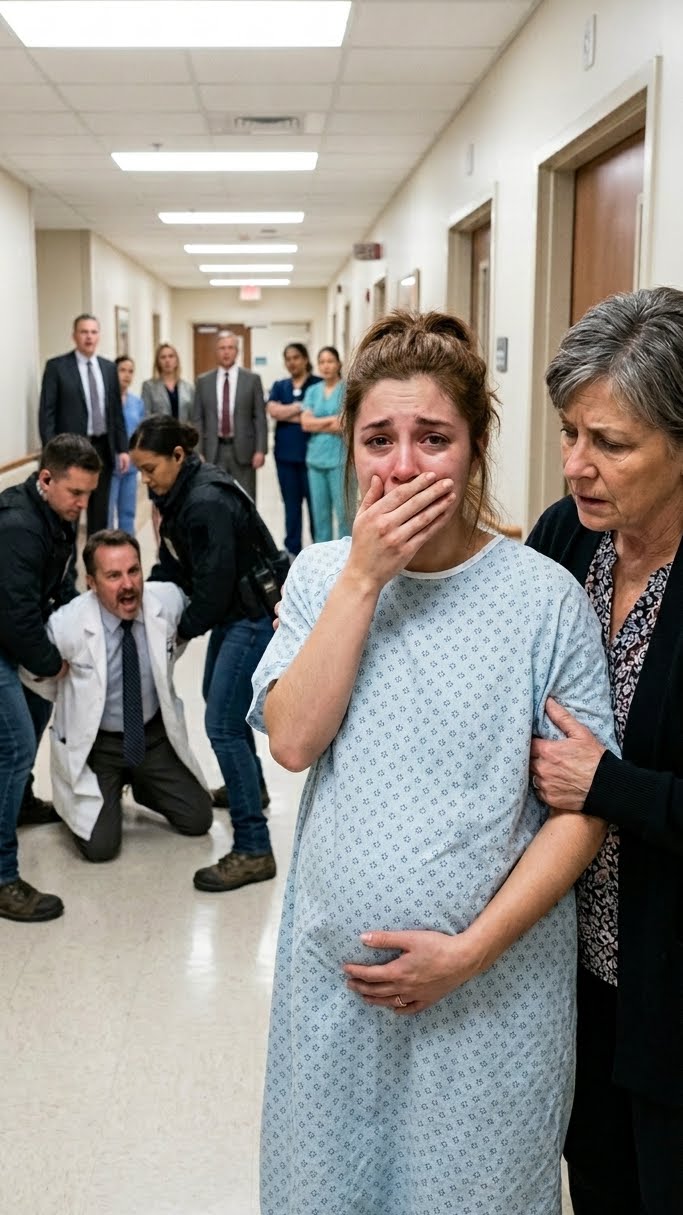
Evan staggered backward, his hands instinctively flying up in the air. “What the hell is this?! This is a medical facility! You can’t just barge in here!”
Agent Sarah Quinn, a formidable woman with steel-gray eyes and a no-nonsense demeanor, stepped forward. She didn’t hesitate. She grabbed Evan’s wrist, twisted his arm sharply behind his back, and drove him down onto the sterile marble floor.
His cheek hit the tile with a sickening smack. The crystal face of his silver Rolex cracked beneath the weight of his body.
“Hey! Watch the suit!” Evan yelled, struggling against the pressure.
Celeste shrieked, clutching her designer handbag like a shield. “Do you know who he is?! He is a doctor! You are making a terrible mistake!”
Agent Quinn snapped heavy steel cuffs around Evan’s wrists, her knee planted firmly in his back. “Yes, ma’am,” she said calmly, pulling him to his knees. “We know exactly who he is. That’s why we came in person.”
Evan twisted his neck, his eyes burning into mine with a look of pure, unadulterated hatred. The charming facade was completely gone, replaced by a rabid, cornered animal.
“You poisonous old witch,” he spat, spittle flying from his lips. “I’ll kill you. I’ll take everything from you!”
Mia flinched violently against me, whimpering.
I stepped away from the table, walking slowly toward him until I was looking down at him.
“No,” I said, my voice soft but carrying the weight of an anvil. “I’m a mother.”
Agent Quinn pulled Evan to his feet, hauling him back. She handed me a thick, folded legal document.
“Mrs. Vance,” Agent Quinn said, her tone softening slightly. “The emergency protective order has been signed by a federal judge. It is active immediately. Your daughter is being transferred to a secure surgical team at Mercy General Hospital via private ambulance. Dr. Sterling has been stripped of all medical privileges and has zero access to her or the child.”
Evan’s confidence finally, spectacularly fractured. The reality of his situation crashed over him. His empire was burning, and the ashes were already cold.
“Mia,” he pleaded, his voice shifting instantly from rage into the practiced, pathetic voice of apology he had likely used a hundred times before. “Baby, please. You know I love you. This is your mother manipulating you. She’s crazy. Tell them! Tell them it’s a mistake!”
Mia sat up on the table. She looked at the man she had married. She looked at his cuffed hands, his bruised cheek, his desperate, lying eyes. She looked at him for a long, long time.
The silence in the room was absolute.
Then, with trembling but determined fingers, she untied the side of her hospital gown. She let the fabric slip down, just enough to expose her shoulder and her ribs to Agent Quinn and the other officers.
The harsh fluorescent light illuminated the purple and black boot-shaped bruises.
“He did this,” Mia said, her voice shaking but clear. “He told me he would kill me during my C-section if I left him.”
The officers stared at the bruising. The air in the room grew heavy with a collective, silent fury.
Celeste covered her mouth with her hand. Not in horror at what her son had done to his pregnant wife, but in frantic, terrified calculation of her own impending legal ruin.
Agent Quinn’s jaw clenched. She nodded to the officer beside her. “Photograph the injuries immediately. Contact the Special Victims Unit. Add witness intimidation, aggravated domestic assault, and attempted murder to the federal charges.”
Evan thrashed wildly in the officers’ grip. “Mia! Don’t do this! You’re ruining my life!”
She didn’t answer. She pulled the gown back up, turning her back to him, and looked at the ultrasound monitor.
“Get him out of my hospital,” I told Agent Quinn.
They dragged Dr. Evan Sterling out of the room, his protests echoing down the pristine hallways of the empire he no longer owned.
Our baby’s heartbeat filled the quiet room once more.
Fast.
Alive.
Free.
The transfer to Mercy General was a blur of flashing lights and frantic paramedics. I rode in the back of the ambulance, holding Mia’s hand while she stared blankly at the ceiling. The adrenaline was fading, leaving behind the crushing weight of exhaustion and the terrifying reality of premature labor.
The stress of the confrontation had triggered contractions. By the time we arrived at the secure, heavily guarded maternity ward at Mercy General, Mia was in active labor.
“Mom,” she gasped, gripping the rails of the hospital bed as a nurse checked her vitals. “What if he finds us? What if he gets out on bail?”
“He won’t,” I promised, wiping the sweat from her forehead. “Harrison is ensuring the federal prosecutor denies bail based on the flight risk and the direct threats to your life. He is locked in a federal holding cell, Mia. He can’t hurt you anymore.”
Thirty-six grueling hours later, via an emergency but safely executed C-section by a brilliant, female surgeon who had no ties to Evan, my granddaughter was born.
When the nurse placed the tiny, screaming bundle wrapped in a warm blanket into Mia’s arms, the tension that had gripped my daughter for three years finally broke. She wept—not tears of terror, but tears of overwhelming, exhausting relief.
She looked up at me, her face pale but radiant. “I want to name her Hope.”
I kissed her forehead. “Hope is a beautiful name.”
She hadn’t named the baby Hope because life had been gentle, or fair, or kind. She named her Hope because life, in all its brutality and darkness, had utterly failed to destroy her.
But while the medical crisis was over, the war was just beginning.
Two days later, while Mia was sleeping and I was holding Hope by the window, my phone buzzed. It was Harrison.
“Eleanor,” his gravelly voice came through the speaker. “We have a situation. Evan’s defense attorney just hand-delivered a letter to my office.”
“What does it say?” I asked, rocking the baby gently.
“It’s a threat. A very polite, legally worded threat. They are preparing to file a massive defamation and wrongful termination suit. They are claiming the bruises were self-inflicted or the result of a fall, and that you orchestrated a hostile takeover using federal agents as your personal hit squad.”
I let out a slow breath, staring out the hospital window at the sprawling city. Evan was wounded, but he was still a snake. And snakes strike hardest when they are cornered.
“Let them file,” I said softly.
“Eleanor, a civil suit will open up Mia to depositions. They will drag her through the mud. They’ll claim she’s mentally unstable.”
“Harrison,” I interrupted, my voice dropping an octave. “Did the auditors find the Cayman accounts?”
I heard the rustle of paper on the other end of the line. “Yes. And they found the shell companies. It’s worse than we thought. He’s been double-billing Medicare for unperformed surgeries and kicking back the profits to offshore accounts managed by Celeste.”
“Good,” I smiled grimly. “When they file their civil suit, don’t just respond. Bury them. Release the audit to the federal prosecutor, the medical board, and the press. I want Evan Sterling’s name to be a synonym for fraud.”
“It will be a bloodbath, Eleanor.”
“I brought the mop, Harrison. Make the call.”
The next six months were a masterclass in scorched-earth litigation.
Saint Aurelia no longer carried Evan Sterling’s name anywhere. The massive brass letters had been quietly removed from the facade in the middle of the night. The hospital survived, but only just, operating under new leadership. I installed an independent patient safety board and fully funded a new domestic abuse response unit, paying for it using every single dollar recovered from Evan’s illegal, bloated contracts.
Celeste Sterling fought like a rabid dog to keep her social standing, but the federal indictments were inescapable. When the FBI raided her country club locker and found the ledgers for the shell companies, her friends abandoned her instantly. She was forced to sell her sprawling, historic mansion at a massive loss just to pay her defense attorneys. The last I heard, she had relocated to a small, rented condominium in a different state, her sharp smile permanently erased.
As for Evan, his arrogance finally met reality.
He was denied bail. He awaited trial in a federal detention center, trading his tailored navy suits for an orange jumpsuit. The federal prosecutors, armed with Harrison’s forensic audit, uncovered a rot so deep it shook the state’s medical community.
There were falsified immigration sponsorships for underpaid, overworked nurses who were threatened with deportation if they spoke up. There were kickback networks involving pharmaceutical reps. There were dozens of testimonies from staff regarding his volatile temper and patient intimidation. And, finally, there was the insurance fraud—a scheme so massive and brazen it was large enough to bury not just Evan, but two state senators and a judge who had been on his payroll.
When the prosecution offered him a plea deal—twenty years in federal prison in exchange for flipping on the politicians—he tried one last, desperate manipulation.
He told his lawyer he would only sign the plea if he could see Mia one last time.
Harrison relayed the message to me while we were sitting in the sunroom of my lake house.
“He says he needs closure,” Harrison said, his tone dripping with disgust. “He says he needs to apologize to her in person before he signs his life away.”
Mia was sitting on the floor rug, stacking wooden blocks for Hope. She stopped, her hand hovering over a red block.
I looked at her, waiting. It was her choice.
Mia picked up the block, placed it carefully on top of the tower, and looked at Harrison.
“Tell him,” Mia said, her voice steady and clear, “that I don’t negotiate with inmates. Tell him to sign the paper, or go to trial and get forty years. I don’t care.”
Harrison smiled, a genuine, terrifying shark smile. “I will deliver the message personally.”
Evan signed the plea deal the next morning.
It has been two years since the day in the clinic.
Sunlight spilled across the nursery in my lake house, painting warm, golden rectangles on the hardwood floor. A gentle breeze rolled off the water, billowing the white curtains inward.
Mia sat in a wooden rocking chair, humming softly as she rocked Hope. The baby was no longer a fragile newborn but a fiercely independent toddler with a mop of curly hair and a laugh that could cure any sorrow.
Mia still had nightmares sometimes. There were nights I would hear her pacing the hallway, the ghosts of the past reaching out from the dark. Healing is not a straight line; it is a brutal, jagged mountain climb. But she was climbing. She had returned to painting, her canvases filled with vibrant, chaotic, beautiful colors. She laughed again, a real, unrestrained sound that filled the house.
I stood in the doorway, watching them, a mug of black coffee in my hands.
Mia looked up, catching my eye. She smiled, pausing the rocking chair.
“Mom,” she whispered, her voice carrying over the quiet hum of the afternoon, “can I ask you something?”
“Anything.” I stepped into the room, leaning against the doorframe.
“That day in the clinic… when you saw the bruises. When he walked into the room.” She hesitated, tracing a pattern on Hope’s blanket. “Were you afraid?”
I thought about the cold dread that had coiled in my stomach. I thought about the sheer size of Evan, the power he wielded, the very real possibility that he could have killed us both before the agents arrived.
I looked down at my granddaughter, who was currently trying to eat a plush giraffe, her tiny fingers clutching the toy with absolute determination.
“Yes,” I said honestly. “Every single second.”
Mia frowned slightly, tilting her head. “But you looked so calm. You looked like you were just ordering a cup of coffee. You completely dismantled his life without raising your voice.”
I smiled, looking out the window at the dark, deep water of the lake shimmering under the sun.
“That’s what revenge looks like when it has a good lawyer, sweetheart.”
Mia let out a sudden, bright laugh, wiping a stray tear from her eye. “Remind me never to make you angry.”
“I am never angry,” I replied, taking a sip of my coffee. “I am just highly organized.”
Inside the crib, Hope stirred, dropped the giraffe, and sighed happily in her sleep.
I looked at my daughter, alive and safe. I looked at my granddaughter, sleeping without fear. The empire of glass was shattered, the monsters were locked in cages, and the storm had finally passed.
And for the first time in a very long time, as the sun began to set over the water, no one in our family was afraid of footsteps in the hall.
If you want more stories like this, or if you’d like to share your thoughts about what you would have done in my situation, I’d love to hear from you. Your perspective helps these stories reach more people, so don’t be shy about commenting or sharing.
✅ End of story — Part 3 of 3
← Read from Part 1